


Last Updated: November 2026
Preferred stock valuation finds what a company’s preferred shares are worth, and the answer turns on the share’s rights, not just the cash paid in. The liquidation preference sets how much preferred holders collect before common holders in a sale. Participation terms, conversion rights, and dividends shift value further between the classes. Because of these rights, analysts cannot simply split total equity by share count. They use a model such as the OPM, PWERM, a hybrid, or the Current Value Method to allocate value class by class.
The team at Sofer Advisors builds these models for business owners, investors, and attorneys.
This guide explains the main rights, how each one shifts value, and the methods used to split value across share classes.
Key Takeaways
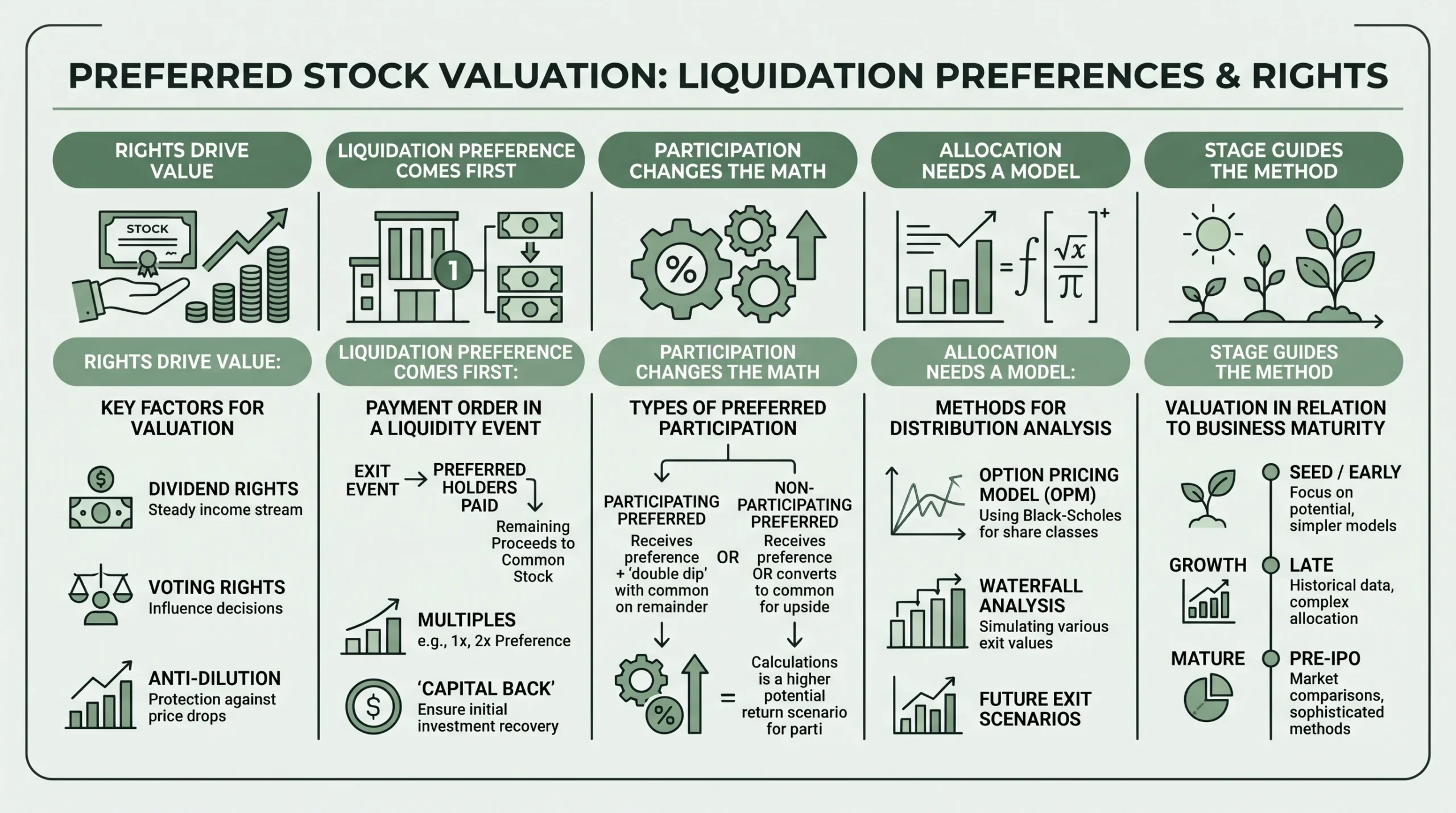
- Rights drive value: Preferred stock is worth more than common because of its rights, not just the cash paid in.
- Liquidation preference comes first: This right sets how much preferred holders collect before common holders in a sale.
- Participation changes the math: Participating preferred takes its preference and shares the rest, so it can far outpace common.
- Allocation needs a model: Analysts use the OPM, PWERM, a hybrid, or the Current Value Method to split equity value across classes.
- Stage guides the method: Early companies often fit the OPM, while firms near a known exit fit PWERM.
What makes preferred stock different from common stock?
Preferred stock is a hybrid security. It blends features of debt and equity. It ranks above common stock for payouts. It often skips the voting control that common holders enjoy.
Common stock is simple. It is basic ownership. Holders vote, and they share in whatever value is left after everyone else is paid. Their upside is large, but they stand last in line.
Preferred holders stand ahead of common holders. They get paid first in a sale or wind-down. They may also collect fixed dividends. In exchange, they often give up some control and some upside. These trade-offs are what a valuation has to measure.
How does a liquidation preference work?
A liquidation preference sets the order of payouts. It names who gets paid first when a company is sold or wound down. Preferred holders collect their preference before common holders see a dollar.
The preference is usually 1x the original investment. So an investor who put in money gets that amount back first. Some deals use a higher multiple, such as 2x or 3x, though that is less common. A higher multiple raises the floor for the preferred holder.
Seniority matters when a company has raised several rounds. Each round may rank ahead of the last, or all rounds may rank together. Senior shares get paid before junior ones. This order, often called stacking, can decide who recovers money in a weak exit.
A liquidation overhang can result. This happens when total preferences are larger than the sale price. Common holders then receive little or nothing. All the proceeds go to the preferred holders first.
A short example helps show the idea. Say an investor holds a 1x non-participating preference. The company is sold at a low price. The investor takes the preference and gets their money back first. Common holders split only what is left. In a high-price sale, the same investor would convert to common instead, since that pays more. These figures are illustrative only, but they show how the preference sets a floor.
What is the difference between participating and non-participating preferred?
The split between participating and non-participating preferred is a key value driver. It decides how much a preferred holder collects in a strong exit. The two structures can produce very different payouts.
Non-participating preferred makes the holder choose. They take the greater of two amounts. The first is the liquidation preference. The second is the value they would get by converting to common. They pick whichever pays more, but not both.
Participating preferred pays twice. The holder first takes the preference. Then they also share in the remaining proceeds, as if they had converted. Some deals cap this second share at a set multiple. Participating terms favor the investor and shrink what common holders keep.
The difference grows as the exit price rises. A non-participating holder eventually converts and gives up the preference. A participating holder keeps both the preference and a share of the rest. This gap is why the term sheet language matters so much. A valuation has to read each class’s terms with care before it assigns any value.
How do conversion rights affect value?
Conversion rights let a preferred holder turn shares into common stock. This gives them a path to the upside. If the company does well, converting can beat taking the preference.
The choice is an economic one. The holder compares two numbers. One is the fixed preference. The other is the value of the shares after converting to common. When the converted value is higher, a rational holder converts.
Conversion can be optional or mandatory. Optional conversion lets the holder decide when to act. Mandatory conversion is triggered by an event, such as a large public offering. Both forms shape the payoff, so a valuation has to model each class on an as-converted basis.
Conversion also links to the other rights. A holder who converts gives up the preference. They trade a safe floor for a full share of the upside. The point where converting beats holding the preference is a breakpoint. Analysts track these breakpoints closely, since they mark where value shifts from one class to another.
What other rights shape preferred stock value?
Several more rights affect the value of preferred shares. Each one shifts cash or control between the classes. A careful valuation prices each feature in turn.
Dividends can be cumulative or non-cumulative. Cumulative dividends build up over time, even when unpaid. They must be cleared before common holders get paid. Non-cumulative dividends do not stack up this way.
Anti-dilution protection guards the investor in a down round. A down round is a new raise at a lower price. These clauses adjust the conversion price to protect early money. A full-ratchet clause is harsh, while a broad-based weighted-average clause is milder and far more common.
Redemption rights let holders force the company to buy back shares after a set date. Voting and protective provisions give preferred holders a say on key moves. All of these rights add weight to the preferred share, above the plain common share.
How do analysts value preferred versus common stock?
Analysts value the classes by splitting total equity value among them. They do not assign a flat percentage. They use a model that respects each class’s rights at different exit values. The main methods are the OPM, PWERM, a hybrid, and the Current Value Method.
The Option Pricing Method, or OPM, treats each class as a call option on the company’s value. It uses a Black-Scholes framework. It splits value at breakpoints, which are the exit values where payoffs change. The OPM fits early companies with an uncertain exit.
The Probability-Weighted Expected Return Method, or PWERM, models specific exit scenarios. Think of an IPO, a sale, or a shutdown. The analyst values each class in each case, then weights the results by how likely each case is. PWERM fits firms with a clearer path to an exit.
The Current Value Method splits today’s value based only on current rights. It ignores future upside. It works for a near-term exit or a basic check. A hybrid method blends the OPM and PWERM when some outcomes are known and others are not.
This allocation work is not just academic. It supports real filings. A 409A valuation under IRC Section 409A sets the strike price for employee options. A fair value measurement under ASC 820 feeds financial statements. In both cases, the value of common stock depends on how much value the preferred rights absorb first. A sound method gives each class a defensible number.
The table below sums up the main methods.
| Method | Best for | How it treats the classes |
|---|---|---|
| Current Value Method | A near-term exit or a quick check | Splits value using today’s liquidation waterfall |
| Option Pricing Method (OPM) | Early companies with an uncertain exit | Treats each class as a call option at breakpoints |
| PWERM | Firms with clear exit scenarios | Values each class in each scenario, then weights them |
The right method depends on the facts. It turns on the company’s stage, the clarity of the exit, and the rights in the term sheet. Sofer Advisors selects the method that fits the purpose of the valuation. The goal is an allocation that each class can defend for tax or financial reporting.
Frequently Asked Questions
Why is preferred stock usually worth more than common stock?
Preferred stock carries rights that common stock lacks. It gets paid first in a sale. It may earn fixed dividends and carry anti-dilution protection. These features lower the risk and raise the value, so a preferred share is usually worth more than a common share.
What does a 1x liquidation preference mean?
A 1x preference means the holder gets back the amount they invested before common holders are paid. It sets a floor on their recovery. Some deals use a higher multiple, such as 2x, which raises that floor.
What is the difference between participating and non-participating preferred?
Non-participating preferred takes the greater of its preference or its as-converted value, but not both. Participating preferred takes the preference and then shares in the remaining proceeds. Participating terms pay the investor more and leave less for common holders.
What is a liquidation overhang?
A liquidation overhang happens when total liquidation preferences are larger than the sale price. The preferred holders absorb most or all of the proceeds. Common holders can be left with little or nothing.
Why do analysts use the Option Pricing Method?
The OPM handles companies that have no clear exit date. It treats each share class as an option on the company’s value. This lets the analyst split value across classes without guessing a single exit, which fits many early-stage firms.
When is PWERM the better choice?
PWERM fits a company with clear, distinct exit paths. The analyst models each path, such as an IPO or a sale, and weights them by likelihood. It works best when the outcomes and their odds can be estimated with support.
Do conversion rights add value to preferred stock?
Yes. Conversion rights give the holder a path to the upside if the company grows. The holder can trade the fixed preference for common shares when that pays more. This optionality adds value, so a valuation models each class on an as-converted basis.
Why can you not value preferred stock as a simple percentage?
A flat percentage ignores the rights that make preferred different. Preferences, participation, and conversion all change the payout at different exit values. A model that skips these features can misstate the value of each class.
How do anti-dilution provisions affect value?
Anti-dilution provisions protect early investors in a down round. They adjust the conversion price when new shares are sold at a lower price. A full-ratchet clause reprices to the new low price and is harsh on common holders. A broad-based weighted-average clause is milder and more common, since it weighs both price and the size of the new round.
Related Case Studies
- Estate Freeze Valuation: Preferred Interests and 2701
- Blockage Discount Valuation: Large Blocks of Stock
- Collateral and Liquidation Valuation for Lenders: Orderly vs Forced Value
Executive Summary
Preferred stock is worth more than common because of its rights, not just the cash paid in. This right sets how much preferred holders collect before common holders in a sale. Participating preferred takes its preference and shares the rest, so it can far outpace common. Analysts use the OPM, PWERM, a hybrid, or the Current Value Method to split equity value across classes. Early companies often fit the OPM, while firms near a known exit fit PWERM.
What Should You Do Next?
Start by gathering your cap table, term sheets, and recent financials. Review the rights attached to each share class. If a financing round or a sale is near, confirm your valuation reflects those rights under ASC 820 or IRC Section 409A. Sofer Advisors provides independent preferred stock valuations led by David Hern CPA ABV ASA CVA. Schedule a consultation to discuss your situation.
People Also Read
- Secondary Sales of Private Stock: Valuation and 409A Implications
- Stock Appreciation Rights: How SARs Work and How They Are Valued
About the Author
This guide was prepared by David Hern CPA ABV ASA CVA, founder of Sofer Advisors, a business valuation firm headquartered in Atlanta, GA serving clients across the United States. David holds accreditations as an Accredited Senior Appraiser (ASA) and is Accredited in Business Valuation (ABV), credentials recognized by the IRS, SEC, and FINRA, and is also a Certified Valuation Analyst (CVA). David has served as an expert witness in dozens of cases across multiple jurisdictions, and Sofer Advisors is an Inc. 5000 honoree in 2024 and 2025 with 240+ five-star Google reviews.
For professional business valuation services, visit soferadvisors.com/about-us/ or contact Sofer Advisors at soferadvisors.com/contact-us/.
Disclaimer: This content is for informational purposes only and does not constitute professional valuation advice. Business valuation conclusions depend on specific facts and circumstances. Contact Sofer Advisors for guidance regarding your specific situation.









