


Last Updated: July 2026
A company-specific risk premium is one part of a discount rate, and it captures risks unique to a business that broad market data miss. This add-on helps a valuation model reflect real risk that generic industry numbers often fail to catch. Analysts add the premium to the cost of equity, which sets a base discount rate for private firms, and that rate feeds straight into a DCF valuation.
Sofer Advisors offers independent valuation work for the choices covered here. Finding these risks takes clear, honest study. We look at a firm’s inner stability and its place in the market, drawing on 11+ expert witness cases and 180+ five-star Google reviews. We isolate things like customer concentration and key person risk, while also weighing past swings in earnings. Our work stays rigorous so each adjustment meets professional rules set by the AICPA.
Owners and advisors study this premium for good reason. It shows how unique traits shape total value, and these risks help you judge whether a discount rate is fair. A fair rate reflects the doubt around future cash flow, so solid data here supports strong reports. That matters for tax filings and shareholder disputes.
Key Takeaways
- Definition of CSRP: The company-specific risk premium covers built-in risks that market data leave out.
- Role in Valuation: This add-on is a key part of the build-up method. It helps set a fair cost of capital.
- Primary Influencing Factors: Common risks include a single key person, few customers, and unique weak spots.
- Quantification Process: Analysts often use scoring models to set a premium percent. It usually runs from 1% to 10%, per valuation records.
- Impact on Valuation: A higher premium lowers the final value. That gives owners a clear reason to cut inner risk.
These points frame a defensible rate for any private firm. The sections below show how traits become real adjustments.
What is a company-specific risk premium (CSRP)?
A company-specific risk premium, or CSRP, is extra return investors want. It pays them for risks unique to one business, risks you cannot spread away by holding many stocks. This add-on matters most in private company work, where inner risks loom large. Think of key person risk or a few big customers, which weigh more than they do in public markets.
In the build-up method, analysts add the CSRP last, after they first count the equity risk premium and the size premium. The equity risk premium is the extra return stocks pay over safe bonds. Meanwhile, the size premium is the added return small firms tend to bring. Then the CSRP finishes the rate because it reflects risk that markets do not share. This gives a precise, risk-adjusted hurdle rate that fits the exact business being valued.
Diversification cannot erase these risks, which is what sets them apart. An investor who holds many stocks can smooth out swings that hit a whole sector, yet the loss of a founder or a single large client still strikes one firm alone. Because no portfolio spreads that danger away, buyers demand extra return to bear it. The CSRP puts a number on that demand, so the discount rate reflects what a real buyer would require rather than a market average.
The right method depends on your deal type and industry, as well as the standard of value you need. Talk to a Sofer Advisors specialist about your case.
Why is CSRP added to the discount rate?
Analysts add the CSRP to catch risks that standard models miss. One common model is CAPM, which stands for the Capital Asset Pricing Model, and it measures risk against the whole market as a core input to WACC. These models assume broad market risk, but they skip the unique hurdles one firm may face, hurdles that can threaten future cash flow. The add-on makes the rate match the real doubt behind income. Skip this step and you risk a value that is too high, since the math would not punish the firm for its weak spots.
Several factors call for a higher premium. Customer concentration is one, meaning a single client brings a large share of sales. Key person risk is another big worry, because losing a vital leader could stop the work, and a thin bench at the top can also cause harm. Sofer Advisors weighs these traits with care so the discount rate shows the firm’s true risk.
A well-supported premium also protects the report when others review it. Tax authorities such as the IRS, opposing experts, and auditors often test the discount rate first, since a small change there moves the final value a great deal. When each adjustment ties back to a documented risk, the rate holds up under that scrutiny and under the USPAP standards that govern defensible work. Sofer Advisors links every point of the premium to specific evidence, so the conclusion stays defensible in filings and disputes.
What factors determine the size of a CSRP?
The size of the CSRP rests on many traits. We weigh both hard numbers and softer signs that raise a firm’s risk above a broad market index. Key person risk leads the list, since heavy reliance on one founder creates owner dependency that turns dangerous if that person leaves or falls ill. Sofer Advisors looks for depth in the ranks and asks whether the firm can run without its key figures.
Other big factors include supplier reliance and product mix. When one client brings more than half of all sales, the CSRP often rises to reflect that shaky income, a pattern detailed in our guide to customer concentration.
Earnings volatility carries similar weight, because a firm with steady margins looks far safer than one whose profits swing year to year. Supplier reliance adds risk when a single vendor controls a vital input, since a disruption there can halt production. Product mix matters too, as a firm built around one offering has less cushion if demand shifts. We weigh each trait against the firm’s records to set the extra return.
Turning these traits into a single percentage takes a structured method rather than a guess. Analysts score each risk factor, weigh how severe and how likely it is, and then map the total to a premium that usually lands between 1% and 10%. A firm with deep management and a broad client base sits near the low end, while heavy concentration or a fragile supply chain pushes it higher. This scoring keeps the result consistent from one engagement to the next, and it gives owners a clear view of which risks cost them the most value.
The premium has a direct effect on price. Because a higher rate discounts future cash flow more heavily, every added point of risk lowers the value a buyer will pay, giving owners a practical reason to reduce key person reliance or widen the customer base.
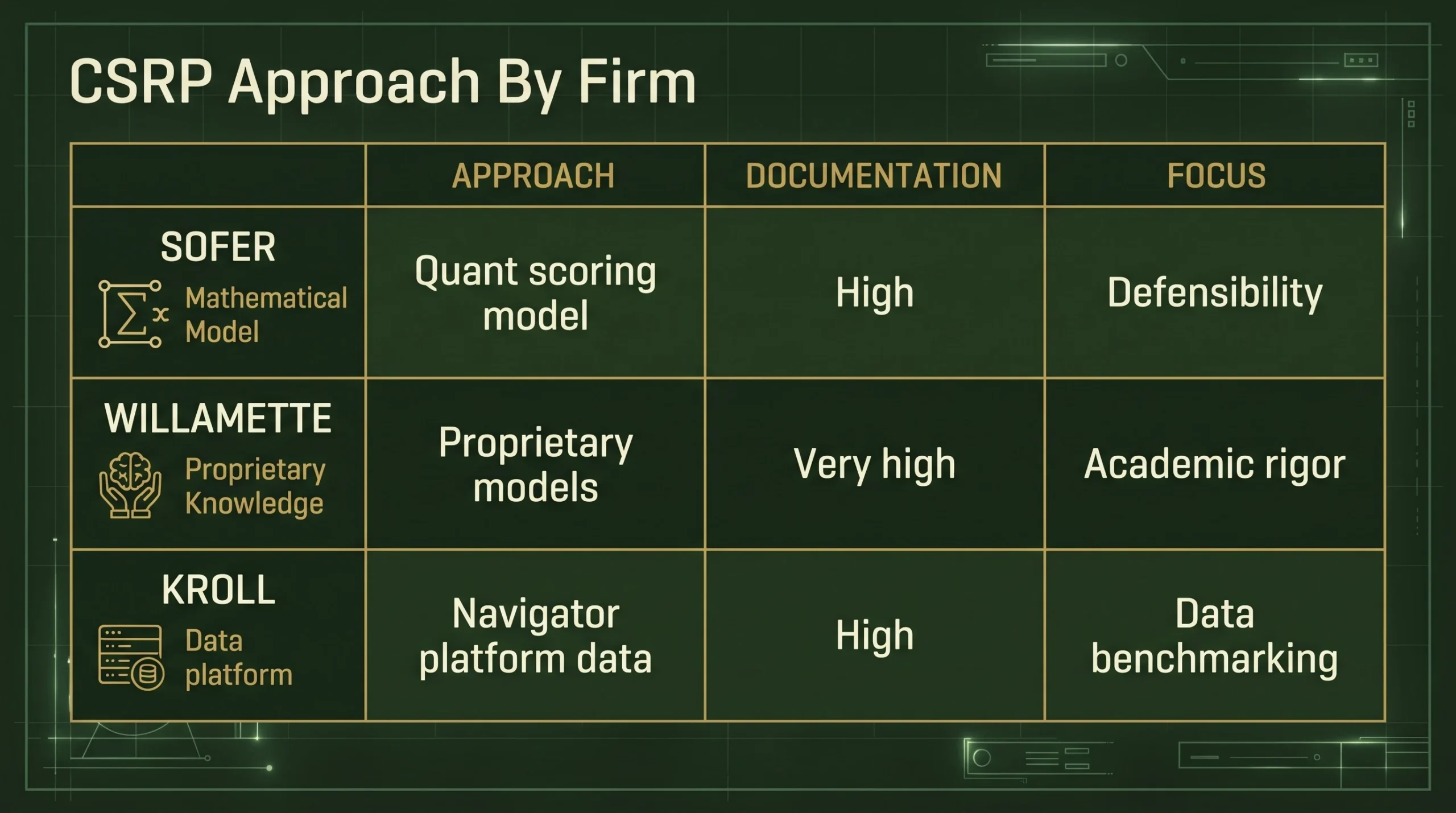
| Firm | Approach to CSRP | Typical Documentation Level | Primary Focus |
|---|---|---|---|
| Sofer Advisors | Quantitative scoring model based on The Sofer Difference diligence process, cross-referenced with qualitative factors. | High. Detailed narrative linking each risk factor to the premium, suitable for transactions, tax, and litigation. | Defensibility and transparency for business owners (Heart of a Teacher approach). |
| Willamette Management Associates | Proprietary models and extensive database comparisons, often referencing their own published research. | Very High. Geared towards litigation support and complex financial reporting with empirical backing. | Academic rigor and empirical data support. |
| Kroll | Leverages their Cost of Capital Navigator platform data and industry benchmarks to derive CSRP. | High. Standardized reports drawing from their extensive proprietary data sets and industry studies. | Data-driven benchmarking and consistency across industries. |
Each firm shapes its work for a different standard of value. Owners should check that the method matches their use, whether tax rules or inner planning, and pick a provider that explains each risk adjustment. With 180+ five-star Google reviews and 11+ expert witness cases, Sofer Advisors keeps these adjustments clear.
What should the valuation review compare?
A sound analysis ties each big judgment to real records and market proof from the valuation date.
| Decision area | Evidence and review focus |
|---|---|
| What is a company-specific risk premium (CSRP) | A company-specific risk premium, often called CSRP, is the additional return required by investors to compensate for risks unique to a single business that cannot be mitigated through portfolio diversification. |
| Why is CSRP added to the discount rate | A company-specific risk premium is added to the discount rate to account for risks that standard pricing models like CAPM fail to capture. |
| What factors determine the size of a CSRP | The size of a Company Specific Risk Premium, or CSRP, is determined by an assessment of qualitative and quantitative factors that increase the risk profile of a business compared to a broader market index. |
Frequently Asked Questions
What is a company-specific risk?
A company-specific risk is an inner hazard unique to one business. It does not touch the broader market. These risks include high customer concentration, along with reliance on one product or a thin team. Sofer Advisors spots these issues and splits manageable inner threats from the larger forces that hit every firm in a field.
What is a company-specific risk in WACC?
WACC stands for weighted average cost of capital. In WACC, the company-specific risk is an add-on to the equity cost that pays investors for firm-specific doubt. Models like CAPM measure risk against market norms, but they often miss the quirks of private firms. Sofer Advisors adds this premium so the final rate shows the firm’s true risk.
What is the formula for the specific risk premium?
There is no single formula for the specific risk premium. It comes from a build-up method that adjusts the base cost of equity for unique risks. Analysts score these risks with a model that weighs inner and outer factors. Sofer Advisors uses a structured scoring approach, which keeps the adjustment sound and fit to each client.
How to find a company’s risk premium?
Pros find the premium by studying key data. They look at past swings in sales, and they also weigh debt levels and key person risk. Sofer Advisors applies this study to set a premium that rests on firm results and clear market proof.
How much does a business valuation from Sofer Advisors cost?
A standard valuation from this firm runs from $7,500 to $25,000. The price depends on how complex the firm is and on the time deep study takes. Some jobs fall outside this base range, including 409A valuations or deal-focused work.
What is a typical range for a company-specific risk premium?
Most company-specific risk premiums fall between 1% and 10%, based on valuation records. A firm with deep management and a broad customer base tends to sit near the low end. Meanwhile, heavy concentration or a fragile supply chain pushes the figure higher. Sofer Advisors sets the exact percent through a structured scoring process. So the number rests on the firm’s own facts rather than a rule of thumb.
Does a higher CSRP raise or lower a company’s value?
A higher CSRP lowers the value. The premium feeds into the discount rate, and a higher rate discounts future cash flow more heavily. This cuts the present value a buyer will pay. This is why owners often work to reduce inner risks, such as key person reliance or customer concentration, before a sale or tax event. Sofer Advisors shows how each risk factor moves the final number.
What is the build-up method?
The build-up method sets a discount rate by stacking risk premiums in order. Analysts start with the equity risk premium, the extra return stocks pay over safe bonds, then add the size premium for small firms, and finish with the CSRP for risks unique to one business. The result is a hurdle rate built for the exact firm being valued.
Why is customer concentration a risk factor?
Customer concentration matters because one client bringing a large share of sales makes income shaky. When a single customer brings more than half of all sales, the loss of that account could threaten future cash flow, so the CSRP often rises to reflect that risk. Sofer Advisors weighs concentration against the firm’s records when sizing the premium.
Related Case Studies
- Key Person Discount: What Is It and When Does It Apply?
- Customer Concentration: Why It Cuts Sale Price 10 to 30 Percent
- WACC for Business Valuation: Calculation and Application
Executive Summary
The company-specific risk premium quantifies unique, non-diversifiable risks that broad market data and models like CAPM leave out of a private firm’s discount rate. It is the final layer in the build-up method, added after the equity risk premium and the size premium to produce a risk-adjusted hurdle rate. Its size rests on factors such as key person reliance, customer concentration, supplier dependence, product mix, and earnings volatility, which analysts score and map to a premium that usually falls between 1% and 10%. Because a higher rate discounts future cash flow more heavily, every added point of premium lowers the value a buyer will pay, so reducing internal risk directly supports a stronger number.
A well-documented premium, with each adjustment tied to specific evidence, holds up when tax authorities, opposing experts, and auditors test the discount rate. Sofer Advisors uses a structured scoring model, backed by 11+ expert witness cases and 180+ five-star reviews, to keep each adjustment defensible for transactions, tax, and litigation.
What Should You Do Next?
First, review your current risk profile by measuring key person reliance and customer concentration ratios against market benchmarks. Second, prepare a current org chart and a short summary of known operational hazards so an appraiser can weigh each factor against your records. Third, share that documentation with a qualified valuation expert who can translate the picture into a defensible premium and discount rate. David Hern CPA ABV ASA, founder of Sofer Advisors provides neutral, defensible valuations for businesses sizing a company-specific risk premium. Schedule a free consultation to discuss your situation.
People Also Read
- Fintech Company Valuation: Revenue Quality and Regulatory Risk
- SaaS Valuation: Complete Guide to Software Company Value
About the Author
This guide was prepared by David Hern CPA ABV ASAc, founder of Sofer Advisors, a business valuation firm headquartered in Atlanta, GA serving clients across the United States. David holds dual accreditations as an Accredited Senior Appraiser (ASA) and is Accredited in Business Valuation (ABV), credentials recognized by the IRS, SEC, and FINRA. He also holds the Certified Exit Planning Advisor (CEPA) designation. With 15+ years of valuation experience, David has served as an expert witness in 11+ cases across multiple jurisdictions and built Sofer Advisors into an Inc. 5000-recognized firm with 180+ five-star Google reviews. Its full W2 employee team maintains subscriptions to all major valuation databases and operates under a next business day response policy.
For professional business valuation services, visit soferadvisors.com/about-us/ or contact Sofer Advisors at soferadvisors.com/contact-us/.
Disclaimer: This content is for informational purposes only and does not constitute professional valuation advice. Business valuation conclusions depend on specific facts and circumstances. Contact Sofer Advisors for guidance regarding your specific situation.









