


Last Updated: July 2026
A discount rate is a math factor you apply to future cash flows to find their value today. A capitalization rate is a ratio that estimates the value of income in one steady period. Experts use both rates to turn future earnings into a value today, and the right rate depends on your model and your growth path.
Sofer Advisors serves business owners, attorneys, and financial pros. With 7 years in business, the team stays focused on accuracy and clear teaching through its Heart of a Teacher approach. And it has earned 180+ five-star Google reviews. The firm brings deep skill to hard valuation work, having also given expert witness testimony in 11+ cases across Georgia, Florida, California, and New Mexico.
Experts must pick the right rate for each job, and that choice depends on data, growth, and the standard of value. The wrong rate can cause big errors in reports or tax filings. This guide shows how these two rates differ and how each one shapes your final result.
Key Takeaways
- Dynamic business valuation: The discount rate applies to many future cash flows, so it fits firms with changing growth.
- Mature company valuation: The capitalization rate needs one steady period of income, so it fits firms with stable earnings.
- Mathematical connection: The cap rate comes from the discount rate minus long-term growth.
- Model selection factors: Your choice of model depends on how stable and steady your income is.
- Risk of error: The wrong rate or bad math is a top source of valuation disputes.
These points frame most income-based valuations, and the next sections show how business facts guide your choice.
What is the core difference between the two rates?
The main difference is the time frame. A discount rate applies to many future cash flows, while a capitalization rate applies to one steady period of income. This split centers on the time value of money: a discount rate reflects changing risk across periods, while a cap rate assumes steady, constant growth forever.
Think of a discount rate as a measure of risk in your forecast; analysts use it to turn many future cash flows into a value today, and it fits firms with shifting earnings or staged growth. The cap rate is a simpler form, often the discount rate minus the long-term growth rate, which people call the Gordon Growth Model.
Both rates share a common root but answer different questions, and knowing this keeps your model on track.
How do you calculate a business discount rate?
You build a discount rate with the build-up method. It starts with a risk-free rate, then adds layers of risk to reflect the full danger of the deal, creating a base return that rises with firm-specific risk.
The method often starts with the U.S. Treasury yield as the risk-free rate. Experts then add an equity risk premium and a size premium to cover broad market conditions, and a company-specific risk premium for risks unique to the subject firm. Data from the Kroll Cost of Capital sets each layer with market proof. Analysts often extend this build-up into a weighted average cost of capital, which blends every capital provider’s required return into one rate.
Each layer must rest on solid market evidence, since guessing at a premium can skew the whole result. Guidance published by the AICPA stresses that every input in a cost-of-capital build must be supported and documented.
How is a capitalization rate mathematically derived?
You find a cap rate by subtracting the long-term growth rate from the discount rate. We call growth “g” and the discount rate “DR.” This formula is the core of the Gordon Growth Model, since it links the return an investor wants to the growth expected forever.
The formula works only when growth is stable and endless, not for a short burst in results. If a firm expects zero growth, the cap rate equals the discount rate. Because this link relies on steady figures, analysts must define the growth rate with care. The same logic drives the terminal value in a discounted cash flow model, where the final forecast year is capitalized into a perpetual value using this exact relationship.
A wrong growth figure can throw off your whole estimate.
When should a discount rate be used in valuation?
Use a discount rate with the Discounted Cash Flow (DCF) method. This model fits firms with changing growth and is common for startups, SaaS firms, and firms in transition, since it accounts for shifts in earnings over time through year-by-year forecasts that catch details a single-period model would miss.
The DCF method is a must for some reports. Auditors need it for ASC 350 impairment testing, which checks if an asset’s book value tops its fair value, and requires reliable cash flow forecasts that follow set accounting rules. Skipping a DCF model here often leads to compliance issues or rejected reports. If you are new to the mechanics, our primer on what a DCF valuation is walks through each step, from forecasting free cash flow to discounting it back to a present value.
The DCF model asks for real work and clean data, but rewards you with a clear year-by-year picture of value.
When is a capitalization rate more appropriate?
Use a cap rate with the Capitalized Earnings Method. This fits mature, stable firms that have a long record of steady earnings and modest, steady future growth. You apply one period of expected benefit to a steady cap rate, which gives an indicative value. It suits set manufacturing firms, local service firms, and some commercial real estate. The IRS framework in Revenue Ruling 59-60 stresses stable earning power when picking a model.
When earnings are level or grow at a constant rate, the model turns those figures into a value estimate fast. Sofer Advisors often uses this method for stable firms, since more complex forecasts might add needless guesses. The original ruling text remains available directly from the IRS for readers who want the source.
By skipping the noise of many forecasts, the cap rate method stays clean and quick, but it only works when the past predicts the future well.
What are common mistakes with these rates?
A common mistake is using the wrong rate for the wrong firm, such as applying a cap rate to a firm with wild earnings, which ignores the need for stable income.
Another key mistake is double-counting risk, which happens when you apply a high discount rate to a gloomy forecast. Sofer Advisors makes one point clear: risk should sit in the forecast or the rate, but not both. Owners also err by using real estate cap rates for operating firms. These rates miss the unique risks and labor issues in a business and leave out non-real estate asset needs, so they often lead to big errors. The choice between an income view and an asset view is its own decision; our guide to the cost approach versus the income approach explains when each one leads.
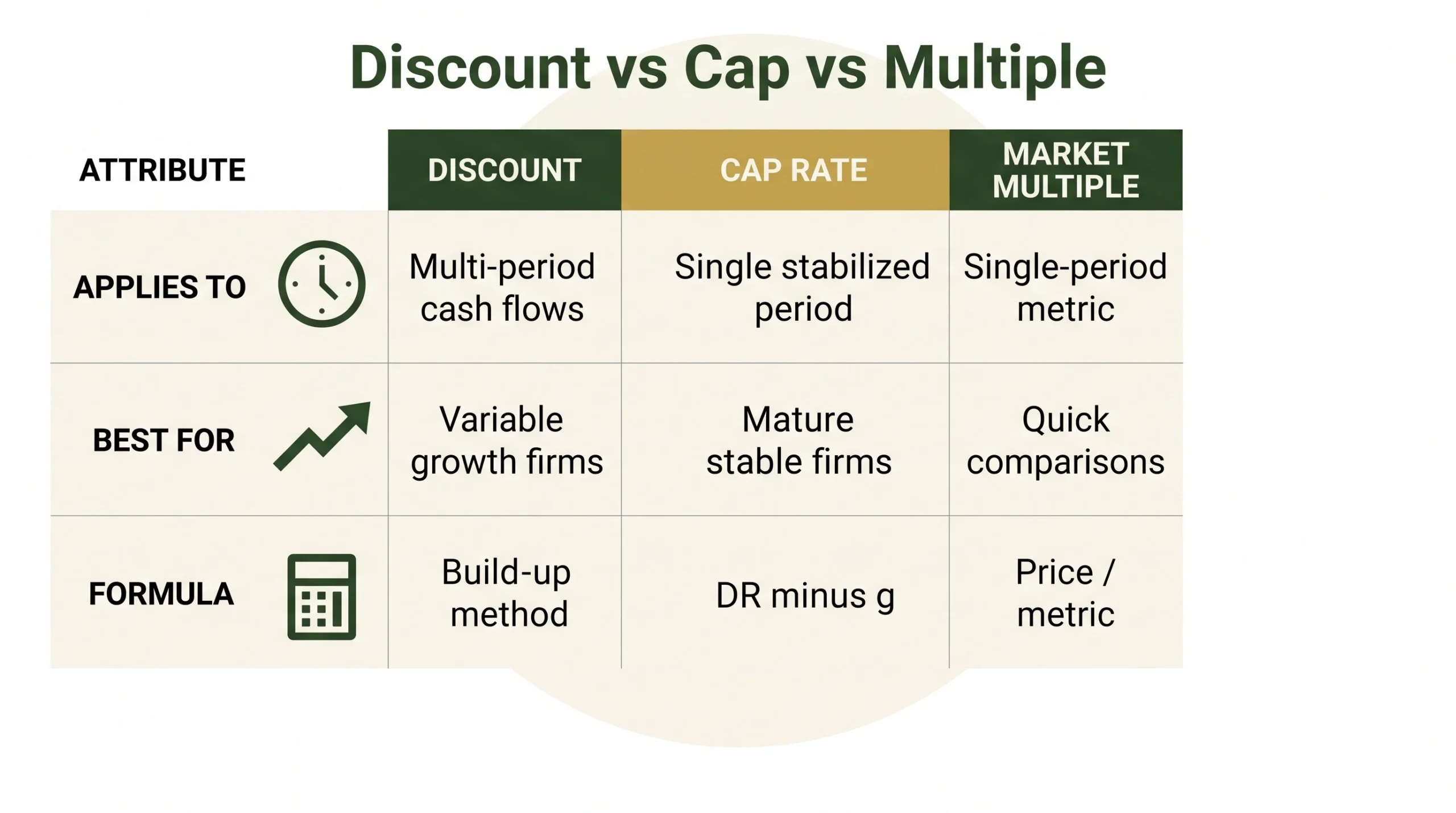
| Attribute | Discount Rate in DCF Method (Sofer Advisors) | Capitalization Rate Method (Sofer Advisors) | Market Multiple (propertymetrics.com / fnrpusa.com) |
|---|---|---|---|
| Applies To | A stream of projected future cash flows over multiple periods. | A single, stabilized earning or cash flow figure for one period. | A single-period metric like EBITDA or Revenue. |
| Best For | Businesses with variable growth, startups, or turnarounds. | Mature, stable businesses with predictable, perpetual earnings. | Quick rule of thumb comparisons against market data. |
| Core Formula Concept | Build-Up Method (RFR + ERP + Size + Specific Risk) | Discount Rate – Long-Term Growth Rate (DR – g) | Transaction Price / Financial Metric (e.g., EBITDA) |
Your method depends on the purpose of the valuation and the quality of your data. A poor fit causes big swings: a steady cap rate on a high-growth startup often gives a low, wrong value.
Experts study the past stability of earnings, which tells them if a single-period or multi-period method works best, then match the right method to each firm. Independence and documentation matter too, since work that follows the Appraisal Foundation USPAP standards is far easier to defend. A talk with an advisor aligns these choices with your goals.
What should the valuation review compare?
A strong analysis ties each choice to real records and market proof from the valuation date. The points below sum up the core choices in this article.
| Decision area | Evidence and review focus |
|---|---|
| What is the core difference between the two rates | The primary difference between a discount rate and a capitalization rate lies in the time horizon; a discount rate is applied to a series of multiple future cash flows, whereas a capitalization rate is applied to a single, stabilized period of income. |
| How do you calculate a business discount rate | A business discount rate is calculated by using a build-up method, which starts with a risk-free rate and adds successive layers of risk premiums to reflect the total danger of the investment. |
| How is a capitalization rate mathematically derived | A capitalization rate is mathematically derived by subtracting the long-term growth rate, denoted as g, from the discount rate, often referred to as the DR. |
The final report should tie these areas together, not treat any input alone.
Frequently Asked Questions
Is a discount rate the same as a cap rate?
No. These metrics are linked by math but serve different goals. A discount rate is a multi-period factor that reflects risk across a set forecast window. Meanwhile, a cap rate is a single-period divisor you use for stable, perpetual earnings.
What is the difference between discounting and capitalization?
Discounting turns a series of future cash flows into today’s value. Capitalization turns one period of steady income into a total value. Discounting handles changing cash flows, which makes it ideal for startups, while capitalization assumes stable, constant growth.
What does a discount rate of 15% mean?
A 15% discount rate means the total return needed to offset the risk in the cash flows you model. This percentage folds in the risk-free rate and adds premiums for market swings, size, and company-specific risk.
What does Warren Buffett use as a discount rate?
Warren Buffett often cites the long-term U.S. Treasury yield as a favored benchmark. He uses it for his internal hurdle rates, and his approach favors steady, long-term cash. But valuation analysts must adjust this base rate further to account for liquidity and operational risks in private firms. Sofer Advisors uses a rigorous build-up method that layers these risk premiums on top of government bond yields.
How do interest rates affect discount and cap rates?
Interest rates form the base for both metrics. As the risk-free rate rises, both rates usually rise too, unless other factors offset the move. Higher rates raise the cost of capital, which lowers values in both models. Sofer Advisors watches current Treasury yield curves, and this keeps every model in step with the broad economy.
What is the build-up method for a discount rate?
The build-up method constructs a discount rate one layer at a time. You start with a risk-free rate, often the U.S. Treasury yield. Then you add an equity risk premium, a size premium, and a company-specific risk premium. Each layer must rest on solid market evidence, and Sofer Advisors uses data like the Kroll Cost of Capital to support every figure.
What happens to the cap rate if a firm has zero growth?
When a firm expects zero growth, the cap rate equals the discount rate. This follows the Gordon Growth Model, where you subtract the long-term growth rate from the discount rate. With no growth to subtract, the two rates match. Because this link relies on steady figures, analysts must define the growth rate with care to keep the final value accurate.
Why should you avoid using real estate cap rates for an operating business?
Real estate cap rates miss the unique risks and labor issues that operating firms face. They also leave out non-real estate asset needs, so applying them to a business often leads to big errors. Sofer Advisors treats this as a common mistake and matches each firm with a method that reflects its true operational and financial facts.
What documents should I gather before a valuation?
Gather your latest financial statements, past-year tax returns, and your current year-to-date budget. These three years of data help an expert judge whether your income history fits a multi-period model or a steady cap rate. Having this information ready sharpens the review of your risk and growth, and it makes the whole engagement smoother.
Related Case Studies
- What is a DCF Valuation? Complete Guide to DCF Method
- WACC for Business Valuation: Calculation and Application
- What Are the Discounted Cash Flow Techniques? A Guide
Executive Summary
A discount rate and a capitalization rate both convert future earnings into present value, but they fit different firms. The discount rate applies across many forecast periods, suits businesses with changing growth, and is built with a build-up method layering a risk-free rate, equity risk premium, size premium, and company-specific premium. The capitalization rate applies one stabilized period of income, suits mature firms with predictable earnings, and comes from the Gordon Growth Model as the discount rate minus long-term growth. Because the two are linked, a zero-growth firm sees them converge. The most costly errors are matching the wrong rate to the wrong firm, double-counting risk, and borrowing real estate cap rates for operating businesses. Choosing well depends on the stability of earnings and the standard of value the engagement demands.
What Should You Do Next?
First, gather your latest financial statements, prior-year tax returns, and current year-to-date budget so an expert can judge whether your earnings history fits a multi-period or single-period model. Second, define the purpose and standard of value, since a tax filing, a sale, and a dispute each shape the method differently. Third, engage a credentialed valuation professional to build a defensible rate supported by current market evidence. David Hern CPA ABV ASA, founder of Sofer Advisors provides neutral, defensible valuations for businesses relying on income-based valuation methods. Schedule a free consultation to discuss your situation.
People Also Read
- Incremental Borrowing Rate ASC 842 Calculation Guide
- What is Incremental Borrowing Rate: IBR Calculation Guide
About the Author
This guide was prepared by David Hern CPA ABV ASAc, founder of Sofer Advisors, a business valuation firm headquartered in Atlanta, GA serving clients across the United States. David holds dual accreditations as an Accredited Senior Appraiser (ASA) and is Accredited in Business Valuation (ABV), credentials recognized by the IRS, SEC, and FINRA. He also holds the Certified Exit Planning Advisor (CEPA) designation. With 15+ years of valuation experience, David has served as an expert witness in 11+ cases across multiple jurisdictions and built Sofer Advisors into an Inc. 5000-recognized firm with 180+ five-star Google reviews. Its full W2 employee team maintains subscriptions to all major valuation databases and operates under a next business day response policy.
For professional business valuation services, visit soferadvisors.com/about-us/ or contact Sofer Advisors at soferadvisors.com/contact-us/.
Disclaimer: This content is for informational purposes only and does not constitute professional valuation advice. Business valuation conclusions depend on specific facts and circumstances. Contact Sofer Advisors for guidance regarding your specific situation.









