


Last Updated: July 2026
The equity risk premium is the extra return investors want from stocks compared to a safe, risk-free asset, and this premium is a key input when an appraiser finds a firm’s cost of equity.
A weak or old input can hurt your results, distorting both the discount rate and the final value. Owners and advisors must know how this premium shapes their total cost of capital, since it matters most during big financial events.
This value moves with interest rates and market risks, so models need frequent updates. Sofer Advisors gives independent valuation analysis for the choices in this article. The sections below show how these inputs set long-term value and how to keep your work sound.
Key Takeaways
- Risk Premium Definition: The equity risk premium is the extra return investors want to hold risky stocks over a safe asset.
- Calculation Approach: Experts find this figure by subtracting the risk-free rate from the expected market return, and that rate is often a long-term government bond yield.
- Valuation Utility: This value is a core input in the Capital Asset Pricing Model, helping set a firm’s total cost of equity.
- Dynamic Valuation Input: The premium shifts with the economy, investor mood, and total market risk.
- Defensible Selection: Pros use trusted sources like the Kroll Cost of Capital guide, which helps them pick a premium they can support.
Finding an accurate premium takes care, since you must study current market conditions and long-term trends. A clear process makes each choice easier to defend.
What Are the Main Inputs for ERP?
The main inputs for an equity risk premium, or ERP, are two figures. These are the expected market return and the current risk-free rate, which is the yield on a very safe asset. Pros find the ERP by subtracting this rate from the projected market return.
This spread is the extra pay investors want for holding stocks instead of a safe asset. Because the choice of the risk-free rate changes the final result a lot, most pros use the yield on a 10-year U.S. Treasury bond, which acts as a baseline for long-term investments.
Changes in government bond yields shift the implied ERP, which affects how analysts view the cost of capital. An analyst can adjust the expected market return too, modeling many scenarios that each show a different view of risk and reward.
These inputs form the base for many outputs in Business Valuation Services. Since a small change in either input can move the final value, pros document why they picked each number.
How Is ERP Used in Business Valuation?
The Equity Risk Premium is a core part of the Capital Asset Pricing Model, or CAPM. This model finds the cost of equity for a firm by weighing the extra return investors want for risky assets. So consultants then get a percentage that reflects the firm’s risk.
This cost of equity feeds into the weighted average cost of capital. Sofer Advisors uses these figures to build sound models that meet current rules. And a clear link between inputs and output helps others trust the work.
Once set, the cost of equity acts as a discount rate inside a Discounted Cash Flow, or DCF, analysis. Under the income approach, this rate adjusts future cash flows, bringing them back to their value today.
This step turns future earnings into a value now; think of it as pricing money that arrives years later. The right discounted cash flow technique depends on your deal type, industry, and the standard of value you need, so talk to a Sofer Advisors specialist about the best fit.
What Is the Difference Between Historical and Implied ERP?
Historical ERP looks back. It uses returns earned over a chosen period, while implied ERP looks forward, starting from current prices, expected cash flows. And a risk-free rate.
The first can give a stable, long-run view, while the second reacts faster to today’s market. Historical data stays steady over long spans, but it may miss recent shifts. And that lag can matter when conditions change fast.
Implied measures give a more current view, yet they can be volatile because they lean heavily on the accuracy of earnings forecasts. If those forecasts are off, the result is off too. So pros often blend both methods to find the right cost of capital.
Sofer Advisors studies these signals with care, and every job follows set professional standards, including those from the AICPA. Owners should weigh how these points affect their own case during a deal or tax event.
Why Does the Equity Risk Premium Change Over Time?
The equity risk premium moves over time. Shifts in investor caution drive part of this, as do large economic forces and broad market mood. These factors push investors to adjust the pay they want when they compare risky assets to safe ones.
When doubt grows, investors want a higher premium because they need more to stay in the market. Big economic forces press on these numbers, while calm markets can push the premium the other way.
Signals from the Federal Reserve about rates often move the risk-free rate, which is a main input for the premium. News about GDP growth or earnings can shift things too, forcing analysts to redo their projections.
Global unrest can cause fast spikes in market risk, leading to quick swings in the required return. According to Business Valuation Resources, analysts must watch these shifts so they avoid old, wrong cost of capital figures. Models stay credible only when they mirror the present.
How Do Size and Company-Specific Risk Premiums Add to ERP?
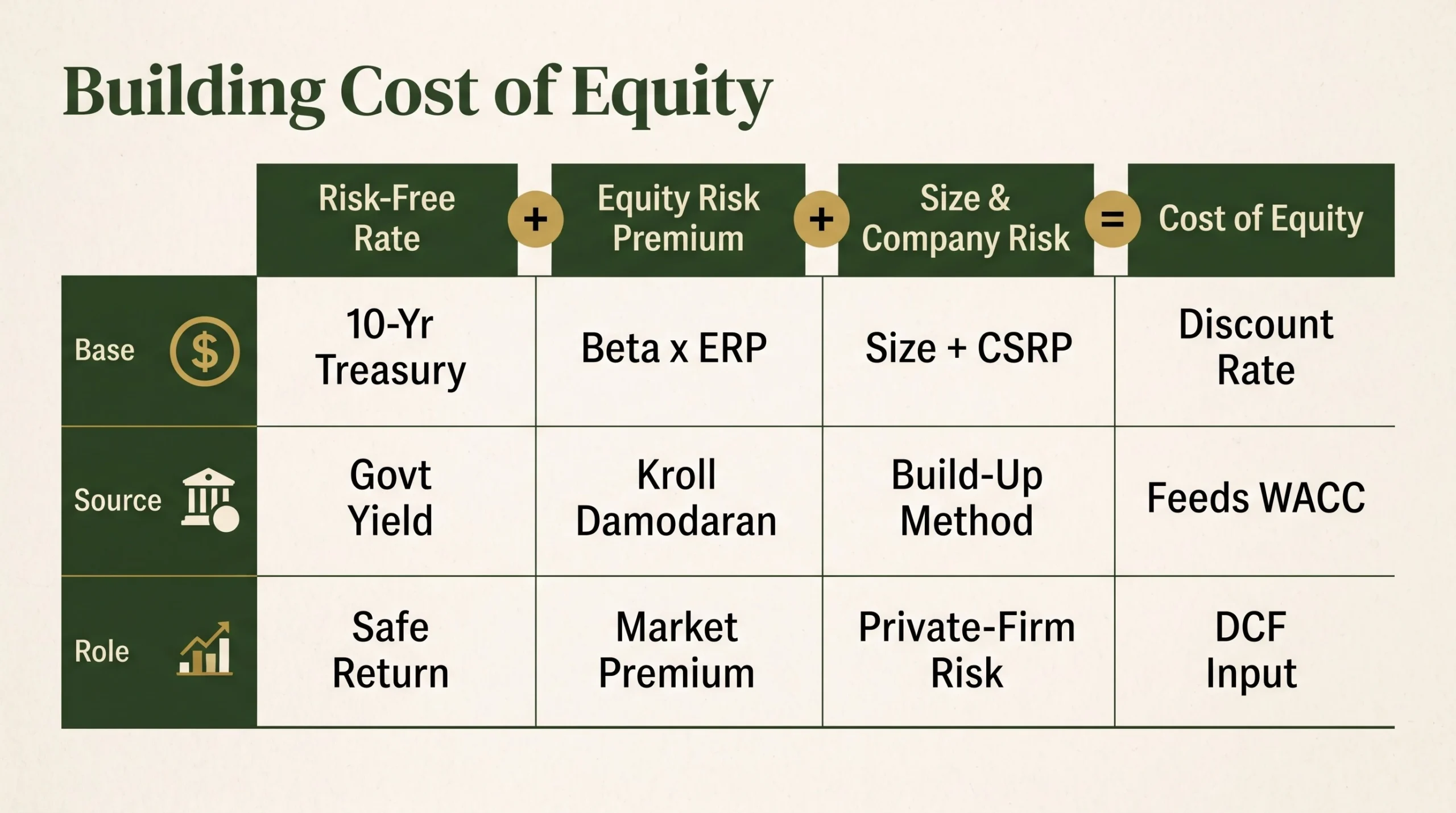
Size and company-specific premiums widen the base ERP. They adjust for the special risks of small or private firms, and less-liquid businesses need this too. A broad market ERP reflects the cost of capital for large, public stocks. So it does not cover the extra doubt in smaller firms.
The build-up method captures these finer risks by adding specific premiums to the base rate. This keeps the discount rate in line with a private firm’s true risk rather than a generic market standard.
The Size Premium, or SP, reflects a known pattern in which smaller firms tend to earn higher returns, paying them for their greater sensitivity to shifts in the economy. Analysts also add a Company-Specific Risk Premium, or CSRP, which covers unique internal issues.
Such issues may include key-person risk, customer concentration, or limited access to capital. Pros often use the Kroll Cost of Capital for data that helps justify these changes, which stops firms from underrating risk.
Which Data Sources Do Professionals Use for ERP?
Pros rely on vetted, outside data sources. These provide an ERP figure they can defend, and the Kroll Cost of Capital Navigator is one of the most common tools, since it offers data that keeps analysts current with rates and premiums.
Professor Aswath Damodaran shares widely cited datasets that capture global risk premiums and sector betas. They give a useful frame of reference for many private firm valuations.
Sources like Business Valuation Resources, or BVR, also help by giving high-quality data and peer-reviewed studies that help pros pick inputs for their models. Using these sources keeps the valuation on a sound footing. So it stands up to the IRS and other outside parties.
This practice ends reliance on guesswork and keeps every valuation step in line with industry standards. Picking the right premium takes judgment, since no single source fits every job.
Investopedia and textbooks explain the concept, but they do not replace dated market evidence in a formal report. The team makes sure each input meets high standards, including those from the Appraisal Foundation and other bodies.
Owners rely on this mix of hard data and skilled review to handle complex tax and deal events, since general finance knowledge alone often falls short.
What should the valuation review compare?
A sound analysis ties each key judgment to the records and to market evidence on the valuation date. The points below sum up the article’s core decision areas.
| Decision area | Evidence and review focus |
|---|---|
| What Are the Main Inputs for ERP | The main inputs for an equity risk premium, or ERP, are the anticipated market return and the current risk-free rate. |
| How Is ERP Used in Business Valuation | The Equity Risk Premium (ERP) is a core variable in the Capital Asset Pricing Model (CAPM). |
| What Is the Difference Between Historical and Implied ERP | Historical ERP looks back at returns earned over a chosen period. |
The final report should reconcile these areas rather than treat any method or input alone.
Frequently Asked Questions
What’s a good equity risk premium?
There is no single “good” number. A fair equity risk premium depends on many things, including current rates, expected inflation. And the market’s risk tolerance at the time. Analysts often use data from the Kroll Cost of Capital to find the range that fits current conditions. And the right figure shifts as the market shifts.
What is the current equity risk premium of the S&P 500?
The equity risk premium of the S&P 500 shifts daily. It relies on live market prices and analyst growth forecasts. Historical and implied premiums change too, moving with the period, prices, volatility. And investor hopes, so any single reading reflects just that moment.
How to calculate equity risk premiums?
To find the equity risk premium, start with the expected market return. Then subtract the risk-free rate, which is usually the 10-year U.S. Treasury bond yield. The result is the extra return investors want for choosing stocks over a government bond.
What is the relationship between equity risk premium and CAPM?
The equity risk premium is the key input in the Capital Asset Pricing Model. It helps find the cost of equity, as analysts multiply this premium by the firm’s beta and then add the risk-free rate. This gives a fair discount rate for their projections.
What is considered the risk-free rate in ERP calculation?
The 10-year U.S. Treasury bond yield is the standard proxy. It stands in for the risk-free rate in most models, and this term matches the long-term nature of stock investments. Because it gives a stable baseline for comparison, so many pros rely on it.
Why does the choice of risk-free rate matter so much?
The risk-free rate is one of two main inputs, and it changes the final ERP a lot. Because a small shift moves the result, most pros use the 10-year U.S. Treasury yield as a baseline. When bond yields move, the implied ERP shifts too, which affects how analysts view the cost of capital.
How do size and company-specific premiums adjust the base ERP?
A broad market ERP reflects the cost of capital for large, public stocks, so it misses the extra risk in small or private firms. The build-up method adds specific premiums to the base rate. The Size Premium pays for greater sensitivity to the economy, while the Company-Specific Risk Premium covers key-person risk, customer concentration, or limited access to capital.
How does the cost of equity connect to a full valuation?
The cost of equity from CAPM feeds into the weighted average cost of capital. Once set, it acts as a discount rate inside a Discounted Cash Flow analysis. Under the income approach, this rate adjusts future cash flows to bring them back to their value today, turning future earnings into a value now. Sofer Advisors builds sound models around this link.
Why do professionals rely on outside data sources for ERP?
Vetted outside sources give an ERP figure analysts can defend before tax authorities and other parties. The Kroll Cost of Capital Navigator, Professor Aswath Damodaran’s datasets, and Business Valuation Resources supply market data and peer-reviewed studies. Investopedia and textbooks explain the concept but do not replace dated market evidence in a formal report, so good sourcing protects the work under review.
Related Case Studies
- WACC for Business Valuation: Calculation and Application
- What is a DCF Valuation? Complete Guide to DCF Method
- Terminal Value Formula: How to Calculate It in a DCF
Executive Summary
The equity risk premium measures the excess return investors require to hold risky equities instead of a safe asset, and it feeds directly into the cost of equity an appraiser derives through the Capital Asset Pricing Model. It is found by subtracting the risk-free rate, typically the 10-year U.S. Treasury yield, from the expected market return, so the choice of risk-free rate materially changes the result. Historical ERP looks backward at realized returns for stability, while implied ERP works forward from current prices and forecasts for a timelier but more volatile reading, and many analysts blend the two. The premium moves with investor caution, Federal Reserve signals, GDP and earnings news, and global unrest, which is why stale inputs quietly distort a discount rate. Size and company-specific risk premiums are layered onto the base ERP through the build-up method to reflect the added risk of small or private firms, including key-person risk and customer concentration. Professionals defend their figures with vetted sources such as the Kroll Cost of Capital Navigator, Damodaran datasets, and Business Valuation Resources rather than general finance references.
What Should You Do Next?
First, review every valuation model you rely on and confirm the equity risk premium reflects current market conditions rather than data more than six months old. Next, document the source and date for each market input, drawing on vetted references like the Kroll Cost of Capital so each choice can be defended later. Finally, layer in any size and company-specific premiums your subject firm requires, then reconcile the inputs before you finalize the report. David Hern CPA ABV ASA, founder of Sofer Advisors provides neutral, defensible valuations for equity risk premium and cost of equity analysis. Schedule a free consultation to discuss your situation.
People Also Read
- Cost Approach vs Income Approach: Complete Guide
- Business Valuation Services United States: Expert Guide 2025
About the Author
This guide was prepared by David Hern CPA ABV ASAc, founder of Sofer Advisors, a business valuation firm headquartered in Atlanta, GA serving clients across the United States. David holds dual accreditations as an Accredited Senior Appraiser (ASA) and is Accredited in Business Valuation (ABV), credentials recognized by the IRS, SEC, and FINRA. He also holds the Certified Exit Planning Advisor (CEPA) designation. With 15+ years of valuation experience, David has served as an expert witness in 11+ cases across multiple jurisdictions and built Sofer Advisors into an Inc. 5000-recognized firm with 180+ five-star Google reviews. Its full W2 employee team maintains subscriptions to all major valuation databases and operates under a next business day response policy.
For professional business valuation services, visit soferadvisors.com/about-us/ or contact Sofer Advisors at soferadvisors.com/contact-us/.
Disclaimer: This content is for informational purposes only and does not constitute professional valuation advice. Business valuation conclusions depend on specific facts and circumstances. Contact Sofer Advisors for guidance regarding your specific situation.









