


Last Updated: August 2026
The iterative WACC method is a way to fix a loop inside a discounted cash flow model. The weights in WACC should use the market value of debt and equity. But the equity value is the very thing the model sets out to find. So the rate needs a number that the rate itself will produce. Data from the Kroll Cost of Capital Navigator shows why this matters. A one point shift in the cost of capital can move firm value by more than ten percent. Sofer Advisors treats this loop as a core step, not a rounding note.
The loop appears in any income approach model that uses market value weights. It grows more serious when a company plans to pay down debt or take on more. As the mix of debt and equity shifts, so does the rate. A model that skips this can misstate value in a tax filing, a sale, or a dispute.
Key Takeaways
- The loop is real: WACC weights need market values, yet the equity value is the DCF output. So the rate and the value each depend on the other.
- Iterate to agree: The iterative WACC method runs the rate and the value in cycles until both settle on the same answer.
- Target versus actual: A target capital structure uses a planned debt and equity mix. An actual structure uses the model’s own solved values.
- Simple often wins: A fixed target structure skips the loop. It fits firms whose mix stays steady, and it is easier to defend.
- It matters most when the mix moves: The iterative path changes the answer for buyouts, high growth, or planned debt paydown.
These points frame a single question: how much precision does your case need? The sections below show how the loop forms, how to close it, and when the extra work is worth it.
What is the circularity problem in a DCF?
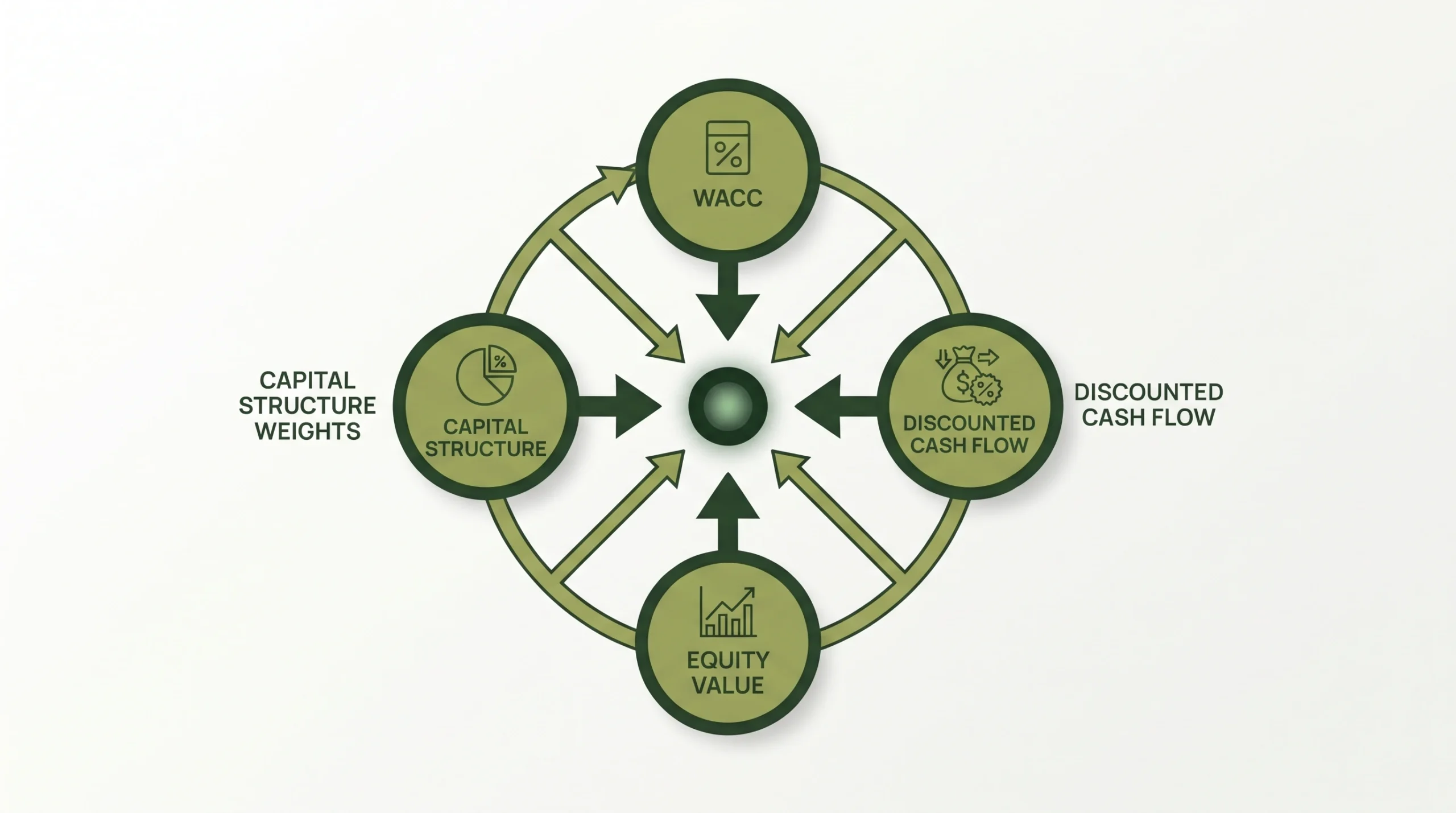
The circularity problem is a loop between the discount rate and the value. A DCF discounts future cash flows at WACC to reach firm value. WACC blends the cost of debt and the cost of equity by their market weights. Those weights need the market value of equity. But that value is the output of the DCF. So you cannot set the rate without the answer, and you cannot get the answer without the rate.
This is why a single pass does not work in strict form. Many models hide the loop by using book values or a fixed mix. That shortcut can hold, yet it drifts when the capital structure changes over the forecast. Fair market value under IRS Revenue Ruling 59-60 rests on sound, market based inputs, and the weights are part of that test.
Why should WACC use market value weights?
WACC should use market value weights because value, not cost, drives what investors require today. Book values record what debt and equity once cost the company. Market values show what the same claims are worth now. The cost of equity reflects current risk, so the weight on equity must reflect the current worth of equity. Mixing a current rate with an old weight breaks the logic and skews the blended rate.
The gap can be wide. A firm may carry equity on the books at a fraction of its market value, so a book weighted WACC leans too hard on debt. That understates the rate and inflates the value. The AICPA Statement on Standards for Valuation Services expects inputs that a market participant would use. Market value weights meet that bar.
How does the iterative WACC method work?
The iterative WACC method solves the rate and the value together in short cycles. You start with a guess, then let the model correct itself until it stops moving. Each pass feeds the prior value back into the weights. The gap between passes shrinks fast, often within a handful of rounds. You stop when the change falls below a set tolerance, such as one dollar or one tenth of a percent.
The loop follows a simple order:
- Assume a starting WACC from market data or a peer group.
- Discount the cash flows to get an enterprise and equity value.
- Rebuild the debt and equity weights from that fresh value.
- Recompute WACC, then repeat until the value holds steady.
In a spreadsheet, you can enable iterative calculation or use a goal seek to close the loop without manual edits. The math is not hard, but the setup invites errors. A weight that fails to update will bias every later step. Sofer Advisors tests each model so the weights track the solved value, and so the final rate rests on evidence a reviewer can follow.
Target or actual capital structure: which fits?
A target structure uses a planned, steady mix of debt and equity. An actual structure uses the values the model itself solves for. The choice shapes both the rate and the effort. A target mix breaks the loop, because the weights are fixed by assumption rather than by output. That makes it faster and simpler. An actual mix honors the market value rule at every step, but it requires the iterative path to settle.
Most engagements lean on a constant target structure, and for good reason. If a company holds a stable mix and plans no major change, a fixed set of weights gives nearly the same answer with far less risk of a modeling slip. The table below sets the three common paths side by side.
| Approach | How it sets the weights | Best fit | Main trade-off |
|---|---|---|---|
| Constant target WACC | Fixed planned debt and equity mix | Stable firms with a steady structure | Drifts if the real mix changes |
| Iterative WACC | Rebuilt from the model’s solved value | Firms with a shifting mix | More build steps and error risk |
| Adjusted Present Value | Values operations, then adds debt effects | Buyouts and heavy debt paydown | Must forecast tax shields on their own |
The right pick depends on the case, not on habit. A constant target structure is often the cleaner, more defensible choice for a mature, steady company. The iterative WACC earns its cost when the mix truly moves. The Adjusted Present Value method sidesteps the loop by valuing the business first as if all equity funded, then adding the value of the interest tax shield.
When does the iterative method change the answer?
The iterative method changes the answer when the capital structure moves a lot over the forecast. In a leveraged buyout, debt starts high and falls year by year. As it falls, equity risk drops, and the rate should drop with it. A fixed rate would tax the later years too hard and understate value. A high growth firm shows the reverse, as new equity reshapes the mix. In both cases the loop and the value are tightly linked.
For a settled company with a steady mix, the iterative path and a good target structure land within a rounding step of each other. The extra work adds little. The method also anchors financial reporting work, such as goodwill impairment and purchase price allocation, where the value flows straight to the balance sheet. Sofer Advisors sizes the approach to the stakes, so the model is neither too thin for a dispute nor too heavy for a simple planning need.
Who should build an iterative WACC model?
An iterative model should be built by an appraiser who can defend every input, not just run a spreadsheet. The loop is easy to code and easy to break. A biased weight or a hidden circular link can pass a quick glance yet fail an audit. That is the line between a directional estimate and a number that holds up before the IRS, a court, or a buyer.
This is where The Sofer Difference shows. It is a four phase process of Discovery, Diligence, Analysis, and Delivery that ends in an audit ready report. Large firms such as Alvarez and Marsal, Kroll, and Stout bring this rigor to enterprise clients. Sofer Advisors brings the same senior level care to middle market owners, and unlike a solo practitioner, it backs each model with a full W2 team of 14 and a next business day response policy. That reflects the Heart of a Teacher approach: show the owner the math, not just the result.
Frequently Asked Questions
What is the circularity problem in one line?
It is a loop where the discount rate depends on the equity value, and the equity value depends on the discount rate. WACC weights need the market value of equity, yet that value is the output of the DCF. So neither can be set alone. The iterative WACC method breaks the loop by solving both together until they agree on one steady answer.
Why not just use book value weights?
Book values show what debt and equity once cost, not what they are worth today. The cost of equity reflects current risk, so pairing it with an old weight breaks the logic. Book weighted WACC often leans too hard on debt, which understates the rate and inflates the value. Market value weights fix this, and they are what a market participant, and a reviewer, would expect.
How many passes does the loop need?
Most models settle within a few passes, because each cycle shrinks the gap between the prior value and the new one. You set a stopping rule, such as a change below one tenth of a percent, and the loop ends when it clears that bar. A spreadsheet with iterative calculation turned on handles the passes for you.
Is a constant target WACC ever correct?
Yes, and it is often the better choice. When a company holds a steady mix of debt and equity and plans no major change, a fixed target structure gives nearly the same answer as the loop. It is faster and carries less risk of a modeling slip. The iterative path earns its cost only when the mix truly moves across the forecast.
How does APV differ from an iterative WACC?
The Adjusted Present Value method avoids the loop by splitting the work. It values the business first as if funded fully by equity, then adds the value of the interest tax shield on its own. An iterative WACC keeps everything in one blended rate and cycles to a stable value. APV suits buyouts and heavy debt paydown, where the tax shield deserves its own forecast.
Does circularity affect the terminal value?
Yes. The terminal value is usually the largest piece of a DCF, and it depends on WACC. Since WACC depends on total value, and total value includes the terminal value, the loop runs through it too. A careless model can compound the error there. Solving the rate and the value together, or using an analytic fix, keeps the terminal value in step with the rest of the model.
What standards govern the inputs?
Fair market value under IRS Revenue Ruling 59-60 rests on sound, market based inputs, which include the capital structure weights. The AICPA Statement on Standards for Valuation Services expects inputs a market participant would use. USPAP adds the duty to support and document each choice. Together they mean the weights and the rate must be built on evidence, not on a generic benchmark.
How much does a business valuation from Sofer Advisors cost?
A business valuation from Sofer Advisors typically runs 7,500 to 25,000 dollars, depending on complexity and scope. Simpler engagements for planning or tax fall toward the lower end. Buyouts, litigation support, and detailed financial reporting need deeper modeling, so they fall higher. The purpose of the report and the state of your records both shape the fee. Contact Sofer Advisors for a quote matched to your situation.
Related Case Studies
- Discount Rate vs Capitalization Rate
- Levered vs Unlevered Beta in Private Valuation
- Debt Capacity: How Much Leverage a Business Supports
Executive Summary
The iterative WACC method fixes a loop in the DCF, where the discount rate needs the market value of equity that the model is trying to solve. WACC weights must use market values, since a current cost of equity paired with an old book weight breaks the logic and can swing value by more than ten percent. The iterative path cycles the rate and the value until they agree, often within a few passes. A constant target structure is a simpler, defensible stand-in when the mix stays steady. The loop matters most for buyouts, high growth, and planned debt paydown, and it must meet IRS Revenue Ruling 59-60 and AICPA standards.
What Should You Do Next?
Start by checking whether your capital structure changes across the forecast. If the mix is steady, a well built constant target WACC will likely serve, and it is easier to defend. If debt levels shift, set up the iterative loop or an Adjusted Present Value model and document the tolerance you use to stop it.
For a rate and a value you can stand behind, work with David Hern CPA ABV ASA. His team has given expert witness testimony in 11+ cases across Georgia, Florida, California, and New Mexico. Schedule a consultation to discuss the model that fits your business.
People Also Read
- The Size Premium: Why Small Firms Carry Higher Rates
- Equity Risk Premium: How It Sets Cost of Equity
About the Author
This guide was prepared by David Hern CPA ABV ASA, founder of Sofer Advisors, a business valuation firm headquartered in Atlanta, GA serving clients across the United States. David holds dual accreditations as an Accredited Senior Appraiser (ASA) and is Accredited in Business Valuation (ABV), credentials recognized by the IRS, SEC, and FINRA. He also holds the Certified Exit Planning Advisor (CEPA) designation. With 15+ years of valuation experience, David has served as an expert witness in 11+ cases across multiple jurisdictions and built Sofer Advisors into an Inc. 5000-recognized firm with 180+ five-star Google reviews. Its full W2 employee team maintains subscriptions to all major valuation databases and operates under a next business day response policy. For professional business valuation services, visit soferadvisors.com/about-us/ or contact Sofer Advisors at soferadvisors.com/contact-us/.
Disclaimer: This content is for informational purposes only and does not constitute professional valuation advice. Business valuation conclusions depend on specific facts and circumstances. Contact Sofer Advisors for guidance regarding your specific situation.









