


Last Updated: July 2026
A debt capacity analysis is a financial check that finds the most debt a company can carry safely, without harming daily operations or missing payments. It reviews current cash flow, weighs existing debt, and studies the results the business expects.
These facts point to the best capital structure, the mix of debt and equity a firm uses. Leaders compare their numbers to industry benchmarks to see how much new debt fits across many outcomes. The result is a defensible range that holds up when a bank, a board, or a court reviews it.
Sofer Advisors guides owners, CFOs, and attorneys who need clear data, whether they plan new financing or a change in structure. Founded in 2019, the team handles complex financial reports and valuation needs.
Key Takeaways
- Defining Debt Capacity: A debt capacity analysis finds the top level of debt a firm can bear before it hits financial trouble, showing how much credit it can hold while keeping operations safe.
- Monitoring Essential Metrics: Analysts study three figures, the Debt-to-EBITDA ratio, the Debt Service Coverage Ratio, and the Interest Coverage Ratio, to see how much cash is free to meet regular bills.
- Lending Standard Thresholds: Lenders often want a Debt Service Coverage Ratio above 1.25x and a Debt-to-EBITDA ratio under 4.0x to 5.0x for mid-market firms.
- Structuring M&A Transactions: This work shapes deal financing for buyouts and mergers, keeping the resulting debt mix workable under likely results.
- Managing Long-Term Solvency: Going past your debt limit can trigger covenant breaches, forced restructuring, or even bankruptcy, so a good check guards the firm’s future.
What is a debt capacity analysis?
A debt capacity analysis is a forward-looking review that finds the debt a firm can absorb and repay safely while protecting daily operations. It goes past simple balance sheet ratios, modeling future cash flows against likely debt payments and testing them across many outcomes. Owners use it to weigh capital use, refinancing, and possible acquisitions.
A risk framework guides the modeling, letting owners stress test their assumptions against market swings. These “what if” checks reveal how a revenue drop or higher interest rates could hurt, and whether a firm can still meet its loan rules over time.
How do you calculate debt capacity?
Owners find debt capacity with a few key figures: the Debt-to-EBITDA ratio, the Debt Service Coverage Ratio (DSCR), and the Interest Coverage Ratio (ICR). These let lenders check whether a firm makes enough cash to cover both interest and principal.
The Debt-to-EBITDA ratio measures total debt against earnings, where EBITDA means earnings before interest, taxes, depreciation, and amortization. Because reported EBITDA can hide one-time items, many analysts start from a normalized EBITDA figure. Lower multiples signal less risk. The DSCR compares net operating income to total debt payments, and a value above 1.0 shows a firm earns enough to pay. The ICR divides EBITDA by interest expense to gauge interest coverage.
The after-tax cost of debt also shapes leverage. Because interest is often deductible, the true cost sits below the stated rate, though IRS limits on business interest expense under Section 163(j) can cap that benefit for larger firms. This cost feeds the firm’s weighted average cost of capital, which weighs debt against equity. The right plan depends on your industry, deal type, and standard of value, so talk your needs over with a Sofer Advisors specialist.
What factors influence a company’s debt capacity?
Three things drive debt capacity: the power to make steady cash flow, the risk profile, and the collateral a firm can offer, meaning the assets pledged to back a loan. Lenders study these to judge whether a firm can meet interest and principal under many conditions. Firms in cyclical industries often carry less debt, since swinging revenue raises the risk of default in a downturn. A firm in a steady sector gives lenders more comfort.
The quality of tangible assets matters here. Machinery or equipment owned free and clear gives lenders a clear path to recover money if default hits, and a strong management team builds trust. Recurring revenue and a broad client base also raise the debt a lender will support, while a firm that leans on one large account looks riskier and draws tighter terms.
What are common debt capacity ratios for lenders?
Commercial lenders often want a DSCR of 1.25x or higher and a Debt-to-EBITDA multiple below 4.0x. These thresholds show whether a borrower has enough cash to cover its bills, and lenders apply them with care so future payments stay workable across many outcomes.
The 1.25x mark is a common floor, but it shifts with the loan type and the industry. Senior debt carries stricter rules, set in the credit agreement covenants, the contract’s list of promises a borrower makes. Subordinated debt may allow higher thresholds, since a lender’s risk appetite decides the ratios. Government programs add a layer too: an SBA loan often requires an independent business valuation before a lender will fund a deal, and that report shapes both the loan size and the terms.
How is this analysis critical for M&A transactions?
This analysis is vital for M&A, meaning mergers and acquisitions, because it sets safe limits for deal financing and shows how much debt a buyer can place on the new firm, stopping the buyer from borrowing too much.
Buyers model cash flows after the deal closes, then check whether the firm can meet its payments. The model adjusts for expected synergy, the extra value two firms create as one, which often adds cash flow to pay down debt faster. In a leveraged buyout, the debt load is central to the structure, so a careful capacity check separates a deal that works from one that strains under its own weight.
Reviewing these figures measures risk and confirms the firm keeps enough liquidity, meaning cash it can reach quickly, to fund growth while paying new debt. Getting it right early avoids overpaying or taking on a debt mix the business cannot bear. To support your next deal, you can request a valuation estimate.
What happens when a business exceeds its debt capacity?
A firm goes past its debt limit when cash falls short and it can no longer meet scheduled principal and interest. This overreach often sparks a liquidity crisis, meaning the firm runs low on cash, so it cannot pay vendors or staff. Without quick fixes to the debt mix, the risk of failure grows.
Lenders watch results through strict contracts, so breaking a financial covenant puts the firm in technical default. Lenders can then demand faster repayment or refuse more credit, and if the problem stays unsolved, owners face forced restructuring or a full loss of equity. In deals where creditors worry about the debt load, a solvency opinion can confirm a firm will still pay its bills after taking on new leverage. Sofer Advisors watches these risks and keeps a neutral stance to aid all parties.
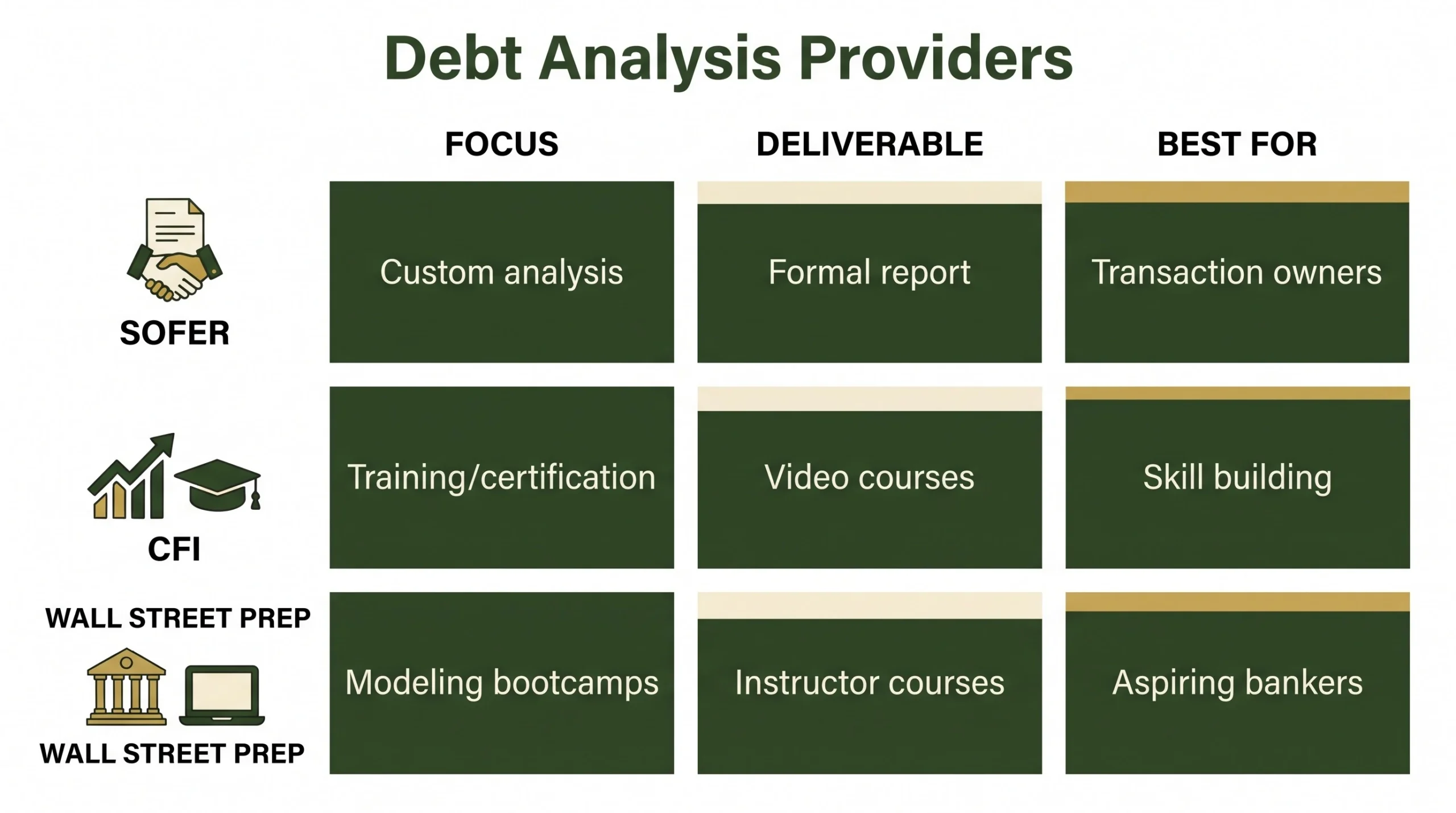
| Provider | Focus | Deliverable | Best For |
|---|---|---|---|
| Sofer Advisors | Customized Debt Capacity & Valuation Analysis | Formal report with scenario modeling specific to the client’s business and industry benchmarks | Business owners, CFOs, and attorneys needing a defensible analysis for a transaction, financing, or strategic planning |
| Corporate Finance Institute (CFI) | Online Training & Certification | Self-paced video courses and downloadable Excel templates on financial modeling | Individuals seeking to learn the theoretical concepts and build general financial modeling skills for career development |
| Wallstreetprep.com | Intensive Training Bootcamps | Live or online instructor-led courses focused on LBO and M&A modeling techniques | Aspiring investment bankers and private equity professionals needing to master complex transaction modeling |
The right resource depends on your goal: firms like Sofer Advisors deliver a finished product that suits banks or courts, while training platforms build internal skill.
Most mid-market deals need proof from a neutral source that holds up during due diligence, the close review buyers and lenders run. Training teaches you to build a model, but not the signed, neutral report banks and legal teams need for compliance. Sofer Advisors uses a four-phase method, The Sofer Difference, and follows recognized standards including the AICPA’s valuation guidance and the Appraisal Foundation’s USPAP rules, so conclusions stay credible over the life of a loan.
What should the valuation review compare?
A strong analysis ties each judgment to the evidence on the valuation date. The points below sum up the core choices in this article.
| Decision area | Evidence and review focus |
|---|---|
| What is a debt capacity analysis | A debt capacity analysis is a forward-looking assessment of the amount of debt a company can safely absorb and repay without compromising its operational stability. |
| How do you calculate debt capacity | Business owners calculate debt capacity by evaluating metrics like the Debt-to-EBITDA ratio, the Debt Service Coverage Ratio (DSCR), and the Interest Coverage Ratio (ICR). |
| What factors influence a company’s debt capacity | A company’s debt capacity is determined by its ability to generate stable cash flow, its risk profile, and the nature of its available collateral. |
The final report should tie these areas together rather than lean on any one input.
Frequently Asked Questions
What is KD in WACC formula?
WACC stands for Weighted Average Cost of Capital. In this formula, KD means the after-tax cost of debt. You find it in two steps: take the current interest rate a firm pays, then adjust it for the tax shield benefit. Because interest payments are tax-deductible for many firms, the real cost is lower than the stated rate. Sofer Advisors adds this cost when we study a firm’s capital mix for valuation work.
What are the 3 C’s of creditworthiness?
The three C’s are character, capacity, and collateral. Character refers to the borrower’s credit history and reliability, capacity measures the firm’s power to make enough cash for its debt. And collateral means the assets pledged to secure the loan. Lenders weigh all three factors, which helps them judge the risk of default before they lend.
Is CFADS the same as EBITDA?
No, CFADS and EBITDA are different metrics. They serve separate roles in debt review. EBITDA measures operating profit before interest and taxes. Meanwhile, CFADS, or Cash Flow Available for Debt Service, focuses on the cash left to fund principal and interest after paying for maintenance capital costs. Creditors favor CFADS when they judge a firm’s true power to repay. So Sofer Advisors uses it to build accurate models for bank financing and reporting.
What is the debt capacity test?
The debt capacity test is an analytical process. It finds the level of debt a firm can bear before the firm risks trouble or covenant breaks. The test weighs projected free cash flow against the need to pay interest and principal, showing the top debt a firm can absorb safely relative to its industry norms. Sofer Advisors runs this test for owners, giving them a defensible upper limit for borrowing.
How much does a debt capacity analysis from Sofer Advisors cost?
A debt capacity analysis often runs from $7,500 to $25,000. The price depends on how complex the business is, the historical data we must review. And the timeline of the work. This service gives a detailed report that owners can present to lenders to back their financing requests.
What DSCR do lenders usually require?
Commercial lenders often want a Debt Service Coverage Ratio of 1.25x or higher. This mark shows a firm earns enough cash to cover its debt payments. A value above 1.0 means the firm can pay, but the 1.25x floor gives lenders a safety cushion. The exact number can shift with the loan type and the industry.
What Debt-to-EBITDA ratio do lenders look for?
Lenders often look for a Debt-to-EBITDA multiple below 4.0x, and mid-market firms may face a range of 4.0x to 5.0x. This ratio measures total debt against earnings before interest, taxes, depreciation, and amortization. Lower multiples signal less risk, so lenders favor them. Sofer Advisors helps owners read these benchmarks during financing talks.
Why do firms in cyclical industries carry less debt?
Firms in cyclical industries often carry less debt because their revenue swings up and down. These swings raise the risk of default during a downturn, so lenders offer less comfort. A firm in a steady sector gives lenders more certainty about future payments. Strong collateral and a proven management team can also build the trust lenders need.
How does synergy affect debt capacity in an M&A deal?
In an M&A deal, buyers model cash flows after the deal closes to check whether the new firm can meet its payments. The model adjusts for expected synergy, the extra value two firms create as one. This synergy often adds cash flow, which can help pay down debt faster. Sofer Advisors tests whether the deal still works under many outcomes.
Related Case Studies
- What Is a Leveraged Buyout? LBO Structure Explained
- Solvency Opinions for LBOs: What They Cover and What They Don’t
- Leveraged Recapitalization: How to Take Cash Out Without Selling
Executive Summary
A debt capacity analysis measures the most debt a company can repay safely without straining operations or breaking loan covenants. Analysts model projected cash flow against interest and principal, then test it across many outcomes using the Debt-to-EBITDA ratio, DSCR, and Interest Coverage Ratio. Lenders often want a DSCR of 1.25x or higher and a Debt-to-EBITDA multiple below 4.0x to 5.0x for mid-market firms. Steady cash flow, a strong risk profile, and quality collateral raise the debt a lender supports, while cyclical revenue lowers it. The work is central to M&A financing. Exceeding capacity risks a liquidity crisis, covenant default, forced restructuring, or a full loss of equity.
What Should You Do Next?
Start by pulling your latest financials and calculating your current DSCR, Interest Coverage Ratio, and Debt-to-EBITDA multiple against today’s lending norms. Next, stress test those figures against a revenue drop or a rise in interest rates to see whether you still clear your covenants. Finally, bring a neutral, defensible analysis to any lender or counterparty before you sign, so the numbers answer their questions first. David Hern CPA ABV ASA, founder of Sofer Advisors provides neutral, defensible valuations for companies evaluating debt capacity and financing decisions. Schedule a free consultation to discuss your situation.
People Also Read
- How Much Is My Business Worth? Getting an Accurate Answer
- How Much Is a Restaurant Worth? Complete Valuation Guide
About the Author
This guide was prepared by David Hern CPA ABV ASAc, founder of Sofer Advisors, a business valuation firm headquartered in Atlanta, GA serving clients across the United States. David holds dual accreditations as an Accredited Senior Appraiser (ASA) and is Accredited in Business Valuation (ABV), credentials recognized by the IRS, SEC, and FINRA. He also holds the Certified Exit Planning Advisor (CEPA) designation. With 15+ years of valuation experience, David has served as an expert witness in 11+ cases across multiple jurisdictions and built Sofer Advisors into an Inc. 5000-recognized firm with 180+ five-star Google reviews. Its full W2 employee team maintains subscriptions to all major valuation databases and operates under a next business day response policy.
For professional business valuation services, visit soferadvisors.com/about-us/ or contact Sofer Advisors at soferadvisors.com/contact-us/.
Disclaimer: This content is for informational purposes only and does not constitute professional valuation advice. Business valuation conclusions depend on specific facts and circumstances. Contact Sofer Advisors for guidance regarding your specific situation.









