


Last Updated: August 2026
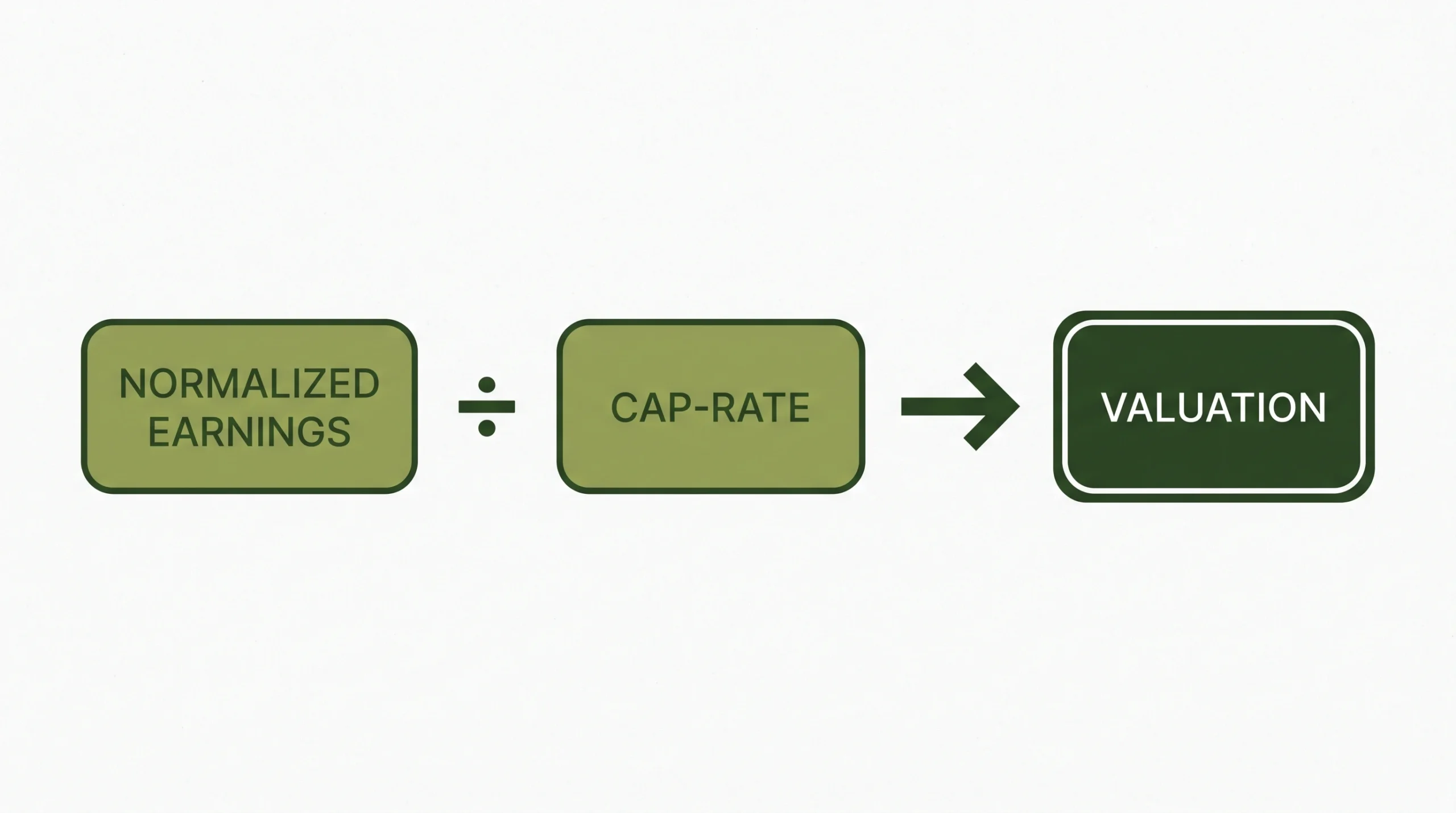
The capitalization of earnings method is an income approach. It turns one period of normalized earnings into a business value. You divide those earnings by a cap rate. That rate equals the discount rate minus a long-term growth rate. Private-company cap rates often run from 8 percent to more than 25 percent, based on completed private transaction data. Sofer Advisors uses the method for stable firms whose past results guide the future.
The method works best when a single year can stand in for the whole future. A firm with steady margins, slow growth, and a long track record fits that test. When earnings swing with the economy or a company is still scaling fast, one period cannot carry the value, and a multi-period model gives a fairer answer. The earnings pattern, not the formula, drives the choice.
Key Takeaways
- What it is: The method divides one period of normalized earnings by a cap rate.
- Best fit: It suits mature firms with steady, low-growth results.
- The rate: A cap rate equals the discount rate minus a long-term growth rate.
- Clean inputs: Analysts normalize earnings to strip out one-time and owner items.
- Its limit: It assumes stable growth, so it fails for firms that change fast.
These points tie value to risk and stability. The sections below show how the method works. They also show when a multi-period model fits the job better.
What is the capitalization of earnings method?
The capitalization of earnings method is a single-period income approach. It turns one year of normalized earnings into a total business value. The formula is short: Value equals normalized earnings divided by the cap rate. The method treats current earning power as a fair guide to future returns. So it fits firms whose results hold steady year after year.
The approach rests on one core idea. A stable business earns a steady stream of profit. That stream, priced against risk, gives value today. IRS Revenue Ruling 59-60 backs this income logic for closely held firms. Sofer Advisors uses the method when a single figure can stand in for the business. The result is an enterprise value that owners and reviewers can follow.
When does this method fit best?
This method fits mature, stable firms with a long record of steady earnings. Think set service firms, real estate holding companies, or older makers of goods. Their results move within a narrow band each year. Growth is slow but steady. Because their past is a fair guide to their future, one figure can carry the value well. That trait is what the method needs most.
The method fits poorly when earnings jump around. A start-up with no track record is a weak fit. A fast-growing tech firm with heavy research costs is another. Cyclical firms, whose sales rise and fall with the economy, also fail the test. A single fixed period cannot catch that swing. For those firms, a multi-period model gives a more honest answer, and the method must fit the company, not the reverse.
How do you build the capitalization rate?
You build the cap rate by subtracting long-term growth from the discount rate. So the cap rate equals the discount rate minus the growth rate. The discount rate comes from the build-up method. That method stacks several risk premiums onto a base return. The gap between the two rates turns one period of earnings into a full value.
The build-up starts with the risk-free rate, often a long-term government bond yield. Analysts then add an equity risk premium for the extra return stocks demand. A size premium covers the added risk in smaller firms. A company-specific premium covers traits unique to the business, such as customer concentration or key-person reliance. Data from the Kroll Cost of Capital Navigator supports these inputs. A small change in the rate moves the value sharply, so each premium must rest on proof.
What are normalized earnings?
Normalized earnings are adjusted past earnings that show a firm’s true, ongoing profit. Analysts remove one-time, non-operating, and owner-choice items. The goal is a clean base that mirrors normal operations. Without it, a single odd year could skew the whole value. So this step does much of the work in the method.
Common adjustments follow a clear pattern. An analyst adds back owner pay above a fair market wage for the role. One-time legal costs or gains from an asset sale come out. Non-operating income, like rent from an unused building, is set aside. The result is a figure a new owner could truly expect to earn. AICPA SSVS guides how analysts record these steps. A cap rate on a clean base gives a value that holds up under tax or deal review.
How does it differ from a DCF?
The capitalization method uses one stable period; a discounted cash flow model uses many. A DCF forecasts each year’s cash flow across a set window, then adds a terminal value. That extra detail catches growth cycles, capital spending, and shifting margins. The capitalization method skips all of that. It works when a single figure already tells the story, which is true only for steady firms.
| Factor | Capitalization of Earnings | Discounted Cash Flow |
|---|---|---|
| Periods used | One stabilized period | Several forecast years |
| Best fit | Mature, steady firms | Growing or variable firms |
| Growth assumption | One constant rate | Year-by-year projections |
| Main input | Normalized earnings and a cap rate | Forecast and a discount rate |
| Output | Enterprise value | Enterprise value |
The two methods share a root, since a cap rate equals a discount rate minus growth. The Gordon Growth Model makes that link plain in a DCF terminal value. The choice between them comes down to the earnings pattern. A firm with flat, steady profit gains little from a year-by-year forecast. A firm in flux needs the detail a DCF gives. Match the tool to the business, and the final number will hold up in a deal or an audit.
What are the method’s limits?
The method’s main limit is its constant-growth assumption. It prices a firm as if one steady rate holds forever. Real businesses rarely move in such a straight line. The value also swings hard on two inputs: the earnings base and the cap rate. A small change in either moves the answer by six figures. The model cannot catch a big future investment or a one-time market shift either.
That is why the choice of method matters as much as the math. This is where The Sofer Difference shows up, a four-phase process of Discovery, Diligence, Analysis, and Delivery that yields an audit-ready report. Large firms such as Alvarez and Marsal or Kroll aim at big enterprise clients. David Hern CPA ABV ASA brings that same senior-level rigor to middle-market owners. Unlike a solo practitioner, Sofer Advisors backs each answer with a full W2 team of 14 and 180+ five-star Google reviews. This reflects the Heart of a Teacher approach: show the owner the math, not just the answer.
Frequently Asked Questions
When should you use the capitalization of earnings method?
Use it for mature, established firms with stable, predictable earnings and slow, steady growth. It works best when the past is a fair guide to the future, following the logic in IRS Revenue Ruling 59-60. Established service firms and holding companies are strong fits. Firms with volatile or cyclical results need a multi-period model, so the choice starts with the earnings pattern, not the formula.
What is the formula for the capitalization method?
Value equals normalized earnings divided by the capitalization rate. To get the cap rate, subtract the long-term growth rate from the discount rate. The discount rate comes from a build-up analysis or a weighted average cost of capital. This gives a clean, logical start point. It works only when the earnings base is stable and the growth rate is truly sustainable over the long run.
How is the capitalization rate determined?
Analysts subtract the long-term growth rate from a build-up discount rate. The build-up starts with a risk-free rate, then adds an equity risk premium, a size premium, and a company-specific premium. Sources like the Kroll Cost of Capital Navigator support each input. The rate reflects the firm’s real risk against the wider market, and a small shift in it moves the final value a great deal.
How does it differ from a DCF?
The capitalization method uses one stable period of earnings; a DCF uses several forecast years. A DCF models each year’s cash flow, then adds a terminal value for the period beyond the forecast. That detail suits firms with growth cycles or shifting margins. The capitalization method suits steady firms, where a single figure already reflects the business well and a full forecast would add little.
Is a higher cap rate better or worse for value?
A higher cap rate lowers the value. It signals more risk or weaker expected returns, so a buyer pays less for each dollar of earnings. A lower rate signals more stability and lifts the value. Because a small change moves the answer so much, the rate must rest on market evidence. That keeps the final number defensible in a sale, a tax filing, or a dispute.
What businesses are poor candidates for this method?
Start-ups, early-stage firms, and businesses with volatile or cyclical earnings are poor fits. The method assumes steady, indefinite performance from one period. It cannot capture the swings seen in high-growth or distressed firms. For those cases, a multi-period forecast gives a more honest value. A good analyst spots this early and picks the model that matches the firm’s real earnings pattern.
What standards govern this method?
The AICPA SSVS and the American Society of Appraisers set the professional standards. IRS Revenue Ruling 59-60 guides how analysts value closely held firms for tax purposes. These standards shape how earnings are adjusted and how a rate is chosen. They keep the final report objective and defensible. Sofer Advisors follows these benchmarks so the work holds up under review by auditors, courts, and regulators.
How much does a business valuation from Sofer Advisors cost?
Business valuations from Sofer Advisors typically run from 7,500 to 25,000 dollars. The price depends on the complexity of your financials and the scope of the work. Simpler jobs for internal planning or tax fall toward the lower end. Deals and litigation support need deeper analysis and fall higher. Contact Sofer Advisors for a fee quote matched to your situation and the purpose of the report.
Related Case Studies
- Discount Rate vs Capitalization Rate
- Excess Earnings: Valuing Goodwill and Assets
- The Net Asset Value Method: Balance Sheet Over Earnings
Executive Summary
The capitalization of earnings method turns one period of normalized earnings into a business value. It fits mature, stable firms whose past results predict future ones. The cap rate equals the discount rate minus long-term growth, and it often lands from 8 percent to more than 25 percent, per DealStats deal evidence. A small change in that rate can shift value by six figures. Sofer Advisors builds each rate on market data, so the conclusion holds up under IRS Revenue Ruling 59-60 and AICPA SSVS. For firms with variable earnings, a multi-period DCF gives a more defensible answer.
What Should You Do Next?
Start by normalizing your financial statements, so one-time items do not distort the earnings base. Then confirm that your firm shows the steady, predictable results this method needs. If earnings swing year to year, ask whether a multi-period DCF fits better.
For a valuation you can stand behind, work with David Hern CPA ABV ASA. His team has given expert witness testimony in 11+ cases across Georgia, Florida, California, and New Mexico. Schedule a consultation to discuss the method that fits your business.
People Also Read
About the Author
This guide was prepared by David Hern CPA ABV ASA, founder of Sofer Advisors, a business valuation firm headquartered in Atlanta, GA serving clients across the United States. David holds dual accreditations as an Accredited Senior Appraiser (ASA) and is Accredited in Business Valuation (ABV), credentials recognized by the IRS, SEC, and FINRA. He also holds the Certified Exit Planning Advisor (CEPA) designation. With 15+ years of valuation experience, David has served as an expert witness in 11+ cases across multiple jurisdictions and built Sofer Advisors into an Inc. 5000-recognized firm with 180+ five-star Google reviews. Its full W2 employee team maintains subscriptions to all major valuation databases and operates under a next business day response policy. For professional business valuation services, visit soferadvisors.com/about-us/ or contact Sofer Advisors at soferadvisors.com/contact-us/.
Disclaimer: This content is for informational purposes only and does not constitute professional valuation advice. Business valuation conclusions depend on specific facts and circumstances. Contact Sofer Advisors for guidance regarding your specific situation.









