


Last Updated: July 2026
The mid-year convention is a tool used in Discounted Cash Flow, or DCF, work. A DCF model finds what future cash is worth today. This tool assumes a company earns cash evenly all year long. It does not assume all cash arrives at the end.
Money has a time value. Cash you get sooner is worth more than cash you get later. So this tool raises the present value, the worth today, compared to a year-end guess. Business Valuation Resources (BVR / DealStats) data treats this as a standard step for firms with steady monthly sales. It sits inside a broader DCF valuation process that many analysts follow.
Sofer Advisors serves owners, CPAs, and attorneys who need solid analysis for tax, deal, or reporting needs. The team has 180+ five-star Google reviews and 11+ expert witness cases. Strong standards help the team give results you can trust, down to small details like this timing tool.
Timing matters a lot for your final value, especially if you plan a sale or a tax event. Owners must ask if their cash pattern fits this tool or a plain end-of-year model. This pick shapes your final number and needs a clear reason that can hold up to review.
Key Takeaways
- Improved Accuracy: This tool gives a more real value. It assumes cash comes in all year. This raises the present value over the old year-end way.
- Adjusted Timing: Experts shift the time for each cash flow. They move it from ‘t’ to ‘t – 0.5’. This shift shows how steady firms really work.
- Ideal Business Profiles: It works best for stable firms. These firms lack big seasonal swings. It fits subscription models and B2B service firms with steady sales.
- Standard Application Limits: This tool does not touch terminal value in most cases. Experts discount terminal value from the last day of the forecast.
- Best Practice Standards: ASC 820 does not force this method. Still, pros widely accept it. Many use it to sharpen DCF models.
Correct timing helps your models show real results, not purely theory-based year-end math. David Hern CPA ABV ASA founded Sofer Advisors and helps owners weigh their needs for hard deals.
What is the mid-year convention in a DCF?
This tool assumes cash comes in evenly all year, so you discount cash from the middle of each period, not the end. Plain models use an end-of-period rule that treats all cash as if it lands on the last day.
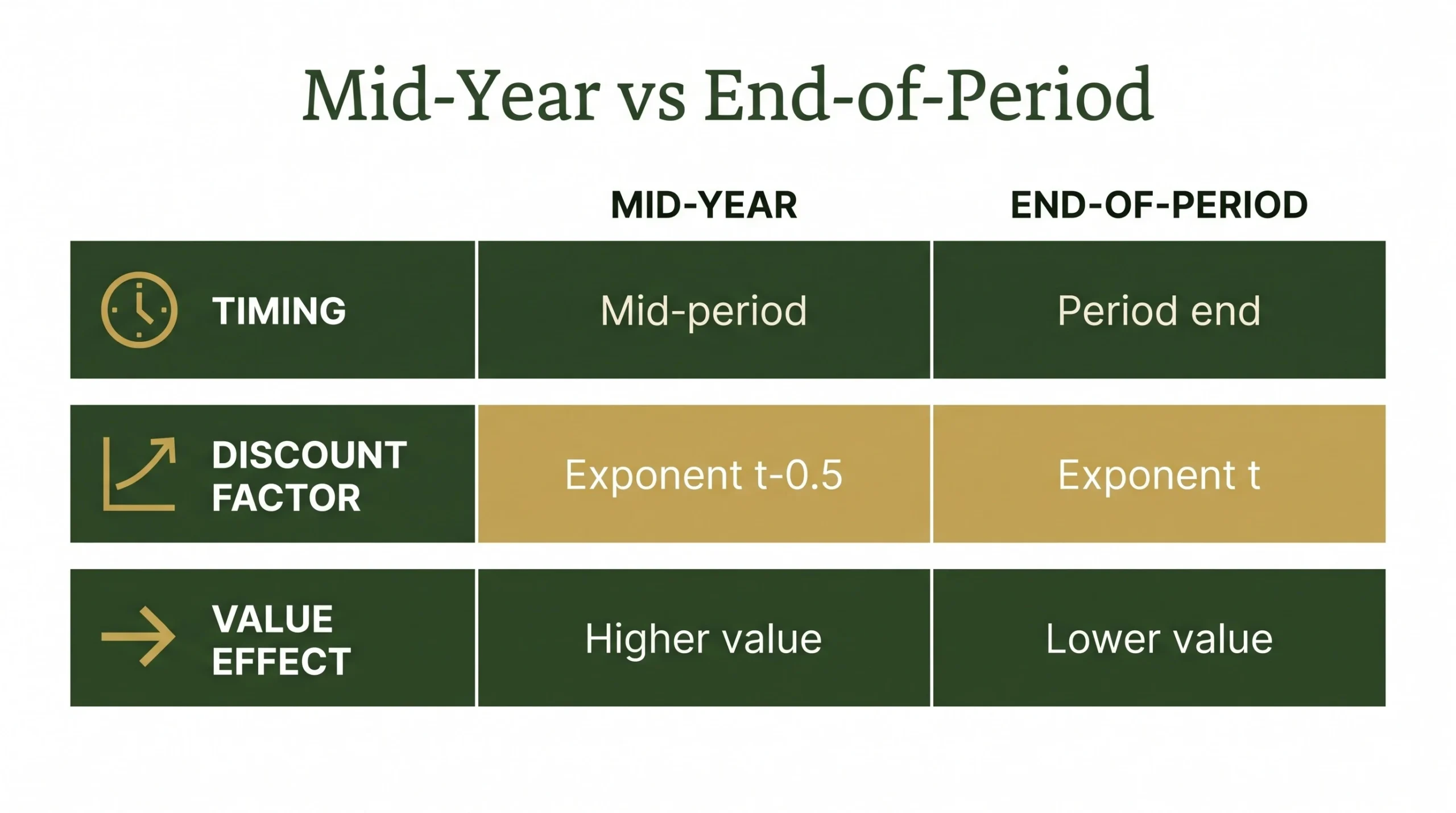
This shift gives a slightly higher present value than the end-of-period guess, since it treats cash as arriving sooner, so the discount has less time to shrink it. This method is common where income flows steadily, and it is one of several discounted cash flow techniques that adjust for timing.
| Feature | Mid-Year Convention | End-of-Period Convention | Sofer Advisors’ Role |
|---|---|---|---|
| Timing assumption | Assumes cash comes in evenly all year, discounting from the middle of each period. | Treats all cash as if it lands on the last day of the period. | Applies the convention that best matches how the subject firm truly earns income. |
| Discount factor | Uses an exponent of t – 0.5, giving PV = CFt / (1 + r)^(t-0.5). | Uses the standard exponent of t, discounting from the period end. | Builds the DCF so the timing choice is applied consistently and documented. |
| Effect on value | Gives a slightly higher present value, since cash is treated as arriving sooner. | Simple, but can overstate the discount, which can lower the value. | Explains these timing points during a valuation, in line with AICPA practice. |
Why is the mid-year convention important for value?
This tool matters because it gives a more real value. The plain year-end rule is too cautious: it assumes all cash shows up on the last day, which pushes back your returns by a full year and can lower your value by mistake.
This shift has a real effect on present value, since a shorter discount time raises it. That higher value helps in M&A talks, fairness opinions, and ASC 820 reporting. Experts use it so the output fits real operations and how a firm earns cash day by day.
The effect grows with the discount rate: a higher rate means the six-month shift saves more value. The lift is modest but real, often near a few percent. In a close deal or a tax dispute, that gap can matter.
How do you calculate the mid-year convention?
To find it, you change your discount factor to use an exponent of t – 0.5 instead of t, which assumes cash comes in the middle of each period. The formula is PV = CFt / (1 + r)^(t-0.5). This works when cash flows steadily all year.
This method often gives a higher present value than the plain rule, since the discount time is six months shorter. Your discount rate itself comes from a WACC analysis that reflects the firm’s cost of capital.
Try a simple example. Say you expect $100 in Year 1 at a 10% discount rate. The plain method finds $100 / (1.10)^1, which is $90.91. The mid-year formula uses $100 / (1.10)^0.5 instead, giving a present value of $95.35.
So the mid-year way values that same $100 higher, and the shorter discount time drives this rise. Your method depends on your deal, industry, and value standard.
When should the mid-year convention be used?
Use this tool for stable firms with even cash flows that come in all year, not by season. It fits SaaS firms and service firms with steady, recurring sales. Here, income arrives in small bits each day, matching how daily work really flows and avoiding a single year-end lump.
Avoid this tool for firms with big seasonal swings, like a store that earns much of its sales in the fourth quarter. A midpoint guess would speed up those returns too much. Firms that wait on milestone payments also fit poorly, since their cash comes in odd, uneven bursts.
The choice also ties to your value standard. The IRS Revenue Ruling 59-60 framework stresses facts a willing buyer would weigh. A timing tool that fits real cash patterns supports that fair market value standard.
What are alternatives to the mid-year convention?
The main other choice is the end-of-period rule, which treats all cash as landing on the last day. This way is simple in theory but often misses the true timing of growth. It cuts complex math, yet can overstate the discount and lower your value.
More detailed models bring more precision. Daily discounting uses 365 periods a year to match cash timing to real dates, cutting the year-end distortion. Analysts weigh ease against precision, and the mid-year tool stays the best balance for non-seasonal firms.
Whatever convention you pick, the standard of care stays high. The Appraisal Foundation sets guidance stressing clear, supported choices. So the pick needs a written reason tied to the facts, which holds up better under review than a default rule.
How does this affect terminal value calculation?
This tool only touches cash in the forecast years. It does not change the terminal value, which is the worth of all cash beyond the forecast. Experts set it at the end of the last year. You can see the mechanics in this terminal value formula guide.
Next, the expert discounts that value back to today using the plain end-of-period factor for that final year. This keeps the terminal value tied to the end date, not a mid-year point. It keeps timing steady and stops math errors in the final value.
| Provider | Focus | Primary Format | Best For |
|---|---|---|---|
| Sofer Advisors | Transactions, financial reporting (ASC 820), and litigation support | Custom Business Valuation & Advisory | Credentialed analysis (CPA, ASA, ABV) |
| breakingintowallstreet.com | Financial Modeling Training | Online courses, videos, and Excel templates | Career development for aspiring finance professionals |
| wallstreetprep.com | Financial Modeling & Certification | Live and online boot-camps, self-study courses | Training for investment banking and corporate finance roles |
One path buys pro analysis; the other teaches you modeling skills. Credentialed analysts with ABV or ASA titles give certified reports that can pass SEC, IRS, or court review. Firms like Sofer Advisors give independent, audit-ready help for hard deals or tax reports, so owners must weigh a certified audit trail against internal skill gains. For reporting work, the choice also links to ASC 820 fair value measurement rules.
What should the valuation review compare?
A strong analysis ties each big call to records and market facts from the valuation date. The points below sum up the core choices.
| Decision area | Evidence and review focus |
|---|---|
| What is the mid-year convention in a DCF | The mid-year convention in a Discounted Cash Flow (DCF) model is an adjustment that assumes cash flows are received evenly throughout the year, meaning they are discounted from the midpoint of each period rather than the end. |
| Why is the mid-year convention important for value | The mid-year convention is important for value because it produces a realistic and accurate valuation by correcting the inherently conservative assumption that all cash flows materialize on the last day of the year. |
| How do you calculate the mid-year convention | To calculate the mid-year convention, you adjust your discount factor by using an exponent of t – 0.5 instead of the standard t. |
The final report should tie these areas together, not treat any method alone. Each timing choice should trace back to a fact about the firm, and that trail makes the value defensible.
Frequently Asked Questions
How to do a mid-year convention?
To use this tool in a DCF, you change the exponent for each cash flow. You move from a full period to a half period. You do this by subtracting zero point five from the time variable. Analysts divide the annual cash flow by the discount rate. They raise that rate to the power of t minus zero point five. Sofer Advisors follows this standard step to sharpen its models.
What is the mid-year assumption?
The mid-year assumption says a firm earns cash evenly all year. It rejects the view that all cash lands on the last day. That view treats yearly income as one lump sum. It sees that sum falling on December thirty-first. Sofer Advisors uses this assumption to reflect daily sales and daily costs. This applies to its private valuation work.
How to calculate mid-year?
Use this formula to find the value. Present value equals the cash flow divided by one plus the discount rate. You raise that to the power of t minus zero point five. You do this for each period. This shift moves every payment ahead by six months. It beats the standard year-end way.
Is DDM or DCF better?
Your choice between these two depends on dividends. The Dividend Discount Model fits firms that pay steady dividends. The Discounted Cash Flow model suits more flexible cases. It works well for private firms that reinvest growth. Those firms do not pay out cash.
What is the main difference between the mid-year and end-of-year convention?
The main gap is the timing of the discount period. The mid-year rule assumes cash comes six months sooner. The end-of-year rule does not. This shift cuts the discount rate’s effect. So it gives you a higher present value.
Which businesses fit the mid-year convention best?
This tool works best for stable firms with even cash flows all year. It fits subscription models, SaaS firms, and B2B service firms with steady, recurring sales. Avoid it for firms with big seasonal swings, like a store that earns most of its sales in the fourth quarter. Firms that wait on milestone payments also fit poorly.
Does the mid-year convention change the terminal value?
No, this tool only touches cash in the forecast years. It does not change the terminal value, which is the worth of all cash beyond the forecast. Experts set the terminal value at the end of the last year. They then discount it back using the plain end-of-period factor, not a mid-year point. This keeps the timing steady.
Is the mid-year convention required by ASC 820?
No, ASC 820 does not force this method. Still, valuation pros widely accept it, and many use it to sharpen DCF models. This tool helps in M&A talks, fairness opinions, and ASC 820 reporting. Sofer Advisors applies it as a best practice so the output fits how a firm truly earns cash day by day.
What does a mid-year convention example show?
Say you expect $100 in Year 1 with a 10% discount rate. The plain year-end method finds $100 divided by 1.10, which is $90.91. The mid-year formula uses the power of t minus zero point five instead, giving $95.35. So the mid-year way values that same $100 higher. The shorter discount time drives this rise.
Related Case Studies
- What is a DCF Valuation? Complete Guide to DCF Method
- What Are the Discounted Cash Flow Techniques? A Guide
- Terminal Value Formula: How to Calculate It in a DCF
Executive Summary
The mid-year convention is a DCF timing tool that discounts each forecast cash flow from the middle of its period rather than the end. It replaces the standard exponent t with t – 0.5, which shortens the discount period by six months and raises present value. On a $100 Year 1 cash flow at a 10% rate, the value rises from $90.91 to $95.35. The tool fits stable firms with even, recurring cash flows and is a poor fit for seasonal or milestone-driven businesses. It does not change how terminal value is discounted. ASC 820 does not require the method, but valuation pros widely accept it as a best practice.
What Should You Do Next?
First, review your DCF model and confirm whether your cash flows arrive evenly across the year. Second, test the mid-year convention against your end-of-year output to see how much it moves your value. Third, document a clear reason for the convention you pick so it holds up under review.
David Hern CPA ABV ASA, founder of Sofer Advisors provides neutral, defensible valuations for businesses that rely on discounted cash flow modeling. Schedule a free consultation to discuss your situation.
People Also Read
- WACC for Business Valuation: Calculation and Application
- ASC 820 Fair Value Measurement: Hierarchy Levels Explained
About the Author
This guide was prepared by David Hern CPA ABV ASAc, founder of Sofer Advisors, a business valuation firm headquartered in Atlanta, GA serving clients across the United States. David holds dual accreditations as an Accredited Senior Appraiser (ASA) and is Accredited in Business Valuation (ABV), credentials recognized by the IRS, SEC, and FINRA. He also holds the Certified Exit Planning Advisor (CEPA) designation. With 15+ years of valuation experience, David has served as an expert witness in 11+ cases across multiple jurisdictions and built Sofer Advisors into an Inc. 5000-recognized firm with 180+ five-star Google reviews. Its full W2 employee team maintains subscriptions to all major valuation databases and operates under a next business day response policy.
For professional business valuation services, visit soferadvisors.com/about-us/ or contact Sofer Advisors at soferadvisors.com/contact-us/.
Disclaimer: This content is for informational purposes only and does not constitute professional valuation advice. Business valuation conclusions depend on specific facts and circumstances. Contact Sofer Advisors for guidance regarding your specific situation.









