


Last Updated: September 2026
A solvency opinion for a dividend recapitalization is an independent opinion that a company will stay solvent right after it borrows to pay a large distribution to its owners. The opinion measures the balance sheet, the cash flow, and the remaining capital of the business at the moment the payout clears. New debt in these deals often reaches several times a company’s yearly earnings, so the timing matters: can the company stand on its own once that weight is added?
The stakes are high because a payout that leaves a company unable to pay its bills can be unwound later. Creditors can challenge it as a voidable transaction, and the directors who approved it can face personal exposure. A clean solvency opinion gives the board a good-faith record that the payout was reasonable when it was made. That is why lenders often require one before they fund the deal.
Sofer Advisors prepares independent solvency opinions for closely held companies, private equity sponsors, and their lenders across the United States. With 180+ five-star Google reviews and expert witness testimony in 11+ cases, the firm applies recognized valuation standards to debt-financed payouts. Founder David Hern holds dual ABV and ASA accreditations recognized by the IRS, SEC, and FINRA.
Key Takeaways
- Three tests decide it: the opinion checks the balance sheet, the ability to pay debts as they come due, and whether the company keeps adequate capital.
- It is not a fairness opinion: it speaks to survival after the payout, not to whether a price is fair, and it is never a guarantee.
- Fraudulent-transfer risk is the driver: a payout that leaves a company insolvent or undercapitalized can be reversed under the UVTA or bankruptcy law.
- Directors carry personal exposure: board members who approve an unlawful distribution can face personal liability and clawback.
- Lenders and boards commission it: both sides want a neutral record of good-faith diligence before the debt closes.
These points shape how a board and its lender approach any debt-financed payout. The sections below cover what the opinion is, when it is needed, and how the three tests work.
What is a solvency opinion for a dividend recapitalization?
A solvency opinion is an independent opinion that a company will still be solvent after it takes on new debt to fund a distribution to its owners. In a recapitalization, the company changes its mix of debt and equity. In a dividend recap, it borrows so it can pay cash to shareholders without selling the business. The opinion looks at the company as it will exist right after the payout clears. An analyst reviews the financial statements, projections, new debt terms, and the size of the payout, then reaches a reasoned conclusion on solvency. A full solvency opinion guide shows how that conclusion is supported.
When do you need a solvency opinion before a leveraged distribution?
You need a solvency opinion when a company borrows to pay owners and the size of that payout could put the business at risk. The clearest triggers are a sponsor-backed dividend recap, a large special dividend, and any payout funded by fresh debt rather than cash on hand. Lenders often make the opinion a condition of funding. Boards ask for one when a payout is large next to the company’s earnings or net worth. A leveraged recapitalization that returns capital to owners is the classic case, because value leaves the company while new debt stays behind.
What are the three solvency tests?
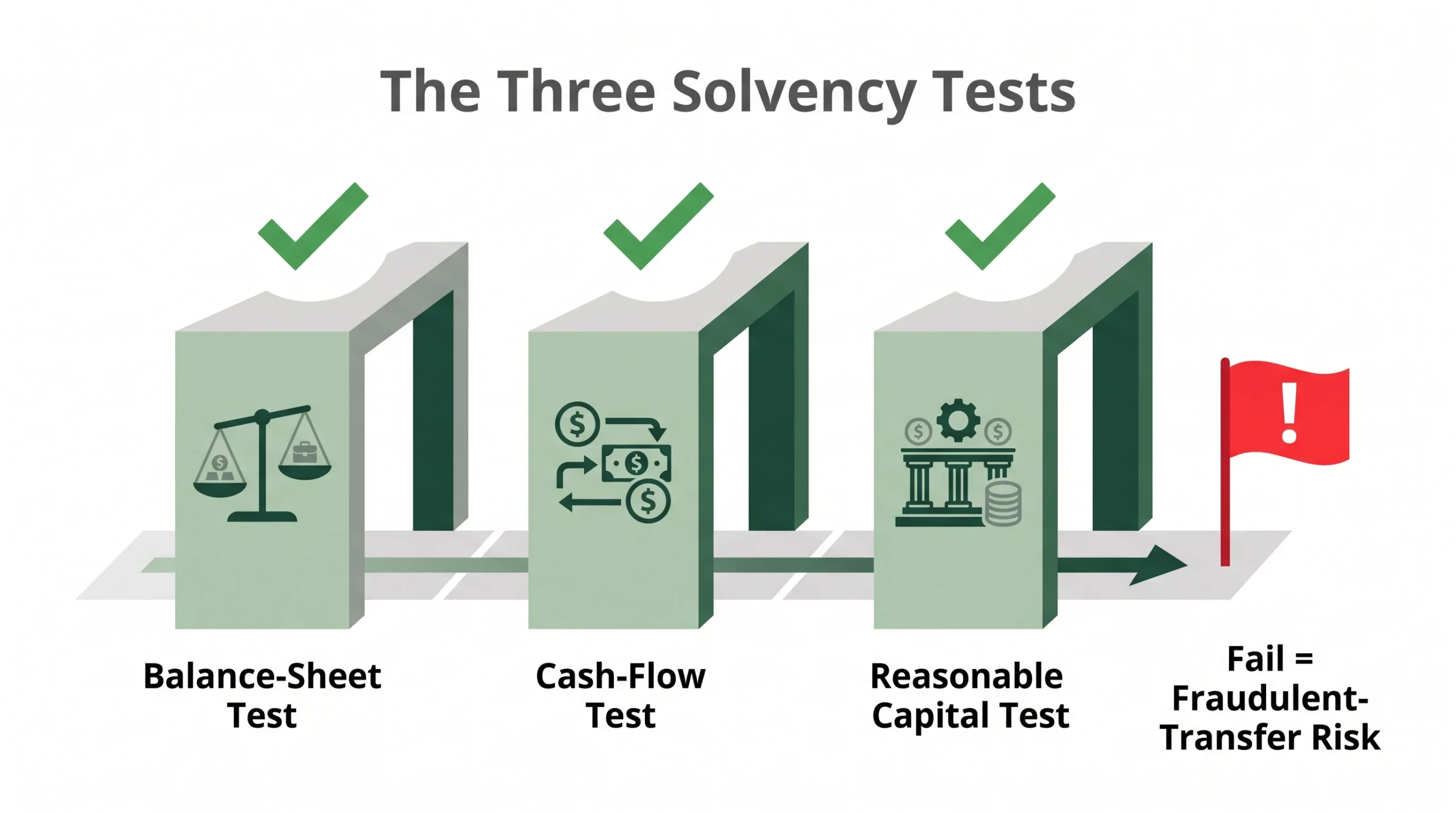
The three solvency tests ask whether the company can survive the payout on its balance sheet, in its cash flow, and in its remaining capital. Each test looks at the business right after the distribution, giving effect to the new debt:
- Balance-sheet test: the fair value, or present fair saleable value, of the company’s assets is greater than its liabilities after the distribution.
- Cash-flow test: the company can pay its debts as they become due in the ordinary course, and it is not left unable to meet maturing obligations.
- Reasonable-capital test: the company is not left with unreasonably small capital for the business it plans to run.
A company must clear all three, not just one. A business might show more assets than liabilities yet still fail the cash-flow test if its cash is tied up and near-term bills cannot be met. Each test uses a mix of appraised values, projections, and stress cases. That is why an independent analyst runs them rather than relying on book figures alone.
How does a dividend recap create fraudulent-transfer risk?
A dividend recap creates fraudulent-transfer risk when the payout leaves the company insolvent or undercapitalized, because a court can treat that distribution as a transfer made for less than fair value. Under the Uniform Voidable Transactions Act, formerly the Uniform Fraudulent Transfer Act, and under bankruptcy law, a creditor can seek to unwind a transfer that harms the company’s ability to pay what it owes. This is usually constructive fraud. It does not require intent to cheat; it turns on whether the company got reasonably equivalent value and was left solvent. You can read the framework in the Uniform Voidable Transactions Act materials and in the Legal Information Institute overview of fraudulent conveyance. Whether a specific payout crosses the line is a legal question for counsel. A solvency opinion supports that review rather than replacing it.
What personal liability do directors face without one?
Directors can face personal liability when they approve a distribution that renders the company insolvent, and in many states the money paid out can be clawed back. Corporate statutes generally bar distributions that leave a company unable to pay its debts. A board that ignores that limit may answer for the shortfall. A solvency opinion helps the board document good-faith diligence. It shows the directors relied on an independent analysis before they voted, which often matters to how a court views their conduct. An independent firm prepares the opinion as a neutral record the board and its counsel can point to later. The opinion does not decide the legal outcome, and it does not stand in for advice from an attorney. It simply gives the board a defensible basis for its judgment.
How is a solvency opinion different from a fairness opinion?
A solvency opinion tests whether a company survives a transaction, while a fairness opinion tests whether the price or terms are fair to a party. The two are often confused, since both appear in deals and both come from independent advisers. But they answer different questions, and neither is a guarantee of any result. A fairness opinion is common in a sale or merger; a solvency opinion is common in a debt-financed payout. The table below sets out the difference.
| Feature | Solvency opinion | Fairness opinion |
| Question answered | Will the company stay solvent after the payout? | Are the price and terms fair to a party? |
| Typical use | Dividend recap or large debt-financed distribution | Merger, sale, or related-party deal |
| Main audience | Board and lenders | Board and shareholders |
| What it is not | Not a fairness opinion and not a guarantee | Not a solvency finding and not a guarantee |
Some deals call for both. A recap that also buys out one group of owners may need a fairness opinion on the buyout price and a solvency opinion on the new debt. Read together, they give the board a fuller picture of the risk it is accepting.
Which firm should provide your solvency opinion?
The firm should be independent, credentialed, and free of any stake in whether the distribution closes. Owners can choose among independent valuation firms, national advisory practices, and investment banks. Large practices such as Alvarez & Marsal, Stout, and Kroll serve the biggest deals. An independent valuation firm focuses on a defensible, standards-based opinion. Work should follow recognized guidance such as the Uniform Standards of Professional Appraisal Practice, so the conclusion holds up if it is ever questioned. That independence sits at the center of The Sofer Difference, a four-step process of Discovery, Diligence, Analysis, and Delivery. A Heart of a Teacher approach means the team explains each test in plain terms, so the board understands what it is signing. This is part of the firm’s transaction advisory work.
Frequently Asked Questions
What is a solvency opinion for a dividend recapitalization?
It is an independent opinion that a company will still be solvent right after it borrows to pay a distribution to its owners. The analyst measures the business as it will exist the moment the payout clears, giving effect to the new debt. The opinion reviews financial statements, projections, and the deal terms, then states a reasoned conclusion on solvency for the board and the lender.
When is a solvency opinion needed before a leveraged distribution?
It is needed when a company borrows to pay owners and the payout is large enough to put the business at risk. Common triggers include a sponsor dividend recap, a big special dividend, and any distribution funded by new debt. Lenders often make it a condition of funding, and boards request one when the payout is large relative to earnings or net worth.
What are the three solvency tests?
The three tests are the balance-sheet test, the cash-flow test, and the reasonable-capital test. The first asks whether assets exceed liabilities after the payout. The second asks whether the company can pay its debts as they come due. The third asks whether the company is left with adequate capital for its business. A company must clear all three, measured immediately after the distribution.
How does a dividend recap create fraudulent-transfer risk?
The risk arises when the payout leaves the company insolvent or with too little capital, because a court can treat that distribution as a transfer for less than fair value. Under the Uniform Voidable Transactions Act or bankruptcy law, a creditor can seek to unwind it. This is usually constructive fraud, which turns on value and solvency rather than intent. Whether a payout crosses that line is a question for legal counsel.
What director liability does a leveraged distribution create without a solvency opinion?
Directors who approve a distribution that renders the company insolvent can face personal liability, and the money paid out may be clawed back. Most corporate statutes bar distributions that leave a company unable to pay its debts. Without an independent opinion, the board has less to show it acted in good faith. The opinion documents that diligence, though the legal outcome remains for counsel.
Is a solvency opinion the same as a fairness opinion?
No. A solvency opinion asks whether the company survives the transaction, while a fairness opinion asks whether the price or terms are fair to a party. Both come from independent advisers, but they answer different questions. A dividend recap usually calls for a solvency opinion; a sale or merger calls for a fairness opinion. Neither is a guarantee of any result.
Who requests a solvency opinion, the lender or the board?
Both often do, for different reasons. The lender wants comfort that its borrower will stay solvent, so the loan is not later challenged as a voidable transaction. The board wants a good-faith record before it approves the payout. Because their interests overlap, one independent opinion can serve both, provided the analyst stays neutral.
How long does a solvency opinion take?
A solvency opinion generally takes four to eight weeks, depending on the size of the deal and how ready the records are. The timeline covers gathering data, stressing projections, applying the three tests, and delivering a written opinion. A rush timeline is sometimes possible when a closing date is fixed, though it can raise the cost.
How much does a solvency opinion for a dividend recap cost?
A fairness or solvency opinion from Sofer Advisors typically runs $15,000 to $40,000 and takes four to eight weeks, with larger or more complex distributions reaching the higher end. Cost depends on the size of the debt, the number of entities, and how much projection work the tests require. For a quote tied to your deal, contact the team with your financials and the proposed distribution.
Related Case Studies
- Fairness Opinion in M&A: What Business Owners and Boards Need to Know
- Business Valuation for a Partner Buyout: Complete Transition Guide
- Management Buyout Process: Steps, Financing and Valuation
Executive Summary
A solvency opinion is an independent opinion that a company will stay solvent right after it borrows to fund a dividend recapitalization or a large special distribution. It applies three tests: assets exceed liabilities, the company can pay its debts as they come due, and it keeps adequate capital. A payout that fails these tests can be attacked as a fraudulent transfer under the UVTA or bankruptcy law, and the directors who approved it can face personal liability and clawback. The opinion is not a fairness opinion and not a guarantee; it documents good-faith diligence. A fairness or solvency opinion from Sofer Advisors runs $15,000 to $40,000 over four to eight weeks.
What Should You Do Next?
Start by sizing the payout against the company’s earnings and net worth, then map the new debt terms and covenants. Next, gather three years of financial statements, current projections, and the draft distribution and loan documents so an analyst can run the three tests. Then bring in independent counsel and an independent valuation firm before the board votes, so the diligence record is built while there is still time to adjust the deal.
David Hern CPA ABV ASA, founder of Sofer Advisors, prepares independent solvency opinions for boards, sponsors, and lenders. Schedule a consultation to discuss your distribution.
People Also Read
- What Is a Leveraged Buyout? LBO Structure Explained
- How Does Seller Financing Work in a Business Sale?
About the Author
This guide was prepared by David Hern CPA ABV ASA, founder of Sofer Advisors, a business valuation firm headquartered in Atlanta, GA serving clients across the United States. David holds dual accreditations as an Accredited Senior Appraiser (ASA) and is Accredited in Business Valuation (ABV), credentials recognized by the IRS, SEC, and FINRA. He also holds the Certified Exit Planning Advisor (CEPA) designation. With 15+ years of valuation experience, David has served as an expert witness in 11+ cases across multiple jurisdictions and built Sofer Advisors into an Inc. 5000-recognized firm with 180+ five-star Google reviews. Its full W2 employee team maintains subscriptions to all major valuation databases and operates under a next business day response policy.
For professional business valuation services, visit soferadvisors.com/about-us/ or contact Sofer Advisors at soferadvisors.com/contact-us/.
Disclaimer: This content is for informational purposes only and does not constitute professional valuation advice. Business valuation conclusions depend on specific facts and circumstances. Contact Sofer Advisors for guidance regarding your specific situation.









