


Last Updated: April 2026
Seller financing in a business sale is a transaction structure in which the business owner accepts a portion of the purchase price as a promissory note from the buyer rather than receiving all proceeds at closing. Instead of the buyer securing third-party bank financing for the full purchase price, the seller defers a portion of the payment over a defined term, typically three to seven years, at an agreed-upon interest rate, and receives principal and interest payments directly from the buyer during that period. Seller financing is common in middle-market and small business transactions, particularly when buyers cannot qualify for full conventional financing, when the business is goodwill-heavy with limited tangible collateral, or when the seller wants to signal confidence in the business’s continued performance to close a deal that might otherwise stall.
For business owners considering a seller-financed sale, the transaction structure fundamentally changes how the business must be valued and documented. Sofer Advisors, a nationally recognized business valuation firm headquartered in Atlanta, GA, provides independent business appraisals that establish the defensible fair market value on which a seller note should be based, ensuring the sale price and financing terms hold up to IRS scrutiny, lender review, and potential future dispute resolution.
The decision to offer seller financing is not simply a financing question it is a valuation question. The sale price, the down payment percentage, the interest rate, and the note term all interact to determine the seller’s effective yield on the deferred proceeds, and a miscalculated business value can leave significant money on the table or expose the seller to default risk if the buyer overpays for a business that cannot service the note.
Key Takeaways
- Deferred Payment Structure: Seller financing allows buyers to pay a portion of the purchase price over time via a promissory note, with the seller acting as the lender and receiving principal and interest payments over a defined term.
- Middle-Market Prevalence: Seller financing is most common in transactions under $10 million, particularly for service businesses, professional practices, and goodwill-heavy companies where conventional lenders require significant tangible collateral.
- Typical Terms: Seller notes typically cover 10% to 30% of the total purchase price, carry interest rates of 6% to 9%, and have terms of three to seven years, though each deal is negotiated individually based on buyer creditworthiness and deal structure.
- Valuation Dependency: The promissory note amount, interest rate, and repayment schedule all depend on an accurate, defensible business valuation, an overpriced business increases default risk; an underpriced one directly reduces seller proceeds.
- IRS Installment Sale Rules: Seller-financed transactions are governed by IRC §453, which allows sellers to defer capital gains recognition proportionally as payments are received, but also requires the seller note’s interest rate to meet or exceed the IRS Applicable Federal Rate (AFR).
Understanding how each of these elements is structured and documented before signing a letter of intent is essential for sellers who want to maximize net proceeds while managing the risks of extended payment terms. The sections below examine each component in detail.
How Does Seller Financing Work?
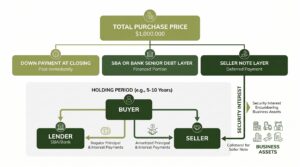
Seller financing works by splitting the purchase price of a business into two components: a down payment paid at closing and a seller note representing the deferred balance. The seller, rather than requiring the buyer to secure financing from a bank for the entire purchase price, agrees to accept a legally binding promissory note that obligates the buyer to make regular payments of principal and interest until the note is paid in full. The seller essentially becomes the buyer’s lender, retaining a security interest in the business assets or ownership interest as collateral for the note.
At closing, the buyer pays the agreed down payment, typically 20% to 40% of the purchase price depending on deal structure and the involvement of SBA or conventional debt. The seller signs over ownership, the buyer takes control of operations, and the seller note goes into effect. Monthly or quarterly payments then flow from the buyer to the seller over the note term. If the buyer defaults, the seller’s security interest allows them to pursue remedies including re-taking ownership of the business, though enforcement is significantly more complex and costly than initially receiving full payment at closing.
What Are the Typical Terms in Seller Financing?
The terms of a seller-financed business sale are negotiated between buyer and seller, but market conventions exist that guide most transactions. Interest rates, note duration, down payment percentage, and security provisions all vary based on the buyer’s financial strength, the business’s cash flow, the presence of other financing layers (such as SBA debt), and the seller’s risk tolerance. According to BizBuySell‘s Insight Report (2024), approximately 70% of small business transactions under $5 million involve some form of seller financing, confirming it is the norm rather than the exception at this transaction size.
The typical structure of a seller note in a small to middle-market business sale:
- Note amount: 10% to 30% of the total purchase price; higher when SBA financing is involved since SBA 7(a) lenders frequently require a seller note as a condition of loan approval.
- Interest rate: 6% to 9% annually in current market conditions, with the rate required to meet or exceed the IRS Applicable Federal Rate (AFR) to avoid imputed interest treatment; rates are typically fixed over the term.
- Term: Three to seven years is most common; longer terms reduce monthly payment burden on the buyer but extend the seller’s credit risk period.
- Amortization: Most seller notes fully amortize over the term, though balloon payment structures (lower payments with a lump sum due at maturity) are used when the buyer plans to refinance.
- Security: The seller retains a security interest in the business assets or the buyer’s ownership stake, typically subordinated to any senior SBA or bank debt in priority.
- Standstill provisions: In SBA transactions, the seller note is typically on full standstill (no principal or interest payments) for the first 24 months, which directly affects the seller’s near-term cash flow.
| Seller Note | SBA 7(a) Loan | Conventional Bank Loan | |
|---|---|---|---|
| Lender | Business seller | SBA-approved bank (SBA guarantee) | Commercial bank |
| Typical rate (2026) | 6% to 9% fixed | Prime + 2.75% (variable) | Prime + 1% to 3% (variable or fixed) |
| Maximum term | 3 to 7 years | 10 years (business acquisition) | 5 to 7 years |
| Collateral required | Security interest in business assets/equity | All available business and personal assets | Business assets; personal guarantee typically required |
| Approval speed | Immediate (negotiated at closing) | 60 to 90 days | 30 to 60 days |
| Best use | Bridging gap in buyer financing; signaling seller confidence | Acquisitions under $5M with limited collateral | Strong-credit buyers; asset-heavy businesses |
What Are the Benefits of Seller Financing?
Seller financing offers meaningful benefits for both parties that can make deals succeed where all-cash or conventional-only structures would fail. For sellers, the primary benefits are a higher achievable sale price, a tax deferral opportunity under installment sale treatment, and an interest income stream that generates returns well above most passive investment alternatives. For buyers, the primary benefit is access to acquisition financing that they might not qualify for from a bank, particularly for service-based or professional businesses where tangible collateral is limited.
For sellers specifically, offering financing often commands a sale price premium of 5% to 15% above what a comparable all-cash buyer would offer, because the seller is absorbing financing risk that the buyer’s bank would otherwise price into its credit decision. The interest income earned on the note, typically at 6% to 9%, also represents a meaningful yield on a deferred payment that would otherwise be sitting in a checking account. According to the IRS (2024), installment sale treatment under IRC §453 allows sellers to recognize capital gains proportionally as principal payments are received rather than in a single lump sum at closing, which can prevent the entire gain from being pushed into the highest marginal rate in the year of sale.
Schedule your free consultation with Sofer Advisors to understand how an independent business appraisal establishes the fair market value that anchors a seller-financed deal, protects your sale price, and supports IRS installment sale documentation. Discover The Sofer Difference.
What Are the Risks of Seller Financing?
The primary risk in seller financing is buyer default: if the buyer cannot operate the business successfully enough to generate the cash flow needed to service the seller note, the seller faces missed payments, a protracted collections process, and the possibility of re-acquiring a business that has declined in value under new management. Unlike a bank loan where the institutional lender absorbs default risk, in seller financing the seller bears that risk directly. A quality of earnings report completed during due diligence helps assess whether the buyer’s projections for operating the business are realistic, but the seller ultimately relies on the buyer’s judgment and execution ability.
The secondary risks are structural: the seller note is typically subordinated to any SBA or bank debt, meaning in a default the senior lender is paid first and the seller’s recovery may be limited. Standstill provisions in SBA transactions prevent the seller from receiving any principal or interest payments during the standstill period, reducing near-term cash flow. And if the interest rate on the note falls below the IRS Applicable Federal Rate, the IRS will impute interest at the AFR regardless of the stated rate, creating a taxable interest income component that the seller did not receive.
Key risk factors sellers should evaluate before offering financing:
- Buyer creditworthiness: Personal financial statements, credit score, industry experience, and prior business ownership history are essential inputs; sellers should apply the same rigor a bank would.
- Business cash flow coverage: The business’s trailing free cash flow should comfortably cover all debt service, including the seller note, with a coverage ratio of at least 1.25x after owner compensation adjustment.
- Collateral quality: The security interest should be perfected and senior to other claims; in SBA deals, senior lender priority means the seller’s collateral may have limited recovery value.
- Standstill provisions: Sellers who need near-term income should model the standstill period cash flow impact before agreeing to SBA note subordination requirements.
Each of these risk factors interacts with the others, and a seller who does not evaluate them systematically before agreeing to financing terms may find that the apparent premium in sale price is offset by default risk that was never priced.
How Is Business Value Established in Seller Financing?
Establishing the right business value is more consequential in a seller-financed deal than in an all-cash transaction because the purchase price directly determines the size of the promissory note the buyer must repay from business operations. If the sale price is too high relative to the business’s actual free cash flow, the buyer will struggle to service the note, increasing default probability. If it is too low, the seller forgoes value that a properly conducted appraisal would have identified. Understanding how to value your business when selling is therefore one of the most important steps a seller takes before structuring any financing offer.
Credentialed valuation firms including Kroll and Stout provide transaction advisory and business valuation services in large-cap seller-financed transactions; for middle-market business owners, Sofer Advisors provides independent business appraisals using the income approach, market approach, and asset approach under IRS and AICPA standards, concluding a fair market value that can withstand IRS examination of the installment sale and buyer challenge if the business underperforms relative to the stated price. According to AICPA Forensic and Valuation Services (2023), seller-financed transactions that lack an independent, qualified appraisal are more vulnerable to IRS price reallocation challenges under IRC §1060, which governs the allocation of consideration in business sales and can affect the tax treatment of each asset class acquired.
How Should Sellers Negotiate a Seller Note?
Negotiating a seller note requires balancing price maximization against credit risk and cash flow timing. Sellers who approach the note terms as a separate negotiation from the headline price, rather than treating them as mechanical outputs of the purchase agreement, consistently achieve better economic outcomes. The interest rate, term, security provisions, prepayment rights, and default remedies are all negotiable and collectively determine the present value of the deferred consideration.
The most important provisions to address before finalizing a seller note:
- Personal guarantee: Always require the buyer to personally guarantee the note, regardless of whether the acquisition is structured through a holding company; this is the seller’s primary protection against strategic default.
- Security agreement: Perfect a first- or second-lien security interest in all business assets; file a UCC-1 financing statement to put other creditors on notice.
- Prepayment rights: Build in the right to allow the buyer to prepay without penalty, since a buyer who grows the business quickly should be incentivized to retire the note early.
- Default and cure provisions: Define default specifically, require written notice and a reasonable cure period before acceleration, and specify remedies including acceleration of the full balance.
- Subordination terms: If an SBA loan is part of the deal, review the SBA’s subordination and standstill requirements before agreeing to the note structure, since these materially affect when the seller receives payment.
Sellers who negotiate note terms without independent valuation support are effectively setting the size of an unsecured loan based on a price they and the buyer agreed upon, rather than on a defensible, market-supported analysis of what the business is actually worth.
Frequently Asked Questions
What is seller financing in a business sale?
Seller financing in a business sale is when the seller agrees to accept a portion of the purchase price as a promissory note from the buyer rather than receiving full payment at closing. The buyer makes regular principal and interest payments to the former owner over a defined term, typically three to seven years. It is most common in smaller and middle-market transactions where buyers cannot secure full conventional financing, and it allows deals to close that might otherwise be impossible to fund.
What are typical seller financing terms?
In most small to middle-market business sales, seller notes cover 10% to 30% of the total purchase price, carry interest rates of 6% to 9% annually, and have terms of three to seven years. Down payments at closing typically range from 20% to 40%, with SBA or bank debt filling the remainder. The interest rate must meet or exceed the IRS Applicable Federal Rate to avoid imputed interest adjustments, and the note is usually subordinated to any senior SBA or bank debt in the capital structure.
What are the risks of seller financing?
The main risk is buyer default: if the buyer cannot generate sufficient cash flow from operations to service the seller note, the seller faces missed payments and potential re-acquisition of a business that may have declined under new management. Additional risks include subordination to senior debt limiting recovery in default, standstill provisions that delay payments during SBA loan periods, and imputed interest if the stated rate falls below the IRS Applicable Federal Rate. Requiring a personal guarantee from the buyer is the most effective mitigation.
What is a typical seller financing interest rate?
Seller note interest rates in 2026 typically range from 6% to 9% annually for fully amortizing notes. The rate must equal or exceed the IRS Applicable Federal Rate (AFR) for the relevant term, which is published monthly. If the stated rate falls below the AFR, the IRS will impute interest at the AFR, treating the difference as taxable interest income to the seller even if it was not received. Sellers should confirm the current AFR with a tax advisor before finalizing the note rate in any purchase agreement.
How is a seller-financed business sale taxed?
A seller-financed business sale typically qualifies for installment sale treatment under IRC §453, which allows the seller to recognize capital gains proportionally as principal payments are received rather than all in the year of sale. This deferral can meaningfully reduce the seller’s effective tax rate by spreading the gain over multiple tax years. The seller must also report interest income received on the note each year. Asset allocation in the purchase agreement determines the character of the gain (ordinary income versus capital gains) for each class of assets sold.
Can a seller note be used with an SBA loan?
Yes. SBA 7(a) loans frequently require a seller note as a condition of approval, particularly when the business lacks sufficient tangible collateral for the full loan amount. In an SBA deal, the seller note is typically placed on full standstill for 24 months, meaning no principal or interest payments are made to the seller during that period. After the standstill, the seller note resumes payments but remains subordinated to the SBA loan in priority. Sellers should model the standstill cash flow impact carefully before agreeing to SBA note terms.
Do I need a business appraisal for a seller-financed sale?
An independent business appraisal is strongly recommended for any seller-financed transaction. The appraisal establishes the defensible fair market value that anchors the sale price and the promissory note amount, supports the IRS installment sale documentation, and helps the seller evaluate whether the buyer’s proposed price reflects the actual business value. Without an independent appraisal, the sale price is effectively set by negotiation alone, which can expose the seller to IRS price reallocation challenges under IRC §1060 and to default risk if the price exceeds what the business can reasonably support.
How do I protect myself as a seller in a seller-financed deal?
The most effective protections in a seller-financed transaction are a personal guarantee from the buyer, a perfected security interest in all business assets filed via UCC-1, a clear default and cure provision in the note agreement, and an independent business appraisal establishing that the sale price is grounded in fair market value. Working with a business attorney to draft the promissory note and security agreement is essential; a generic template does not adequately address the specific collateral, subordination, and enforcement issues that arise in a business sale.
How much does a business appraisal for a seller-financed sale from Sofer Advisors cost?
A business appraisal for a seller-financed transaction from Sofer Advisors typically ranges from $7,500 to $25,000 depending on the company’s revenue, industry, and the documentation required to support the installment sale filing under IRC §453. Engagements are generally completed in four to eight weeks from document receipt. For a fee estimate based on your transaction specifics, contact Sofer Advisors.
Related Case Studies
- Deferred Compensation Dispute: Precise Valuation Changed the Outcome
- Valuation Timing: Why the Right Date Changes Everything
- Divorce Business Valuation: Resolving Conflict Through Expert Analysis
Executive Summary
Seller financing is a business sale structure in which the seller accepts a promissory note from the buyer for a portion of the purchase price, typically 10% to 30%, with principal and interest payments made over three to seven years. It is common in transactions under $10 million where conventional financing is insufficient, and it can enable deals that would otherwise fail to close. For sellers, the benefits include a price premium, tax deferral under IRC §453 installment sale rules, and an interest income stream. The primary risk is buyer default, which requires careful evaluation of buyer creditworthiness, note security provisions, and the business’s free cash flow coverage of all debt service. Sofer Advisors provides independent business appraisals that establish the defensible fair market value needed to anchor a seller note, support IRS installment sale documentation, and protect the seller’s economic outcome in a financed transaction.
What Should You Do Next?
If you are planning to sell your business and considering offering seller financing, an independent business appraisal before negotiating terms gives you the market-supported value that anchors the note, demonstrates the business’s worth to the buyer, and meets IRS documentation requirements. David Hern CPA ABV ASA, founder of Sofer Advisors, and his team of 14 credentialed valuation professionals provide independent business appraisals that support seller-financed transactions, installment sale filings, and purchase price negotiations for middle-market business owners across all industries. Schedule your free consultation to understand what your business is worth and how a qualified appraisal strengthens your position in a seller-financed sale.
People Also Read
- How to Value Your Business When Selling: Complete Guide
- Quality of Earnings Report: What Buyers Discover Before a Sale
About the Author
This guide was prepared by David Hern CPA ABV ASA, founder of Sofer Advisors – a business valuation firm headquartered in Atlanta, GA serving clients across the United States. David holds dual accreditations as an Accredited Senior Appraiser (ASA) and is Accredited in Business Valuation (ABV), credentials recognized by the IRS, SEC, and FINRA. He also holds the Certified Exit Planning Advisor (CEPA) designation. With 15+ years of valuation experience, David has served as an expert witness in 11+ cases across multiple jurisdictions and built Sofer Advisors into an Inc. 5000-recognized firm with 180+ five-star Google reviews. The firm’s full W2 employee team maintains subscriptions to all major valuation databases and operates under a next business day response policy.
For professional business valuation services, visit soferadvisors.com or schedule a consultation.
This content is for informational purposes only and does not constitute professional valuation advice. Business valuation conclusions depend on specific facts and circumstances. Contact Sofer Advisors for guidance regarding your specific situation.