


Last Updated: April 2026
A management buyout (MBO) is a transaction in which the existing management team purchases the company from its current owner using personal equity, seller financing, and third-party debt. The team acquires both ownership and operational control, assuming the debt obligations necessary to fund the purchase. According to the AICPA (2023), MBOs are most common when an owner is ready to exit but wants to preserve continuity under known leadership rather than sell to an outside buyer.
At Sofer Advisors, we provide independent business valuations for management buyouts, including the fair market value opinion lenders and sellers require to confirm the transaction price is supportable. Accurate valuation protects both sides and prevents the pricing disputes that stall closings.
Management teams evaluating an MBO need to understand the transaction structure, financing layers, valuation method, and lender documentation requirements. The sections below walk through each stage in the order buyers and their advisors follow.
Key Takeaways
- Definition – a management buyout is a transaction in which the incumbent management team purchases the business from its owner using personal equity, bank debt, and often a seller note.
- Financing Structure – MBOs combine management equity (10-30% of purchase price), senior bank debt (3x-5x normalized EBITDA), and seller financing or mezzanine capital to cover the balance.
- Valuation Role – an independent fair market value appraisal anchors the purchase price, satisfies lender requirements, and protects management from overpaying and sellers from accepting below-market value.
- Timeline – most MBO transactions take six to twelve months from initial discussions to closing depending on financing complexity and due diligence scope.
- Primary Risk – over-leverage is the most studied MBO failure mode; lenders require 1.25x to 1.5x debt service coverage to limit the risk of covenant violations during a performance downturn.
Each of these components determines whether the transaction closes at a price both parties accept and lenders will fund. The sections below examine each in detail.
What Is a Management Buyout?
A management buyout is a transaction in which the incumbent management team acquires ownership of the business they currently operate, replacing the selling owner or shareholder group. The team provides a portion of the equity themselves and funds the remainder through senior bank debt, seller financing, or mezzanine capital. MBOs preserve operational continuity because the people running the business before the transaction continue to run it after closing.
MBOs contrast with external acquisitions because the buyer already has inside knowledge of the business. Management knows the customer relationships, vendor terms, and operational vulnerabilities, which reduces due diligence risk and makes lenders more willing to underwrite. According to the AICPA (2023), fair value for MBO transactions must reflect a market-participant perspective, not the management team’s internal assumptions about future performance.
How Is an MBO Typically Financed?
MBO financing combines multiple capital sources because no single lender provides 100 percent of the purchase price. Management equity provides the first layer, demonstrating financial commitment to lenders. Senior bank debt provides the largest portion, sized against normalized EBITDA. Seller financing and mezzanine capital fill the gap when the equity and senior layers fall short of the total required purchase price.
The four standard components are:
- Management Equity – management contributes 10 to 30 percent of the purchase price from personal savings or loans against personal assets, demonstrating financial commitment to lenders
- Senior Bank Debt – the largest layer, typically 3x to 5x normalized EBITDA, provided by commercial banks or unitranche lenders with the lowest interest rate and the most restrictive covenants
- Seller Financing – the owner carries a subordinated note, typically 10 to 20 percent of total proceeds, bridging the gap between senior debt capacity and the total required purchase price
- Mezzanine Capital – subordinated debt or preferred equity provided by specialty lenders above senior bank limits, priced at 12 to 18 percent to reflect higher risk
According to the Pepperdine Private Capital Markets Report (2024), lower middle market MBOs typically close with 3x to 5x debt-to-EBITDA ratios, with the specific multiple driven by industry, cash flow predictability, and customer concentration. A management team that can demonstrate two to three years of stable EBITDA and low customer concentration will attract better senior debt terms than one relying on projected growth. Sellers who include a seller note alongside the senior facility typically see higher total proceeds because the deal becomes easier to finance and lender resistance to the proposed capital structure decreases.
What Steps Does an MBO Follow?
An MBO follows a structured sequence from initial management interest through financing, due diligence, and legal closing. The steps parallel a third-party acquisition but differ in who leads each phase: the management team’s inside knowledge compresses due diligence timelines but creates potential conflicts of interest that both parties must navigate carefully with independent legal and financial advisors throughout the process.
The five stages of a standard management buyout are:
- Letter of Intent – management and the selling owner execute a non-binding LOI setting the proposed purchase price, deal structure, and exclusivity period before formal due diligence begins
- Business Valuation – an independent appraiser issues a fair market value opinion; lenders use it to calibrate debt capacity and the seller uses it to confirm the offer reflects market value
- Financing Commitment – management secures firm debt commitments from senior lenders and arranges any seller note or mezzanine financing needed to complete the capital structure
- Due Diligence – legal, financial, and operational due diligence proceeds, typically including a quality of earnings review, legal title search, and review of material contracts
- Purchase Agreement and Close – the parties execute the definitive purchase agreement, financing closes, ownership transfers, and the selling owner receives proceeds
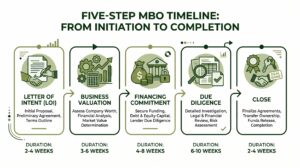
The valuation step in phase two is not a formality. Lenders require an independent appraisal to confirm that the purchase price is supportable by the business’s cash flows at the proposed leverage level. A valuation significantly below the LOI price can trigger a renegotiation or a reduction in the senior debt commitment, affecting the entire capital structure. Management teams that commission a valuation early identify pricing misalignments before they become closing obstacles and avoid the renegotiation risk that surfaces late in the process.
How Is the Business Valued in an MBO?
In an MBO, the business is valued using the same methods applied in a third-party acquisition: the income approach, the market approach, and sometimes the asset approach. The income approach discounts projected cash flows at a market-based rate; the market approach applies comparable transaction multiples to normalized EBITDA. Lenders require an independent appraisal rather than a management-prepared estimate because management has an inherent interest in a lower purchase price.
| Valuation Approach | Method | MBO Application |
|---|---|---|
| Income Approach | Discounted Cash Flow | Primary method; discounts normalized cash flows at WACC |
| Market Approach | EBITDA Multiple | Cross-check using industry comparable transaction multiples |
| Asset Approach | Net Asset Value | Used for asset-heavy businesses; rarely primary in operating companies |
| Seller Note Pricing | Interest Rate Benchmark | Sets rate on seller notes; typically prime plus 1-2% |
| Control Premium | Control Premium Analysis | Applied when less than 100% of equity transfers in the transaction |
National advisory firms such as Stout and Kroll provide independent MBO valuations in institutional-scale transactions. Sofer Advisors delivers the same credentialed standard for private company MBOs, including the written fair market value opinion lenders require to close. The income approach carries primary weight because the purchase price is directly tied to what the business’s cash flows can support at the proposed debt level. Under IRS Revenue Ruling 59-60, fair market value assumes a hypothetical willing buyer and seller, not the actual buyer’s optimistic assumptions.
What Are the Risks of an MBO?
Management buyouts carry structural risks that differ from a third-party acquisition because the buyer is also the operating management team during and after closing. Over-leverage is the most common failure mode: a team that borrows too much against actual cash flows faces covenant violations when performance dips. Management bandwidth risk is secondary: the same team running the deal is also running the business, creating execution risk on both fronts.
The four risks most frequently identified in MBO transactions are:
- Over-Leverage Risk – debt service that exceeds operating cash flow forces management to cut investment or seek emergency refinancing; lenders require 1.25x to 1.5x debt service coverage as a covenant floor
- Conflict of Interest – management negotiating their own buyout has inherent conflicts; an independent valuation and separate legal counsel for each side are required to protect both parties
- Key Person Dependency – if the business’s value depends on the selling owner’s relationships or expertise, value will erode after the owner departs unless the dependency is addressed in the deal structure
- Bandwidth and Execution Risk – closing the deal while running the business drains management attention and can cause performance to slip during the transition
Over-leverage is the single most studied cause of MBO failure. A management team that agrees to pay 6x EBITDA when comparable businesses trade at 4x to 5x must grow at an above-historical rate simply to service the debt, leaving no cushion for a demand decline or unexpected cost increase. An independent valuation benchmarking the purchase price against comparable transactions protects management from overpaying and gives lenders the documentary evidence that the price is supportable before they commit capital.
Understanding the financing structure and valuation method before approaching a lender reduces the risk of mispricing the transaction. Teams that commission an independent appraisal early close faster with fewer renegotiations.
Frequently Asked Questions
What is a management buyout in simple terms?
A management buyout is when the team currently running a business buys it from the owner. Instead of selling to an outside buyer, the owner transfers ownership to the people already managing operations. The management team funds the purchase using personal equity, bank debt, and often a seller note where the owner carries part of the price for a period of years. MBOs are common when an owner wants to exit while preserving the business’s existing leadership and culture.
How is an MBO different from an LBO?
An MBO and an LBO are both acquisition structures that use significant debt. The key distinction is who buys: an MBO is led by the company’s existing management team, while an LBO is led by an external private equity buyer. In an MBO, management stays in their roles and gains ownership; in an LBO, the private equity firm typically installs its own operating team and plans to exit within three to seven years.
What happens in a management buyout?
The management team agrees on a purchase price with the selling owner, secures financing, and commissions an independent business valuation. The parties execute a letter of intent, conduct due diligence, and negotiate the definitive purchase agreement. At closing, the lender funds the debt, management contributes its equity, the seller receives proceeds, and ownership transfers. If a seller note is included, the owner receives ongoing payments from the business over a defined period after close.
How long does an MBO process take?
Most management buyouts take six to twelve months from initial discussions to closing. The timeline depends on financing complexity, due diligence scope, and how quickly the parties agree on valuation and deal structure. Simple transactions with clean financials and a cooperative seller close in six to eight months. Complex deals involving multiple financing layers, contested valuation, or regulatory requirements take twelve months or longer.
How much equity does management typically contribute?
Management teams typically contribute 10 to 30 percent of the total purchase price from personal savings, retirement accounts, or loans against personal assets. This equity requirement demonstrates financial commitment to lenders and aligns management’s interests with the business’s long-term performance. Teams below the threshold often bring in a co-investor or negotiate a larger seller note. Without sufficient personal equity at close, lenders may reduce the senior debt commitment or require additional collateral.
What is the role of a business valuation in an MBO?
An independent business valuation establishes the fair market value used to set the purchase price, size the debt, and support the seller’s decision to accept the offer. Lenders require a credentialed appraisal before committing senior debt because it confirms the business’s cash flows support the proposed price at the leverage level requested. The valuation also protects management from overpaying and gives the seller documentation that the price reflects market value, not a discounted insider price.
What is an example of a management buyout?
A common MBO example is a founder ready to retire who wants to preserve the business under known leadership. The operations manager, CFO, and sales director form a buying group, agree on a $12 million purchase price (5x normalized EBITDA), borrow $8 million from a senior lender, contribute $1.5 million of personal equity, and carry a $2.5 million seller note payable over five years. The founder exits at closing, and the management team assumes ownership and operates the business independently.
How much does a business valuation cost for an MBO?
A business valuation supporting a management buyout typically costs $7,500 to $25,000 depending on company size, earnings complexity, the number of valuation methods applied, and whether the engagement requires a formal written opinion for lender or seller use. Engagements involving contested pricing, litigation support, or multiple asset classes sit at the upper end. Turnaround is generally four to eight weeks from receipt of all financial materials. Contact Sofer Advisors to scope your engagement.
Related Case Studies
- Deferred Compensation Dispute: Precise Valuation Changed the Outcome
- Divorce Business Valuation: Resolving Conflict Through Expert Analysis
- Valuation Timing: Why the Right Date Changes Everything
Executive Summary
A management buyout transfers ownership from the selling owner to the incumbent management team using personal equity, bank debt, and often seller financing. The process follows five stages: letter of intent, independent valuation, financing commitment, due diligence, and closing. Valuation anchors the purchase price and the lender’s debt commitment; an independent appraisal protects both parties from pricing disputes that stall closings. Over-leverage is the primary risk, with lenders requiring 1.25x to 1.5x debt service coverage as a standard covenant floor.
What Should You Do Next?
Commission an independent valuation before signing the letter of intent. A credentialed appraisal gives you a defensible purchase price lenders will accept and protects you from overpaying.
David Hern CPA ABV ASA, founder of Sofer Advisors, provides business valuations for management buyouts, partner buyouts, and ownership transitions. Schedule a consultation to discuss the right approach for your transaction.
People Also Read
- ESOP Transaction Process: A Complete Guide for Business Owners
- Business Valuation for Partner Buyout: Complete Transition Guide
About the Author
This guide was prepared by David Hern CPA ABV ASA, founder of Sofer Advisors, a business valuation firm headquartered in Atlanta, GA serving clients across the United States. David holds dual accreditations as an Accredited Senior Appraiser (ASA) and is Accredited in Business Valuation (ABV), credentials recognized by the IRS, SEC, and FINRA. He also holds the Certified Exit Planning Advisor (CEPA) designation. With 15+ years of valuation experience, David has served as an expert witness in 11+ cases across multiple jurisdictions and built Sofer Advisors into an Inc. 5000-recognized firm with 180+ five-star Google reviews. The firm’s full W2 employee team maintains subscriptions to all major valuation databases and operates under a next business day response policy.
For professional business valuation services, visit soferadvisors.com or schedule a consultation.
This content is for informational purposes only and does not constitute professional valuation advice. Business valuation conclusions depend on specific facts and circumstances. Contact Sofer Advisors for guidance regarding your specific situation.