


Last Updated: July 2026
Section 6166 is a provision in the Internal Revenue Code that lets an executor-the person who settles an estate after a death-delay paying the federal estate tax tied to a closely held business for up to 14 years. Once the estate meets the statutory rules, it can spread the tax over that window instead of paying all at once. This tool exists to stop a forced sale of a private company just to cover a single tax bill.
Sofer Advisors advises business owners and their advisors on tax reporting and business valuation. The firm has 180+ five-star Google reviews and has handled 11+ expert witness cases, bringing real rigor to closely held interests.
Owners face a hard balance: an estate needs cash while the company needs long-term health. The first step is to learn if your interest counts as a closely held business under IRS rules, which means a clear look at share counts and how the company runs.
Key Takeaways
- Valuation purpose dictates standards: Tax reporting and audit needs follow strict rules like IRC Section 409A or ASC 805, so the wrong standard can bring audit failures or tax penalties.
- Independence protects the result: Neutral outside experts give strong numbers that hold up before the IRS or private buyers, and credible data removes bias from the price.
- Three standard valuation approaches: Firms judge companies using the income, market, and asset approaches, and the choice depends on how mature the company is. Business Valuation Resources notes that the right logic must match the entity type.
- Timeline and cost estimation: Most jobs take four to twelve weeks, since the size and data of the business drive that span. Sofer Advisors client data shows fees range from $5,000 to $50,000.
- Expert witness adds defense: Valuation records often need defense in court or in tax disputes, where expert testimony backs up the math used to reach a value.
What Are Key Section 6166 Eligibility Requirements?
To qualify, the business interest must top 35% of the adjusted gross estate. The person who died must also have been a U.S. citizen or resident at death. The business must run an active trade, not just hold passive investment assets, a distinction the IRS estate tax rules read strictly.
If the business qualifies, the estate must file the choice on time on IRS Form 706, since a late or missing form voids the election. Because ownership and activity rules are read strictly, many owners get a formal valuation first. A closely held business valuation for estate tax confirms the share of the estate the business holds and gives the executor a defensible number to file behind.
Sofer Advisors helps families check these thresholds before they file, so the estate meets every rule and can join the installment payment program set by law.
This rule lets an estate delay the tax tied to the business for up to five years, during which it pays interest only. After that term, the executor can clear the rest in 10 yearly payments, each covering both principal and interest.
This longer timeline gives real cash relief, since some estates would otherwise face pressure to sell assets fast to pay tax. Spreading the load helps the family keep key business interests, though the business must keep running throughout, a core IRS rule.
What Qualifies as a ‘Closely Held Business’?
A closely held business here can be a sole proprietorship, a partnership, or a corporation. For a partnership, one of two tests must hold: it must have 45 or fewer partners, or the person who died owned 20% or more of the capital interest.
For a corporation, similar tests apply: it qualifies with 45 or fewer shareholders or 20% or more of the voting stock owned by the decedent. These limits keep the delay tied to small, active firms.
Owners often hold partial stakes in several closely held firms, and you may combine these stakes to meet the 35% test-though the decedent must have owned at least 20% of each. This rule stops small stakes from being tossed out, since together they can still make up a large part of the estate.
What Can Trigger an Acceleration of Payments?
Acceleration means the whole balance comes due at once. It happens if the estate misses a required payment by its due date. The IRS keeps strict timelines, so a missed deadline can drop the whole bill on the estate at once.
Other triggers tie to changes in ownership or cash. The IRS ends the delay if 50% or more of the interest is sold or given away, or if 50% or more of the value is pulled from the business. Owners often ask Sofer Advisors to watch these thresholds during the 14-year window.
How Does Section 6166 Compare to Section 303?
These two rules offer different paths to estate tax relief. Section 6166 gives a multi-year payment plan that delays the tax, while Section 303 lets an estate redeem stock on good terms to pay death taxes and costs.
An estate can often use both at once to manage cash flow, raising cash from the business without breaking the payment plan rules. Precise valuation sets the numbers for both, since exact reporting shows the stock redemption does not exceed the allowed tax bill. Where minority stakes are involved, the right valuation discounts such as DLOC and DLOM can further shape the reported value and the tax owed.
Why Is a Business Valuation Crucial for 6166?
A qualified valuation is a must. It proves the business tops the 35% threshold needed to elect Section 6166; without it, an estate has no proof that the business is a large part of total assets. The report sets fair market value at the date of death, and from that value the executor finds the exact tax that can be delayed. A rigorous fair market value analysis for estate tax gives executors a number they can stand behind.
This analysis gives a strong basis for the choice of the IRS audits. An estate that skips a pro report faces more risk, since officials may push back on eligibility. The report is a neutral record of the methods and metrics used to reach the value, ideally built to the standards published by the Appraisal Foundation, showing why the company meets the program’s rules.
The Sofer Difference uses a four-phase process-Discovery, Diligence, Analysis, and Delivery-building each valuation on solid data that holds up to questions. The reports do more than confirm the estate share; they help executors track how future payments hit yearly cash flow, which is key to a smart choice on the election.
A strong estate plan needs precise data that matches your exact tax duties. Sofer Advisors has 180+ five-star Google reviews for clear, honest valuations. Families weighing gift and estate exposure often pair this with an estate planning business valuation to see the full picture before filing.
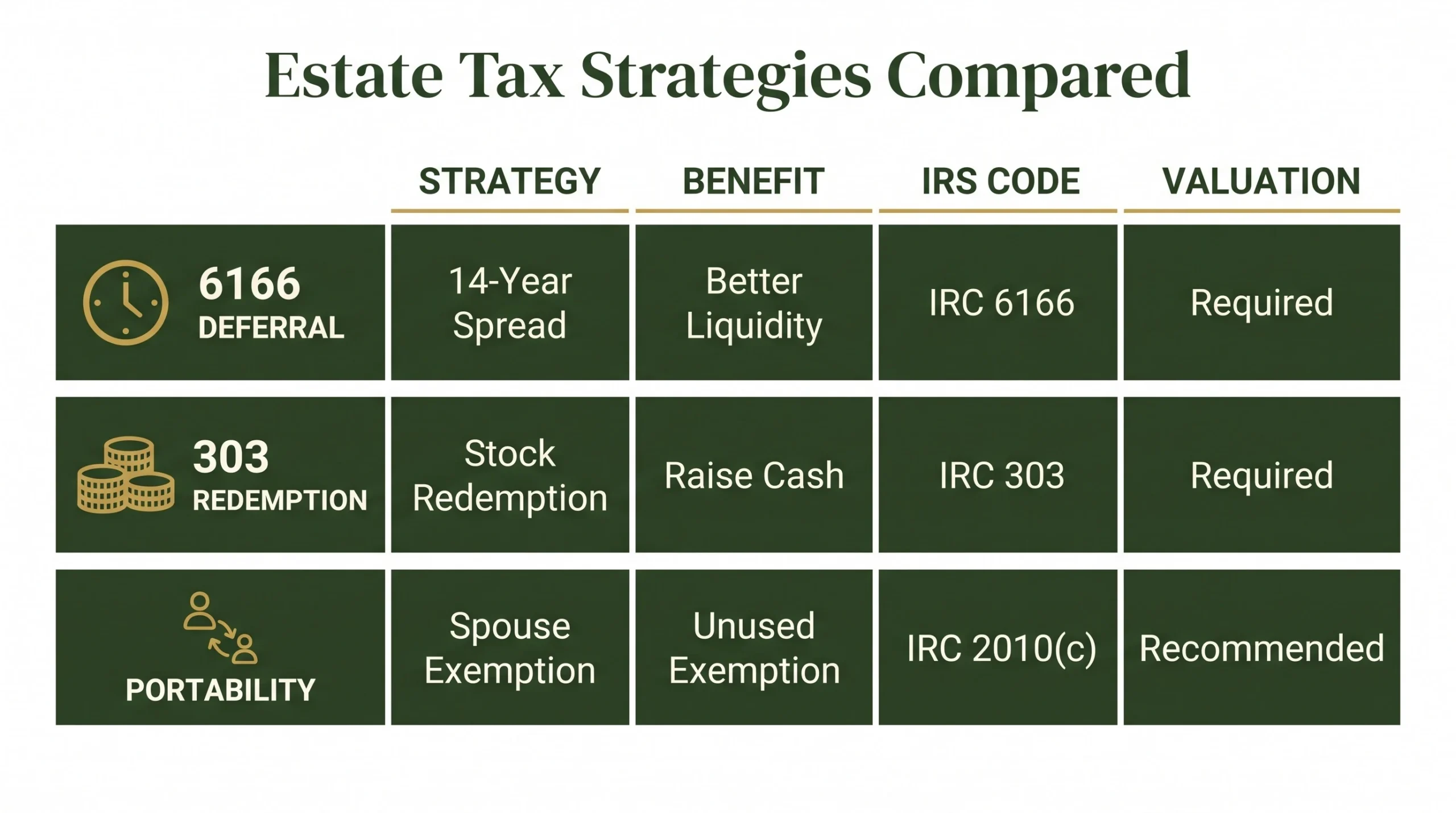
Owners and executors often weigh many tax paths to hold onto cash during a wealth transfer. Each choice brings its own gains, but the record and valuation needs differ by intent. The table below compares common estate tax strategies and their valuation needs.
| Tax Strategy | Primary Benefit | Key IRS Code | Valuation Requirement |
|---|---|---|---|
| Section 6166 Deferral | Spreads estate tax payments over 14 years to improve liquidity | IRC § 6166 | Required to prove business value exceeds 35% of adjusted gross estate |
| Section 303 Redemption | Allows tax-favored stock redemption to raise cash for death taxes | IRC § 303 | Required to establish fair market value for the stock redemption |
| Portability Election | Allows surviving spouse to use deceased spouse’s unused exemption | IRC § 2010(c) | Not required, but recommended to document value of assets |
The choice among these paths takes a clear view of the estate’s mix of assets and its cash needs. For example, an executor may blend strategies when the business is most of the estate value but cash is low.
An objective advisor helps because the data in these filings must hold up under audit. A certified pro keeps you in line with the rules, and Sofer Advisors follows a firm process from discovery to analysis to reach a defensible result. Used wrong, these strategies can bring late payments or lost tax breaks.
What should the valuation review compare?
A strong analysis links each big judgment to records and market proof from the valuation date. The points below sum up the core decision areas.
| Decision area | Evidence and review focus |
|---|---|
| What Are Key Section 6166 Eligibility Requirements | Section 6166 eligibility requires the value of an interest in a closely held business to exceed 35% of the adjusted gross estate. |
| What Qualifies as a ‘Closely Held Business’ | A closely held business under Section 6166 qualifies based on its structure as a sole proprietorship, a partnership, or a corporation. |
| What Can Trigger an Acceleration of Payments | An acceleration of payments occurs if the estate fails to make a required interest or principal payment by its due date. |
The final report should tie these areas together and should not treat any method or input alone.
Frequently Asked Questions
What is Section 6166 payment of estate taxes?
Section 6166 is a rule in the Internal Revenue Code. It lets an executor delay paying federal estate taxes tied to a closely held business. And the rule exists to stop a forced sale of a business just to pay the tax bill when an owner dies. Sofer Advisors helps check the valuation metrics needed to qualify for these payments.
What is the difference between Section 303 and 6166?
Section 6166 gives a multi-year extension to pay taxes. Section 303 offers a way to redeem corporate stock, which raises cash for death taxes without dividend treatment. Many estates coordinate both, since this move boosts cash during the transition period.
What is the purpose of Form 6166?
Form 6166 is a certification letter from the IRS for international tax use. It verifies that a taxpayer is a U.S. resident, and it is not the same as the election form for estate tax delay under Section 6166.
What is the current 6166 interest rate?
The first million dollars of business value gets a special 2% rate on delayed tax. The rest carries a rate equal to 45% of the yearly underpayment rate. Because these rates change with federal law, executors should track current shifts through official Treasury notices. Sofer Advisors keeps updated models to account for these shifting costs over the long payment period.
Can multiple businesses be combined to meet the 35% test?
Yes. Several businesses can be combined. But the estate must own at least 20% of the total value of each business joined. This step helps estates reach the 35% threshold of the adjusted gross estate.
How long can an estate defer estate tax under Section 6166?
An estate can delay this tax for up to 14 years under Section 6166. For the first five years, it pays interest only. After that term, the executor clears the rest in 10 yearly payments, each covering both principal and interest. This longer timeline gives real cash relief and helps a family avoid selling assets fast to pay the tax bill.
What actions can trigger an acceleration of payments?
Acceleration means the whole unpaid balance comes due at once. It happens if the estate misses a required payment by its due date. The IRS also ends the delay if 50% or more of the business interest is sold or given away, or if 50% or more of the value is pulled from the business. Sofer Advisors helps owners watch these thresholds.
What form must the executor file to make the election?
If the business qualifies, the estate must file the election on time using IRS Form 706. A late or missing form voids the election, so the timing matters. Because the IRS reads the ownership and activity rules strictly, many owners get a formal valuation of their interest first. Sofer Advisors helps families check these thresholds before they file.
How many partners or shareholders can a qualifying business have?
For a partnership, one of two tests must hold: it must have 45 or fewer partners, or the person who died owned 20% or more of the capital interest. For a corporation, it qualifies with 45 or fewer shareholders, or the person who died owned 20% or more of the voting stock. These limits keep the delay tied to small, active firms.
Related Case Studies
- Valuation of Closely Held Business for Estate Tax Purposes
- How Family Limited Partnerships Are Valued for Gift and Estate Tax
- Estate Freeze Strategies: How Valuations Lock In Today’s Value
Executive Summary
Section 6166 lets an executor defer federal estate tax on a closely held business over as long as 14 years, easing the pressure to sell a company just to pay a tax bill. The estate qualifies only when the business interest tops 35% of the adjusted gross estate, the decedent was a U.S. citizen or resident, and the firm runs an active trade rather than holding passive assets. The election runs five years of interest-only payments, then ten annual installments of principal and interest. Missing a payment or transferring 50% or more of the interest or value accelerates the entire balance. A qualified, independent valuation is the linchpin: it proves the 35% threshold, fixes fair market value at the date of death, and defends the election under IRS audit. Executors often pair Section 6166 with Section 303 redemptions to manage cash flow across the transition.
What Should You Do Next?
Start by pulling your recent financial statements and organizational documents to confirm whether the business interest clears the 35% threshold. Next, have an independent valuation set fair market value at the date of death so the election rests on defensible numbers. Then coordinate the Form 706 filing with your tax advisor before the deadline to lock in the deferral.
David Hern CPA ABV ASA, founder of Sofer Advisors provides neutral, defensible valuations for closely held business estates. Schedule a free consultation to discuss your situation.
People Also Read
- Stepped-Up Basis at Death: What Business Owners Must Know
- What Is a GRAT and How Does It Transfer Business Value to Heirs?
About the Author
This guide was prepared by David Hern CPA ABV ASAc, founder of Sofer Advisors, a business valuation firm headquartered in Atlanta, GA serving clients across the United States. David holds dual accreditations as an Accredited Senior Appraiser (ASA) and is Accredited in Business Valuation (ABV), credentials recognized by the IRS, SEC, and FINRA. He also holds the Certified Exit Planning Advisor (CEPA) designation. With 15+ years of valuation experience, David has served as an expert witness in 11+ cases across multiple jurisdictions and built Sofer Advisors into an Inc. 5000-recognized firm with 180+ five-star Google reviews. Its full W2 employee team maintains subscriptions to all major valuation databases and operates under a next business day response policy.
For professional business valuation services, visit soferadvisors.com/about-us/ or contact Sofer Advisors at soferadvisors.com/contact-us/.
Disclaimer: This content is for informational purposes only and does not constitute professional valuation advice. Business valuation conclusions depend on specific facts and circumstances. Contact Sofer Advisors for guidance regarding your specific situation.









