


Last Updated: July 2026
The alternate valuation date is an option under Internal Revenue Code (IRC) Section 2032 that lets an executor, the person who settles an estate, value the estate’s assets six months after the date of death rather than on the date of death itself. This election can help when an estate loses value in the six months after a death, though the IRS requires the executor to apply it to every asset, so you cannot pick and choose which items to revalue. Sofer Advisors gives independent valuation help for exactly these choices, turning a narrow statute into a defensible filing position.
Sofer Advisors guides CPAs, attorneys, and executors through these tricky decisions. With 7 years of business experience, the team balances strict federal rules with clear, defensible reports. The firm has earned 180+ five-star Google reviews and has handled 11+ expert witness cases across Georgia, Florida, California, and New Mexico. The team knows that fast, correct appraisals keep estate administration on track.
When an estate passes to heirs, the valuation date matters a lot because it shapes both the estate tax and the basis of the assets, the value used to figure future gains. The right timing needs a close look at the market, tracking how asset values shifted in the six-month window and matching the assets held at death. Early study helps everyone grasp the tax effect before a return is ever filed.
Key Takeaways
- Definition of the Election: Under IRC § 2032, an estate may value assets six months after death, offering a possible change to the total value.
- Goal of Tax Reduction: The main aim is to lower the estate tax when values fall, so it only helps when the market causes a real drop.
- Strict Eligibility Criteria: The IRS allows it only if it lowers both the gross estate and the tax owed, so you cannot use it to shift tax or raise value.
- Disposition Timing Matters: Property sold or given away before six months uses its sale value, so you must track all asset moves during this waiting time.
- Binding Legal Irrevocability: Once an estate picks this date on a timely Form 706, the choice is final, so expert study is key before you file.
The sections below cover each rule in detail to help you plan your filings with care.
What is the Alternate Valuation Date under IRC § 2032?
The alternate valuation date is a tax choice under IRC Section 2032. It lets an executor value estate assets six months after death, and it applies to the whole gross estate, the full value of all assets at death, rather than to just some items. The rule gives tax relief if the estate loses value after the death.
When values fall, the executor may pick this second date to lower the taxable estate, though all assets must still be valued correctly and reported to the IRS. Executors often weigh this choice against the basis that passes to heirs, and Sofer Advisors checks these values against the code. For estates built around a company, that check often overlaps with the valuation of a closely held business for estate tax purposes.
Who can elect the alternate valuation date?
Only the executor or personal representative may pick this date. This step needs a formal mark on IRS Form 706, the United States estate tax return. A fiduciary, a person with a duty to manage the estate, must act within the time the law sets, since a late choice is not valid. The IRS explains the deadlines in its instructions for Form 706.
The election must meet two strict tests. First, the alternate date must lower the gross estate value compared with the date of death value. Second, it must lower the total estate and transfer tax due. If either test fails, the election is not valid. Sofer Advisors reviews estate assets under both dates to show the effect on the tax owed and keep the estate in line with federal rules. Getting the fair market value for estate tax that executors need right at each date is what makes the comparison defensible.
How does the disposition rule affect valuations?
The disposition rule sets the value of an asset that leaves the estate. A disposition means the asset is sold, given away, or moved. If this happens within six months of death, you use the sale date value rather than the alternate date value. An asset that stays through the full six months follows the normal alternate date rule.
A disposition happens when ownership moves to another party. A sale to a buyer counts, as does a transfer to a beneficiary, the person who inherits from the estate. Just holding assets does not count. Sofer Advisors helps executors sort these events, and correct sorting stops common errors. Any real transfer ends the alternate window for that asset.
What assets are included in alternate valuation?
What assets are included in alternate valuation? The election applies to all assets in the gross estate. An executor cannot include some assets and leave out others.
Closely held businesses, which have just a few owners, often make up a big part of the estate, and this choice shapes their reported value. The value of the interest can shift with the timing, and any discounts, such as those covered in the guide to valuation discounts (DLOC and DLOM) on estate and gift tax returns, must be applied consistently at whichever date the estate picks. Post-death income is treated differently: income like interest, rent, or dividends earned after death is left out, as IRS tax code guidance explains for executors.
When is alternate valuation not a good strategy?
This choice is a poor fit when asset values rise after death. Because the IRS bars the choice unless it lowers both the gross estate and the tax due, rising values make the alternate date off limits.
This choice also brings a clear trade-off for heirs because it affects the stepped-up basis, which resets an asset’s value for the heir. If the executor uses the date of death value when prices rise, assets get a higher basis, and understanding stepped-up basis at death helps you see why. A higher basis cuts the future capital gains tax heirs owe when they later sell. Estate tax savings now must be weighed against a higher value that often helps heirs more over time. Sofer Advisors studies these factors to show how tax planning shapes the value passed between generations.
Skilled pros can tell if an estate valuation choice fits your case. Discuss your needs with our team, and they will review how tax rules shape your choice.
How is the AVD election made and is it revocable?
You make the alternate valuation date choice on IRS Form 706. Check a box on line 11 of Part 2, the U.S. Estate Tax Return, then attach the needed support and file on time. Once the executor makes this choice on a timely filed return, it is final, even under an extension.
Business owners and executors often lean on detailed appraisals that compare the date of death value against the alternate date value. This work reviews how easy assets are to sell and checks market conditions to confirm the choice meets all IRS rules. Each method uses its own timing and reporting rules.
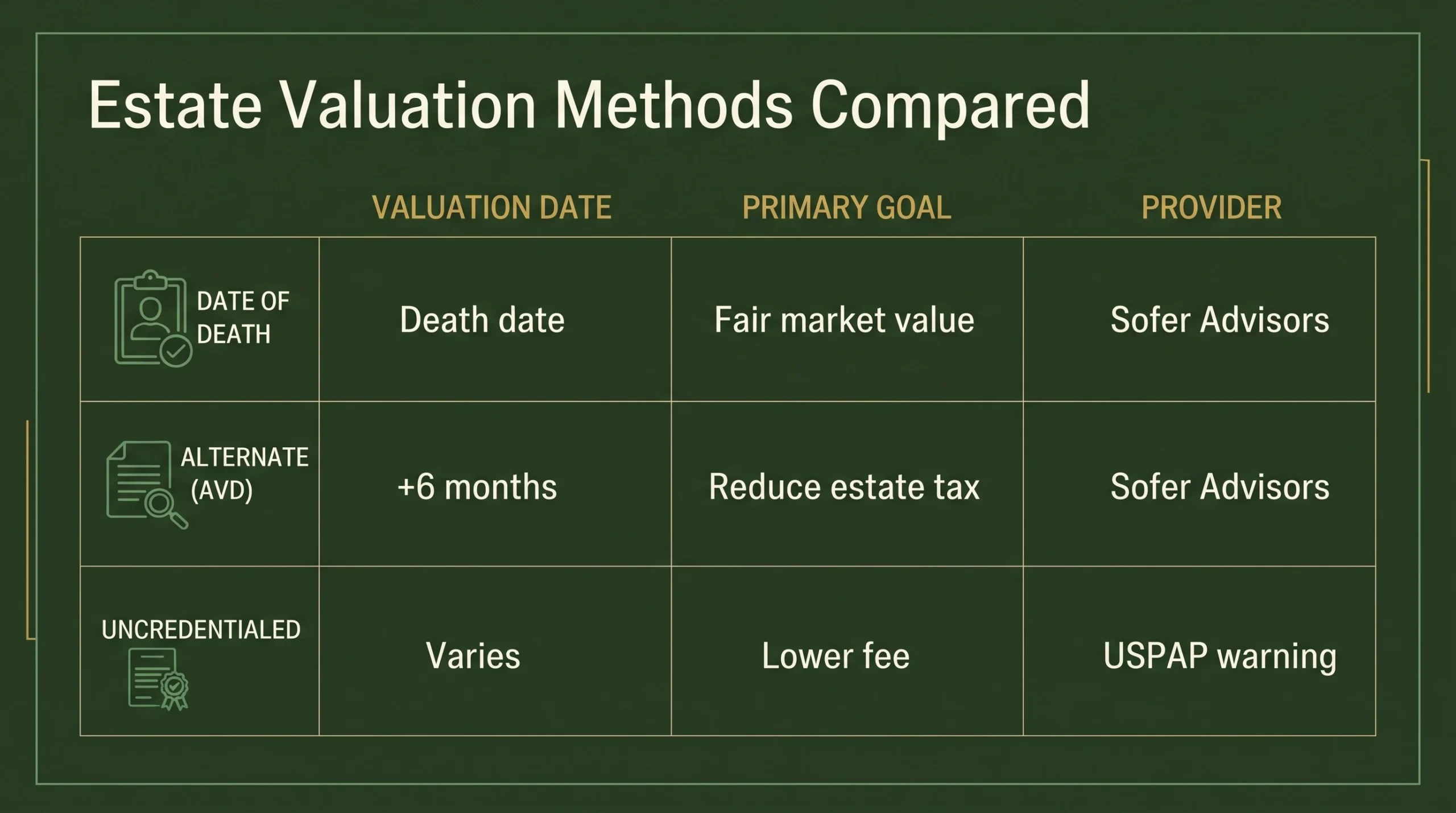
| Valuation Method | Valuation Date | Primary Goal | Service Provider / Resource |
|---|---|---|---|
| Date of Death Valuation | Date of the decedent’s death | Establish fair market value at the moment of death | Sofer Advisors (Internal Revenue Code compliance) |
| Alternate Valuation Date (AVD) | 6 months after death or date of disposition | Reduce estate tax if asset values fall before the tax filing | Sofer Advisors (IRS guidance for Form 706) |
| Uncredentialed Appraiser Valuation | Varies | Provide a valuation number at a lower fee | The Appraisal Foundation (USPAP) warning |
The path you pick shapes two things: the basis for heirs and the total tax for the estate. A Date of Death value gives a standard baseline, while the AVD suits estates with big swings. Uncredentialed values bring risk, and that risk grows if the appraiser skips the professional standards published by The Appraisal Foundation under USPAP or the valuation guidance issued by the AICPA. These filings need exact records to hold up under IRS review.
Pro firms like Stout, Kroll, or Sofer Advisors supply the papers that back the values. Reports that clash often lead to audits, so appraisal quality is a key risk. Owners and advisors should weigh their provider’s skill against court and tax needs, and keep a clear trail for any date they pick.
What should the valuation review compare?
A strong review ties each big call to real records. The points below sum up the article’s core choices.
| Decision area | Evidence and review focus |
|---|---|
| What is the Alternate Valuation Date under IRC § 2032 | The alternate valuation date is a tax election under Internal Revenue Code (IRC) Section 2032 that allows an executor to value estate assets six months after the date of death. |
| Who can elect the alternate valuation date | The executor or personal representative of the decedent’s estate is the only party authorized to elect the alternate valuation date. |
| How does the disposition rule affect valuations | The disposition rule requires an asset to be valued as of its specific date of disposition if the item is sold, distributed, or otherwise disposed of within the six-month period following the date of death. |
The final report should tie these areas together rather than treat any method or input alone.
Frequently Asked Questions
When can you use the alternate valuation date for an estate?
You may use it if the executor files a timely estate tax return. The choice must lower both the gross estate and the total tax owed. And this IRC Section 2032 strategy applies to all assets held at death. Sofer Advisors helps verify these tests to confirm all legal conditions for the choice are met.
Why might an executor choose to use the alternate valuation date?
An executor picks this choice mainly to lower the federal estate tax. It helps when asset values drop in the six months after a death, since moving the date forward may let the estate show lower asset totals for tax.
What is alternate valuation on form 706?
Alternate valuation is a formal choice made on IRS Form 706. It lets an estate value its assets six months after death instead of on the date of death, acting as a report tool for estates with big value shifts. Sofer Advisors gives clear, defensible papers for Form 706 filings, which keeps all values in line with strict federal rules.
What happens if an asset is sold before the alternate valuation date?
If an asset is sold or given away within six months, the estate uses the deal date value. This disposition rule closes the alternate window for that asset, no matter its value at the six-month mark.
Is the alternate valuation date election always beneficial?
The choice rarely helps if assets gain value in the six-month window. That gain would raise the estate tax, and a lower value for tax also limits the basis step-up for heirs.
Who can elect the alternate valuation date?
Only the executor or personal representative of the estate may pick this date. This fiduciary, a person with a duty to manage the estate, must mark the choice on IRS Form 706 within the time the law sets. If the election is made too late, it is not valid. Sofer Advisors helps fiduciaries meet these strict federal timing rules.
Can the alternate valuation date apply to only some estate assets?
No. The election applies to all assets in the gross estate, the full value of everything held at death. An executor cannot revalue some items and leave others at their date of death value. This all-or-nothing rule means you must weigh the effect across the whole estate before you file, since you cannot pick and choose.
How does the alternate valuation date affect the stepped-up basis for heirs?
Using a lower value for estate tax also lowers the stepped-up basis, the reset value an heir receives. A lower basis can raise the future capital gains tax heirs owe when they later sell. So estate tax savings now may cost heirs more later, and Sofer Advisors studies this trade-off to show the value passed between generations.
How is income earned after death treated under alternate valuation?
Post-death income is treated differently from the assets themselves. Income like interest, rent, or dividends earned after death is left out of the alternate valuation. While the value of an interest can shift with the timing, this separate treatment of later income keeps the reported figures in line with IRS tax code guidance for executors.
Related Case Studies
- Fair Market Value for Estate Tax: What Executors Need
- Valuation of Closely Held Business for Estate Tax Purposes
- Stepped-Up Basis at Death: What Business Owners Must Know
Executive Summary
The alternate valuation date under IRC Section 2032 lets an executor value an entire estate six months after death instead of on the date of death, but only when the switch lowers both the gross estate and the estate tax due. The election is made on a timely Form 706, applies to every asset rather than a chosen few, and becomes irrevocable once filed. Assets sold or distributed inside the six-month window are valued at their disposition date, not the six-month mark. Because a lower estate value also lowers the stepped-up basis heirs inherit, the choice can trade estate tax saved today for higher capital gains tax later. Closely held business interests, discounts, and post-death income each need careful, documented treatment to survive IRS review.
What Should You Do Next?
First, gather every financial record and appraisal for each business interest so both the date of death and the six-month values can be modeled side by side. Second, confirm with your tax attorney that the election lowers both the gross estate and the tax due before you commit. Third, file the choice on a timely Form 706 only after the numbers and the basis effect for heirs are fully understood.
David Hern CPA ABV ASA, founder of Sofer Advisors provides neutral, defensible valuations for estates and closely held business interests. Schedule a free consultation to discuss your situation.
People Also Read
- Section 1202 QSBS: Qualifying for the $10M Capital Gains Exclusion
- Section 338(h)(10): Tax Implications for Buyer and Seller
About the Author
This guide was prepared by David Hern CPA ABV ASAc, founder of Sofer Advisors, a business valuation firm headquartered in Atlanta, GA serving clients across the United States. David holds dual accreditations as an Accredited Senior Appraiser (ASA) and is Accredited in Business Valuation (ABV), credentials recognized by the IRS, SEC, and FINRA. He also holds the Certified Exit Planning Advisor (CEPA) designation. With 15+ years of valuation experience, David has served as an expert witness in 11+ cases across multiple jurisdictions and built Sofer Advisors into an Inc. 5000-recognized firm with 180+ five-star Google reviews. Its full W2 employee team maintains subscriptions to all major valuation databases and operates under a next business day response policy.
For professional business valuation services, visit soferadvisors.com/about-us/ or contact Sofer Advisors at soferadvisors.com/contact-us/.
Disclaimer: This content is for informational purposes only and does not constitute professional valuation advice. Business valuation conclusions depend on specific facts and circumstances. Contact Sofer Advisors for guidance regarding your specific situation.









