


Last Updated: August 2026
A normalization adjustment is a change to a company’s financial records that removes owner, one-time, or non-operating items so the numbers show real, ongoing profit. Owner pay is the most common change. Tools that set a fair salary, such as RCReports, draw on more than 100 million wage data points to size it. Sofer Advisors uses these changes to turn tax-basis books into a clean earnings base a buyer or the IRS can trust.
The reason this matters is simple. Value rests on earnings, and earnings multiply. A single $50,000 add-back can move the price by six figures once a market multiple is applied. So each change must be real, backed by records, and easy to defend. Get the recasting right and the number holds up. Get it wrong and the valuation can fall apart.
Key Takeaways
- Definition: Normalization adjustments recast past results to show a company’s true, ongoing earning power for a valuation.
- Four families: The core changes cover owner pay, one-time items, personal costs, and non-operating income or assets.
- Owner pay: Analysts reset the owner’s salary to a market rate, then add back any excess as profit.
- Normalized EBITDA and SDE: Clean earnings feed both, which the income approach and market approach turn into value.
- Defense first: Every add-back needs proof, or it will not survive an IRS review or a buyer’s diligence.
Each change feeds a different part of the value math. The sections below show how the four families work, how they lift or lower earnings, and how the recast number reaches a sound result.
Why recast earnings before a valuation?
Financials are recast to show what a business really earns, not what its tax return reports. Owners often run personal costs through the company that a buyer would never carry. They also book one-time gains and losses that will not repeat. Recasting strips all of that out. What remains is a steady earnings base. Analysts then apply the income approach or the market approach to it. IRS Revenue Ruling 59-60 has framed this work since 1959. It still guides how closely held companies are valued today.
The goal is a fair view of profit, not a flattering one. A tax return is built to lower taxable income; a valuation needs the opposite. When the earnings base is honest, the value built on it is honest too.
What are the four families of adjustments?
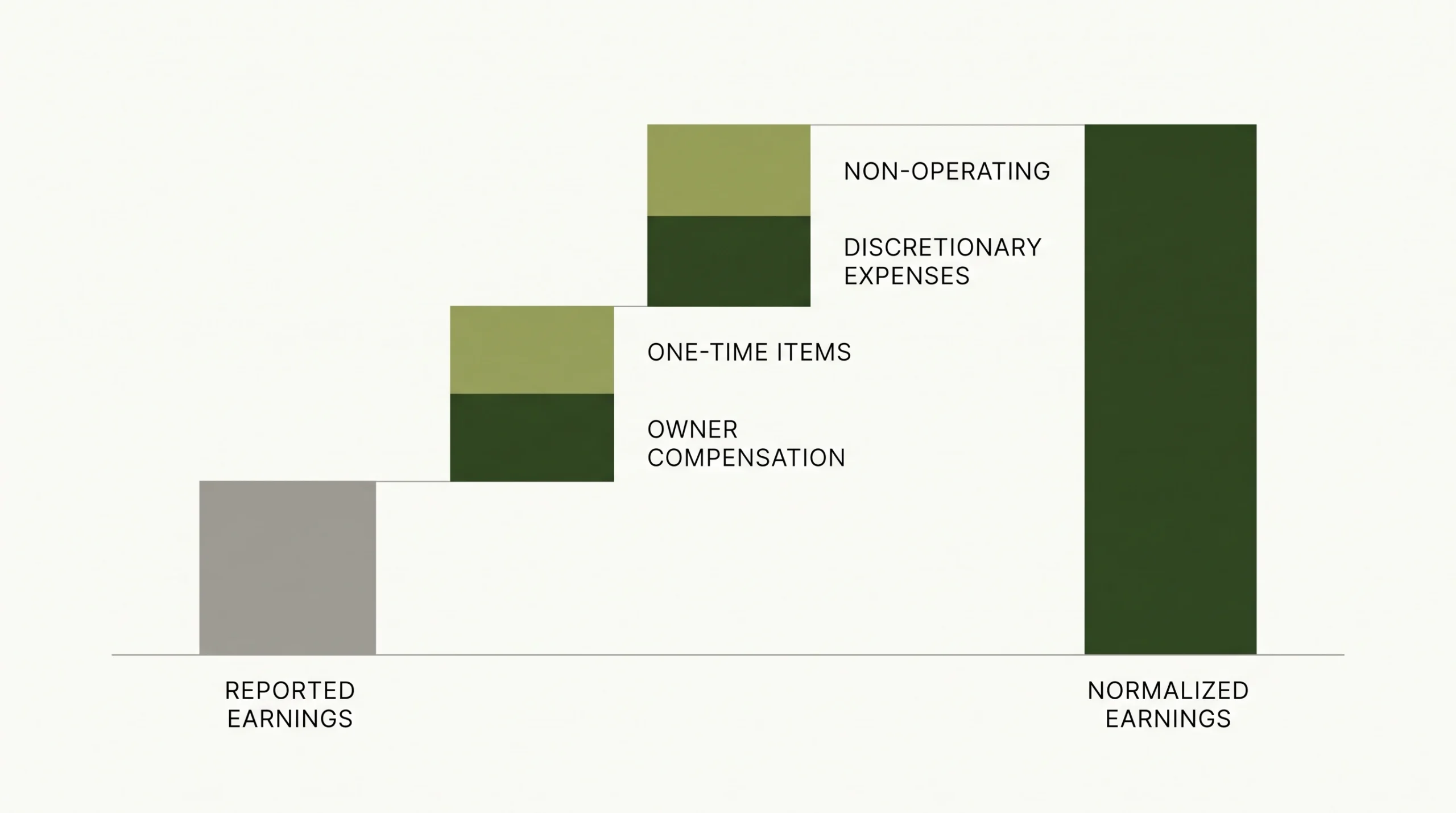
Most changes fall into four groups, plus two related types. The first resets owner and officer pay to a market rate. The second removes one-time items that will not repeat. The third strips out personal and discretionary spending. The fourth pulls out non-operating income and the assets tied to it. Two more, related-party terms and accounting choices, round out the work. Together they move reported profit toward true, steady earnings.
| Adjustment family | What it removes or resets | Effect on earnings | Common example |
|---|---|---|---|
| Owner and officer pay | Salary above or below market | Up or down | Owner paid $400K for a $150K role |
| Non-recurring items | One-time gains and costs | Usually up | Lawsuit payout, storm repair |
| Discretionary and personal | Owner perks with no business need | Up | Personal car lease, family travel |
| Non-operating income and assets | Income unrelated to the core work | Down | Rent from an idle building |
| Related-party terms | Off-market deals with insiders | Up or down | Below-market rent to a sister firm |
| Accounting methods | Basis and inventory choices | Up or down | Cash to accrual, LIFO to FIFO |
Reading the table top to bottom shows a clear pattern. Some changes raise earnings and some lower them, and a fair analysis makes both. Honest recasting is not just a hunt for add-backs. It removes income that will not last as readily as costs a buyer would not repeat. That balance is what makes the final number, and the value built on it, easy to trust.
How do you normalize owner compensation?
Owner pay is reset to what a third party would charge for the same job. Say the owner takes $400,000 to run a role a manager would fill for $150,000. The extra $250,000 is added back as profit. If the owner underpays, the analyst subtracts the shortfall instead. The point is a market wage, not the number on the W2. This one change often moves earnings the most, so buyers and the IRS review it closely.
Setting that wage takes real data, not a guess. Analysts weigh the roles the owner fills, the hours worked, and pay for jobs nearby. Sources like RCReports blend IRS rules, court rulings, and wage data to back the figure. The IRS even prints a reasonable compensation job aid for its own reviewers. So a loose estimate rarely survives. A well-sourced salary holds up when someone pushes back.
Which items count as one-time or non-operating?
One-time items are events that will not repeat, so they get removed to show steady profit. A lawsuit payout, storm damage, or a gain on selling gear all qualify. Non-operating items are different. They are real and ongoing, but they sit outside the core business. Rent from an idle building, interest on spare cash, and life insurance payouts are common ones. Both types skew the earnings base, so an analyst pulls them out first.
The non-operating side reaches the balance sheet too. If a company holds an unused lot, a stock account, or extra cash, those assets do not help daily work. Analysts remove them from the operating value, then add them back on their own at fair market value. This keeps the adjusted earnings tied only to the working business.
How do related parties and accounting methods shift earnings?
Related-party and accounting changes are quieter, but they matter just as much. A related-party item is any deal with an insider on off-market terms. An owner may charge the company low rent through a second entity, or pay a relative for little real work. The analyst resets those figures to arms-length rates. Accounting choices, such as cash versus accrual basis or LIFO versus FIFO inventory, also bend profit and get adjusted for a fair peer match.
These changes bring the numbers in line with set standards. The AICPA Statement on Standards for Valuation Services, updated in June 2025, guides how members record and back each change. Moving cash-basis books to accrual, for one, shows the true timing of income and costs. The result is a cleaner read that stands next to peers without an asterisk.
How do adjustments build normalized EBITDA or SDE?
Every change feeds one of two earnings numbers. Normalized EBITDA starts with earnings before interest, taxes, depreciation, and amortization. It then removes one-time, non-operating, and discretionary items. It fits larger firms that keep a paid management team after a sale. Seller’s discretionary earnings, or SDE, goes further and adds back the full owner salary. SDE suits smaller, owner-run firms where one person is the business.
The value math shows why the recast number carries so much weight. Take a company whose books show $600,000 in profit. A $100,000 net add-back lifts normalized EBITDA to $700,000. At a market multiple of four times earnings, that one change adds $400,000 to value. This is why careful recasting, built on clean cash flow work, decides so much of the final price.
Who should recast your earnings?
The person doing the recasting shapes how well it holds up. Large names like Alvarez and Marsal or Stout bring deep benches, but they aim at enterprise clients and price to match. Solo practitioners cost less. Yet they often lack the data feeds and second reviewers that a defense needs. Sofer Advisors sits between the two. It brings senior-level rigor to middle-market owners and backs every add-back with a source.
That work follows The Sofer Difference, a four-phase process of Discovery, Diligence, Analysis, and Delivery. It reflects the firm’s Heart of a Teacher approach: show the owner the math, not just the answer. David Hern CPA ABV ASA leads the work, with a full W2 team of 14 and all major valuation databases on hand. With 180+ five-star Google reviews and Inc. 5000 spots in 2024 and 2025, the firm builds reports that hold up under a hard second look.
Frequently Asked Questions
What are normalization adjustments in a business valuation?
Normalization adjustments are changes to a company’s past financial records that remove one-time, non-operating, or personal items. They reveal the true, ongoing profit a new owner can expect. Sofer Advisors makes these changes by resetting owner pay, stripping out perks, and pulling out income that sits outside the core business. The clean figure gives every later step, from a multiple to a discount rate, a sound start.
What is normalized EBITDA?
Normalized EBITDA is earnings before interest, taxes, depreciation, and amortization, adjusted to remove items that will not repeat. It shows the steady cash a business earns from its core work. Analysts use it to compare a company against peers and to apply market multiples. Because it clears out owner quirks and one-time noise, it gives buyers and lenders a fairer read than a raw tax figure.
What is seller’s discretionary earnings?
Seller’s discretionary earnings, or SDE, is a number used for smaller, owner-run firms. It starts with normalized profit, then adds back the full salary and perks of one working owner. SDE shows the total benefit a single owner draws from the business. Buyers of small firms lean on it because they plan to step into the owner’s role, so that pay becomes profit for them.
What are common add-backs to owner earnings?
Common add-backs include pay above a market wage, personal car costs, and travel with no business purpose. Pay to relatives who do little real work also counts, as do one-time legal fees and non-operating income. Our team adds back each item only when records support it. An unproven add-back lifts earnings on paper, but it falls apart the moment a buyer or the IRS asks for proof.
How do you set reasonable owner compensation?
Reasonable compensation is the wage a third party would earn to do the owner’s job. Analysts weigh the roles the owner fills, the hours worked, and pay for like jobs in the same area. Data tools such as RCReports and the IRS job aid back the figure. Pay above that market rate is added back to earnings, while pay below it is subtracted for a fair result.
How is normalization different from working capital adjustments?
Normalization works on the income statement to refine reported earnings. Working capital adjustments work on the balance sheet to check that a business has enough short-term assets to run day to day. One shapes the profit that value is built on. The other sets the cash and inventory a buyer expects at closing. The firm handles both, but keeps them apart so the earnings base and the deal terms stay clear.
How does a one-time event affect value?
A one-time event pushes earnings up or down for a single year, which can skew the whole valuation. A lawsuit payout drags profit lower, while a gain on selling gear lifts it. Neither reflects normal work. Analysts remove the event so the value multiple applies to a steady base. Left in place, one odd year can swing the price far from true worth.
How much does a business valuation from Sofer Advisors cost?
A business valuation from Sofer Advisors typically runs $7,500 to $25,000. The range depends on the size of the company, the number of adjustments, and the purpose of the report. A simple planning study sits near the low end. A valuation for a sale, a tax filing, or a court case takes deeper work, so it sits higher. Contact us for a quote matched to your specific situation.
Related Case Studies
- Owner Compensation Normalization: Why Salary Affects Sale Value
- EBITDA Add-Backs: What Buyers Accept and What They Reject
- Reasonable Compensation and S-Corp IRS Scrutiny
Executive Summary
Normalization adjustments recast a company’s earnings to show its true, ongoing profit. The work covers four families: owner pay reset to market, one-time items, personal costs, and non-operating income or assets. Related-party terms and accounting methods round it out. A fair analysis both adds and subtracts, then arrives at normalized EBITDA or SDE. The stakes are high, since a $100,000 add-back at a four times multiple adds $400,000 to value. Sofer Advisors records every change under IRS Revenue Ruling 59-60 and AICPA SSVS, so the number survives a buyer’s diligence or an IRS review.
What Should You Do Next?
Start by pulling three years of financial statements and flagging any owner perks, one-time costs, and non-operating income. Set the owner’s pay against real market wage data, not habit. Then keep a source document for each change, since proof is what makes an add-back stick in a sale or an audit.
For a recast earnings base you can stand behind, work with David Hern CPA ABV ASA. His team has given expert witness testimony in 11+ cases across Georgia, Florida, California, and New Mexico. Schedule a consultation to discuss the adjustments that fit your business.
People Also Read
About the Author
This guide was prepared by David Hern CPA ABV ASA, founder of Sofer Advisors, a business valuation firm headquartered in Atlanta, GA serving clients across the United States. David holds dual accreditations as an Accredited Senior Appraiser (ASA) and is Accredited in Business Valuation (ABV), credentials recognized by the IRS, SEC, and FINRA. He also holds the Certified Exit Planning Advisor (CEPA) designation. With 15+ years of valuation experience, David has served as an expert witness in 11+ cases across multiple jurisdictions and built Sofer Advisors into an Inc. 5000-recognized firm with 180+ five-star Google reviews. Its full W2 employee team maintains subscriptions to all major valuation databases and operates under a next business day response policy. For professional business valuation services, visit soferadvisors.com/about-us/ or contact Sofer Advisors at soferadvisors.com/contact-us/.
Disclaimer: This content is for informational purposes only and does not constitute professional valuation advice. Business valuation conclusions depend on specific facts and circumstances. Contact Sofer Advisors for guidance regarding your specific situation.









