


Last Updated: July 2026
Owner compensation normalization adjusts a private owner’s total pay, including salary, benefits, and perks, to match what the company would pay a non-owner for the same job. That gives a clear view of true past and future profit. This step is the base for an accurate valuation, especially when owners keep earnings as cash flow or pay themselves off-market rates. With seven years of experience and 180+ five-star Google reviews, Sofer Advisors brings the skill to make these adjustments to set standards.
Private company pay often differs sharply from fair market wages. When owners draw too much or too little, the bottom line gets clouded, and the real health of the business is hard to see. By normalizing these figures, Sofer Advisors creates a baseline that lets owners, investors, and buyers judge the company on market data rather than personal preference. That clarity is vital for a legal dispute, a tax filing, or an ownership transfer.
A specialized advisor helps spot items that a standard payroll report can miss, such as personal vehicles, insurance plans, or non-business travel booked as company costs. Without precise normalization, owners risk mispricing their stake or facing trouble in an audit. A clear method lets all parties see the company’s real earning power.
Key Takeaways
- Clarity on profit: adjusting owner pay to market rate reveals the true, sustainable earnings of a business.
- Valuation uses adjusted earnings: buyers use EBITDA or SDE, and normalization keeps these tied to the market, not personal preference.
- Market data sets the salary: pay is based on role, industry, and city, not the owner’s personal needs.
- Add back hidden costs: family salaries or personal travel inflate stated profit, so adding them back gives an accurate view of cash flow.
- Accuracy protects the deal: wrong compensation figures create distrust with buyers, while precise normalization protects the price.
Each of these ties to the broader work of financial reporting and tax compliance. The sections below cover how these adjustments affect specific deals and long-term value.
What is owner compensation normalization?
Owner compensation normalization adjusts an owner’s reported salary to a market rate you can verify, so you can find a company’s true recurring profit. Private owners often set their pay on tax strategy or personal cash needs, not the fair value of their work. That gap distorts the financials and makes earning power hard to judge. When an owner takes a salary well above or below market, the figures do not reflect what a new operator would pay. Our guide to valuing a plumbing business shows this in an owner-run setting.
To find accurate figures like EBITDA or Seller’s Discretionary Earnings (SDE), analysts adjust the numbers to industry benchmarks. Under the Uniform Standards of Professional Appraisal Practice, these adjustments give a clear picture of cash flow. Sofer Advisors uses these metrics to set the baseline value of a business, so parties rely on normalized data rather than accounting choices.
Why is this adjustment critical for valuation?
Normalization is critical because it adjusts earnings to reflect steady cash flow, which directly moves the EBITDA multiple or SDE result. Failing to normalize owner pay creates a false picture that misleads both sides. A too-low salary inflates profit, a red flag that forensic accounting will catch in due diligence. A too-high salary lowers net income, so the owner leaves money on the table when negotiating.
Sofer Advisors valuations rely on IRS Revenue Ruling 59-60 to set fair market value. That guidance requires pay to be adjusted to market rates before applying a multiple. When an owner draws a salary far above or below industry norms, the valuation must correct it to produce a reliable equity value. Accurate normalization prevents large valuation errors and deal disputes.
How do you determine a market-rate salary?
A market-rate salary for an owner or key leader comes from comparing the job duties against pay studies. These studies align pay with clear factors like company size, industry, and location. Using databases from sources like NACVA or BVR, an analyst pulls salary ranges that reflect the real pay for the role.
The process often defines a hypothetical replacement CEO, an unrelated person hired to do the same job as the current owner. Analysts weigh the responsibilities, required skills, and local labor market to build a defensible figure. That objective number supports the report in talks with buyers, lenders, or tax authorities who require transparency on company expenses. Verified data helps the findings stand up during a transaction.
Talk to a Sofer Advisors specialist to review how normalization applies to your situation.
What else is adjusted besides salary?
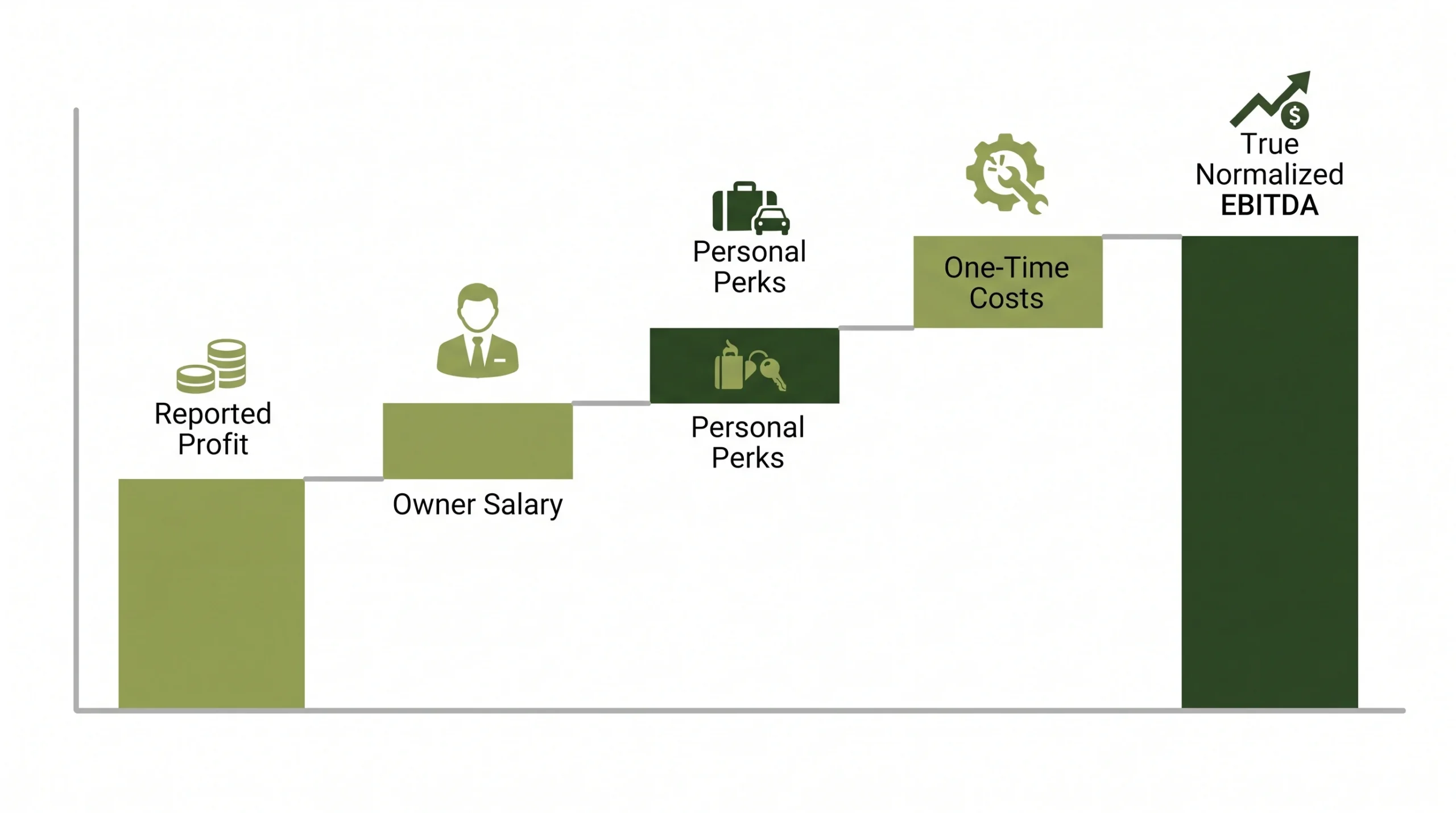
Normalization covers more than salary. It includes discretionary expenses and one-time costs that a new owner would not incur, commonly called add-backs. These represent personal or non-essential spending that artificially reduces reported profit. Adding them back gives buyers a clearer, more accurate view of true profit potential. Common add-backs include:
- Personal auto, meals, and entertainment run through the company
- Salaries paid to non-working family members
- One-time legal fees from litigation or a property dispute
- Other non-recurring costs a buyer would not assume
Many small businesses book personal expenses through the company ledger. These are valid deductions for the current owner, but a new buyer would not carry them. Adding them back raises the base value used for restaurant valuation and other transaction work. Recognizing these early helps owners prepare for a future sale.
Does this impact SDE and EBITDA differently?
Seller’s Discretionary Earnings (SDE) and EBITDA measure profit differently, based on business size and how much it depends on the owner. SDE fits smaller main-street businesses where the owner is the primary operator who will be replaced at exit. EBITDA is the standard for larger companies that run with a management team expected to stay after a deal.
SDE is calculated before subtracting a market-rate owner salary, capturing the total cash flow available to a sole proprietor. EBITDA is calculated after subtracting all operating expenses, including a market-rate salary for every manager. Because these measure different levels of profit, they command different multiples. Investors apply higher risk to SDE, since the cash flow depends on one person, while EBITDA multiples track more stable, scalable revenue.
What happens if you skip normalization?
Skipping normalization leads to a wrong value that either leaves money on the table or sets an asking price too high to defend in due diligence. Without the adjustments, the value does not reflect the real economics of the business. A buyer will almost always run a quality of earnings report, which quickly finds unadjusted items like personal expenses or off-market pay.
Finding these late in a deal often triggers a demand for a price cut. That creates a loss of credibility, which frequently causes the whole deal to collapse. Owners can avoid this by engaging a neutral third-party firm for an objective analysis before going to market. Sofer Advisors uses standard adjustments so your final valuation is defensible and ready for any buyer’s scrutiny.
Which provider is best for normalization?
The right provider uses empirical data and documents every adjustment, not anecdotal estimates. National firms like Alvarez & Marsal, Stout, and Kroll produce highly technical reports for public companies, while smaller practices may use simplified methods that favor speed over depth. The table below compares the options.
| Provider type | Compensation data sources | Scope of adjustments |
| Sofer Advisors | Multiple paid databases (BVR, NACVA) and industry-specific surveys | Full review of salary, bonuses, perks, family members, and one-time items |
| General CPA firm | General industry surveys and public salary data | Owner salary and obvious personal expenses |
| Basic accounting service | Broad benchmarks from accounting software | Direct owner W-2 compensation only |
These differences mirror larger shifts in valuation quality across the profession. Owners must verify that their advisor uses empirical data instead of anecdotal estimates, so the report gives a defensible position. Detailed adjustments prevent disagreements during negotiation and satisfy the rigorous requirements of professional valuation standards. A summary-level report may move faster, but it rarely survives a buyer’s quality of earnings review.
Normalization rewards market data and documented add-backs. The questions below cover what owners ask most.
Frequently Asked Questions
Does EBITDA include owner compensation?
EBITDA, earnings before interest, taxes, depreciation, and amortization, includes the W-2 salary and benefits paid to owners as an operating expense. Because that figure is often set at the owner’s discretion rather than the market rate, it must be adjusted during a valuation. Sofer Advisors normalizes these figures so the EBITDA reflects what a buyer would pay a qualified non-owner for the same management.
How do you calculate normalized revenue?
Normalized revenue adjusts reported data to remove one-time events, accounting inconsistencies, or non-operating items that distort true earning power. Analysts find these by reviewing historical statements and separating recurring from non-recurring items. Sofer Advisors runs a systematic review of your ledger to isolate and normalize these streams so the value reflects sustainable performance.
What is a typical owner’s salary as a percentage of revenue?
There is no fixed percentage across industries, since pay varies with company size, complexity, and the role’s duties. Professional service firms show higher salary percentages due to high human capital, while manufacturers may show lower ones relative to revenue. Sofer Advisors uses empirical benchmarking data from the American Society of Appraisers to see whether your salary sits in a reasonable range.
How do you prove owner compensation adjustments to a buyer?
You prove adjustments with clear documentation that links your actual pay to independent market data for similar titles and areas. A formal report should include an appendix citing specific salary surveys or databases, such as those from Business Valuation Resources, to justify each adjustment. Sofer Advisors strengthens your position with a professional, neutral third-party appraisal that explains these changes in a way that lowers a buyer’s risk.
What is the difference between an add-back and normalization?
Normalization is the broad process of adjusting financial statements to reflect the true economics of the business. An add-back is the specific step of restoring earnings by returning a discretionary cost, like an owner’s personal expense, to net income. Sofer Advisors handles the accounting in both to prevent the inclusion of disallowed expenses that could invalidate your valuation.
Are personal expenses run through a business illegal?
Using a business for personal expenses is common, but failing to report them accurately or trying to treat them as tax-deductible operating costs can create serious issues with the IRS. Forensic standards require every personal item to be identified and separated during a valuation to find true profit. Sofer Advisors flags these during the discovery phase so your records show an accurate, compliant picture.
Can an owner perform their own salary normalization for a sale?
An owner can attempt it, but doing so creates a conflict of interest that buyers will not accept in due diligence. Buyers require a neutral, third-party assessment to confirm the numbers are not skewed to favor the seller. Sofer Advisors provides that objectivity through a disciplined process built to survive scrutiny from investors, acquisition teams, or litigation.
Does normalization impact SDE and EBITDA differently?
Yes. SDE typically includes the owner’s total compensation plus benefits as an adjustment, while EBITDA treats the owner’s salary as a standard operating expense. SDE is designed for smaller, owner-operated businesses where the total return to the owner is the primary metric. Sofer Advisors guides the method by your company size and deal type so the result matches standard practice for your industry.
How much does a business valuation from Sofer Advisors cost?
A business valuation from Sofer Advisors runs $7,500 to $25,000, based on its published engagement data, with complex financials and fast turnarounds reaching the higher end. Cost depends on your company profile, the organizational structure, and the depth required. For a quote tied to your business, request a valuation estimate with your financials and payroll records.
Related Case Studies
- How to Value an HVAC Company: Multiples and Buyer Demand
- How to Value a Trucking Company: Fleet, Lanes, and Multiples
- What Are Business Exit Planning Strategies for Owners?
Executive Summary
Owner compensation normalization adjusts an owner’s pay to what the company would pay a non-owner for the same job, which reveals the true recurring profit that drives EBITDA and SDE. An above-market salary understates profit and leaves money on the table; a below-market one inflates profit and raises a red flag that a buyer’s quality of earnings report will catch. Analysts set the market rate from compensation studies by role, industry, and city, then add back discretionary items like personal auto, family salaries, and one-time legal fees. SDE is figured before an owner salary; EBITDA after. To prepare, review your pay against regional norms and build a schedule that separates personal perks and one-time costs from standard operating expenses.
What Should You Do Next?
Review your compensation against recent tax returns and payroll records to see where your salary deviates from regional norms. Build a schedule of proposed adjustments that separates personal perks, non-working family payouts, and one-time costs from standard operating expenses. Keeping this in a clear format lets an advisor assess your true earning power before you go to market.
David Hern CPA ABV ASA, founder of Sofer Advisors, brings deep experience normalizing complex owner compensation for high-stakes deals. Schedule a free consultation to discuss your situation.
People Also Read
- Business Valuation Services Atlanta: An Expert Guide
- How to Transfer Business Ownership: Options and Tax Impact
About the Author
This guide was prepared by David Hern CPA ABV ASA, founder of Sofer Advisors, a business valuation firm headquartered in Atlanta, GA serving clients across the United States. David holds dual accreditations as an Accredited Senior Appraiser (ASA) and is Accredited in Business Valuation (ABV), credentials recognized by the IRS, SEC, and FINRA. He also holds the Certified Exit Planning Advisor (CEPA) designation. With 15+ years of valuation experience, David has served as an expert witness in 11+ cases across multiple jurisdictions and built Sofer Advisors into an Inc. 5000-recognized firm with 180+ five-star Google reviews. Its full W2 employee team maintains subscriptions to all major valuation databases and operates under a next business day response policy.
For professional business valuation services, visit soferadvisors.com/about-us/ or contact Sofer Advisors at soferadvisors.com/contact-us/.
Disclaimer: This content is for informational purposes only and does not constitute professional valuation advice. Business valuation conclusions depend on specific facts and circumstances. Contact Sofer Advisors for guidance regarding your specific situation.









