


Last Updated: July 2026
Reasonable compensation is the pay a shareholder-employee must earn for the work they do for the company, and this salary comes before the owner takes any tax-friendly distributions. That order is a key rule for staying right with the IRS.
For an S corp, this pay must match what a comparable business would pay a non-owner for the same executive or daily work, keeping wages in line with fair market value so the IRS will not treat distributions as taxable income. Many owners struggle to set this number, and the IRS guidance for S corporation shareholders and officers makes clear that officers who perform services must be treated as employees.
Sofer Advisors gives neutral, data-driven valuations that help owners set the right pay and stay compliant, drawing on the founder’s 11+ expert witness cases and strict professional standards. Setting a base salary means you weigh market data, job duties, and cash flow, then write down your reasons with care so the record stands up to IRS questions.
Key Takeaways
- Mandatory Compensation: S-Corp owners must pay a fair W-2 salary for services before taking any profit distributions.
- Multi-Factor Compliance: The IRS weighs the facts of each case with a multi-factor test, not one formula.
- Risk of Reclassification: A salary set too low lets the IRS treat distributions as wages, triggering back payroll taxes, interest, and penalties.
- Limitation of Rules of Thumb: Rules of thumb like the 60/40 rule are weak, since they lack the market data of a formal study.
- Documentation Necessity: A formal compensation report gives you key proof to defend your stance if the IRS reviews your filings.
The sections below show how to build a record that supports your salary choices and keeps pay in line with market data.
What is reasonable compensation for an S Corp?
Reasonable compensation is the value that a person’s work would earn in an arm’s-length deal. An arm’s-length deal is one between two parties with no special ties. So this value shows what a company would pay a stranger for the same work. It rests on the same fair market value standard the IRS applies across tax matters. The IRS wants this amount paid as a W-2 salary. And it must come before the owner takes any profit distributions.
Some owners take profit distributions and skip a real salary to cut the payroll taxes they owe. But this move draws strong review from the IRS, which sees it as a top reason to start an audit. The salary must match the real work and duties, not just reflect how much cash is on hand, and a well-set salary shields the business from tax penalties.
A stranger doing the same job would demand a market wage. So the owner cannot pay themselves less just to save on taxes. The work has a value, and the IRS expects that value in wages.
How does the IRS determine reasonable compensation?
The IRS uses a multi-factor test, not one simple formula. Agents look at the facts of each case and decide if the pay fits the work done. This test stops owners from hiding taxable income and blocks those who shift income into large, deductible salaries.
The IRS also leans on past court rulings. It reviews the worker’s schooling, special skills, and work history, then weighs these against the job they hold and the nature of the duties. An owner who runs many high-level teams may justify higher pay than a simple operator would. The same evidentiary discipline that governs a Revenue Ruling 59-60 valuation analysis applies here, since both weigh facts over formulas.
Comparison data also plays a big role. Examiners match the salary against pay for non-owner staff doing similar work in similar companies. Strong profits can support generous pay, but the IRS looks closely at such cases, using the logic from Watson v. Commissioner to keep numbers near fair market standards.
What are common methods for calculating it?
You can set this pay a few ways: survey data from sources like the Bureau of Labor Statistics, a well-known rule of thumb, or a formal compensation study. A rule of thumb, like the 60/40 rule, gives a quick start, but such rules lack the rigor to survive an IRS challenge, a limit explored in this guide on the uses and limits of rule-of-thumb valuation. The IRS wants proof tied to duties and market rates for similar roles.
A formal study blends two methods to build a strong case. The market approach looks at what others pay for similar work. Meanwhile, the cost approach looks at the value of the tasks done. To see how those lenses differ, review this breakdown of the cost approach versus the income approach. This work draws on trusted data, such as Business Valuation Resources, to check pay for equal positions.
Facts beat generic formulas every time, which is why Sofer Advisors helps owners match payroll to current tax rules. Professional standards from the AICPA’s forensic and valuation services practice reinforce this evidence-first approach. A rule of thumb might guess a round number, while a formal study points to real jobs and real pay in your field.
What are the risks of low S-Corp salaries?
The main risk is reclassification, when the IRS treats distributions as wages. If it finds a salary that does not match the value of the work, it treats those distributions as earned income. This forces the business to pay back employment taxes, including FICA and FUTA on the reclassified amounts, plus interest and extra tax. Owners may also face an accuracy-related penalty under IRC Section 6662 on the underpaid tax.
When this happens, a smart-looking plan turns costly. Owners should keep a clear paper trail that justifies their pay levels, and a formal analysis gives you the proof you need to defend those choices against these exact risks.
Can S-Corp owners take distributions instead of salary?
Yes, but there is an order to follow. Owners can take distributions as a return on their invested money, but they must first pay a fair W-2 salary for their work. The IRS is strict here, so pay for labor must stay apart from dividends paid to shareholders, a point echoed in the IRS guidance on S corporation compensation. This makes sure the company pays proper payroll taxes on the owner’s work.
Some owners take big distributions but almost no salary. That often becomes a top audit trigger, because the IRS sees it as a way to skip Social Security and Medicare taxes. A safe setup pays a W-2 salary that reflects the market value of daily work, then treats the rest of the profit as distributions on invested money. This clean split keeps you compliant and blocks reclassification.
When should you get a formal compensation study?
Timing matters here. Get a formal study when your S-corp turns a profit, well before any audit, or when owner duties change in a big way. For firms with more than one shareholder-employee, a study is vital, since it sets defensible salary levels that can survive review and tracks how each role shifts over the years. The same discipline that makes a valuation defensible, covered in this guide to USPAP compliance and court-defensible work, applies to a compensation study.
This report is strong proof in a tax dispute, because it shows a clear, good-faith effort to follow the law. With this detailed work, the burden of proof shifts to the IRS, and you do not leave your figures up to chance. Building the record early acts as a shield for long-term tax planning.
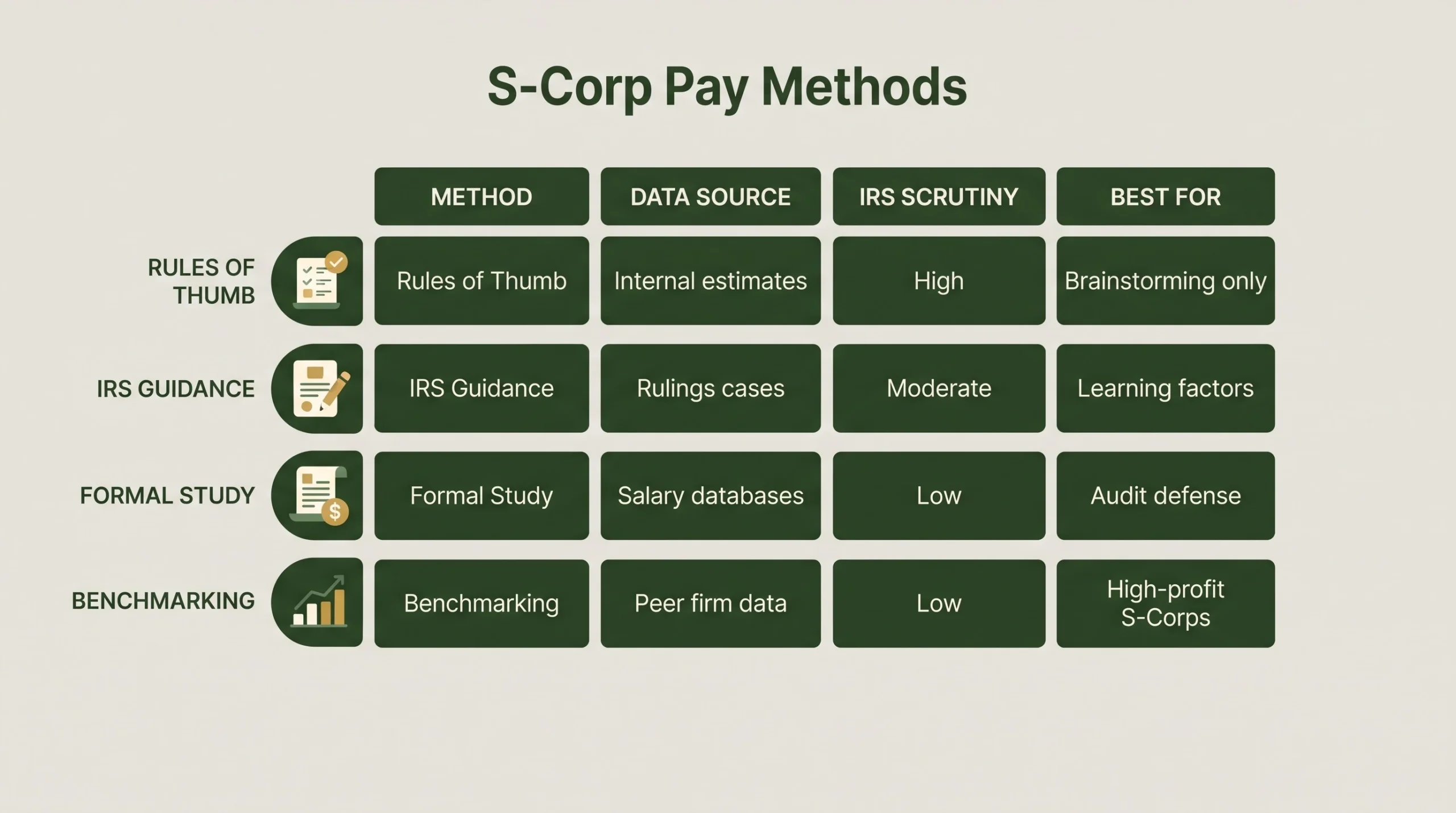
The table below sums up common ways to set pay and how much the IRS may scrutinize each one.
| Determination Method | Primary Data Source | IRS Scrutiny Level | Best For |
|---|---|---|---|
| Industry Rules of Thumb | General estimates; internal opinion | High | Initial brainstorming only |
| IRS Guidance Review | IRS Revenue Rulings and court case summaries | Moderate | Understanding factors; no specific dollar target |
| Formal Reasonable Comp Study | Empirical salary databases, company financials, job analysis | Low | Defensible documentation for audits |
| Competitor Benchmarking | Data from firms like Alvarez & Marsal, Stout, or Kroll | Low | High-profit S-Corps requiring market validation |
The methods above range from guesses to firm, evidence-based reports. General guidance helps you grasp tax duties, but it lacks the hard data to settle disputes. Most experts favor formal studies when the stakes are high, since they want proof that can withstand a challenge. A qualified specialist can weigh company-specific duties against broad market data.
Frequently Asked Questions
What is considered a reasonable salary for an S Corp?
A reasonable salary is what a shareholder-employee would earn for like work in an arm’s-length deal. It weighs the duties, the local market, and the firm’s profit. No single percentage or dollar amount fits all, so the IRS judges each case on its own facts. Sofer Advisors uses market-based data to give owners objective proof for their pay rate.
What is the 2% rule for S Corps?
The 2% rule relates to health insurance premiums and tax treatment for S-corp shareholders who own more than 2% of the entity. These payments are typically treated as taxable wages for income tax purposes but are exempt from Social Security and Medicare taxes if specific rules are met.
What is the 70/30 rule for S Corp?
The 70/30 rule is a common rule of thumb: pay 70 percent of net income as salary and take the other 30 percent as distributions. The IRS does not recognize it as a compliance standard, and it raises audit risk because it lacks job-related market data. Sofer Advisors recommends a formal study to prove your salary rests on real market value.
How often should I review my reasonable compensation?
Review your salary each year. Also review it when your role or results shift in a big way, since market conditions for your job can move over time and change the fair rate for your work. Proactive reviews help you adjust payroll before the tax year ends.
Does my S Corp’s industry affect my reasonable salary?
Yes. Industry standards are part of the IRS multi-factor test. So roles in high-profit sectors often earn more, while the same role in a low-margin field may pay less. Analysts must study pay surveys for your niche, and that is how they set a fair baseline.
What happens if my S-Corp salary is set too low?
The main risk is reclassification. If the IRS finds your salary does not match the value of your work, it treats your distributions as wages. This forces the business to pay back employment taxes, including FICA and FUTA, plus interest and extra tax. You may also face an accuracy-related penalty under IRC Section 6662 on the underpaid amount.
Can S-Corp owners take distributions instead of a salary?
Yes, but in order. Owners must first pay a fair W-2 salary for their work, then take the rest of the profit as distributions on invested money. Big distributions with almost no salary is a top audit trigger, since it looks like a way to skip Social Security and Medicare taxes.
Why is a formal study better than a rule of thumb?
A rule of thumb, like the 60/40 rule, gives a quick start, but it lacks the rigor to survive an IRS challenge. A formal study blends two methods: the market approach looks at what others pay for similar work, and the cost approach weighs the value of the tasks done. This draws on trusted data to build defensible proof.
When should I get a formal compensation study?
Get a formal study when your S-corp turns a profit, well before any audit, or when owner duties change in a big way. For firms with more than one shareholder-employee, a study is vital, since it sets defensible salary levels. This report is strong proof in a tax dispute, and it shifts the burden of proof to the IRS.
Related Case Studies
- F Reorganization for S Corp Sales: Why Buyers Often Require It
- Tax Court Valuation Challenges: 5 Lessons from Recent Cases
- What Makes a Valuation IRS Qualified: Section 170 and 6695A
Executive Summary
Reasonable compensation is the arm’s-length value of a shareholder-employee’s services, and S-corp owners must pay it as a W-2 salary before taking any profit distributions. The IRS applies a multi-factor test, weighing the owner’s background, duties, comparable pay, and company results rather than a single formula, drawing on case law such as Watson v. Commissioner. Rules of thumb like the 60/40 and 70/30 splits fail under scrutiny because they lack duty-specific market data. A salary set too low risks reclassification of distributions as wages, triggering back FICA and FUTA taxes, interest, and a penalty under IRC Section 6662. A formal study built from salary databases, company financials, and job analysis delivers the defensible documentation that shifts the burden of proof to the IRS.
What Should You Do Next?
Start by comparing your current W-2 salary against real market pay for your role, duties, and industry. Next, document how your responsibilities and company results support that figure, keeping the record contemporaneous. Finally, commission a formal reasonable compensation study before your next filing or any audit so your numbers rest on evidence, not guesswork.
David Hern CPA ABV ASA, founder of Sofer Advisors provides neutral, defensible valuations for S-corp owners. Schedule a free consultation to discuss your situation.
People Also Read
- How S Corp Owner Basis Is Tracked and Why It Matters at Sale
- Rule of Thumb Business Valuation: Uses and Limitations
About the Author
This guide was prepared by David Hern CPA ABV ASAc, founder of Sofer Advisors, a business valuation firm headquartered in Atlanta, GA serving clients across the United States. David holds dual accreditations as an Accredited Senior Appraiser (ASA) and is Accredited in Business Valuation (ABV), credentials recognized by the IRS, SEC, and FINRA. He also holds the Certified Exit Planning Advisor (CEPA) designation. With 15+ years of valuation experience, David has served as an expert witness in 11+ cases across multiple jurisdictions and built Sofer Advisors into an Inc. 5000-recognized firm with 180+ five-star Google reviews. Its full W2 employee team maintains subscriptions to all major valuation databases and operates under a next business day response policy.
For professional business valuation services, visit soferadvisors.com/about-us/ or contact Sofer Advisors at soferadvisors.com/contact-us/.
Disclaimer: This content is for informational purposes only and does not constitute professional valuation advice. Business valuation conclusions depend on specific facts and circumstances. Contact Sofer Advisors for guidance regarding your specific situation.









