


Last Updated: October 2026
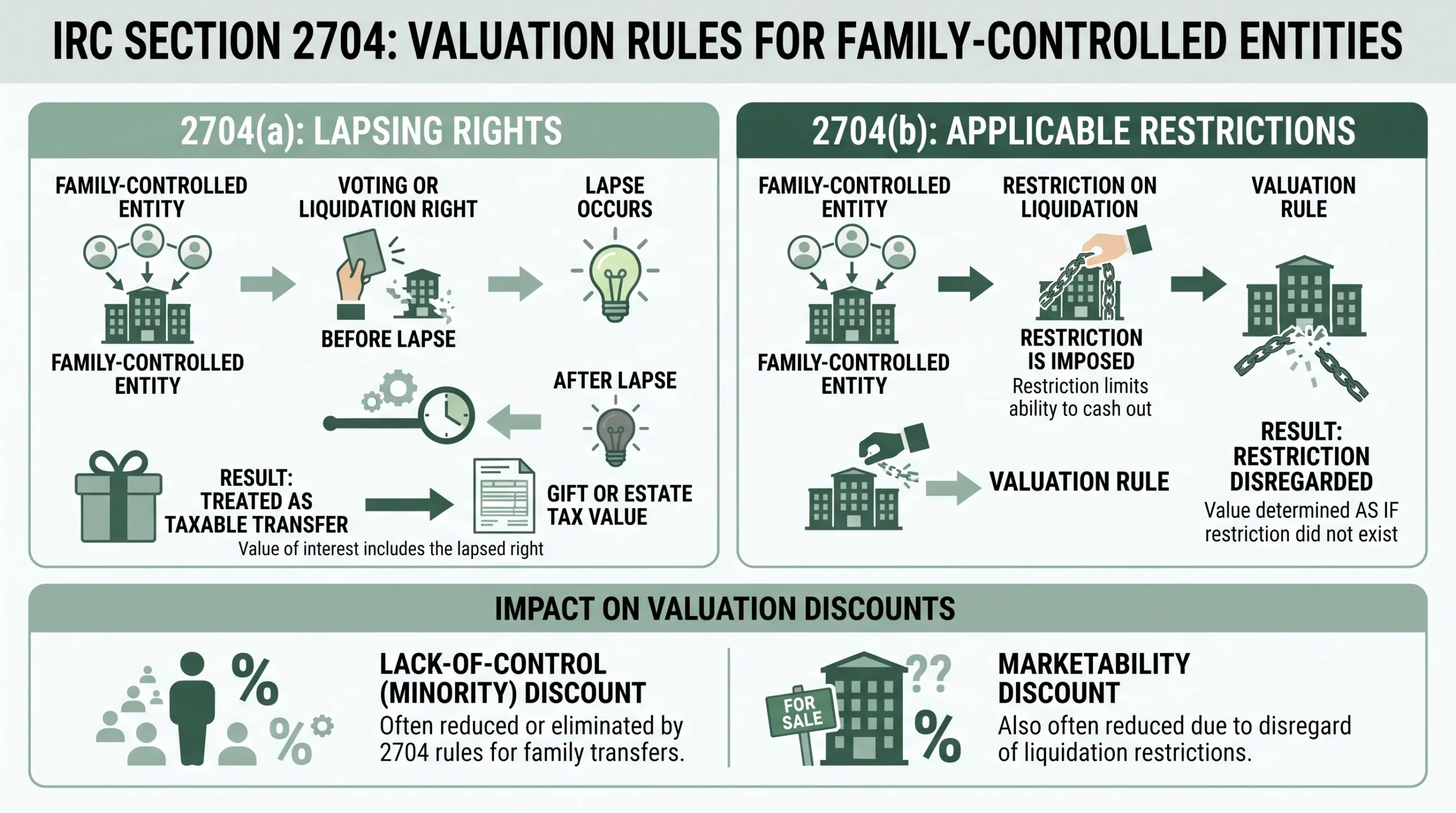
IRC Section 2704 is a federal tax rule that stops families from understating the value of a business interest they transfer to relatives. It sits inside Chapter 14 of the tax code. It works in two ways. It treats the lapse of a voting or liquidation right as a transfer. It also disregards certain restrictions on liquidation when an appraiser values a family-controlled entity. The goal is a value that reflects real economic worth, not paper limits written into an operating agreement.
Owners and their advisors meet this rule during gift and estate planning. The question is almost always the same. How much can a minority interest in a family company really be discounted? Sofer Advisors values these interests for business owners, CPAs, and estate attorneys, backed by Inc. 5000 recognition in both 2024 and 2025. Price the discount too aggressively and the IRS can disregard the restriction behind it, which raises the taxable value.
This guide explains why Section 2704 exists, how 2704(a) and 2704(b) work, and how the rule touches valuation discounts. It also covers family limited partnerships, the withdrawn 2016 regulations, and what owners should do before a transfer.
Key Takeaways
- Two separate rules: Section 2704(a) handles lapsing rights, and Section 2704(b) handles liquidation restrictions. They solve different problems inside the same provision.
- A lapse is a transfer: when a voting or liquidation right ends and the family keeps control, the lost value is taxed as a gift or added to the estate.
- Some restrictions get ignored: a liquidation limit stricter than state law that the family can remove is disregarded when the interest is valued.
- Discounts are narrowed, not erased: legitimate minority and marketability discounts still apply, but the part built on a disregarded restriction falls away.
- The 2016 regulations are gone: Treasury withdrew the proposed rules in 2017, so well-supported family entity discounts remain available today.
Each piece feeds into the wider transfer plan. The sections below take them one at a time.
Why Does IRC Section 2704 Exist?
Section 2704 exists to stop families from manufacturing valuation discounts that do not reflect real economic value. Congress added it to Chapter 14 in 1990 after taxpayers used special voting rights and liquidation limits to shrink the taxable value of family transfers. The rule aims the tax at the true worth of what changes hands, not at a figure lowered by restrictions the family itself controls.
The problem Congress saw was simple. A parent could place a business in a partnership, give children limited interests, and write the agreement so those interests looked nearly worthless. The economic value was still there, but the paper said otherwise. Section 2704 answers that move in two places. It treats certain lapses as transfers under 2704(a). It disregards certain liquidation restrictions under 2704(b). You can see how it fits beside the related provisions in the Chapter 14 rules that govern family transfers.
What Are Lapsing Rights Under Section 2704(a)?
A lapsing right is a voting or liquidation right that ends or shrinks when an interest passes to the next holder. Under Section 2704(a), if the individual and family control the entity both before and after the lapse, the lost value counts as a transfer. That means a gift during life, or an addition to the gross estate at death. The rule closes a popular discount trick.
Here is the classic setup. A parent holds voting stock that can force the company to liquidate. The parent gives most shares to children but keeps the voting block. At the parent’s death, that voting right lapses, and the remaining shares look far less valuable. Section 2704(a) treats that drop as value transferred at death. The text of 26 U.S. Code 2704 sets the measurement, so an appraiser prices the interests both before and after the lapse.
What Are Applicable Restrictions Under Section 2704(b)?
An applicable restriction is a limit on liquidating a family-controlled entity that is harsher than the state law default, and that the family can remove after the transfer. Section 2704(b) tells the appraiser to ignore such a restriction and value the interest as if it were gone. The effect is a higher value, because the interest then looks easier to cash out than the agreement suggests.
Two exceptions keep normal business terms in place. A restriction required by an unrelated lender as a condition of financing is commercially reasonable, so it still counts. A restriction imposed by federal or state law also stands. What gets ignored are limits the family wrote purely to depress value, such as a clause blocking any partner from forcing a liquidation when state law would allow it. Sofer Advisors reads each agreement against the governing statute to separate the two.
How Does Section 2704 Affect Valuation Discounts?
Section 2704 narrows discounts tied to disregarded restrictions, but it does not erase legitimate ones. A minority interest still lacks control. A private interest still lacks a ready market. Those facts support a discount for lack of control and a discount for lack of marketability. What the rule removes is the extra discount built on a restriction the family can lift or a right that lapses.
This distinction decides the tax. Say an appraiser claims a 40 percent combined discount, and part of it rests on a liquidation limit stricter than state law. Section 2704(b) disregards that limit, so the appraiser must rebuild the discount without it. The number usually falls, and the taxable value rises. The supportable part remains. You can see how these discounts are sized for family entities in our guide to FLP valuation discounts.
How Does Section 2704 Apply to Family Limited Partnerships?
Family limited partnerships are the main target of Section 2704(b). Owners often use a partnership agreement to limit when a partner can withdraw or force a sale, which supports a large discount. If those limits are stricter than state partnership law, and the family can remove them, the appraiser disregards them. The transferred interest is then valued as if the partner had more access to the underlying assets.
The result can surprise families who planned around a deep discount. When the harsh liquidation clause drops out, the interest looks more liquid, and the gift or estate value climbs. State law matters here, because it sets the baseline the restriction is measured against. Some states give partners strong withdrawal rights, which can leave less room for restriction-based discounts. A smart step for owners is to get independent business valuation services before the transfer is signed.
Who Values a Family Entity Interest, and How Do Options Compare?
Owners choose a valuation provider based on the size of the interest, the audit risk, and the budget. Large national firms serve big public companies with broad teams. Specialized valuation practices focus on closely held and family entities, where discount support and document review decide the outcome. An estate attorney drafts the agreement but does not value it. The table below lays out the common options.
The choice usually comes down to fit. Large national firms such as Alvarez & Marsal, Stout, and Kroll serve big public companies with broad advisory teams. They are built for enterprise scale. A family transfer needs something different: close document review, defensible discounts, and a report an examiner can follow. Sofer Advisors focuses on that work for closely held and middle-market businesses, backed by 180+ five-star Google reviews and expert witness testimony in 11+ cases.
| Provider | Typical role | Best for |
|---|---|---|
| Specialized valuation firm (e.g. Sofer Advisors) | Prices discounts and tests each restriction against state law | Family and closely held transfers that need audit-ready support |
| Large national firm | Broad advisory plus valuation at enterprise scale | Large public companies with complex, multi-entity plans |
| Estate attorney | Drafts the partnership or operating agreement; does not value | Families building or revising the legal structure |
Sofer Advisors runs each engagement through a four-phase process it calls The Sofer Difference, moving from Discovery to Diligence to Analysis to Delivery. That structure keeps every discount tied to market evidence and every restriction tested against the governing statute. It reflects the Heart of a Teacher approach, which means explaining why a number lands where it does rather than just handing over a figure. For a family transfer that holds up, an independent valuation supplies both the discount and the record behind it.
Frequently Asked Questions
What does IRC Section 2704 do?
IRC Section 2704 keeps families from lowering the taxable value of a business interest through artificial limits. It has two parts. Section 2704(a) treats the lapse of a voting or liquidation right as a transfer. Section 2704(b) disregards certain liquidation restrictions that are stricter than state law. Sofer Advisors reviews governing documents against these rules so an owner knows how the transferred interest will be valued for tax.
What is the IRS’s alternate valuation date for estate valuation?
The alternate valuation date lets an executor value estate assets six months after the date of death instead of on the death date. It is available under IRC Section 2032, and the choice must lower both the gross estate and the estate tax. It applies to the whole estate, not single assets. Sofer Advisors prepares date-of-death and alternate-date valuations so executors can compare the two figures and elect with confidence.
What is IRC 2701?
IRC Section 2701 is another Chapter 14 rule. It applies when someone transfers a junior equity interest to family while keeping a preferred interest. It can assign a zero value to the retained preferred rights unless they carry a qualified payment, which raises the value of the gifted interest. Sofer Advisors analyzes preferred and common equity classes so owners see how Section 2701 changes the reported gift.
What is an applicable restriction under Section 2704(b)?
An applicable restriction is a limit on the ability to liquidate a family-controlled entity that is stricter than the default rules of state law, and that the family can remove or let lapse after the transfer. When one exists, the appraiser ignores it and values the interest as if it were not there. Sofer Advisors compares each operating agreement against state statutes to flag restrictions the IRS will disregard.
Does Section 2704 eliminate valuation discounts?
No. Section 2704 does not erase minority or marketability discounts for family entities. It only strips out the portion of a discount that rests on a disregarded restriction or a lapsing right. Legitimate discounts supported by market evidence still apply under current law, especially after the 2016 proposed regulations were withdrawn. Sofer Advisors documents each discount with independent data so the surviving portion holds up under review.
What is a family-controlled entity under Section 2704?
An entity is family-controlled when the transferor and family members hold at least 50 percent of the vote or value, or when the transferor holds any general partner interest in a limited partnership. Family includes spouses, ancestors, lineal descendants, and siblings. Sofer Advisors reviews ownership records to confirm whether the control test is met, since Section 2704 applies only when the family controls the entity before and after a transfer.
Are the 2016 proposed Section 2704 regulations still in effect?
No. Treasury proposed regulations in 2016 that would have sharply limited valuation discounts for family entities. They drew heavy criticism, and Treasury withdrew them in 2017. So the older statute and its existing regulations still govern, and well-supported discounts remain available. Sofer Advisors tracks the current rules so an owner is not planning around a regulation that never took effect.
How is a lapsing right valued under Section 2704(a)?
The lapse is valued as the difference between two numbers. First, the appraiser values the interests the individual held before the lapse, treated as if the right never lapsed. Second, the appraiser values those same interests right after the lapse. The drop in value is the amount treated as a transfer. Sofer Advisors prepares both figures so the gift or estate inclusion is measured correctly and can be defended.
How much does a Section 2704 valuation cost?
A standard business valuation for gift or estate work runs from $7,500 to $25,000 and takes about four to eight weeks, depending on the entity and the documents involved. The fee covers the discount analysis and the written support an examiner expects. A fixed price is quoted up front. Sofer Advisors scopes the engagement first, then sets the fee. Request a free estimate for your situation.
Related Case Studies
- Chapter 14 Rules: How IRC 2701 and 2703 Affect Family Transfers
- Section 2701: Valuing Preferred Interests in Family Transfers
- FLP Valuation Discounts: DLOM and Minority Interest
Executive Summary
IRC Section 2704 governs how family-controlled business interests are valued for gift and estate tax. Section 2704(a) treats the lapse of a voting or liquidation right as a transfer, measured as the value lost when the right disappears. Section 2704(b) disregards liquidation restrictions that are stricter than state law and that the family can remove, which can raise the taxable value. The rule narrows discounts built on those restrictions, but legitimate minority and marketability discounts still apply, especially after the 2016 proposed regulations were withdrawn in 2017. Control means holding at least 50 percent of vote or value. The first step is an independent valuation that prices each discount and tests every restriction.
What Should You Do Next?
Start by pulling your operating or partnership agreement and your state’s default statute, then mark every liquidation or voting limit that is stricter than the law allows. Next, get an independent valuation that prices your discounts and tests each restriction, since that report is your first line of defense in an audit. This guide was prepared by David Hern CPA ABV ASA, founder of Sofer Advisors, an Inc. 5000 firm focused on neutral valuations for tax and estate reporting. Schedule a free consultation to discuss your specific situation.
People Also Read
- Section 2703: Does Your Buy-Sell Set Estate Value?
- Valuation Discounts: DLOC and DLOM on Estate and Gift Tax Returns
About the Author
This guide was prepared by David Hern CPA ABV ASA, founder of Sofer Advisors, a business valuation firm headquartered in Atlanta, GA serving clients across the United States. David holds dual accreditations as an Accredited Senior Appraiser (ASA) and is Accredited in Business Valuation (ABV), credentials recognized by the IRS, SEC, and FINRA. He also holds the Certified Exit Planning Advisor (CEPA) designation. With 15+ years of valuation experience, David has served as an expert witness in 11+ cases across multiple jurisdictions and built Sofer Advisors into an Inc. 5,000-recognized firm with 180+ five-star Google reviews. Its full W2 employee team maintains subscriptions to all major valuation databases and operates under a next business day response policy.
For professional business valuation services, visit soferadvisors.com/about-us/ or contact Sofer Advisors at soferadvisors.com/contact-us/.
This content is for informational purposes only and does not constitute professional valuation advice. Business valuation conclusions depend on specific facts and circumstances. Contact Sofer Advisors for guidance regarding your specific situation.









