


Last Updated: August 2026
A family limited partnership discount is a cut in the value of a partnership interest for gift and estate tax. It reflects two facts. The holder cannot control the entity, and the interest is hard to sell. The Stout Restricted Stock Study tracks 770+ private deals. Its data shows market discounts that often run 20 to 35 percent. Sofer Advisors sizes each discount with that kind of hard proof.
These discounts matter because they lower the taxable value of gifted or inherited shares. A family may move a business or land into a partnership. It then gifts limited shares to children over years. The IRS reviews these transfers closely. A weak discount invites a fight, so the number must rest on data, not a guess.
Key Takeaways
- Two discounts, one interest: A minority interest discount reflects a lack of control. A DLOM reflects a lack of a ready market.
- Sized from data: Appraisers build each discount from restricted stock studies, pre-IPO data, and control premium studies.
- IRS scrutiny: The IRS tests for a real business purpose and applies IRC 2704 to limit which restrictions count.
- Defensible support: A qualified appraisal under USPAP and AICPA standards is the core of any audit defense.
- Combined effect: Applied in sequence, the two discounts can lower value by 20 to 40 percent for well-supported interests.
Each point ties value to control and liquidity. The sections below show how experts size each discount and document a number that holds up under review.
What is a family limited partnership discount?
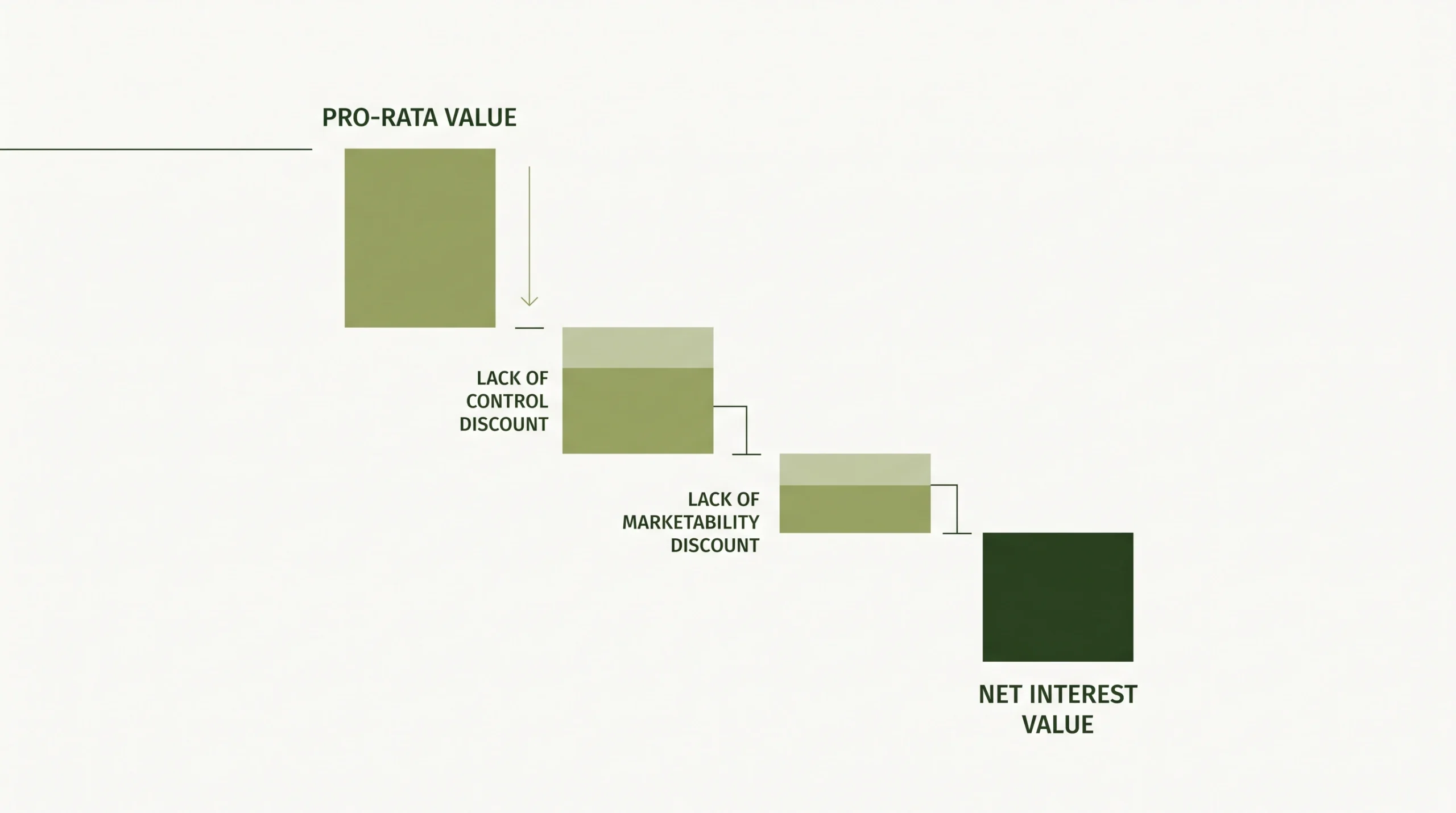
A family limited partnership discount is the gap between an interest’s pro rata share of assets and its fair market value. That gap exists for a reason. A limited partner cannot direct the entity or force a sale. So a buyer would pay less than the raw asset math suggests. The discount has two parts. One covers the lack of control. The other covers the lack of a ready market. Together they set the value used on a tax return.
The general partner runs the entity and makes the calls. The limited partners hold shares but cannot vote on daily matters. They cannot pull out their cash at will. That weak spot is what drives the discount. An appraiser measures it against the partnership agreement. Rules such as IRS Revenue Ruling 59-60 guide how fair market value is set. The result reflects real ownership limits, not a simple share.
How is the minority interest discount sized?
The minority interest discount, also called the discount for lack of control, reflects one hard fact. A small owner cannot steer the business. That holder cannot set pay, direct payouts, or force a sale. So the interest is worth less than a matching slice of a control stake. Appraisers size this discount from control premium studies. Those studies track what buyers pay extra to gain control of a firm. The inverse of that premium gives a supported discount for shares that lack it.
The exact figure depends on the rights in the partnership agreement. A holder with no vote and no exit right supports a larger discount. A holder with some say supports a smaller one. Appraisers read each clause and match it to market data. A generic percentage will not hold up. A rate tied to real deals will. David Hern CPA ABV ASA builds each control discount on that kind of proof, in line with Revenue Ruling 93-12, which lets each gifted interest be valued on its own.
How is the DLOM sized?
The discount for lack of marketability, or DLOM, reflects the cost of being stuck. A public share sells in seconds. A private interest may take years to sell, if it sells at all. That delay carries risk, and a buyer prices it in. Appraisers size the DLOM from two data sets. Restricted stock studies compare public shares to matching shares that carry a sale block. Pre-IPO studies compare private share prices to the later public price. Both show what a lack of liquidity costs.
Newer tools push past a flat rate. Math models price the DLOM like an option, using price swings and holding time as inputs. The Stout Restricted Stock Study pairs 770+ screened deals with a calculator that fits the discount to a firm’s own traits. The table below lays out the main methods and where each fits.
| Method | What it measures | Best data source | Fits when |
|---|---|---|---|
| Restricted stock study | Discount on shares blocked from sale | Stout Restricted Stock Study | A firm has comparable public traits |
| Pre-IPO study | Gap between private and public price | Pre-IPO transaction databases | Recent private share sales exist |
| Option-based model | Cost of illiquidity over a holding period | Volatility and term inputs | Holding period and volatility are known |
| Control premium study | Value of control the holder lacks | Public control transaction data | The interest is a minority stake |
No single method wins every time. A strong report often blends two or more, then squares them up. The firm picks the mix that fits the assets and the facts. That way the DLOM reflects the exact interest, not a broad average from a textbook.
Why does the IRS scrutinize these discounts?
The IRS scrutinizes family limited partnership discounts because they cut tax, sometimes sharply. Auditors look for a real reason behind the entity. They ask whether it holds active assets or just parks cash to shrink a tax bill. They also apply IRC 2704. That rule tells appraisers to ignore certain limits that are tighter than state law would allow. If the entity looks like a pure tax shell, the agency may throw out the discounts in full.
A strong position starts with substance. The partnership should serve a goal beyond tax, such as creditor cover or joint asset care. Records should show real activity and real control. A qualified appraisal ties each claimed discount to market data and to the deal terms. Without that proof, the burden falls on the taxpayer. Large firms such as Alvarez and Marsal serve big corporate clients on these questions. Sofer Advisors brings that same senior-level rigor to family and middle-market owners.
How do you document a defensible discount?
A defensible discount rests on a written appraisal from a trained expert, done before the return is filed. The report must show its work. It must name the data behind each discount and explain how the terms limit the holder. Guesswork fails in an audit. Market proof survives it. The appraisal should follow USPAP standards set by The Appraisal Foundation and the reporting rules in the AICPA SSVS. Those rules force clear support for every number.
Records are where many discounts fall apart. A report that states a rate without proof gives an auditor an easy target. A report that shows control premium data, restricted stock proof, and a clause-by-clause read of the agreement is far harder to move. This is The Sofer Difference at work: a four-phase process of Discovery, Diligence, Analysis, and Delivery that yields an audit-ready file. It reflects a Heart of a Teacher, since the report shows the owner the math, not just the answer. Unlike a solo practitioner, the firm backs each report with a full team and direct testimony if a case reaches court.
How do the two discounts combine?
The two discounts combine in sequence, not by simple addition. An appraiser first applies the control discount to move from a control value to a minority one. Then the DLOM applies to that lower figure. Because the second discount works on an already reduced number, the two stack. A 15 percent control discount and a 25 percent DLOM do not sum to 40 percent. They stack to about 36 percent of the starting value.
This order matters for both accuracy and defense. Applied cleanly, the two discounts can lower a well-supported interest by 20 to 40 percent. Each layer needs its own proof. An auditor may accept one discount and question the other. Sofer Advisors documents both apart, then shows the combined math in plain terms. The final number reflects fair market value under IRS Revenue Ruling 59-60.
Frequently Asked Questions
What is the difference between DLOM and a minority interest discount?
A minority interest discount reflects a lack of control. It applies because a small owner cannot direct the entity or force a sale. A DLOM reflects a lack of marketability. It applies because a private interest is hard to sell quickly for cash. Control focuses on power over the business. Marketability focuses on how fast an interest turns into money. A sound report sizes and supports each one on its own.
How large are FLP valuation discounts?
Combined family limited partnership discounts often fall between 20 and 40 percent of the pro rata asset value. The exact figure depends on the partnership terms, the assets held, and the market data behind each part. Restricted stock studies commonly show marketability discounts near 20 to 35 percent. A well-supported file lands within a defensible range. The firm ties every percentage to evidence so the number holds up during an IRS review.
What data supports a marketability discount?
Two data sets support most DLOM work. Restricted stock studies compare public shares to matching shares that carry a sale block. Pre-IPO studies compare private share prices to the later public price. Both measure what illiquidity costs a buyer. Option-based models add volatility and holding period to refine the figure. The Stout Restricted Stock Study is a common source, since it pairs hundreds of screened deals with a calculator built for this task.
Does IRC 2704 limit these discounts?
IRC 2704 limits which restrictions an appraiser may use to justify a discount. If the partnership agreement contains terms tighter than state law would allow, the IRS may ignore those terms when it values the interest. This rule targets restrictions added only to inflate a discount. It does not erase discounts tied to real ownership limits. A careful review of the agreement against state law keeps the position stable and compliant.
Can you discount an FLP that only holds cash?
Discounting a cash-only partnership is much harder. Cash is already liquid, so a marketability discount has little basis. Some courts have allowed a small discount even for cash-heavy entities, but these positions face heavy pushback. The lack of asset risk weakens the case. An appraiser reviews the specific terms and liquidity limits to decide whether any discount holds. Often a different approach fits a cash-heavy entity better.
Who should prepare an FLP valuation?
A trained valuation expert should prepare the report, not the taxpayer or a general tax preparer. The IRS expects a qualified appraisal from a qualified appraiser under Treasury rules. The expert must apply proven methods and cite real market data. David Hern CPA ABV ASA holds dual ASA and ABV credentials and has served as an expert witness in 11+ cases. That is what an audit or a court expects to see.
How much does a business valuation from Sofer Advisors cost?
Business valuations from Sofer Advisors typically run from $7,500 to $25,000. The price depends on the complexity of the partnership agreement and the scope of the report. A simpler filing for planning or a single gift falls toward the lower end. A layered entity with mixed assets or litigation support needs deeper work, so it runs higher. Contact Sofer Advisors for a fee quote matched to your specific situation.
What standards govern an FLP appraisal?
Several standards govern this work. IRS Revenue Ruling 59-60 sets the framework for fair market value. Revenue Ruling 93-12 allows each transferred interest to be valued on its own. USPAP, from The Appraisal Foundation, sets the rules for how the appraisal is developed and reported. The AICPA SSVS adds reporting standards for CPAs. A report that follows all of these gives an auditor far less room to challenge the result.
Related Case Studies
- Holding Company Discounts: How DLOC and DLOM Apply to Holdcos
- Revenue Ruling 93-12: Why Family Attribution Doesn’t Apply
- Blockage Discounts: Valuing Large Stock Positions
Executive Summary
A family limited partnership discount lowers the value of a gifted or inherited interest for tax purposes. It has two parts. A minority interest discount reflects a lack of control, sized from control premium studies. A DLOM reflects a lack of a ready market, sized from restricted stock studies, pre-IPO data, and option-based models. The Stout Restricted Stock Study shows market discounts near 20 to 35 percent across 770+ deals. Applied in sequence, the two can lower value by 20 to 40 percent. Each must be documented under IRS Revenue Ruling 59-60, USPAP, and AICPA rules to survive an audit.
What Should You Do Next?
Start by reading your partnership agreement and listing the assets the entity holds. Confirm it has a real purpose beyond tax, then gather prior appraisals and payout records. Since the IRS tests these transfers for substance, your key step is to hire an independent expert who sizes each discount from market data.
For a discount you can defend, work with David Hern CPA ABV ASA. His team has given expert witness testimony in 11+ cases across Georgia, Florida, California, and New Mexico. Schedule a consultation to discuss the discounts that fit your family entity.
People Also Read
- Section 6166: Deferring Estate Tax on a Business
- The Alternate Valuation Date (Section 2032) for Estates
About the Author
This guide was prepared by David Hern CPA ABV ASA, founder of Sofer Advisors, a business valuation firm headquartered in Atlanta, GA serving clients across the United States. David holds dual accreditations as an Accredited Senior Appraiser (ASA) and is Accredited in Business Valuation (ABV), credentials recognized by the IRS, SEC, and FINRA. He also holds the Certified Exit Planning Advisor (CEPA) designation. With 15+ years of valuation experience, David has served as an expert witness in 11+ cases across multiple jurisdictions and built Sofer Advisors into an Inc. 5000-recognized firm with 180+ five-star Google reviews. Its full W2 employee team maintains subscriptions to all major valuation databases and operates under a next business day response policy. For professional business valuation services, visit soferadvisors.com/about-us/ or contact Sofer Advisors at soferadvisors.com/contact-us/.
Disclaimer: This content is for informational purposes only and does not constitute professional valuation advice. Business valuation conclusions depend on specific facts and circumstances. Contact Sofer Advisors for guidance regarding your specific situation.









