


Last Updated: October 2026
The journal entry for an impairment loss is simple. You debit Impairment Loss and credit the asset. The hard part comes before the entry, in the asset-group allocation that decides how large the loss is and where it lands. Get the grouping wrong and the number is wrong, no matter how clean the debits and credits look.
The team at Sofer Advisors performs ASC 360 impairment testing for business owners, controllers, and CFOs, backed by Inc. 5000 recognition in both 2024 and 2025. An impairment write-down is permanent under U.S. GAAP. Once you book it, you cannot take it back, so the measurement has to be right the first time.
This guide explains what ASC 360 is, how the two-step test works, and how the entry is recorded. It also covers asset grouping, the no-reversal rule, the tax treatment, and the authoritative source behind the standard.
Key Takeaways
- The entry itself: debit Impairment Loss and credit the asset, or credit accumulated impairment, to write the carrying amount down to fair value.
- Where it shows: the loss is an operating expense inside continuing operations on the income statement, so it lowers operating income.
- Two steps come first: test recoverability against undiscounted cash flows, then measure the loss as carrying amount less fair value.
- Grouping is the hard part: the loss is measured at the asset-group level, and how you draw that group changes the result.
- No reversal under U.S. GAAP: once booked, the loss stands even if value recovers, unlike IFRS, which allows a reversal.
Each piece feeds the next. The sections below take them one at a time.
Why Is the Impairment Loss Journal Entry Important to Understand?
The entry changes two statements at once. It cuts reported assets on the balance sheet and books an expense on the income statement in the same period. That swing can move a covenant, a bonus pool, or a buyer’s view of the business. Auditors test the number and the support behind it. A loss that is measured well and documented well holds up. A loss that rests on a loose asset group or a stale cash flow gets challenged, reworked, or restated. The entry is the easy part. The reasoning behind it is what gets reviewed.
What Is ASC 360 and Which Assets Does It Cover?
ASC 360 is the U.S. GAAP standard for property, plant, and equipment and other long-lived assets held for use. It covers tangible assets such as buildings, machinery, and equipment, plus definite-lived intangibles like customer lists and developed technology. The rules live in FASB Accounting Standards Codification Subtopic 360-10, the authoritative source accountants cite for this work.
ASC 360 does not cover goodwill or indefinite-lived intangibles. Those fall under ASC 350 and follow a different path. The split matters because the two standards test value at different levels and on different schedules. A long-lived asset under ASC 360 is only tested when something triggers it, not on a fixed annual date.
How Does the Two-Step Impairment Test Work?
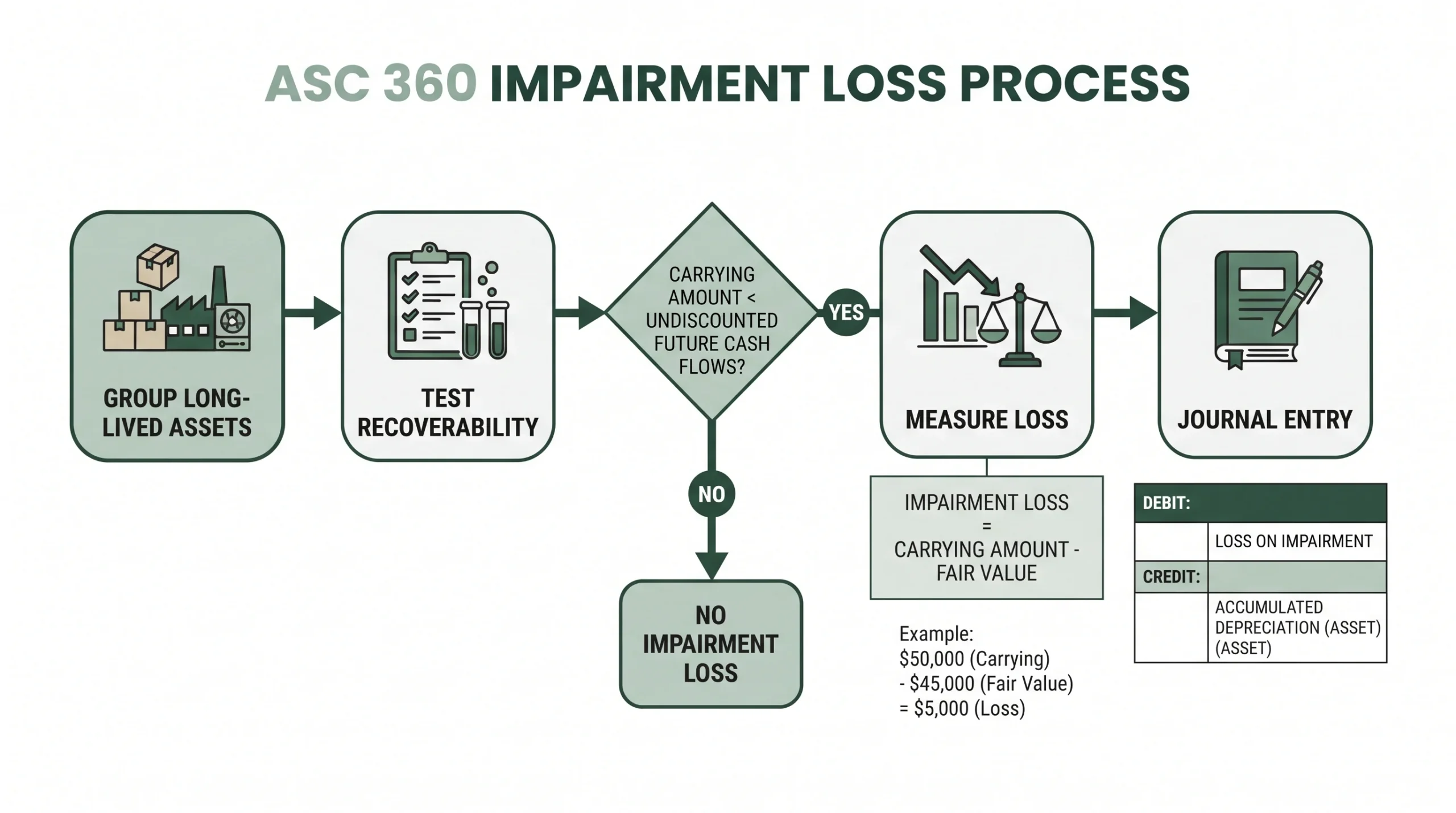
The test starts with a trigger. A sharp drop in market price, a run of operating losses, a change in how an asset is used, or a worsening business climate all count. When a trigger appears, you run the two steps in order.
Step one is the recoverability test. You add up the undiscounted future cash flows the asset group is expected to produce and compare that total to its carrying amount. If the cash flows are equal to or above the carrying amount, the asset is recoverable and you stop. No loss is booked. If the carrying amount is higher, the asset fails step one and you move on.
Step two is measurement. You compare the carrying amount to fair value. The loss equals carrying amount less fair value. Note the quirk built into the standard. Step one uses undiscounted cash flows, but step two uses fair value, which is a discounted or market-based figure. An asset can clear step one and never reach step two, but once it fails, the loss is measured against fair value alone.
What Is the Impairment Loss Journal Entry?
The entry records the result of step two. You debit Impairment Loss, an expense, and credit the asset. The credit can hit the asset account directly or go to an accumulated impairment account that sits against it. Either way, the carrying amount drops to fair value and the expense flows to the income statement.
Take a machine carried at $500,000 with a fair value of $350,000. The loss is $150,000. You debit Impairment Loss for $150,000 and credit Accumulated Depreciation, or the asset itself, for $150,000. After the entry, the machine sits on the books at $350,000. That new figure becomes the asset’s cost basis going forward, and future depreciation runs off the lower number.
Where Does the Impairment Loss Appear on the Financial Statements?
The loss appears on the income statement as an operating expense within continuing operations, because the asset serves the core business. It is a non-cash charge. It lowers operating income and net income for the period, which in turn reduces retained earnings on the balance sheet. No cash leaves the business when you record it.
U.S. GAAP also requires footnote disclosure for a material impairment. The notes identify the asset or asset group, explain why the loss happened, and state the method used to find fair value. Those disclosures let a lender or investor see what drove the charge and whether it signals a one-time event or a deeper problem.
Why Is Asset Grouping the Hard Part?
ASC 360 does not measure a single machine in a vacuum. It measures the lowest group of assets that generates largely independent cash flows. That group, not the individual item, is the unit of account for both the recoverability test and the measurement. Draw the group too wide and a weak asset hides inside strong ones, so no loss appears. Draw it too narrow and you record a loss the business would not otherwise show.
This is the judgment call that drives the whole entry. A plant with shared production lines may be one group. A chain of stores may be one group per store. The cash flow lines are rarely obvious, and reasonable people land in different places. Because the group sets the loss, the grouping decision, not the arithmetic, is where most of the risk and most of the disagreement live.
Can an Impairment Loss Be Reversed, and How Is It Taxed?
Under U.S. GAAP, a loss on an asset held for use cannot be reversed. ASC 360 bars any write-up if the asset later recovers in value. The written-down figure becomes the new cost basis and stays there. IFRS takes the other view. Under IAS 36, most impairments, except goodwill, can be reversed up to the original carrying amount if the recoverable amount rises. A company reporting under both frameworks has to track this divergence, because it changes earnings in a recovery year.
Tax follows a separate track. A book impairment is not a deductible event. The tax code allows a loss deduction only when the asset is sold, abandoned, or otherwise disposed of, under Internal Revenue Code Section 165. Until disposition, the asset keeps its tax basis and keeps depreciating under Section 167, which creates a book-to-tax difference. When the asset is finally sold, the gain or loss is reported on Form 4797.
Who Values Impaired Assets, and How Do the Options Compare?
Owners pick a partner based on the size of the asset base, the audit exposure, and the budget. Large national firms such as Alvarez & Marsal, Stout, and Kroll serve big public companies with broad advisory teams. Sofer Advisors focuses on defensible, partner-led fair value measurements for closely held and middle-market businesses, with expert witness testimony in 11+ cases behind its reports and 180+ five-star Google reviews. You can see how Sofer Advisors approaches financial reporting valuations for these engagements. The table below sets out the common options.
| Provider | Typical role | Best for |
|---|---|---|
| Specialized valuation firm (e.g. Sofer Advisors) | Measures fair value, defines the asset group, and documents the loss | Closely held and middle-market companies needing audit-ready support |
| Large national firm | Broad advisory plus valuation at enterprise scale | Large public companies with complex, multi-entity reporting |
| Internal accounting team | Spots the trigger and books the entry; rarely sets fair value | Routine closes where no material impairment is in play |
Sofer Advisors runs each engagement through a four-phase process it calls The Sofer Difference, moving from Discovery to Diligence to Analysis to Delivery. That structure keeps every fair value tied to the asset group and the cash flows behind it. It reflects the Heart of a Teacher approach, which means explaining the reasoning behind a number rather than just handing over a figure. For a loss that stands up to an audit, an independent measurement supplies both the value and the trail of evidence behind it.
Frequently Asked Questions
Where do I show impairment loss in the P&L?
An impairment loss shows on the income statement as an operating expense, inside income from continuing operations, because the asset serves the core business. It is a non-cash charge that lowers net income for the period and, in turn, reduces retained earnings on the balance sheet. Sofer Advisors classifies each write-down correctly during financial reporting work, so the loss lands in the right line and the statements stay clean for lenders and auditors.
What is an impairment loss in accounting?
An impairment loss is the amount by which a long-lived asset’s carrying value exceeds its fair value once that asset fails the recoverability test. It reflects a permanent decline, not routine wear, and it writes the asset down to what it is actually worth. Sofer Advisors tests these assets objectively under ASC 360, so owners know whether a real loss exists before anything is booked to the financial statements.
How is an impairment loss treated in accounting?
You adjust the asset’s carrying value down to fair value by debiting an impairment loss expense and crediting the asset or its accumulated depreciation. Under U.S. GAAP the write-down is permanent, so you cannot reverse it even if the asset’s value later recovers. Sofer Advisors follows these rules step by step and documents each one, giving owners accurate, defensible adjustments that survive an auditor’s review of the records.
What is the journal entry for an impairment loss?
The entry is a debit to Impairment Loss and a credit to the asset, or to an accumulated impairment account, for the amount of the loss. A machine carried at $500,000 with a fair value of $350,000 takes a $150,000 debit to the loss and a $150,000 credit to the asset. Sofer Advisors measures that fair value first, so the dollar figure in the entry rests on evidence rather than on a rough estimate.
Is an impairment loss an operating expense?
Yes. An impairment loss is usually an operating expense because the write-down relates to assets used in the principal activities of the business. The non-cash charge reduces operating income, which feeds the performance measures lenders and investors watch most closely. Sofer Advisors explains how the charge moves operating results and prepares the supporting detail management needs when it reports the loss to boards and outside stakeholders.
Can an impairment loss be reversed under US GAAP?
No. For an asset held for use, U.S. GAAP does not allow a reversal, even if the asset’s value climbs back in a later period. The written-down amount becomes the new cost basis and stays there. IFRS differs and permits reversals for most assets other than goodwill. Sofer Advisors flags this divergence for clients who report under both frameworks, so the earnings effect in a recovery year is never a surprise.
What is the difference between impairment and depreciation?
Depreciation is the steady, scheduled allocation of an asset’s cost over its useful life. Impairment is an irregular, one-time adjustment for a sudden, permanent drop in value. Depreciation runs every period regardless of market conditions, while impairment only triggers when a specific event signals the carrying amount is no longer recoverable. Sofer Advisors identifies those triggers, so your statements keep normal wear and a genuine value loss clearly separate.
How much does an ASC 360 impairment testing engagement cost?
Most ASC 360 impairment testing engagements run from $7,500 to $25,000 and take about two to six weeks, depending on the number of asset groups, the industry, and the deadline. A flat fee is quoted up front, so the cost is clear before the work starts. Sofer Advisors scopes the engagement first, then quotes a fixed price. Request a free estimate for your situation.
Related Case Studies
- ASC 360 Impairment of Long-Lived Assets: A Complete Guide
- ASC 360 Impairment Loss: Measuring Fair Value (Step 2)
- Asset Grouping Under ASC 360: The Unit of Account
Executive Summary
An impairment loss journal entry debits Impairment Loss and credits the asset, writing the carrying amount down to fair value. The entry is simple, but the work that precedes it is not. ASC 360 first asks you to group the assets that produce independent cash flows, then run the recoverability test against undiscounted cash flows, then measure the loss as carrying amount less fair value. The loss is an operating expense in continuing operations, and it cannot be reversed once booked. Tax treats it separately, with no deduction until the asset is sold under Section 165. The grouping decision drives the whole result, so the first real step is a defensible asset group and a fair value backed by evidence.
What Should You Do Next?
Pull the fixed-asset register, flag the triggering event, and map the cash flows by asset group before you touch a single debit or credit. Confirm whether you are testing under ASC 360 or ASC 350, since the level and timing differ. This guide was prepared by David Hern CPA ABV ASA, founder of Sofer Advisors, an Inc. 5000 firm specializing in neutral third-party valuations for financial reporting. Schedule a free consultation to discuss your specific situation.
People Also Read
- The Recoverability Test: Undiscounted Cash Flows Under ASC 360 (Step 1)
- ASC 360 vs ASC 350: Which Impairment Standard Applies?
About the Author
This guide was prepared by David Hern CPA ABV ASA, founder of Sofer Advisors, a business valuation firm headquartered in Atlanta, GA serving clients across the United States. David holds dual accreditations as an Accredited Senior Appraiser (ASA) and is Accredited in Business Valuation (ABV), credentials recognized by the IRS, SEC, and FINRA. He also holds the Certified Exit Planning Advisor (CEPA) designation. With 15+ years of valuation experience, David has served as an expert witness in 11+ cases across multiple jurisdictions and built Sofer Advisors into an Inc. 5,000-recognized firm with 180+ five-star Google reviews. Its full W2 employee team maintains subscriptions to all major valuation databases and operates under a next business day response policy.
For professional business valuation services, visit soferadvisors.com/about-us/ or contact Sofer Advisors at soferadvisors.com/contact-us/.
This content is for informational purposes only and does not constitute professional valuation advice. Business valuation conclusions depend on specific facts and circumstances. Contact Sofer Advisors for guidance regarding your specific situation.









