


Last Updated: September 2026
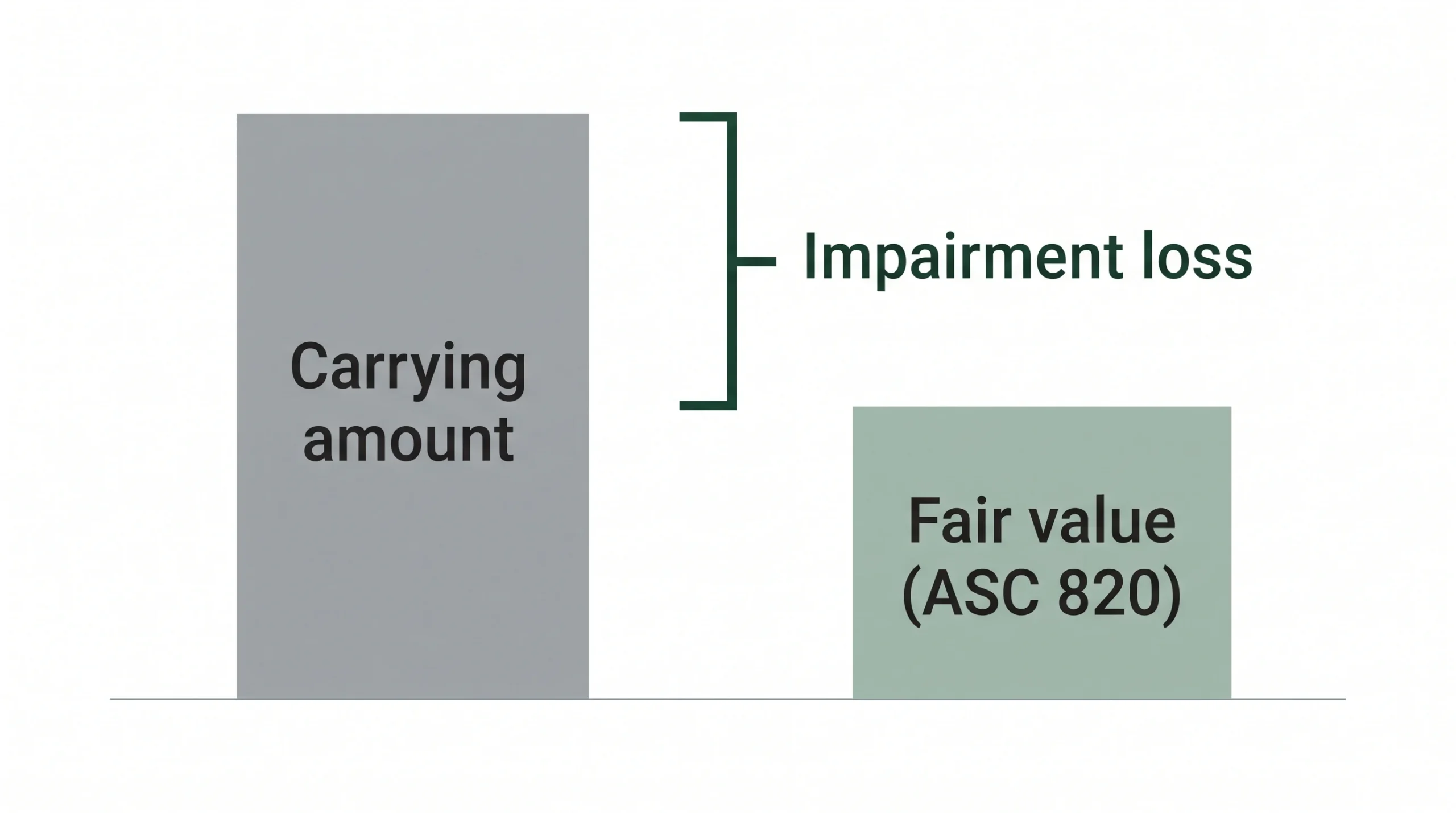
An ASC 360 impairment loss is the amount by which a long-lived asset group’s carrying amount exceeds its fair value. Step 2 of the test measures that gap. You reach Step 2 only after the asset group fails the Step 1 recoverability test. The loss then equals carrying amount minus fair value, and fair value is set under ASC 820. Testing engagements under ASC 350 or 360 usually run $7,500 to $25,000.
This step matters because it fixes the size of the write-down on your balance sheet. A wrong fair value can overstate or understate net income for the period. Owners of asset-heavy firms meet this test during audits, restructurings, or after a plant or store slows down. Getting fair value right keeps the financial statements accurate and defensible.
Sofer Advisors provides independent fair value measurements for financial reporting. The firm applies ASC 820 methods to long-lived asset groups and records each input for auditors. Its team has served as an expert witness in 11+ cases and holds 180+ five-star Google reviews. That track record helps leaders present a number that holds up in an audit or a dispute.
Key Takeaways
- Step 2 measures the loss: the impairment loss equals carrying amount minus fair value, and only after Step 1 fails.
- Fair value follows ASC 820: analysts use the income, market, or cost approach to set an exit price.
- The loss is allocated pro rata: spread it across the group’s long-lived assets, but never below a single asset’s fair value.
- No reversals under US GAAP: once you write the asset down, that lower value becomes the new cost basis.
- Triggering events start the test: a market price drop, idle assets, or ongoing losses call for a review.
These rules shape how a company reports the true worth of its plants, stores, and equipment. The sections below show how you measure fair value, split the loss, and record it in a way auditors accept.
What is Step 2 of the ASC 360 impairment test?
Step 2 is the stage where you measure the actual loss. It begins only after an asset group fails the Step 1 recoverability test. In Step 1 you compare the group’s carrying amount to the sum of its undiscounted future cash flows. If those cash flows fall short, the group is impaired and you move to Step 2. There you find the group’s fair value and subtract it from the carrying amount. That difference is the impairment loss.
The two steps answer different questions. Step 1 asks whether a loss exists. Step 2 asks how large it is. Undiscounted cash flows drive the first test, but they never set the loss amount. Only fair value does that. This split keeps a small dip in cash flow from forcing a write-down when the asset can still recover its cost through use.
When does an asset group move to Step 2?
An asset group moves to Step 2 when a triggering event occurs and the group then fails Step 1. A triggering event is a change that suggests the carrying amount may not be recoverable. Common signs include a sharp drop in an asset’s market price or a plant left idle. Others include new legal or business changes, cost overruns, or a run of operating losses. When one appears, you run the Step 1 recoverability test.
The order matters. A triggering event alone does not create a loss. It only forces the recoverability test. If the undiscounted cash flows still cover the carrying amount, the group passes and no loss is recorded. If they do not, the group fails and you measure fair value in Step 2. Careful tracking of these events keeps the timing of each test clear and well documented.
How do you measure fair value under ASC 820?
You measure fair value as an exit price, the amount a market participant would pay for the asset group. ASC 820 sets this framework and gives three approaches. The income approach discounts the group’s expected future cash flows to a present value. The market approach compares the assets to similar units that recently sold. The cost approach measures what a buyer would pay to replace the assets with ones of like use and age.
The right approach depends on the asset and the data at hand. Specialized equipment with no active market often needs the cost or income approach. Common assets may suit the market approach. ASC 820 also ranks inputs into three levels, from quoted market prices to internal estimates. When a firm relies on internal estimates, those Level 3 inputs draw the closest audit review. Our guide to ASC 820 fair value measurement explains these levels in depth.
Independent appraisers follow professional rules when they build these estimates. Standards such as USPAP guide how an appraiser documents inputs and supports each conclusion. Sofer Advisors’ financial reporting valuation team measures fair value under these rules and keeps a clear record for auditors to test.
How is the impairment loss allocated across the asset group?
You allocate the loss across the group’s long-lived assets on a pro rata basis. The split uses the relative carrying amounts of the assets in the group. So an asset that makes up 40 percent of the group’s carrying amount absorbs 40 percent of the loss. This method keeps the write-down proportional and easy to trace.
One limit protects each asset. You cannot reduce any single asset below its own fair value when that fair value is known. If the pro rata share would push an asset under its fair value, you stop at that floor. You then spread the leftover loss across the other assets in the group. The team applies this floor to every asset with a measurable value so no single item is written down too far.
How do you record the loss, and can it be reversed?
You record the loss with a journal entry that lowers the asset and cuts current income. The entry debits an impairment loss account and credits the asset or its accumulated depreciation. The write-down reduces net income from continuing operations for the period. The new, lower carrying amount then becomes the basis for future depreciation over the asset’s remaining life.
Under US GAAP, the loss is permanent for assets held for use. You cannot reverse it if fair value later recovers. This is a key contrast with international rules. The IFRS standard IAS 36 permits a reversal when the recoverable amount rises again. So the same recovery can look different on a US statement and an international one. Sofer Advisors flags this gap for firms that report under both systems, drawing on guidance such as the SEC Financial Reporting Manual.
What does an ASC 360 impairment analysis cost, and who provides it?
An ASC 360 impairment analysis usually costs $7,500 to $25,000 and takes 2 to 6 weeks. The price depends on the number of asset groups and the depth of the fair value work. Large national firms such as Alvarez & Marsal, Stout, and Kroll serve the biggest public deals at enterprise rates. Independent firms serve small-cap and private companies with a more direct, senior-led approach. The table below compares the main options.
| Provider | Typical focus | Best fit for |
| Sofer Advisors | ASC 360, 350, 820, and 805 fair value work; $7,500 to $25,000, 2 to 6 weeks | Small-cap public and private companies |
| Stout | Broad financial reporting and transaction opinions | Large public and private-equity clients |
| Kroll | Complex, cross-border valuation and disputes | Global and enterprise filers |
| Alvarez & Marsal | Restructuring and enterprise advisory | Large corporations in transition |
Smaller companies often want a partner who explains the mechanics, not just a number. That is the Heart of a Teacher approach that guides each engagement. It also reflects The Sofer Difference, a four-phase process of Discovery, Diligence, Analysis, and Delivery. Sofer Advisors keeps senior staff on every file so owners see how each input shapes the result. Assessing cost against your audit needs is the first step toward a defensible test.
Frequently Asked Questions
Is an impairment loss based on book value or fair value?
An impairment loss is based on fair value, not book value alone. Under ASC 360, the loss equals the carrying amount, or book value, minus the asset group’s fair value. Book value sets the starting point, but fair value sets the floor to which you write the group down. So both figures matter, yet fair value drives the size of the recorded loss.
Which ASC standard covers fair value?
ASC 820, Fair Value Measurement, is the standard that defines and measures fair value under US GAAP. It sets fair value as the price to sell an asset in an orderly deal between market participants. It also ranks the inputs used into three levels. Other standards, including ASC 360, point to ASC 820 whenever they require a fair value figure.
What are the triggering events for an ASC 360 impairment test?
Triggering events are changes that suggest an asset group may no longer be recoverable. Common ones include a sharp drop in an asset’s market price and a major change in how an asset is used. Others are new legal or business shifts, costs that run well over budget, and a history of operating losses. Any of these signs calls for the Step 1 recoverability test.
How do you calculate the impairment amount?
You first set the fair value of the asset group using the income, market, or cost approach. You then subtract that fair value from the carrying amount on the balance sheet. The positive difference is the impairment loss for the period. This calculation applies only after the group fails the Step 1 recoverability test, so undiscounted cash flows do not set the loss.
Can an ASC 360 impairment loss be reversed?
No, an impairment loss on assets held for use cannot be reversed under US GAAP. Once you write the carrying amount down, that lower figure becomes the new cost basis. Future depreciation runs off that new basis. This rule keeps reporting consistent over time. It also differs from IFRS, which allows a reversal when the recoverable amount later rises.
What is an asset group under ASC 360?
An asset group is the lowest level of assets with cash flows largely independent of other assets. You test the group as a unit, not each asset alone. This grouping reflects how assets earn value together, such as a single store or plant. Defining the group correctly is vital, because it sets what you compare against carrying amount in both steps of the test.
How is the impairment loss spread across the assets?
The loss is spread across the group’s long-lived assets in proportion to their carrying amounts. An asset that holds a larger share of the carrying amount takes a larger share of the loss. One limit applies: you cannot cut any single asset below its own fair value when that value is known. Any leftover loss then moves to the other assets in the group.
What is the difference between held for use and held for sale?
Assets held for use are still active in the business and are tested on recoverability. Assets held for sale are measured at the lower of carrying amount or fair value less the cost to sell. Assets held for sale also stop being depreciated once they take that label. The two classes follow different rules, so correct labeling changes how and when you record any loss.
How much does an ASC 360 impairment analysis from Sofer Advisors cost?
An ASC 360 impairment analysis from Sofer Advisors typically costs $7,500 to $25,000 and takes 2 to 6 weeks. The range depends on the number of asset groups and the depth of the fair value modeling. It covers the research, the valuation work, and the documentation an auditor will review. For a quote tied to your assets, contact Sofer Advisors with your asset list.
Related Case Studies
- Impairment Testing: Sofer Advisors’ Complete Guide
- Goodwill Impairment Testing ASC 350: Complete Guide for 2025-2026
- ASC 820 Fair Value Measurement: Hierarchy Levels Explained
Executive Summary
Step 2 of the ASC 360 test measures a loss once an asset group fails the Step 1 recoverability test. The loss equals carrying amount minus fair value, with fair value set under ASC 820 using the income, market, or cost approach. You allocate the loss across the group’s long-lived assets pro rata, but never below any single asset’s fair value. The journal entry lowers the asset and cuts current income, and the new basis is permanent. Unlike IFRS, US GAAP allows no reversal. Impairment testing under ASC 350 or 360 usually runs $7,500 to $25,000 over 2 to 6 weeks.
What Should You Do Next?
Review your fixed asset ledgers and recent results for triggering events, such as idle assets or repeated losses. Run the Step 1 recoverability test on any group at risk, then measure fair value under ASC 820 for those that fail. Document each input and approach so your write-down holds up in the audit.
David Hern CPA ABV ASA, founder of Sofer Advisors, provides independent fair value measurements for financial reporting. Schedule a consultation to discuss your situation.
People Also Read
- What is Impairment Testing? Asset Value Assessment Guide
- Difference Between Book Value and Fair Value Explained
About the Author
This guide was prepared by David Hern CPA ABV ASA, founder of Sofer Advisors, a business valuation firm headquartered in Atlanta, GA serving clients across the United States. David holds dual accreditations as an Accredited Senior Appraiser (ASA) and is Accredited in Business Valuation (ABV), credentials recognized by the IRS, SEC, and FINRA. He also holds the Certified Exit Planning Advisor (CEPA) designation. With 15+ years of valuation experience, David has served as an expert witness in 11+ cases across multiple jurisdictions and built Sofer Advisors into an Inc. 5000-recognized firm with 180+ five-star Google reviews. Its full W2 employee team maintains subscriptions to all major valuation databases and operates under a next business day response policy.
For professional business valuation services, visit soferadvisors.com/about-us/ or contact Sofer Advisors at soferadvisors.com/contact-us/.
Disclaimer: This content is for informational purposes only and does not constitute professional valuation advice. Business valuation conclusions depend on specific facts and circumstances. Contact Sofer Advisors for guidance regarding your specific situation.









