


Last Updated: September 2026
ASC 360 asset grouping sorts long-lived assets into the smallest set that produces cash flows largely independent of your other assets and liabilities. That set is the unit of account you test for impairment. You do not test each machine or building on its own. You test the group. This one choice drives both the recoverability test in Step 1 and the size of any loss in Step 2.
The unit of account is a judgment call, and a wrong call changes the answer. Group too broadly and a strong location can mask a weak one. Group too narrowly and you record a loss that does not reflect how the business runs. Owners of asset-heavy firms face this choice during an audit, a restructuring, or after a plant or store slows down.
Sofer Advisors helps companies set and defend these boundaries for financial reporting. The firm maps cash flows to the right unit of account and records the logic for auditors. Its team has served as an expert witness in 11+ cases and holds 180+ five-star Google reviews. That record helps leaders present groupings that hold up in an audit or a dispute.
Key Takeaways
- Use the lowest level: group assets at the lowest level with cash flows largely independent of other assets and liabilities.
- Grouping drives the result: the unit of account shapes both the recoverability test and the measured loss.
- Apply judgment consistently: base groups on how cash is earned, not on reporting lines, and keep the method stable across periods.
- Allocate shared assets with care: corporate assets and overhead join a group only when a reasonable basis exists.
- Both extremes distort: too broad hides real impairment, and too narrow triggers a loss that is not there.
These rules shape how a company reports the true worth of its plants, stores, and equipment. The sections below show how you draw the boundary, why it changes the test, and where firms get it wrong.
What is asset grouping under ASC 360?
Asset grouping is the step where you define the unit of account for an impairment test. ASC 360 covers long-lived assets held for use, such as property, plant, and equipment, plus finite-lived intangibles. You rarely test one asset alone, because most assets earn cash only when they work together. So you gather the related assets into a group and test that group as a whole.
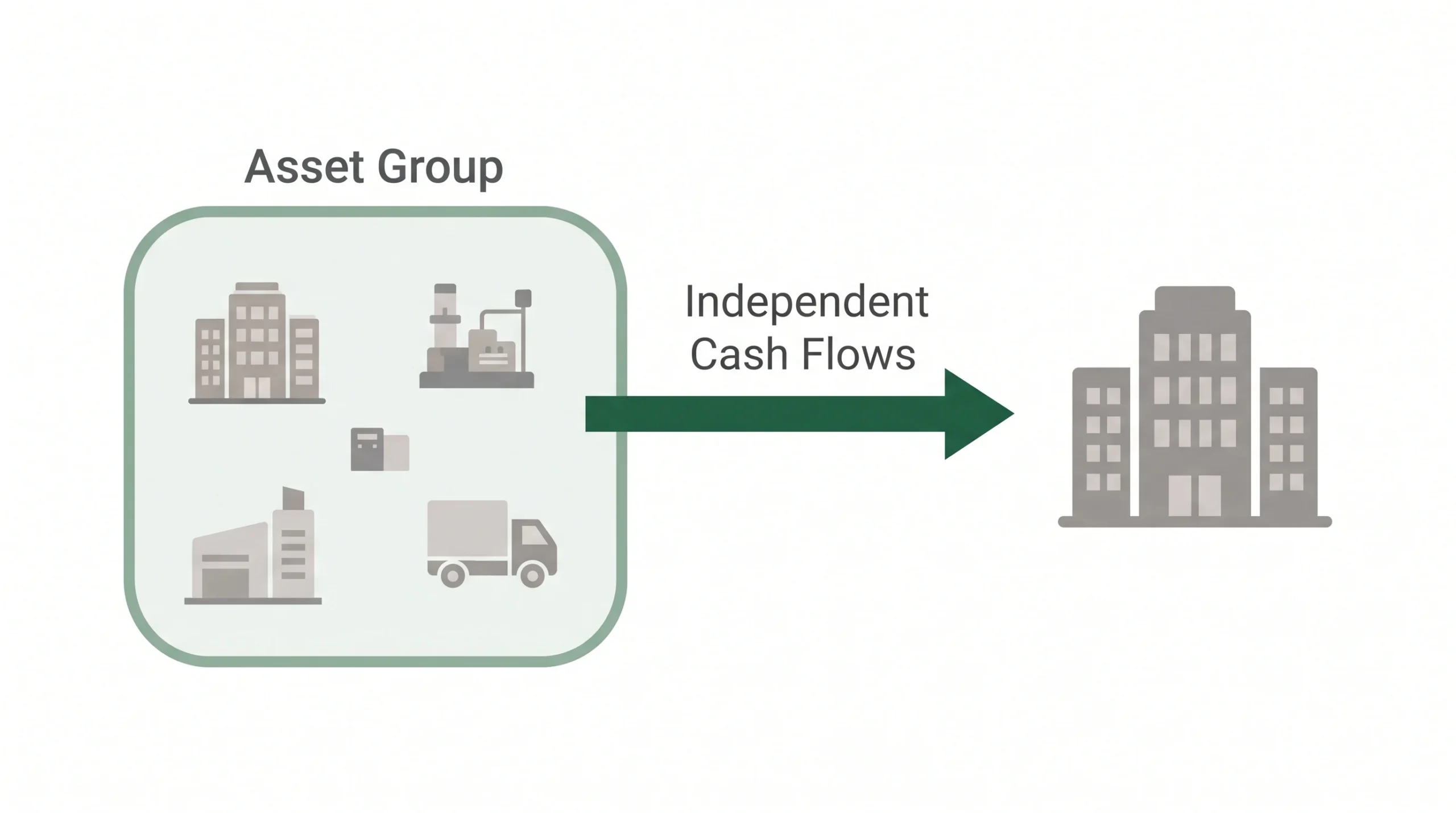
The rule is specific. An asset group is the lowest level for which cash flows are largely independent of the cash flows of other assets and liabilities. A single store in a chain can be a group if its cash flows stand apart. A production line that feeds a second line cannot be split from it, because neither earns cash on its own. Getting the group right is the first task in any ASC 360 review, and it sets up every step that follows.
How do you find the lowest level of independent cash flows?
You find the lowest level by tracing where cash actually comes in and where it depends on other assets. Start with the assets that share customers, output, or a single revenue stream. Ask a plain question about each cluster. Could this set of assets keep earning cash if the rest of the business went away? If the answer is yes, you have found a candidate group. If the answer is no, you widen the boundary until the cash flows stand on their own.
Interdependence is the test, not the org chart. Two stores may report to one regional manager yet still earn cash on their own, so each can be its own group. A warehouse that ships only for one plant is tied to that plant, so the two belong together. Auditors review this logic closely, and standards such as the PCAOB auditing standards guide how they test estimates. A clear map of cash inflows makes the boundary easy to defend.
How does grouping change the impairment result?
Grouping changes the result because the unit of account decides what you compare against carrying amount. Both steps of the test run at the group level. Step 1 compares the group’s undiscounted future cash flows to its carrying amount. Step 2, if the group fails, measures the loss as carrying amount minus fair value. Draw the boundary in a different place and both numbers move.
The two errors pull in opposite directions. A group that is too broad lets a profitable site subsidize a failing one, so real impairment stays hidden and no write-down appears. A group that is too narrow strips out supporting assets, so a normal dip looks like a loss. Testing each grouping against how cash is truly earned keeps both numbers on solid ground. Consistent grouping year to year also keeps results comparable.
How are shared and corporate assets handled?
Shared and corporate assets are handled by allocation, but only when a reasonable and consistent basis exists. A corporate headquarters, a shared IT system, or a central research site supports many groups at once. These assets do not earn cash on their own, so they do not form a group by themselves. Instead, you assign a fair share of their carrying amount to each asset group that they support.
The method has to be defensible. You might allocate a shared building by square footage used, or a support function by headcount or revenue. If no reasonable basis exists, the corporate asset is tested at a higher level, along with the whole set of groups it serves. Independent appraisers document each allocation and each input, and standards such as USPAP guide how they support those conclusions. Sofer Advisors’ financial reporting valuation team sets these allocations and keeps a clear record for auditors to follow.
What are the most common asset grouping mistakes?
The most common mistake is grouping by management reporting lines instead of by independent cash flows. Firms often treat a department, a division, or a geographic region as the group because that is how internal reports are built. That structure rarely matches where cash is actually earned. Other frequent errors include folding a shared corporate asset into one plant’s group, changing the boundary from year to year, and grouping every site into one large unit that buries a weak location.
The provider you choose affects how well the grouping holds up. Large national firms serve the biggest public filers, while independent firms give small-cap and private companies a more direct, senior-led review. Public registrants also weigh guidance such as the SEC Financial Reporting Manual when they set and disclose their policy. The table below compares the main options.
| Provider | Typical focus | Best fit for |
| Sofer Advisors | ASC 360, 350, 820, and 805 valuation work; $7,500 to $25,000, 2 to 6 weeks | Small-cap public and private companies |
| Stout | Broad financial reporting and transaction opinions | Large public and private-equity clients |
| Kroll | Complex, cross-border valuation and disputes | Global and enterprise filers |
| Alvarez & Marsal | Restructuring and enterprise advisory | Large corporations in transition |
An ASC 360 impairment analysis usually runs $7,500 to $25,000 and takes 2 to 6 weeks, set by the number of groups and the depth of the work. Smaller companies often want a partner who explains the mechanics, not just a conclusion. That is the Heart of a Teacher approach behind each engagement. It also reflects The Sofer Difference, a four-phase process of Discovery, Diligence, Analysis, and Delivery. Sofer Advisors keeps senior staff on every file, so owners see how each grouping choice shapes the test.
Frequently Asked Questions
What are the three categories of assets?
Assets are usually sorted into current, non-current, and intangible categories for financial reporting. Current assets convert to cash within one year, such as inventory or receivables. Non-current assets are long-term holdings like property, plant, and equipment. Intangible assets are non-physical rights, such as patents or goodwill. ASC 360 asset grouping applies to the long-lived assets in the second category and to finite-lived intangibles.
What is ASC 360?
ASC 360 is the FASB standard for the impairment and disposal of long-lived assets. It requires a company to review property, plant, equipment, and similar assets when events suggest the carrying amount may not be recoverable. The standard sets a two-step test at the asset group level. It keeps assets from sitting on the balance sheet above the value the business can recover through use or sale.
What is included in ASC 360-10?
ASC 360-10 holds the core guidance for impairment and disposal of long-lived assets. It covers how to recognize and measure an impairment loss, how to define an asset group, and how to present assets held for sale. It also explains the recoverability test and the fair value measurement that follows a failed test. This subtopic is where the asset grouping rules for held-for-use assets live.
What are the criteria for classifying assets as held for sale under ASC 360?
An asset is held for sale only when management commits to a plan, the asset is ready for immediate sale, and an active search for a buyer is under way. The sale must be probable within one year, and the asset must be marketed at a reasonable price. Held-for-sale assets are measured at the lower of carrying amount or fair value less cost to sell. They also stop being depreciated once they take that label.
Can corporate assets be included in an asset group?
Corporate assets do not earn cash on their own, so they are not a group by themselves. A portion may be assigned to an asset group when a reasonable and consistent basis for allocation exists, such as space used or headcount. If no reasonable basis exists, the corporate asset is tested at a higher level that covers the groups it supports. Correct handling of these shared assets keeps the recoverability test accurate.
What is the difference between ASC 360 and ASC 350 grouping?
ASC 360 tests long-lived tangible assets and finite-lived intangibles at the asset group level, which is the lowest level of largely independent cash flows. ASC 350 tests goodwill and indefinite-lived intangibles at the reporting unit level, which is usually higher. The two units of account are not the same, so an asset can sit in one group for ASC 360 and roll into a larger reporting unit for ASC 350. Firms often run both tests in a set order.
How often should a company review its asset groups?
A company should revisit its asset groups whenever the business changes, such as an acquisition, a closure, or a shift in how sites earn cash. Groups are not tested on a fixed calendar; the review is triggered by events that hint at impairment. Even so, an annual look keeps the boundaries current and consistent. Stable groups from year to year make the results easier to compare and to defend.
What triggers an ASC 360 impairment test?
A test is triggered by an event that suggests the carrying amount of an asset group may not be recoverable. Common signs include a sharp drop in an asset’s market price, an idle plant, physical damage, or a run of operating losses. New legal or business changes can also force a review. When a trigger appears, you run the Step 1 recoverability test on the affected group.
How much does an ASC 360 asset grouping analysis from Sofer Advisors cost?
An ASC 360 impairment analysis from Sofer Advisors typically costs $7,500 to $25,000 and takes 2 to 6 weeks. The range depends on the number of asset groups and the depth of the fair value work. It covers the grouping logic, the valuation, and the documentation an auditor will review. For a quote tied to your assets, contact Sofer Advisors with your fixed asset list.
Related Case Studies
- Impairment Testing: Sofer Advisors’ Complete Guide
- Goodwill Impairment Testing ASC 350: Complete Guide for 2025-2026
- ASC 820 Fair Value Measurement: Hierarchy Levels Explained
Executive Summary
ASC 360 asset grouping sets the unit of account for an impairment test. You group long-lived assets at the lowest level with cash flows largely independent of other assets and liabilities. That boundary drives both the Step 1 recoverability test and the Step 2 loss, so a wrong grouping changes the result. Base each group on how cash is earned, not on reporting lines, and apply the same logic every period. Allocate shared corporate assets only when a reasonable basis exists. Grouping too broadly hides real impairment, while grouping too narrowly books a loss that is not real. An ASC 360 analysis usually runs $7,500 to $25,000 over 2 to 6 weeks.
What Should You Do Next?
Pull your fixed asset register and map how each site or line earns cash. Draw the smallest boundary where those cash flows stand on their own, then apply the same logic across every reporting period. Document why each asset sits inside or outside a group, and record how you allocate any shared corporate asset, so an auditor can follow the trail.
David Hern CPA ABV ASA, founder of Sofer Advisors, sets and defends asset groupings for financial reporting. Schedule a consultation to discuss your situation.
People Also Read
- What is Impairment Testing? Asset Value Assessment Guide
- Purchase Price Allocation ASC 805 and IFRS 3: Complete Guide for Business Leaders
About the Author
This guide was prepared by David Hern CPA ABV ASA, founder of Sofer Advisors, a business valuation firm headquartered in Atlanta, GA serving clients across the United States. David holds dual accreditations as an Accredited Senior Appraiser (ASA) and is Accredited in Business Valuation (ABV), credentials recognized by the IRS, SEC, and FINRA. He also holds the Certified Exit Planning Advisor (CEPA) designation. With 15+ years of valuation experience, David has served as an expert witness in 11+ cases across multiple jurisdictions and built Sofer Advisors into an Inc. 5000-recognized firm with 180+ five-star Google reviews. Its full W2 employee team maintains subscriptions to all major valuation databases and operates under a next business day response policy.
For professional business valuation services, visit soferadvisors.com/about-us/ or contact Sofer Advisors at soferadvisors.com/contact-us/.
Disclaimer: This content is for informational purposes only and does not constitute professional valuation advice. Business valuation conclusions depend on specific facts and circumstances. Contact Sofer Advisors for guidance regarding your specific situation.









