


Last Updated: September 2026
ASC 360 impairment is the write-down a company records when a long-lived asset is worth less on the books than the cash it can still earn. Under U.S. GAAP, this happens through a two-step test. First you check whether the asset group is recoverable. Then, if it is not, you measure the loss. Companies run this test only when a triggering event points to a decline in value, not on a fixed annual schedule.
The rule matters because an impairment charge lands straight on the income statement and lowers net income. It also keeps the balance sheet honest, so assets are not carried above their real worth. Controllers and CFOs who oversee large equipment or real estate face it most often. Getting the timing and math right protects the financial statements.
Sofer Advisors provides independent fair value and impairment analysis for financial reporting. With 180+ five-star Google reviews and work on 11+ expert witness cases, its credentialed appraisers help finance teams support each number for auditors and bring an outside, defensible view to reported earnings.
Key Takeaways
- Testing is event-driven: long-lived assets are tested only when a triggering event suggests the carrying amount may not be recoverable, not on an annual cycle.
- The test has two steps: compare the carrying amount to undiscounted future cash flows first, then measure the loss against fair value if the asset group fails.
- The loss is carrying amount minus fair value: the write-down is recorded on the income statement and reduces net income for the period.
- No reversals: once recorded for an asset held for use, the loss is final under U.S. GAAP, and the reduced amount becomes the new cost basis.
- ASC 360 is not ASC 350: ASC 360 covers tangible and finite-lived assets, while ASC 350 covers goodwill and indefinite-lived intangibles on an annual schedule.
These rules sit at the center of accurate financial reporting for any business with a large asset base. The sections below walk through each testing phase, the assets in scope, and the disclosures that follow a write-down.
What triggers an ASC 360 impairment test?
A triggering event is any change that suggests a long-lived asset or asset group may no longer be worth its carrying amount. ASC 360 does not set a yearly test date. Instead, management watches for signs of decline and tests only when one appears. This keeps the balance sheet from overstating assets that have lost economic value.
Common triggers include the following signs:
- A large drop in the market price of the asset
- Physical damage or a decline in condition that limits use
- A plan to sell or abandon the asset before the end of its useful life
- A negative change in laws, regulations, or the business climate
- Current operating losses tied to the asset with more losses expected
Not every soft quarter forces a test. The real question is whether the event makes recovery of the carrying amount unlikely. When a true trigger appears, the company must act in that period. Sofer Advisors helps controllers judge whether an indicator rises to that level and document the call for auditors.
How does the two-step impairment test work?
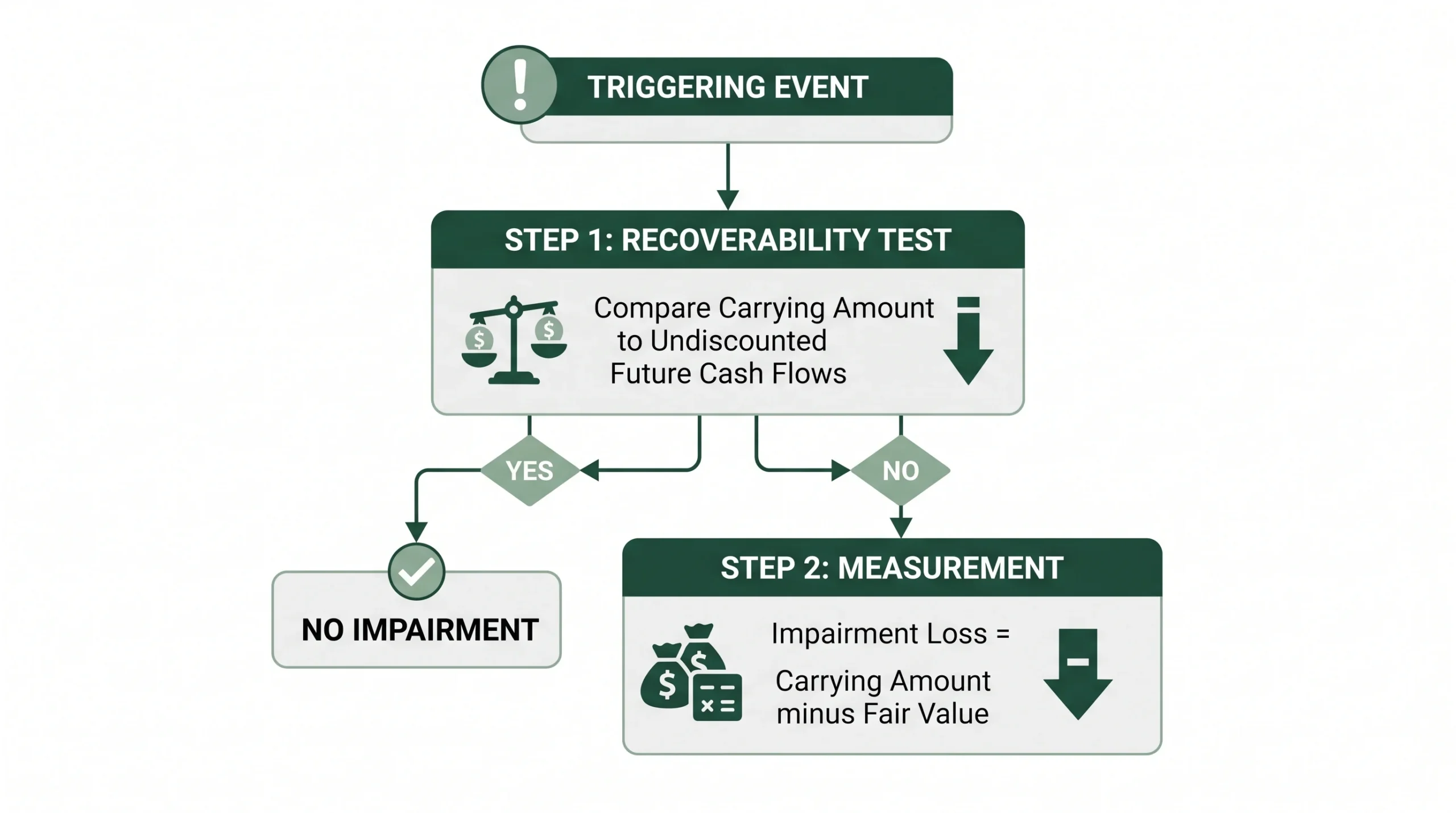
The two-step test first asks if an asset group is recoverable, then measures any loss. Step one is the recoverability test. You add up the undiscounted future cash flows the asset group is expected to produce, then compare that total to its carrying amount. If the cash flows equal or exceed the carrying amount, the asset group passes and no loss is recorded.
Step two begins only when the asset group fails step one. Here you measure the impairment loss as the carrying amount minus the asset group’s fair value. Note the shift: step one uses undiscounted cash flows, step two uses fair value, or what a buyer would pay today. The company records the loss on the income statement and lowers the asset’s basis on the balance sheet.
Grouping matters at both steps. Assets are tested at the lowest level for which cash flows are largely independent. That level is the asset group, and choosing it too broadly or too narrowly can change the result. Sofer Advisors builds and documents these cash flow models so the conclusion holds up under review.
Which long-lived assets does ASC 360 cover?
ASC 360 covers long-lived assets held for use or held for sale, mainly property, plant, and equipment and finite-lived intangibles. That includes buildings, machinery, land improvements, and equipment, plus amortizing intangibles such as patents, customer relationships, and set-life licenses.
The standard leaves out asset types that follow their own rules. Goodwill and indefinite-lived intangibles fall under ASC 350. Financial instruments, deferred tax assets, and certain contract rights each have separate guidance. Knowing the scope early keeps a company from testing the wrong asset under the wrong model.
How is an impairment loss measured and recorded?
An impairment loss equals the amount by which an asset’s carrying amount exceeds its fair value, once the asset group has failed the recoverability test. Fair value is the price a buyer and seller would agree on in an orderly sale today. Appraisers estimate it under professional standards such as the AICPA Statement on Standards for Valuation Services and USPAP, using the market, income, or cost approach.
The accounting entry debits an impairment loss account and credits the asset or its accumulated depreciation. This lowers the carrying amount to fair value. From that point the reduced amount is the new cost basis. Under U.S. GAAP the loss cannot be reversed for an asset held for use, even if the asset recovers value later. This is a key difference from IFRS, which allows some reversals.
Sofer Advisors follows a four-step method it calls The Sofer Difference, moving through Discovery, Diligence, Analysis, and Delivery. With a Heart of a Teacher approach, it walks controllers through each assumption behind the fair value estimate. That clarity helps the number stand up when an auditor asks how it was built.
What is the difference between held for use and held for sale?
An asset held for use still runs in the business, while an asset held for sale is one management has committed to selling. A held-for-use asset keeps depreciating and is tested under the two-step model. A held-for-sale asset stops depreciating and is measured at the lower of its carrying amount or fair value less costs to sell.
The label is not a matter of convenience. To be held for sale, the asset must be ready for immediate sale, actively marketed at a fair price, and likely to sell within a year. If those tests are not met, it stays held for use. Sorting this out early sets the right measurement.
How does ASC 360 differ from ASC 350 for goodwill?
ASC 360 governs long-lived tangible and finite-lived assets, while ASC 350 governs goodwill and indefinite-lived intangibles. The testing triggers and the math differ too. ASC 360 tests only after a triggering event and uses the two-step model at the asset-group level. ASC 350 requires an annual test at the reporting-unit level and compares fair value directly to carrying amount. The table below lays out the split.
| Feature | ASC 360 (long-lived assets) | ASC 350 (goodwill) |
| Assets covered | PP&E and finite-lived intangibles | Goodwill and indefinite-lived intangibles |
| When tested | Only after a triggering event | At least annually |
| Test level | Asset group | Reporting unit |
| Method | Two-step: recoverability then fair value | One-step: fair value vs carrying amount |
| Reversal allowed | No | No |
Both standards protect the same goal, an honest balance sheet, on different paths. A company with plants, equipment, and goodwill may run both tests in one year. Large national firms such as Alvarez & Marsal, Stout, and Kroll perform this work for the biggest public filers. Middle-market companies often want the same rigor with senior attention, which is where Sofer Advisors offers financial reporting valuation for these engagements.
What disclosures does ASC 360 require after a write-down?
After recording an impairment, a company must explain the write-down in its financial statement notes. The disclosure describes the impaired asset or asset group and the facts that led to the loss. It also reports the amount of the loss and where it sits on the income statement.
The notes should state how fair value was measured, including the approach and the key inputs. That lets investors, lenders, and auditors judge the write-down in context, the transparency the SEC expects in public filings. A well-supported file, with the trigger, the cash flow model, and the fair value work, makes the audit far smoother.
Frequently Asked Questions
How do I calculate impairment loss?
Calculating an impairment loss takes two steps under ASC 360. First, compare the asset group’s carrying amount to the sum of its undiscounted future cash flows. If the carrying amount is higher, the group fails the recoverability test. Then measure the loss as the carrying amount minus the asset group’s fair value, and record that amount on the income statement.
What is ASC Topic 360?
ASC 360 is the U.S. GAAP standard for the impairment and disposal of long-lived assets. It sets when and how a company recognizes a reduction in the value of property, plant, equipment, and finite-lived intangibles. The standard keeps reported asset values from exceeding the cash those assets can still produce, so the balance sheet reflects real economic worth.
Which assets are required to be tested for impairment annually?
Long-lived assets under ASC 360 are not tested annually. They are tested only when a triggering event suggests the carrying amount may not be recoverable. Annual testing applies instead to goodwill and indefinite-lived intangibles under ASC 350. A company with large equipment holdings should watch for indicators of decline and test in the period an indicator appears.
What does ASC 360-10 apply to?
ASC 360-10 applies to the accounting for the impairment or disposal of long-lived assets held for use or held for sale. It covers tangible assets such as buildings, machinery, and equipment, along with intangible assets that are amortized. It does not apply to goodwill or to intangible assets that are not amortized, since those fall under separate guidance.
Can an impairment loss under ASC 360 be reversed?
No. U.S. GAAP prohibits reversing an impairment loss for an asset held for use once it has been recorded. The reduced carrying amount becomes the new cost basis, and future depreciation runs off that lower figure. This differs from IFRS, which permits reversals in some cases when the asset later recovers value.
What is the difference between an asset held for use and held for sale?
An asset held for use continues to operate in the business and keeps depreciating. An asset held for sale is one management has committed to selling and is measured at the lower of carrying amount or fair value less costs to sell. A held-for-sale asset stops depreciating once it meets the criteria for that classification.
How is the fair value of a long-lived asset determined?
Fair value is the price that would be received to sell an asset in an orderly transaction between market participants. Appraisers estimate it with the market approach, which uses recent sales of similar assets, or the income approach, which discounts projected cash flows. The cost approach may apply for specialized equipment. The method chosen should fit the asset and be documented for auditors.
What happens if a company fails to record an impairment loss?
Skipping a required write-down overstates both assets and net income on the financial statements. That gap can surface during the annual audit, draw regulatory attention, and mislead lenders or investors about the company’s real position. Recording the loss when the evidence calls for it keeps the statements accurate and reduces the risk of a later restatement.
How much does ASC 360 impairment testing from Sofer Advisors cost?
Impairment testing engagements at Sofer Advisors generally run from $7,500 to $25,000, with most completed in about two to six weeks. The range reflects the number of asset groups, the quality of available data, and the reporting deadline. For a scope tied to your assets, request a quote with your fixed asset list and recent financials.
Related Case Studies
- Goodwill Impairment Testing ASC 350: Complete Guide for 2025-2026
- Purchase Price Allocation ASC 805 and IFRS 3: Complete Guide for Business Leaders
- ASC 820 Fair Value Measurement: Hierarchy Levels Explained
Executive Summary
ASC 360 sets how companies test and record impairment of long-lived assets such as property, plant, equipment, and finite-lived intangibles. Testing runs only after a triggering event, not on an annual schedule. Step one compares an asset group’s carrying amount to its undiscounted future cash flows. If the group fails, step two records a loss equal to carrying amount minus fair value, straight to the income statement. Under U.S. GAAP that loss cannot be reversed for assets held for use. Assets held for sale follow a lower-of rule instead. Careful asset grouping, sound fair value work, and clear disclosure keep the write-down defensible through the audit.
What Should You Do Next?
Start by reviewing your fixed asset list for signs of a triggering event, such as idle machinery, damage, or a planned disposal. Next, pull current cash flow forecasts at the asset-group level so you can run the recoverability test. Then bring in your audit team early to confirm the grouping, inputs, and fair value method before the numbers are set.
David Hern CPA ABV ASA, founder of Sofer Advisors, provides independent fair value and impairment analysis for financial reporting engagements. Schedule a consultation through the contact page to discuss your assets and timeline.
People Also Read
- What is Impairment Testing? Asset Value Assessment Guide
- Incremental Borrowing Rate ASC 842 Calculation Guide
About the Author
This guide was prepared by David Hern CPA ABV ASA, founder of Sofer Advisors, a business valuation firm headquartered in Atlanta, GA serving clients across the United States. David holds dual accreditations as an Accredited Senior Appraiser (ASA) and is Accredited in Business Valuation (ABV), credentials recognized by the IRS, SEC, and FINRA. He also holds the Certified Exit Planning Advisor (CEPA) designation. With 15+ years of valuation experience, David has served as an expert witness in 11+ cases across multiple jurisdictions and built Sofer Advisors into an Inc. 5000-recognized firm with 180+ five-star Google reviews. Its full W2 employee team maintains subscriptions to all major valuation databases and operates under a next business day response policy.
For professional business valuation services, visit soferadvisors.com/about-us/ or contact Sofer Advisors at soferadvisors.com/contact-us/.
Disclaimer: This content is for informational purposes only and does not constitute professional valuation advice. Business valuation conclusions depend on specific facts and circumstances. Contact Sofer Advisors for guidance regarding your specific situation.









