


Last Updated: September 2026
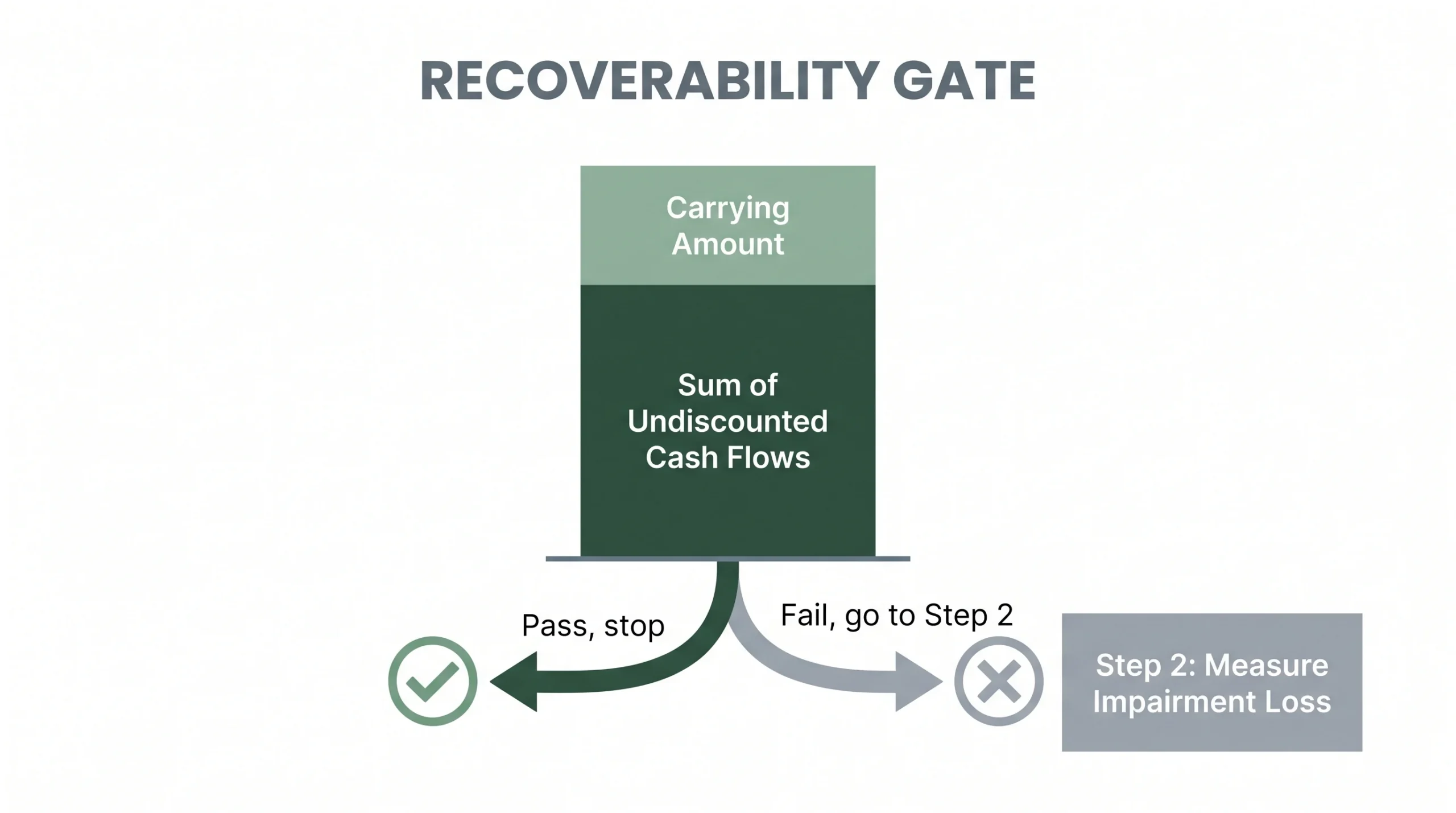
The ASC 360 recoverability test is the first step in the two-step impairment model for long-lived assets. It compares an asset group’s carrying amount to the sum of its future undiscounted cash flows. If the carrying amount is higher than those cash flows, the asset group is not recoverable. The company then moves to Step 2 and measures the loss. The word undiscounted is the key. Step 1 uses raw dollars, not present value.
This test protects the balance sheet from stale asset values. It runs only when a triggering event signals trouble, not on a fixed calendar. Getting Step 1 right matters because it decides whether a write-down is even on the table. A wrong cash flow estimate can hide a real loss or force a loss that does not exist. Careful projections and clear records keep the answer defensible.
Sofer Advisors is a business valuation firm in Atlanta that prepares impairment analyses for financial reporting. The firm carries 180+ five-star Google reviews and has supported clients through 11+ expert witness cases. Its senior appraisers hold the ABV and ASA credentials recognized by the IRS, SEC, and FINRA. That background helps the firm build cash flow support that holds up when an auditor asks hard questions.
Key Takeaways
- Two-step model: Step 1 tests recoverability; Step 2 measures the loss.
- Undiscounted cash flows: Step 1 sums future cash flows with no discount rate.
- Trigger-based: the test runs only when an impairment indicator appears.
- Asset group level: you test at the lowest level of largely independent cash flows.
- Fair value in Step 2: the loss equals carrying amount minus fair value.
These five points frame the rest of this guide. The sections below walk through each trigger, the math behind undiscounted cash flows, and what happens when an asset group fails.
What triggers an ASC 360 recoverability test?
An ASC 360 recoverability test is triggered by specific events that suggest an asset group may have lost value. Companies do not run this test every year by default. They run it when the facts change. The standard calls these facts triggering events or impairment indicators. Common triggers include:
- A large drop in the market price of the asset
- A negative shift in how the asset is used or its physical condition
- An adverse change in legal factors or the business climate
- A current-period operating loss paired with a history or forecast of more losses
- An expectation that the asset will be sold well before the end of its useful life
One clear trigger is enough to start the test. Management should log the event and the date it appeared. Auditors look for that record first. Without it, a company may miss a required test or run one late. A simple internal checklist, reviewed each quarter, helps owners catch these signals early. The goal is to test at the right time, not to test constantly.
How do you calculate undiscounted cash flows?
Undiscounted cash flows are the sum of the future cash a group of assets will bring in from use and its final sale, with no discount rate applied. You add up the raw dollars across the remaining useful life. You do not shrink them to present value. That is the point of the word undiscounted.
Step 1 uses undiscounted numbers on purpose. It is a screen, not a precise measure of value. The screen is meant to be a little forgiving, so only real problems move to Step 2. If Step 1 used discounted cash flows, far more assets would fail, because discounting always lowers the total. So the raw sum keeps the first test fair.
The estimate should reflect management’s best view of the future. Include the normal upkeep needed to keep the asset running. Exclude interest and other financing costs. Also leave out income taxes. Project the cash over the primary asset’s remaining useful life. The primary asset is the main long-lived asset that drives the group’s cash. Then add the expected proceeds from selling the assets at the end.
What happens if an asset group fails Step 1?
If the carrying amount is greater than the undiscounted cash flows, the asset group fails Step 1. The company then moves to Step 2. Step 2 measures the actual loss. Here the company compares the carrying amount to fair value, not to cash flows. The impairment loss equals the carrying amount minus fair value.
Fair value is what a market buyer would pay today. It often comes from a discounted cash flow model or from market data, and it follows the ASC 820 fair value hierarchy. The loss is booked as a charge against earnings. It also lowers the asset’s basis on the balance sheet. Under US GAAP, that lower basis is permanent for a held-and-used asset. You cannot write the value back up later, even if the asset recovers.
This two-step path rewards careful support at each stage. Sofer Advisors handles both the Step 1 screen and the Step 2 fair value measure through its financial reporting valuation service.
What is an asset group under ASC 360?
An asset group is the smallest set of assets whose cash flows are largely independent of other assets. ASC 360-10-35 sets this rule. You test at that level, not asset by asset. Many assets do not earn cash on their own. They only earn cash as part of a larger unit.
A factory line is a good example. One machine may be useless without the machines around it. So the whole line becomes one asset group. A retail chain often treats each store as its own group. Each store brings in its own sales and pays its own local costs. Drawing the group the right way changes the test result, so the choice deserves real thought and clear support.
How does ASC 360 differ from goodwill impairment?
ASC 360 covers long-lived tangible assets and finite-lived intangible assets, while goodwill impairment falls under ASC 350 and uses a different test. Goodwill cannot be amortized and has no physical form. So it needs its own rule rather than the undiscounted screen.
Under ASC 350, a company compares a reporting unit’s fair value to its carrying amount. If the carrying amount is higher, the company books an impairment charge. Public companies also watch related guidance from the SEC staff accounting bulletins when they disclose these charges. The two standards can apply in the same year, so order matters. Test long-lived assets under ASC 360 first, then test goodwill under ASC 350.
What documentation supports a recoverability test?
Good documentation records the trigger, the asset group, the cash flow assumptions, and the useful life behind the test. Auditors treat the file as the proof. Strong records turn a judgment call into a clear trail. The file should name the triggering event and its date. It should show how the asset group was drawn. It should list the revenue and cost assumptions in the cash flow model. It should also explain the remaining useful life.
Auditors test these estimates under set rules. The PCAOB standard on accounting estimates guides how they check assumptions and data. Clear support makes their review faster. It also lowers the risk of a late challenge. A weak file invites more questions and more delay.
Which valuation provider fits ASC 360 work?
The right provider for ASC 360 work pairs deep impairment experience with senior, hands-on attention. Owners usually weigh a few types of firms. Large advisory names like Alvarez & Marsal, Stout, and Kroll serve the biggest public deals. Specialist firms focus on middle-market reporting needs. The table below sums up the trade-offs.
| Provider | Best fit | What sets it apart |
| Sofer Advisors | Middle-market, PE-backed firms | Senior ASA and ABV appraisers on every file |
| Alvarez & Marsal | Large public restructurings | Broad global advisory bench |
| Stout | Large private and public firms | Wide dispute and advisory practice |
| Kroll | Multinational reporting | Deep cost-of-capital data |
Scale is not the only factor. Mid-market companies often want direct time with a credentialed expert, not a junior reviewer. The Sofer Difference follows four clear phases: Discovery, Diligence, Analysis, and Delivery. Each phase keeps the client informed and the file audit-ready. The firm works with a Heart of a Teacher, so owners understand every number. That mix of senior focus and plain talk is what Sofer Advisors brings to an ASC 360 engagement.
The questions below cover the details owners and advisors ask most about Step 1.
Frequently Asked Questions
What does ‘undiscounted cash flows’ mean?
Undiscounted cash flows are the total future dollars an asset group is expected to earn from use and final sale. The figure sums those dollars with no discount rate and no present-value math. It is a raw total, not a fair value. ASC 360 uses this total as the Step 1 screen to test whether an asset group’s carrying amount is recoverable.
When should a long-lived asset be tested for recoverability?
A long-lived asset is tested only when a triggering event signals possible impairment. There is no fixed annual test under ASC 360. The trigger might be a market price drop, physical damage, or a run of operating losses. When such a sign appears, the company must run the recoverability test for the affected asset group before its next reporting date.
What are the triggering events for an impairment test under ASC 360?
Triggering events include a sharp fall in an asset’s market price and adverse changes in legal or business conditions. Physical damage, a planned early sale, and a current loss paired with expected future losses also count. Any one of these can require a test. Management should document the event and the date it arose to support the timing of the analysis.
How do you test for asset impairment?
Testing starts with Step 1, the recoverability test. You compare the asset group’s carrying amount to its undiscounted future cash flows. If the carrying amount is larger, the group fails and you move to Step 2. Step 2 measures the loss as carrying amount minus fair value. That loss is then recorded as a charge against earnings.
Is the recoverability test required for private companies?
Yes. Private companies that follow US GAAP must run the recoverability test when impairment indicators exist. The rule applies the same way it does for public companies. Skipping the test when a trigger is present can create an audit problem. Private firms should keep the same records of triggers and assumptions that public firms maintain.
How often should impairment testing be performed under ASC 360?
There is no set schedule under ASC 360. The test is event-driven, so it runs only when an indicator suggests an asset group may not be recoverable. In a period with no triggers, no formal test is needed. Even so, companies should track potential signals each period so they can show auditors that the review was ongoing.
Can a previously recognized impairment loss be reversed under US GAAP?
No. Under US GAAP, an impairment loss on a held-and-used long-lived asset cannot be reversed. Once the carrying amount is written down, that lower figure becomes the new basis. Later recovery in value does not restore the old number. This rule raises the stakes on getting the first estimate right, since the write-down is permanent.
What is the difference between carrying value and fair value?
Carrying value is an asset’s original cost minus accumulated depreciation and any prior write-downs. Fair value is the price a market buyer would pay for it today in an orderly sale. When carrying value sits above fair value, the asset may be impaired. Step 2 of the ASC 360 test uses fair value to measure the size of any loss.
How much does an impairment testing engagement from Sofer Advisors cost?
Impairment testing engagements from Sofer Advisors generally range from $7,500 to $25,000, and most take two to six weeks. The final fee depends on the number of asset groups, the state of the internal records, and the reporting deadline. For a quote tied to your assets, reach out to the team with your asset list and timeline.
Related Case Studies
- Goodwill Impairment Testing: Step-by-Step ASC 350 Guide
- Goodwill Impairment Journal Entry: Debit and Credit
- What is Impairment Testing? Asset Value Assessment Guide
Executive Summary
The ASC 360 recoverability test is Step 1 of the two-step impairment model for long-lived assets. It compares an asset group’s carrying amount to the sum of its undiscounted future cash flows from use and sale. If the carrying amount is higher, the group fails and moves to Step 2, where the loss equals carrying amount minus fair value. The test is event-driven, not annual, and runs at the asset-group level under ASC 360-10-35. Undiscounted numbers keep Step 1 a fair screen. Clear records of the trigger, the assumptions, and the useful life keep the result defensible. Sofer Advisors supports both steps for financial reporting.
What Should You Do Next?
Start by listing your asset groups and checking each one for a recent triggering event. Pull your cash flow projections, useful-life support, and any evidence of a market or operating decline. Build the undiscounted total first, then decide whether a Step 2 fair value study is needed.
David Hern CPA ABV ASA, founder of Sofer Advisors, leads impairment and financial reporting engagements for middle-market companies. Schedule a consultation to review your ASC 360 position.
People Also Read
- Impairment Testing: Sofers Advisors’ Complete Guide
- Goodwill Impairment Testing ASC 350: Complete Guide for 2025-2026
About the Author
This guide was prepared by David Hern CPA ABV ASA, founder of Sofer Advisors, a business valuation firm headquartered in Atlanta, GA serving clients across the United States. David holds dual accreditations as an Accredited Senior Appraiser (ASA) and is Accredited in Business Valuation (ABV), credentials recognized by the IRS, SEC, and FINRA. He also holds the Certified Exit Planning Advisor (CEPA) designation. With 15+ years of valuation experience, David has served as an expert witness in 11+ cases across multiple jurisdictions and built Sofer Advisors into an Inc. 5000-recognized firm with 180+ five-star Google reviews. Its full W2 employee team maintains subscriptions to all major valuation databases and operates under a next business day response policy.
For professional business valuation services, visit soferadvisors.com/about-us/ or contact Sofer Advisors at soferadvisors.com/contact-us/.
Disclaimer: This content is for informational purposes only and does not constitute professional valuation advice. Business valuation conclusions depend on specific facts and circumstances. Contact Sofer Advisors for guidance regarding your specific situation.









