


Last Updated: September 2026
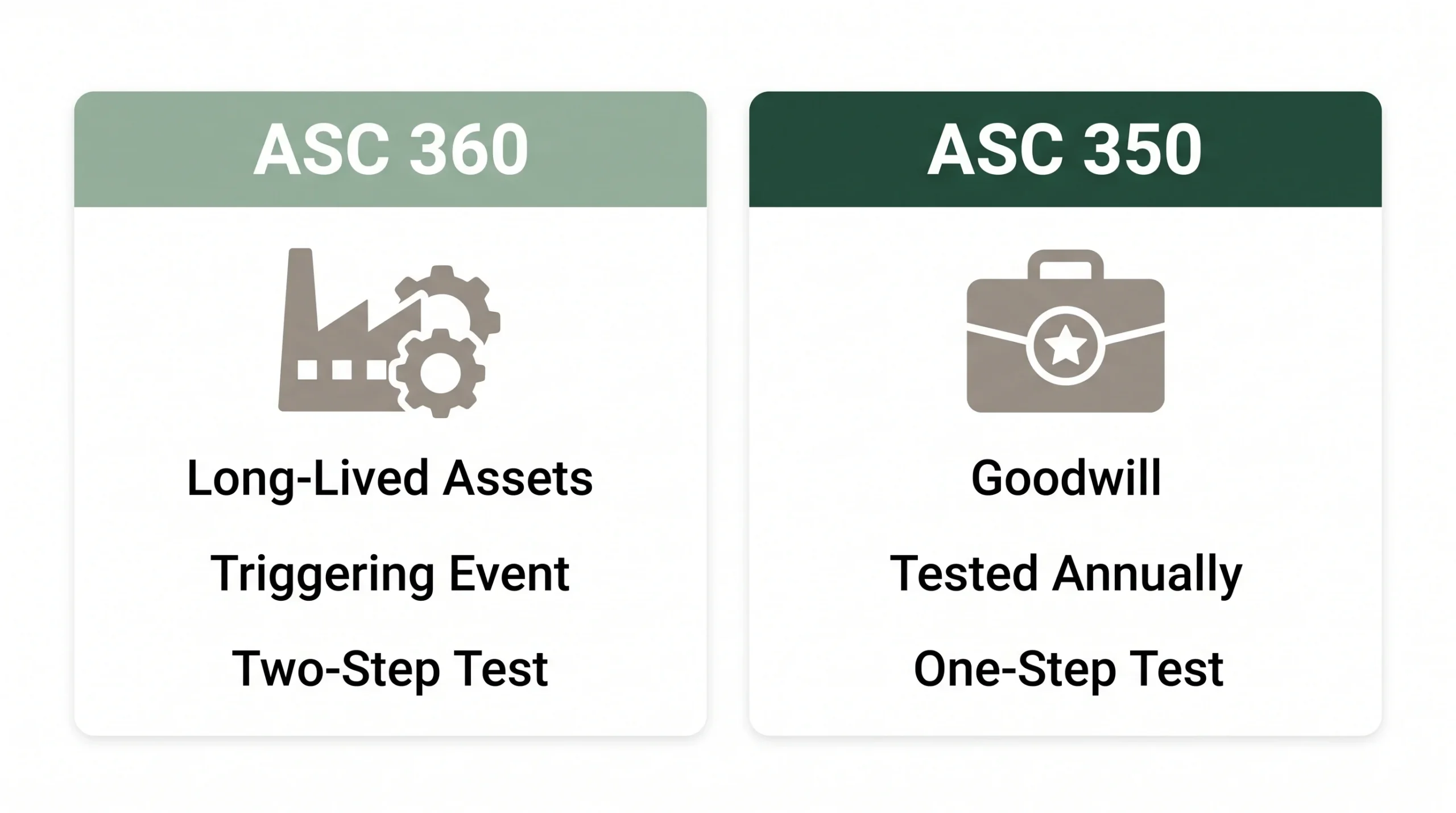
ASC 360 and ASC 350 are two separate U.S. GAAP impairment standards, issued by the FASB, that apply to different assets on the balance sheet. ASC 360 covers long-lived assets that are held and used, such as property, plant, and equipment. ASC 350 covers goodwill and indefinite-lived intangible assets. The two use different triggers and different math, so picking the wrong one gives the wrong answer. ASC 360-10-35-17 sets the undiscounted recoverability screen at the core of the long-lived asset test.
The split is not a filing technicality. It decides how often you test, at what level you test, and how you measure any loss. A company that holds both equipment and goodwill often applies both standards in the same year. Get the scope or order wrong, and the financial statements can overstate assets, the exact outcome these rules exist to prevent.
Sofer Advisors provides neutral, third-party impairment analysis for financial reporting, applying established accounting standards to complex asset structures under US GAAP. That work has held up under scrutiny, including expert witness testimony in 11+ cases across Georgia, Florida, California, and New Mexico. The goal is a defensible answer that satisfies an auditor and the people who rely on the statements.
Key Takeaways
- Different assets – ASC 360 covers long-lived tangible assets and finite-lived intangibles, while ASC 350 covers goodwill and indefinite-lived intangibles.
- Different timing – ASC 350 assets are tested at least once a year, but ASC 360 assets are tested only when a triggering event appears.
- Different level – ASC 360 tests at the asset group level, while ASC 350 tests goodwill at the reporting unit level.
- Different math – ASC 360 uses a two-step test that starts with undiscounted cash flows, while goodwill testing skips that screen and measures against fair value directly.
- Order matters – when both apply, you test other assets under ASC 360 first, then test goodwill under ASC 350.
Each takeaway ties back to one question: which assets are you testing? The sections below walk through the answer, one standard at a time.
Which assets does each impairment standard cover?
ASC 360 covers long-lived assets that are held and used, while ASC 350 covers goodwill and indefinite-lived intangible assets. The line between the two is useful life. If an asset wears out or expires, it lives under ASC 360. If it has no set end date, it lives under ASC 350.
ASC 360 reaches property, plant, and equipment, plus finite-lived intangibles that a company amortizes, such as patents and customer lists. The AICPA guidance on when to test long-lived assets ties the review to warning signs. ASC 350 reaches goodwill from a past acquisition and intangibles with an indefinite life, such as a renewable brand name. The AICPA guidance on when to test goodwill sets an annual floor. A broader impairment testing review shows how both fit together.
How often must each standard be tested?
ASC 350 assets must be tested at least once a year, and again whenever a triggering event appears. ASC 360 assets are tested only when an event or change in circumstances signals that the carrying amount may not be recoverable. So one standard runs on a calendar, and the other runs on warning signs.
Common triggers apply to both standards. They include a large drop in market price, an adverse change in how an asset is used, a run of operating losses, and a shift in law or business climate that hurts value. A plan to sell an asset early is also a trigger. For goodwill, the annual test still stands, but any of these signs forces an earlier look. A dated record of each trigger supports the timing when auditors ask.
How does each impairment test actually work?
ASC 360 uses a two-step test, while ASC 350 uses a single quantitative comparison. One standard screens with undiscounted cash flows before it measures a loss. The other skips that screen and moves straight to fair value. The steps below show how each path runs.
The ASC 360 test starts with a recoverability screen. You compare the sum of the undiscounted future cash flows from the asset group to its carrying amount. If those cash flows meet or beat the carrying amount, the group passes and no loss is booked. If the carrying amount is higher, the group fails, and step two measures the loss as the carrying amount minus the fair value of the asset group.
The ASC 350 goodwill test can begin with an optional qualitative review, sometimes called step zero. If a quantitative test is needed, you compare the fair value of the reporting unit to its carrying amount, including goodwill. The loss equals the excess of carrying amount over fair value, capped at the goodwill assigned to that unit. There is no undiscounted screen. Indefinite-lived intangibles follow a similar direct path. Careful financial reporting valuation work keeps each fair value estimate supportable.
| Feature | ASC 360 (Long-Lived Assets) | ASC 350 (Goodwill and Indefinite-Lived) |
| Assets covered | Property, plant, equipment, and finite-lived intangibles held and used | Goodwill and indefinite-lived intangibles, such as a perpetual trademark |
| Test frequency | Only when a triggering event occurs | At least once a year, plus on triggering events |
| Level of testing | Asset group (lowest level of independent cash flows) | Reporting unit for goodwill; the individual asset for an intangible |
| Method | Two-step: undiscounted recoverability screen, then loss equals carrying amount minus fair value | One-step: compare fair value to carrying amount, with no undiscounted screen |
| Loss reversal | Not allowed for held-and-used assets under US GAAP | Not allowed once the loss is recognized |
The two methods answer different questions, so they can point in different directions for the same business. A long-lived asset group can pass its undiscounted screen while goodwill in the same reporting unit shows a clear shortfall. That is why the scope call matters so much. The method flows straight from the asset type, and the asset type flows from the useful life you assign at the start.
In what order do you test when both standards apply?
When an entity holds several asset types, you test them in a set order: other assets first, and goodwill last. This sequence is not optional. Under ASC 350-20-35-31, an entity tests indefinite-lived intangibles and long-lived asset groups under ASC 360 before it tests goodwill. Any loss on those other assets is recorded first.
The reason is arithmetic. The goodwill test uses the carrying amount of the whole reporting unit, which includes the equipment and finite-lived intangibles inside it. If those assets are overstated, the goodwill test starts from a wrong number. Testing them first sets a clean carrying amount before goodwill is measured, so you neither hide a real goodwill loss nor create one that does not exist.
Which firm should handle your impairment testing?
The choice of provider shapes how defensible the final report is. Owners and their advisors weigh technical depth, independence, and how clearly a firm explains its work to an audit team. Large national firms such as Alvarez & Marsal, Stout, and Kroll serve the biggest global engagements, often with junior staff on early analysis. Mid-market entities usually need direct, senior-level attention instead.
Sofer Advisors runs this work through The Sofer Difference, a four-phase process of Discovery, Diligence, Analysis, and Delivery. That structure keeps each scope call, each test, and each fair value estimate documented and repeatable. Sofer Advisors brings a Heart of a Teacher to the report, so owners and auditors can follow every number and every decision. With a full W2 team and a next business day response policy, an independent appraiser pairs the depth of a larger practice with senior attention on each engagement.
Frequently Asked Questions
What is ASC 350?
ASC 350 is the FASB standard that governs the accounting for goodwill and other intangible assets, including impairment. It requires an entity to test goodwill and indefinite-lived intangibles for impairment at least once a year, and again when a triggering event appears. Testing happens at the reporting unit level for goodwill. The test compares fair value to carrying amount directly, with no undiscounted cash flow screen first.
What is ASC 360?
ASC 360 is the FASB standard for the impairment and disposal of long-lived assets. It covers property, plant, and equipment, plus finite-lived intangibles that a company amortizes. The standard requires a test only when an event or change in circumstances suggests the carrying amount may not be recoverable. Testing happens at the asset group level, which is the lowest level of largely independent cash flows.
How do you account for goodwill impairment?
You compare the fair value of a reporting unit to its carrying amount, including goodwill. If the fair value is lower, the entity records a loss equal to the shortfall, capped at the goodwill assigned to that unit. The reduced goodwill balance becomes the new carrying amount, and the loss is not reversed later. Auditors review these fair value estimates closely under standards like PCAOB AS 2501.
Is goodwill impairment a good thing?
Goodwill impairment is not a positive event. It is an accounting recognition that an acquired business has lost value against the price once paid for it. The charge signals to lenders and investors that expected benefits from a past deal have declined. It does not move cash, but it does lower reported earnings and equity in the period.
What is the difference between an asset group and a reporting unit?
An asset group is the ASC 360 unit of account for long-lived assets. It is the lowest level of identifiable cash flows that are largely independent of other assets, such as one plant or one product line. A reporting unit is the ASC 350 level for goodwill, usually an operating segment or one level below it. So a single business can hold several asset groups inside one reporting unit.
Can an ASC 360 impairment loss be reversed?
For long-lived assets that are held and used, a recognized impairment loss cannot be reversed under US GAAP. Once you write the asset down, the lower carrying amount becomes the new cost basis for future depreciation. This differs from IFRS, which allows a reversal for most non-goodwill assets when conditions improve. Goodwill losses are never reversed under either framework, so the write-down is permanent.
What qualifies as a triggering event?
A triggering event is any significant change that suggests an asset may have lost value. Common examples include a sharp drop in market price, physical damage, a history of operating losses, or a plan to sell an asset early. A negative shift in law, costs, or the business climate can also count. When a sign appears, the entity runs the test for the affected group or reporting unit rather than waiting.
Do private companies test goodwill differently?
Private companies may elect an accounting alternative that lets them amortize goodwill on a straight-line basis over ten years or less. Under that election, they test goodwill only when a triggering event occurs, rather than every year, which lowers the yearly compliance burden. The choice carries trade-offs, so many owners weigh it with their auditor and valuation advisor first.
How much does an impairment testing engagement from Sofer Advisors cost?
An impairment testing engagement from Sofer Advisors generally runs $7,500 to $25,000, with a timeline of two to six weeks. The final fee depends on the number of asset groups or reporting units, the industry, and the depth of analysis the auditors expect. A single, focused review sits near the low end, while a business with many units reaches the higher end. To scope your engagement, schedule a consultation.
Related Case Studies
- Goodwill Impairment Testing ASC 350: Complete Guide for 2025-2026
- Purchase Price Allocation ASC 805 and IFRS 3: Complete Guide for Business Leaders
- ASC 820 Fair Value Measurement: Hierarchy Levels Explained
Executive Summary
ASC 360 and ASC 350 are separate impairment standards. ASC 360 covers long-lived assets held and used, tested only on a triggering event, at the asset group level, using a two-step method that starts with undiscounted cash flows. ASC 350 covers goodwill and indefinite-lived intangibles, tested at least once a year at the reporting unit level, comparing fair value to carrying amount directly. When both apply, test other assets first and goodwill last, and note that neither held-and-used loss reverses under US GAAP. An engagement generally runs $7,500 to $25,000 over two to six weeks, and an independent firm like Sofer Advisors keeps the result defensible for auditors.
What Should You Do Next?
Start by sorting your balance sheet into two buckets: long-lived assets under ASC 360, and goodwill and indefinite-lived intangibles under ASC 350. Confirm whether any triggering event has appeared for the ASC 360 assets, and set your annual test date for the ASC 350 group. Keep a dated file of your scope, testing level, and test order, since that record is your best support during the audit.
David Hern CPA ABV ASA, founder of Sofer Advisors, provides neutral, defensible impairment analysis for financial reporting. Schedule a consultation to discuss your specific situation.
People Also Read
- Impairment Testing: Sofers Advisors’ Complete Guide
- Goodwill vs Intangible Assets: Key Differences Explained
About the Author
This guide was prepared by David Hern CPA ABV ASA, founder of Sofer Advisors, a business valuation firm headquartered in Atlanta, GA serving clients across the United States. David holds dual accreditations as an Accredited Senior Appraiser (ASA) and is Accredited in Business Valuation (ABV), credentials recognized by the IRS, SEC, and FINRA. He also holds the Certified Exit Planning Advisor (CEPA) designation. With 15+ years of valuation experience, David has served as an expert witness in 11+ cases across multiple jurisdictions and built Sofer Advisors into an Inc. 5000-recognized firm with 180+ five-star Google reviews. Its full W2 employee team maintains subscriptions to all major valuation databases and operates under a next business day response policy.
For professional business valuation services, visit soferadvisors.com/about-us/ or contact Sofer Advisors at soferadvisors.com/contact-us/.
Disclaimer: This content is for informational purposes only and does not constitute professional valuation advice. Business valuation conclusions depend on specific facts and circumstances. Contact Sofer Advisors for guidance regarding your specific situation.









