

Last Updated: August 2026
A winery valuation is a study of what a wine business is worth. It weighs the land and vines, the brand, and the wine held in storage. It also weighs cash flow, gear, and how the wine reaches buyers. Sofer Advisors values wineries and vineyards for sales, tax filings, and estate plans. One figure often stands out. The land and planted acres can make up more than half of total value.
Owners commission this work for a sale, a partner buyout, an estate filing, or a gift-tax return, and each purpose sets its own standard of value. Market conditions matter too. Winery and vineyard values have cooled from their 2021 peak, with typical deals now near 8 to 10 times earnings. A number built for planning will not survive IRS or court review without support.
Key Takeaways
- Start with the assets: Value begins with the land, buildings, tanks, and other fixed gear. These form the base figure.
- Price the wine in stages: Bulk wine and bottled stock are valued apart. Each uses its own pricing method.
- Blend the three approaches: Analysts mix the asset, income, and market views. No single lens fits a winery.
- Land can lead the total: Prime acres in a named region, with firm water rights, often drive the largest share of value.
- The brand adds a premium: A known label, a strong wine club, and wide distribution lift price beyond the physical plant.
These points show how hard assets and earning power meet. The sections below explain each method. They also show how an expert ties the pieces into one figure that holds up for a sale, tax filing, or dispute.
What goes into a winery’s value?
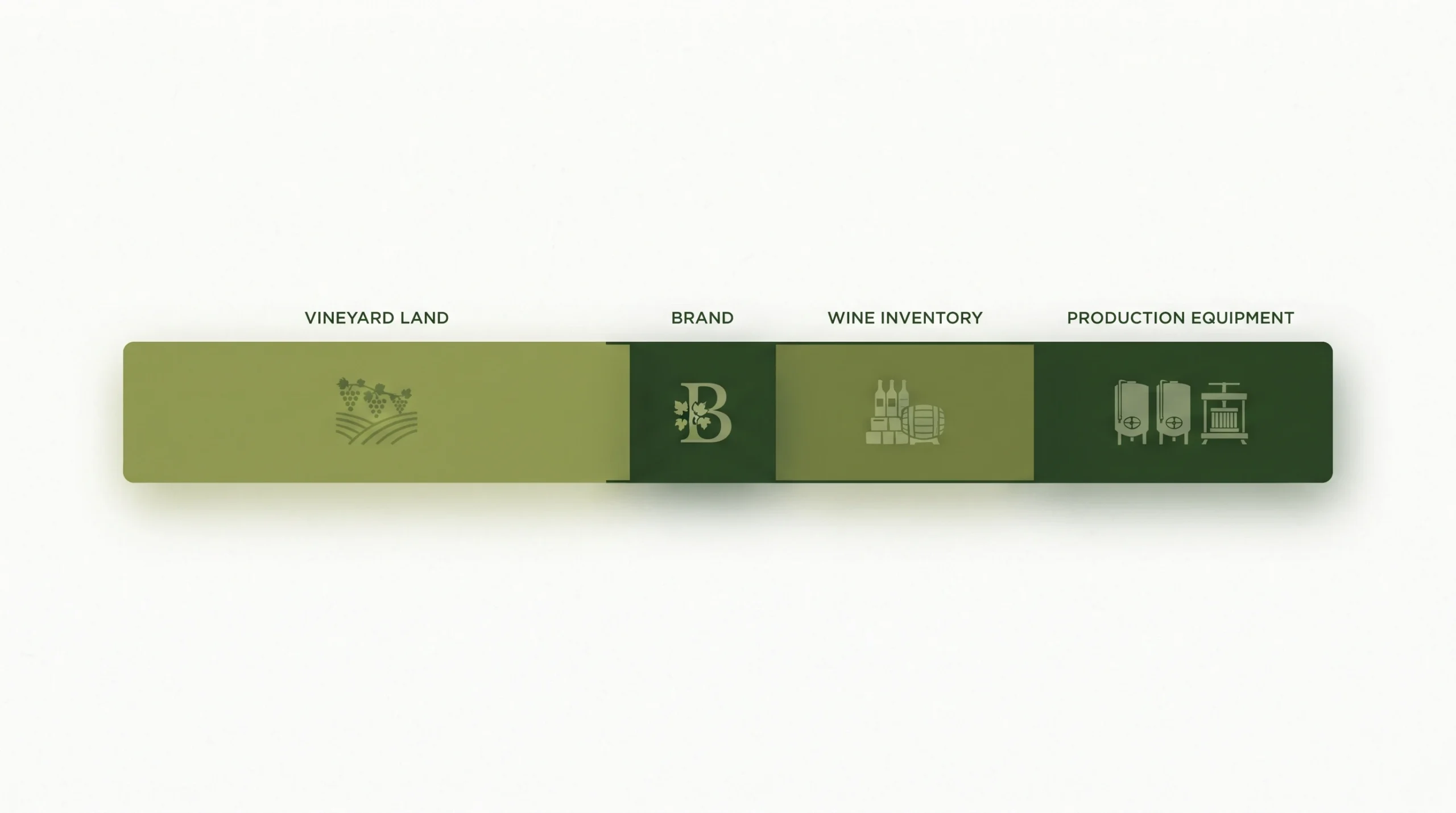
A winery’s value rests on three parts. The first is the tangible assets: the land, vines, buildings, and gear. The second is the wine inventory, both bulk and bottled. The third is the intangible value, such as the brand, the wine club, and distribution deals. An expert prices each part on its own, then checks how they work as one business. Land and vines usually carry the most weight in the final number.
The split matters because each part carries its own risk. A barn and a tank hold a fairly steady value. A brand can rise or fall with a few reviews. Sofer Advisors sorts these layers so the total reflects the real business. This care follows the Heart of a Teacher approach the firm brings to every job: show the owner the math, not just the answer.
Which methods value a winery?
Three methods drive a winery valuation. The asset approach prices the land, buildings, and gear. The income approach values the future cash flow, often through a discounted cash flow model, or DCF. The market approach compares the winery to similar firms that sold, often using an EBITDA multiple. Most jobs blend all three. The asset view sets a floor, and the income and market views test the earning power on top of it.
The blend guards against a thin answer. A pure asset count ignores a strong, growing brand. A pure income model ignores the land under it. Each approach must fit the purpose of the work and the standard of value. A figure built for planning will not survive IRS or court review without proof. Sofer Advisors builds each method against market data, so the result holds up. This mirrors IRS Revenue Ruling 59-60, which asks an appraiser to weigh every relevant factor.
| Approach | What it prices | When it fits best | Main inputs |
|---|---|---|---|
| Asset approach | Land, buildings, tanks, gear | Heavy real estate; a base value | Appraised value, replacement cost |
| Income approach | Future earning power | Steady or growing cash flow | DCF, discount rate, normalized earnings |
| Market approach | Value versus peers | Recent sales of similar firms | EBITDA multiple, comparable sales |
The right mix depends on the winery. A small estate with prime land leans on the asset view. A large label with wide reach leans on income and market data. Many owners want one clear figure they can defend. A skilled analyst reads all three, then reconciles them into a single enterprise value. Using more than one method gives a cross-check. That lowers audit risk during a sale, tax filing, or legal fight.
How is wine inventory valued?
Wine inventory is valued by splitting bulk wine from bottled stock. Bulk wine is priced per gallon by grape, vintage, and demand in the region. Bottled stock uses a net-back method. That starts with the retail or wholesale price, then strips out the cost to sell, ship, and a fair profit. The goal is the net realizable value of the wine as it stands today.
The stage of the wine drives the price. Juice in a tank, wine aging in a barrel, and cased bottles each sit at a different value. An expert counts stock by vintage and checks it against the books. Sofer Advisors reviews these counts so the inventory figure ties back to real, sellable goods, not a rough guess.
How does land drive a vineyard’s value?
Land is often the biggest asset in a vineyard valuation. It can top half of total value. The price of the land turns on its region, or American Viticultural Area. Vines in a named, well-known area draw a premium for their soil and climate. An expert also splits the plantable acres from the land that cannot grow fruit. That split shows the true earning power of the site.
Water and buildings shape the land value too. Firm, long-term water rights keep the vines alive and the crop steady, so they lift the price. A tasting room or event space adds income that sits outside wine sales. These direct-to-consumer draws often carry high margins. Sofer Advisors verifies water rights and prices these spaces as part of the asset base. Land without secure water is worth far less, so the check is a core step, not a footnote.
What makes a wine brand valuable?
A wine brand’s value comes from three drivers: reputation, a loyal wine club, and wide distribution. A known label lets a winery charge more per bottle. That pricing power is goodwill, an intangible asset that sits above the land and gear. Strong critic scores act as proof to buyers and defend the margin. Together these traits separate a premium estate from a plain bulk producer. The brand works as a multiplier on the cash flow the plant produces.
A wine club is a clear sign of steady cash. Members pay on a schedule, which smooths the swings farming brings. Wide distribution matters as well. A label sold across many states holds an edge a small rival cannot copy fast. Sofer Advisors weighs these traits next to the hard numbers. That way the value captures the whole business, not just the buildings and stock.
How does Sofer Advisors value a winery?
Sofer Advisors ties the land, wine, and brand into one economic model. Separate appraisals often miss how these parts interact. A firm with an ABV or ASA credential brings proof of training and ethics to the work. The team blends the three approaches and reconciles them under USPAP, IRS Revenue Ruling 59-60, and AICPA SSVS. The result is one figure an owner can carry into a sale, tax filing, or court. It reads as a single story, not a stack of loose reports.
Large firms such as Alvarez and Marsal or Kroll aim their work at big corporate clients. Sofer Advisors brings that same senior-level rigor to middle-market owners. Unlike a solo appraiser, it backs each figure with a full W2 team of 14 and every major valuation database. This is The Sofer Difference: a four-phase process of Discovery, Diligence, Analysis, and Delivery that yields an audit-ready report. The firm holds 180+ five-star Google reviews and Inc. 5000 spots in 2024 and 2025. David Hern CPA ABV ASA leads each job.
Frequently Asked Questions
What is the 75-85-95 rule for wine?
The 75-85-95 rule sets the labeling limits for wine in the United States. At least 75 percent of the wine must come from the named grape. At least 85 percent must come from the listed region. At least 95 percent must come from the stated vintage year. Sofer Advisors uses these limits to sort and price inventory based on how clean the records are.
What is the difference between valuing a winery and a vineyard?
A winery valuation covers the whole business: the production, gear, brand, and distribution that make cash flow. A vineyard valuation is mostly a land study. It centers on soil, vine age, water rights, and how much fruit the site can grow. Sofer Advisors joins the land appraisal with the operating value. That gives owners one figure for the full estate rather than two loose ones.
How does a direct-to-consumer model raise value?
A direct-to-consumer model lifts value by cutting out the wholesale middle layer. The winery keeps a larger share of each sale. Club memberships add steady, repeat income that lowers risk. That mix of higher margin and steadier cash often supports a higher multiple in a sale. Sofer Advisors folds these channels into the forward projections it builds to reach total enterprise value.
How do you value a winery with no profits?
For a winery with no profits, the focus shifts to the asset approach. That view prices the net worth of the land, gear, and inventory. If the site shows real promise, an analyst may add a discounted cash flow model built on sober market assumptions. Sofer Advisors applies this rigor so owners see the underlying value of their physical and brand assets, even when current earnings are thin.
Are water rights included in a winery valuation?
Water rights are a core part of a winery valuation. They give the site the utility it needs to grow fruit year after year. The value of these rights is often baked into the supporting real estate. An appraiser checks the legal status, the volume, and how reliable the supply is. Sofer Advisors verifies water rights in the asset discovery step, since land without water is worth far less.
What documents does a winery valuation need?
A winery valuation needs profit and loss statements, balance sheets, and tax returns for the past three to five years. This history sets the trend. Other key items include a list of production gear, current stock counts by vintage, and any lease or distribution deals. Sofer Advisors gives owners a checklist and a secure portal, so the right records arrive in order at the start.
What mistakes should sellers avoid?
The common mistakes are mixing personal and business assets, skipping water-rights checks, and handing over messy books. Owners with weak records struggle to prove brand strength or growth to a buyer. That gap can drag down the price or stall the deal. Sofer Advisors flags these risks in the Discovery phase, so every asset and liability is clear before any talks with a buyer begin.
How long does a winery valuation take?
A winery valuation usually takes four to eight weeks. The pace depends on how fast the financial records arrive and how complex the site is. The time allows for due diligence on inventory, land, and the brand. Sofer Advisors runs a structured Analysis phase to build a report that meets professional standards. It also operates under a next business day response policy, so owners are never left waiting on updates.
How much does a business valuation from Sofer Advisors cost?
A business valuation from Sofer Advisors usually runs from 7,500 to 25,000 dollars. The price turns on the complexity of the business and the purpose of the work. Simpler jobs for planning or tax filings sit near the low end. Deals and litigation support need deeper study, so they sit higher. Contact Sofer Advisors for a fee quote matched to your winery and its assets.
Related Case Studies
- How to Value a Craft Brewery or Distillery in 2026
- When the Cost Approach Wins: Valuing Asset-Heavy Businesses
- How to Value a Self-Storage Facility: Cap Rates and Operations
Executive Summary
A winery valuation blends three views into one figure. The asset approach prices the land, buildings, and gear. The income approach values cash flow through a discounted cash flow model. The market approach tests the result against EBITDA multiples from comparable sales. Land and vines often top half of total value, while the brand and wine club add a premium on top. Wine stock is priced apart, with bulk wine per gallon and bottled stock by net-back. Sofer Advisors reconciles all three under IRS Revenue Ruling 59-60 and AICPA SSVS to deliver an audit-ready result.
What Should You Do Next?
Start by gathering three to five years of tax returns, balance sheets, and a fixed-asset list. Then count your wine by vintage and stage, and pull your water-rights and distribution papers together. These records let an expert price the land, stock, and brand as one business.
For a winery valuation you can defend, work with David Hern CPA ABV ASA. His team has given expert witness testimony in 11+ cases across Georgia, Florida, California, and New Mexico. Schedule a consultation to discuss the value of your winery or vineyard.
People Also Read
- The Net Asset Value Method: Balance Sheet Over Earnings
- EBITDA Add-Backs: What Buyers Accept and What They Reject
About the Author
This guide was prepared by David Hern CPA ABV ASA, founder of Sofer Advisors, a business valuation firm headquartered in Atlanta, GA serving clients across the United States. David holds dual accreditations as an Accredited Senior Appraiser (ASA) and is Accredited in Business Valuation (ABV), credentials recognized by the IRS, SEC, and FINRA. He also holds the Certified Exit Planning Advisor (CEPA) designation. With 15+ years of valuation experience, David has served as an expert witness in 11+ cases across multiple jurisdictions and built Sofer Advisors into an Inc. 5000-recognized firm with 180+ five-star Google reviews. Its full W2 employee team maintains subscriptions to all major valuation databases and operates under a next business day response policy. For professional business valuation services, visit soferadvisors.com/about-us/ or contact Sofer Advisors at soferadvisors.com/contact-us/.
Disclaimer: This content is for informational purposes only and does not constitute professional valuation advice. Business valuation conclusions depend on specific facts and circumstances. Contact Sofer Advisors for guidance regarding your specific situation.