
Last Updated: July 2026
A craft brewery or distillery valuation finds the worth of the business. It weighs tangible assets like equipment and real estate against intangibles like brand, distribution deals, and intellectual property. It follows detailed standards, using past earnings, growth plans, and market conditions. Owners use the results for tax planning, equity splits, or an exit.
Sofer Advisors provides these valuations through The Sofer Difference, a four-stage process of Discovery, Diligence, Analysis, and Delivery. With seven years in business and 11+ expert-witness cases, it understands the nuance of specialized production facilities. It has earned 180+ five-star Google reviews with a Heart of a Teacher approach that puts clear explanations first.
Knowing the market value of your production assets is critical before any structural change to the business. Whether you seek new financing or prepare for a change in ownership, you need a precise read on what your equipment and brand equity represent today.
Key Takeaways
- Three core methods: analysts use the market, income, and asset approaches, with EBITDA or per-barrel multiples for profitable, growing firms.
- Aging inventory: a distillery’s barrel stock gains value as it ages and is treated as a distinct, appreciating asset.
- Key indicators: production capacity, taproom traffic, and distribution footprint drive value beyond simple revenue.
- Tangible and intangible: equipment value depends on condition and utility, while state and federal permits are vital intangibles.
- Regulatory moats: compliance and brand strength act as barriers to entry that let an established producer command a premium.
Each component interacts with market conditions. The sections below cover how these variables shape your value.
What are the primary valuation methods for breweries?
The primary methods are the market approach, the income approach, and the asset approach. For a profitable brewery, the market approach is most common, since it relies on comparable sales. It often uses EBITDA multiples and dollars-per-barrel sold to set value from current trends. These metrics show how the brewery compares to other regional or national firms by size and output. Our manufacturing valuation guide covers the same production-plant logic.
The asset approach is usually reserved for a newer brewery or a distressed operation where cash flow is not a reliable value indicator. There, the focus shifts to the fair market value of equipment, inventory, and real property. That ensures the value reflects replacement cost rather than speculative future earnings. Per standards from the American Society of Appraisers, the right method depends on the entity’s circumstances. Analysts must decide whether the brewery is a going concern or a liquidating one.
How do you value a distillery’s aging inventory?
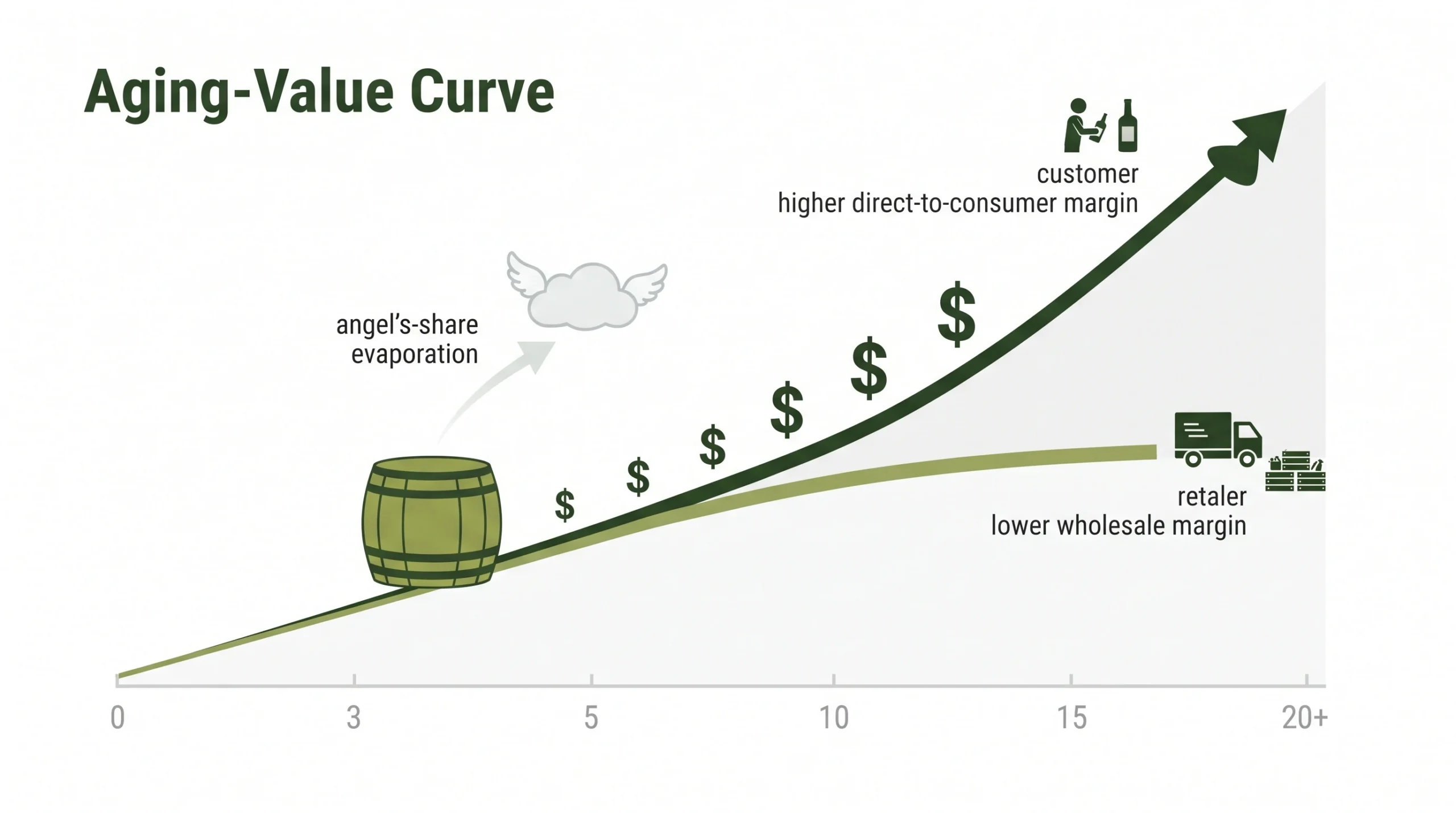
A distillery values its aging inventory by adding up production and carrying costs while adjusting for quality changes over time. Unlike retail stock, spirits in barrels gain value, since the product grows more valuable and easier to sell as it matures. Experts find the base cost of raw materials and labor, then add storage, insurance, and barrel upkeep. They must also forecast the future price of the finished product to set today’s worth.
This process is central to an income approach, such as a discounted cash flow (DCF) analysis. Because inventory maturity dictates future cash flow, the timing of release becomes a critical variable. An accurate read requires careful examination of evaporation rates and the projected grade of the spirit. Owners rely on professional appraisers to make sure these calculations meet the standards set by the American Society of Appraisers.
What KPIs drive brewery and distillery value?
The primary indicators are gross margin per barrel, the size of the distribution footprint, the share of direct-to-consumer (DTC) sales, and how fully the plant runs. Owners often find that high-margin taproom sales, which count as DTC, earn much higher multiples than wholesale-heavy operations. Per the IBBA Market Pulse Survey, the sales channel is a key factor for buyers weighing an earn-out or future cash flow. The KPIs to watch are:
- Gross margin per barrel, which rises with efficiency
- The share of high-margin direct-to-consumer taproom sales
- The distribution footprint and its regional or national reach
- Capacity utilization, which lowers cost per unit when high
A wide distribution footprint signals a brand has reached scale to compete in regional or national markets. Running the plant near full is needed to reach these tiers, since a plant at peak lowers cost per unit and lifts gross margin per barrel. Sofer Advisors watches these efficiencies to tell strong producers from those with too much overhead. National firms like Alvarez & Marsal, Stout, and Kroll note that mixed revenue streams reduce reliance on one channel. These metrics form the base for our business valuation services.
How does equipment affect a brewery’s valuation?
Equipment strongly affects value, because brewing and distilling systems are a major tangible asset that sets production capacity. Appraisers typically use Fair Market Value in Place (FMV-IP) to assess these assets when the brewery runs as a going concern. That standard assumes the equipment stays installed and working as part of the business. A well-kept system from a known maker adds more value than older hardware that needs constant, costly repair.
Analysts must separate owned from leased equipment. Owned gear is a balance sheet asset, while leased gear needs an adjustment for the payments still owed under ASC 842. Every review must account for delayed upkeep, since wear cuts the remaining life. Assessors also weigh whether the system can grow or needs new capital soon. By checking these factors, experts make sure the value reflects the real use of the gear. Our guide to the cost approach versus the income approach shows when each fits.
What regulatory factors impact alcohol business value?
Rules strongly shape how sellable a producer is, since the TTB permit and state liquor licenses are essential intangibles that support operations. These licenses create a high barrier to entry, which raises the value of a fully compliant business over a start-up. Issues with tied-house laws or distribution deals create liabilities, so a clean record is needed for a high value. A firm without secure licensing, or facing distribution trouble, may see limited exit options.
Whether a state liquor license can transfer is a primary factor in the value of a brewery or distillery. In some markets, limited new licenses force buyers to pay a premium for an established firm that holds a permit. Analysts check whether these assets follow local tied-house laws that limit ties between makers and retailers. Breaking those laws triggers penalties that threaten the license. Understanding these limits is a focus of Sofer Advisors advisory support.
Which valuation provider is best for a brewery or distillery?
The right provider gives a certified, independent opinion, not just data or deal listings. A data service publishes benchmark multiples, and a deal platform connects buyers and sellers, but neither gives an opinion of value. Large firms like Alvarez & Marsal, Stout, and Kroll serve the biggest deals, while a specialist firm writes certified reports for tax and legal use. The table below compares the options.
| Provider type | Key focus | Report type |
| Sofer Advisors | Defensible valuations for tax, legal, and reporting | Detailed narrative report (CPA/ABV, ASA certified) |
| Data and research service | Benchmark multiples and transaction data | Databases and publications, not an opinion of value |
| M&A deal platform | Deal sourcing and listings | Platform listings, not a formal valuation |
Pairing good data with professional judgment is essential for an accurate estimate. Data services like Business Valuation Resources give context on deal multiples, but a formal report provides the logic and records for outside review. For tax reporting under IRS Revenue Ruling 59-60 or financial reporting under ASC 820, an appraiser must weigh company-specific risks and economic conditions, in line with AICPA standards. A deal database does not replace an opinion of value from a qualified, independent appraiser.
Brewery valuation rewards DTC margins and a clean license record. The questions below cover what owners ask most.
Frequently Asked Questions
How do you value a craft brewery?
Valuing a craft brewery focuses on capacity utilization, margins per barrel, and local brand strength. Analysts use the market approach with EBITDA or per-barrel multiples for profitable firms, and the asset approach for the worth of systems and inventory in distressed or new operations. Sofer Advisors audits production efficiency and licensing status to give owners a clear picture of their standing.
What is the 3:30:300 rule for beer?
The 3:30:300 rule is a back-of-the-envelope guide for regional brewery potential: aim for around 3,000 barrels of output, a 30 percent gross margin, and a 300-barrel threshold for self-distribution viability. It explains basic scale needs for sustainable cash flow in a crowded market. Sofer Advisors uses precise, custom data models for formal valuations rather than these general rules of thumb.
Is a business worth three times profit?
Many small businesses trade near three times earnings, but the actual value depends on the risk profile, industry trends, and growth potential. Market participants look at SDE or EBITDA, then apply a multiple from peer transactions. Sofer Advisors runs an independent analysis of your earnings quality to see where you sit relative to similar regional producers.
What is a typical EBITDA multiple for a craft distillery?
Craft distillery multiples vary widely with the volume of direct-to-consumer sales and the age of the inventory held. Small operations trade at lower multiples, while established brands with consistent growth command higher values. Analysts compare these against current market data from sources like Business Valuation Resources. Sofer Advisors runs a weighted analysis of relevant transactions to set an appropriate multiple for your production profile.
How do you account for brand value in a brewery valuation?
Brand value shows up in premium pricing, recurring taproom traffic, and the strength of local distribution agreements. Analysts assess this intangible by evaluating customer loyalty, social media following, and the historical growth of the DTC channel. Sofer Advisors folds these qualitative assets into its models to show why one operation holds more value than another with identical equipment.
Does having a restaurant or taproom increase a brewery’s value?
Yes. A profitable taproom significantly increases value by boosting margins and providing a direct link to the consumer. It allows higher profit per barrel than relying only on wholesale distribution. Sofer Advisors evaluates taproom revenue and operating expenses in its analysis, since direct-to-consumer outlets are a primary driver of equity value for modern craft producers.
Are federal and state licenses included in a business valuation?
Yes. Federal and state beverage licenses are essential intangibles that must be included, because they dictate the entity’s ability to operate legally. These permits often represent a significant barrier to entry, which supports the firm’s market value. Sofer Advisors reviews these licenses during diligence so all regulatory requirements are accounted for in the total worth.
What is the difference between enterprise value and equity value for a distillery?
Enterprise value is the total worth of the operating business, including debt and equity, while equity value is what belongs to the owners. Understanding the difference is vital when assessing buyout prices or debt restructuring. Sofer Advisors calculates both during its process so you clearly see what remains for shareholders after all obligations.
How much does a craft brewery or distillery valuation from Sofer Advisors cost?
A brewery or distillery valuation from Sofer Advisors runs $7,500 to $25,000, based on its published engagement data, with multiple business units and complex inventory reaching the higher end. Cost depends on complexity, the number of units, and the report’s purpose. For a quote tied to your operation, request a valuation estimate with your financials and license details.
Related Case Studies
- Negative Goodwill in Acquisitions: A Bargain Purchase Guide
- Business Interruption Valuation: An Insurance Claims Guide
- How to Value a Logistics or 3PL Company
Executive Summary
A craft brewery or distillery is valued on the market, income, and asset approaches, with EBITDA and dollars-per-barrel multiples for profitable firms and the asset approach for new or distressed ones. A distillery’s aging inventory is an appreciating asset, valued on production and carrying cost plus a forecast of the finished product’s market price. High-margin direct-to-consumer taproom sales lift the multiple over wholesale, while capacity utilization and distribution footprint round out the KPIs. Equipment is valued at fair market value in place, and TTB and state licenses are vital intangibles that create a barrier to entry. To prepare, gather financials, an equipment schedule, inventory and barrel records, and all federal and state licenses.
What Should You Do Next?
Gather three years of financials, a full equipment schedule, your inventory and barrel-aging records, and all federal and state licenses, then confirm your license transferability and tied-house compliance. Separate the real estate from the operating business. An independent valuation can then blend the market, income, and asset approaches into a defensible number.
David Hern CPA ABV ASA, founder of Sofer Advisors, provides neutral, defensible valuations for craft breweries, distilleries, and specialized production facilities. Schedule a free consultation to discuss your situation.
People Also Read
- How to Value Intellectual Property: Patents and Trademarks
- How to Value a Business Based on Cash Flow: An Expert Guide
About the Author
This guide was prepared by David Hern CPA ABV ASA, founder of Sofer Advisors, a business valuation firm headquartered in Atlanta, GA serving clients across the United States. David holds dual accreditations as an Accredited Senior Appraiser (ASA) and is Accredited in Business Valuation (ABV), credentials recognized by the IRS, SEC, and FINRA. He also holds the Certified Exit Planning Advisor (CEPA) designation. With 15+ years of valuation experience, David has served as an expert witness in 11+ cases across multiple jurisdictions and built Sofer Advisors into an Inc. 5000-recognized firm with 180+ five-star Google reviews. Its full W2 employee team maintains subscriptions to all major valuation databases and operates under a next business day response policy.
For professional business valuation services, visit soferadvisors.com/about-us/ or contact Sofer Advisors at soferadvisors.com/contact-us/.
Disclaimer: This content is for informational purposes only and does not constitute professional valuation advice. Business valuation conclusions depend on specific facts and circumstances. Contact Sofer Advisors for guidance regarding your specific situation.