


Last Updated: July 2026
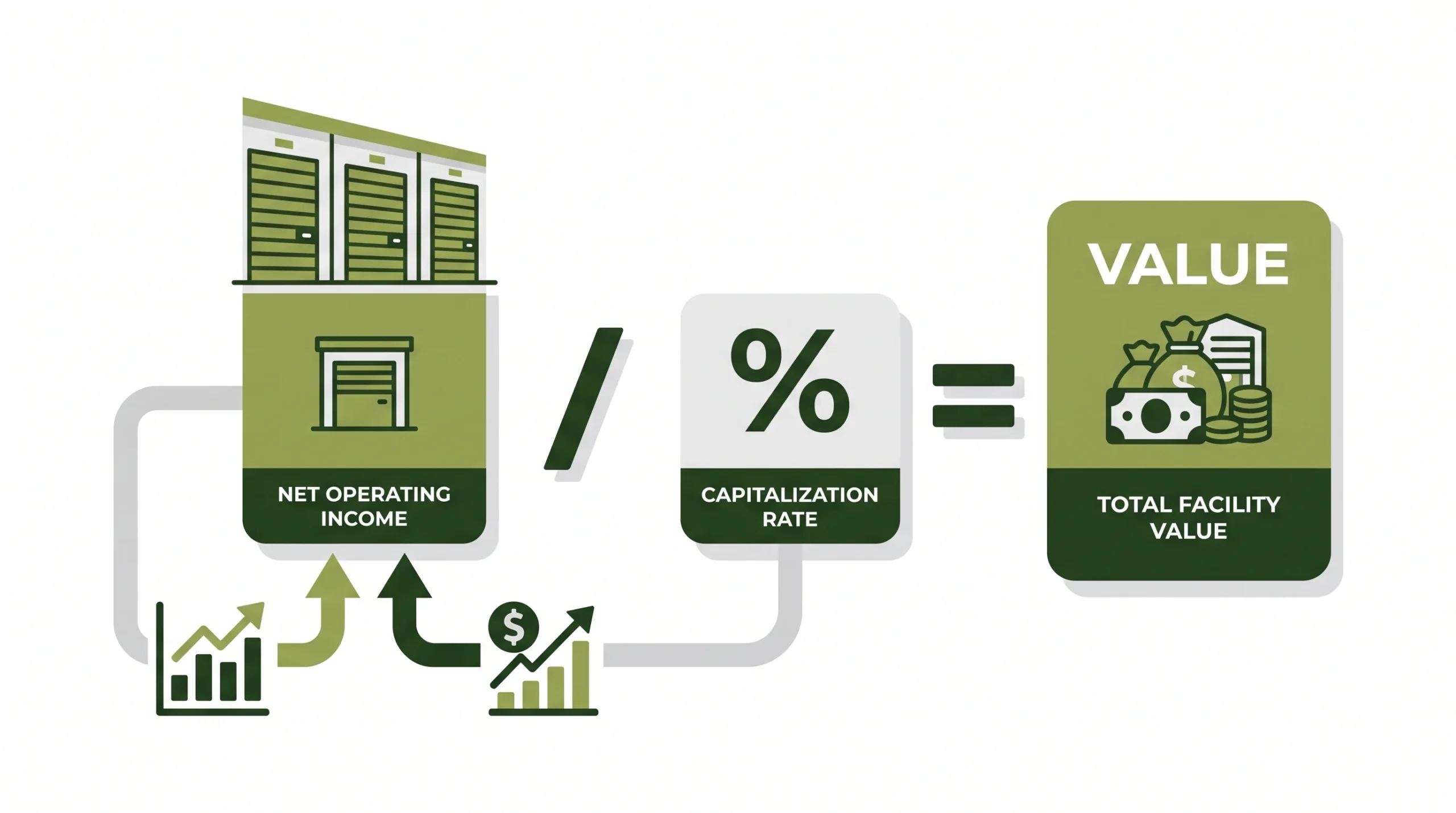
A self-storage facility valuation is the process of setting the economic worth of a storage business and its land. The income approach leads this work. It divides a property’s net operating income by a market cap rate. The self-storage sector reached a market size of about $44.3 billion in the United States, per IBISWorld data. Value hangs on how well each site turns space into steady rent.
These numbers have to survive scrutiny. Sofer Advisors delivers neutral, third-party valuations for storage owners preparing a sale, a refinancing, or a tax filing. Its analysts hold CPA, ABV, and ASA credentials and have supported more than 11 expert-witness cases across several states. That record shapes how every assumption gets documented.
Owners usually order a formal valuation before a sale, a bank loan, or an estate filing. The result depends on two moving parts: the property’s operating income and the cap rate the market assigns to that income. This guide walks through both so you can read your own numbers with more confidence.
Key Takeaways
- Income approach leads: divide NOI by a market cap rate to set value.
- Cap rate band: storage assets trade near 5 to 8 percent; prime Class A sits lower, tertiary sites higher.
- NOI drivers: unit mix, economic occupancy, location, and operating efficiency move the number most.
- NOI definition: gross potential income, minus vacancy and concessions, minus operating expenses; it excludes debt and capital spending.
- Diligence protects the figure: a rent-roll audit and a quality-of-earnings review keep the value defensible.
Each driver feeds the final number in a different way. The sections below break down the methods, the cap rate, and the diligence that make a storage valuation hold up.
Why does a defensible storage valuation matter?
A storage valuation carries real financial weight. Under Revenue Ruling 59-60, the IRS expects fair market value to weigh income, market, and asset evidence, not a single rule of thumb. The Appraisal Foundation sets the USPAP standards that appraisers follow for that work. A weak number can trigger an IRS challenge, a failed loan, or a shortfall at sale. A sound one turns a guess into a roadmap for pricing, financing, and estate planning.
What are the core drivers of facility value?
The core drivers are net operating income, economic occupancy, location, and asset class. NOI matters most because it shows the cash a site produces after costs. A steady, rising NOI points to a well-run facility and a higher exit value.
Economic occupancy tracks the rent actually collected, not just the units filled. A site can look full yet leak value through delinquency or heavy concessions. Owners lift NOI by adding ancillary income too, such as tenant insurance, packing supplies, and late fees. These streams cushion slower months.
Asset class shapes value as well. Class A sites offer climate control, security, and visibility, so they command higher rents. Class B and C sites need more upkeep and draw lower rates. A clear read on these drivers tells an owner where value stands before any sale talk.
How is net operating income calculated?
NOI equals effective gross income minus operating expenses. Effective gross income starts with gross potential income, the rent at full occupancy, then subtracts vacancy and concessions. That gives the rent a site should really collect.
Operating expenses cover the recurring costs of running the site:
- Property taxes and insurance
- On-site management and payroll
- Utilities, repairs, and maintenance
- Marketing and management software
The formula leaves out debt service, depreciation, and capital spending on purpose, since those items sit elsewhere in a cash-flow model. A clean NOI lets an owner compare one site against another on equal terms, because it isolates operating performance from how the deal was financed. Sofer Advisors normalizes NOI to strip out one-time items before it sets a value, and that normalized figure becomes the numerator in the cap rate formula.
What is a cap rate for a storage facility?
A cap rate is the yield a buyer expects from a property’s income in year one. You divide NOI by the cap rate to get value: Value = NOI / Cap Rate. So a $500,000 NOI at a 6 percent cap rate implies about an $8.3 million value.
Storage cap rates generally sit between 5 and 8 percent, based on recent market data. Prime Class A sites in strong metros trade near the low end, since demand is high and risk is low. Secondary markets and older sites carry higher cap rates to price the added risk. Because the band is narrow, a small NOI change swings the value hard. That is why the income approach sits at the center of a storage valuation.
Which valuation methods apply, and how do firms differ?
Three methods apply: the income approach, the market approach, and the cost approach. The income approach capitalizes NOI into value and carries the most weight for storage. The market approach compares recent sales of similar sites. The cost approach adds land value to the depreciated cost to rebuild.
Buyers purchase storage for its cash flow, so appraisers lean on the income approach first. Revenue Ruling 59-60 still guides how the three approaches get weighed for tax and estate work; our guide to Revenue Ruling 59-60 covers the eight factors in detail.
National firms like Alvarez & Marsal, Stout, and Kroll run these methods for large portfolios. Sofer Advisors applies the same standards to single sites and middle-market owners, with senior involvement on every file. That is The Sofer Difference: a Discovery, Diligence, Analysis, and Delivery process built to explain the number, not just hand it over.
Talk to a Sofer Advisors valuation specialist about which approach fits your facility and its intended use.
How does due diligence protect the valuation?
Due diligence verifies the numbers behind the value. A rent-roll audit confirms that stated income matches signed leases. A review of three years of statements flags trends, one-time items, and gaps. A site visit confirms the condition of the units and the building.
A quality-of-earnings review often rides alongside it. This step normalizes NOI and tests whether the income can repeat. Sofer Advisors follows the AICPA valuation standards through this work, so the file holds up with a lender, the IRS, or a court. Careful diligence in the Heart of a Teacher spirit means owners understand every adjustment, not just the total.
How do the three approaches compare?
The table below shows when each approach carries the most weight for a storage facility.
| Method | Best for | Primary input | Typical weight |
| Income approach | Stabilized, income-producing sites | NOI and market cap rate | Highest |
| Market approach | Active sale markets with recent comps | Price per unit or per square foot | Supporting |
| Cost approach | New builds or special-use sites | Land value plus depreciated build cost | Lowest, or a floor |
In practice, an appraiser rarely relies on one method alone. The income approach sets the base value for a stabilized site, the market approach tests that figure against real sales, and the cost approach acts as a floor for newer builds. Weighting the three is a judgment call that depends on data quality and the purpose of the report. Sofer Advisors documents that weighting so the conclusion survives review by a lender, a court, or a tax authority.
Storage valuation blends property analysis with business valuation discipline. The questions below cover the points owners raise most often before an engagement.
Frequently Asked Questions
How do you value a storage facility?
Professional valuation of a storage facility centers on the income approach. An analyst builds net operating income from the rent roll, then divides it by a market cap rate near 5 to 8 percent. Physical condition, occupancy history, and expenses all adjust the figure. Sofer Advisors applies The Appraisal Foundation’s USPAP standards to every storage valuation, which gives owners a defensible basis for tax, sale, or financing decisions.
How much does a 100-unit storage facility make?
Revenue for a 100-unit facility depends on location, unit size, and rent per square foot. National benchmarks give context, but real income follows local absorption and true economic occupancy. An accurate figure requires the current rent roll and verified expenses to reach a sustainable NOI. Sofer Advisors builds that normalized NOI from a site’s own records, so owners see what their specific cash flow supports rather than a national average.
What is a good cap rate for a self-storage facility?
Storage cap rates generally fall between 5 and 8 percent, though the right rate depends on class, age, and local supply. Class A sites in busy metros trade near the low end because risk is lower. Older or rural sites price higher to reflect added risk. Sofer Advisors selects a cap rate from a site’s specific risk profile, not a blanket average, so the value matches the real market for that property.
What is the difference between physical and economic occupancy?
Physical occupancy is the share of units under lease. Economic occupancy is the rent actually collected, after delinquency, concessions, and vacancy. A site can show high physical occupancy yet weak economic occupancy if discounts run deep. Investors watch the economic figure because it drives real cash flow. Sofer Advisors audits both metrics so the reported income reflects the true earning power of the storage site.
What does a self-storage valuation from Sofer Advisors cost?
A standard business valuation from Sofer Advisors runs $7,500 to $25,000, based on its published engagement data. The range reflects ownership complexity, the number of sites, and the report’s purpose, such as a sale, loan, or tax filing. Most single-site storage valuations sit in the lower half of that band. For a quote tied to your facility, request a valuation estimate with your rent roll and recent statements.
How does unit mix affect the value of a facility?
Unit mix sets the flexibility and yield of a facility. A balance of small, medium, and large units draws a wider tenant base and steadies occupancy. When demand for a size outruns supply, owners can raise rates, which lifts NOI and value. Sofer Advisors compares a site’s mix against local supply data to show whether the current layout captures the rent the market will bear.
What documents are needed for a storage valuation?
Appraisers ask for three years of tax returns, year-to-date profit and loss statements, and a current rent roll. Leases, a site survey, and any planned capital projects round out the file. These records let the analyst verify cash flow and confirm the condition of the assets. Sofer Advisors uses this documentation to test income quality, so the final value rests on evidence rather than estimates.
How can I increase the value of my storage facility?
Value tends to rise when owners add recurring income, such as tenant insurance or retail sales of moving supplies. Tighter expense control and better delinquency management also lift NOI. Because value equals NOI divided by the cap rate, each dollar of durable NOI adds several dollars of value. Sofer Advisors highlights the NOI levers with the most impact so owners can focus effort before a sale or refinancing.
Is self-storage considered commercial real estate?
Yes. Self-storage is commercial real estate because it produces income from business use, not residential living. That classification means it follows the same income-based valuation and market analysis as other commercial property types. Sofer Advisors applies the commercial real estate and business valuation standards together, so a storage report meets both accounting and tax-authority expectations. This dual treatment matters most during estate filings and lender reviews.
Related Case Studies
- Eminent Domain Business Valuation: Property and Owner Rights
- How to Value a Construction Company: Expert Guide
- How to Value an HVAC or Home Services Business: Multiples Guide
Executive Summary
A self-storage valuation stands on two figures: net operating income and the market cap rate. Build NOI from a verified rent roll, subtract real operating costs, then divide by a cap rate near 5 to 8 percent. Unit mix, economic occupancy, location, and asset class decide where the NOI lands, and diligence keeps the number defensible. The income approach leads, with the market and cost approaches as checks. To move forward, gather three years of statements, a current rent roll, and property tax records so a credentialed analyst can price your facility with confidence.
What Should You Do Next?
Start by pulling your last three years of operating statements, a current rent roll, and any expansion or capital plans. Clean records shorten the timeline and sharpen the result. A clear read on your NOI and cap rate turns your facility value from a guess into a plan for sale, financing, or estate work.
David Hern CPA ABV ASA, founder of Sofer Advisors, brings CPA, ABV, and ASA credentials and 11+ expert-witness cases to complex storage and real estate engagements. Schedule a free consultation to discuss your facility.
People Also Read
- What Is a DCF Valuation? Complete Guide to the DCF Method
- How to Value a Business Based on Cash Flow: Expert Guide
About the Author
This guide was prepared by David Hern CPA ABV ASA, founder of Sofer Advisors, a business valuation firm headquartered in Atlanta, GA serving clients across the United States. David holds dual accreditations as an Accredited Senior Appraiser (ASA) and is Accredited in Business Valuation (ABV), credentials recognized by the IRS, SEC, and FINRA. He also holds the Certified Exit Planning Advisor (CEPA) designation. With 15+ years of valuation experience, David has served as an expert witness in 11+ cases across multiple jurisdictions and built Sofer Advisors into an Inc. 5000-recognized firm with 180+ five-star Google reviews. Its full W2 employee team maintains subscriptions to all major valuation databases and operates under a next business day response policy.
For professional business valuation services, visit soferadvisors.com/about-us/ or contact Sofer Advisors at soferadvisors.com/contact-us/.
Disclaimer: This content is for informational purposes only and does not constitute professional valuation advice. Business valuation conclusions depend on specific facts and circumstances. Contact Sofer Advisors for guidance regarding your specific situation.









