


Last Updated: August 2026
A medical billing company valuation is the process of setting a fair market value on a firm that runs revenue cycle management for healthcare providers. The value rests on recurring collections, client mix, and contract strength. Recent deal data from Scope Research shows small billing firms trade near 3x to 6x EBITDA, while larger tech-driven platforms reach 12x to 30x. Sofer Advisors builds each figure on this market evidence, not a rule of thumb.
Owners seek a valuation for a sale, a partner buyout, tax reporting, or a dispute. Medical billing sits inside strict healthcare rules. So the work must weigh payer mix and reimbursement risk with care. A steady book of contracts lifts the price. A shaky one pulls it down. The right number gives an owner real footing before any deal.
Key Takeaways
- Multiples by size: Small billing offices trade near 3x to 6x EBITDA. Large, tech-driven platforms can reach 12x to 30x.
- Client concentration: One client above 10 to 15 percent of revenue pulls the value down.
- Payer mix matters: A commercial-heavy book earns more than one loaded with Medicare and Medicaid.
- Technology lifts value: Owned software and automation move a firm from a service shop to a scalable platform.
- Normalize first: Add-backs for owner pay and one-time costs reveal true adjusted EBITDA.
- Private equity is buying: Roll-ups drive strong demand for RCM firms with steady recurring revenue.
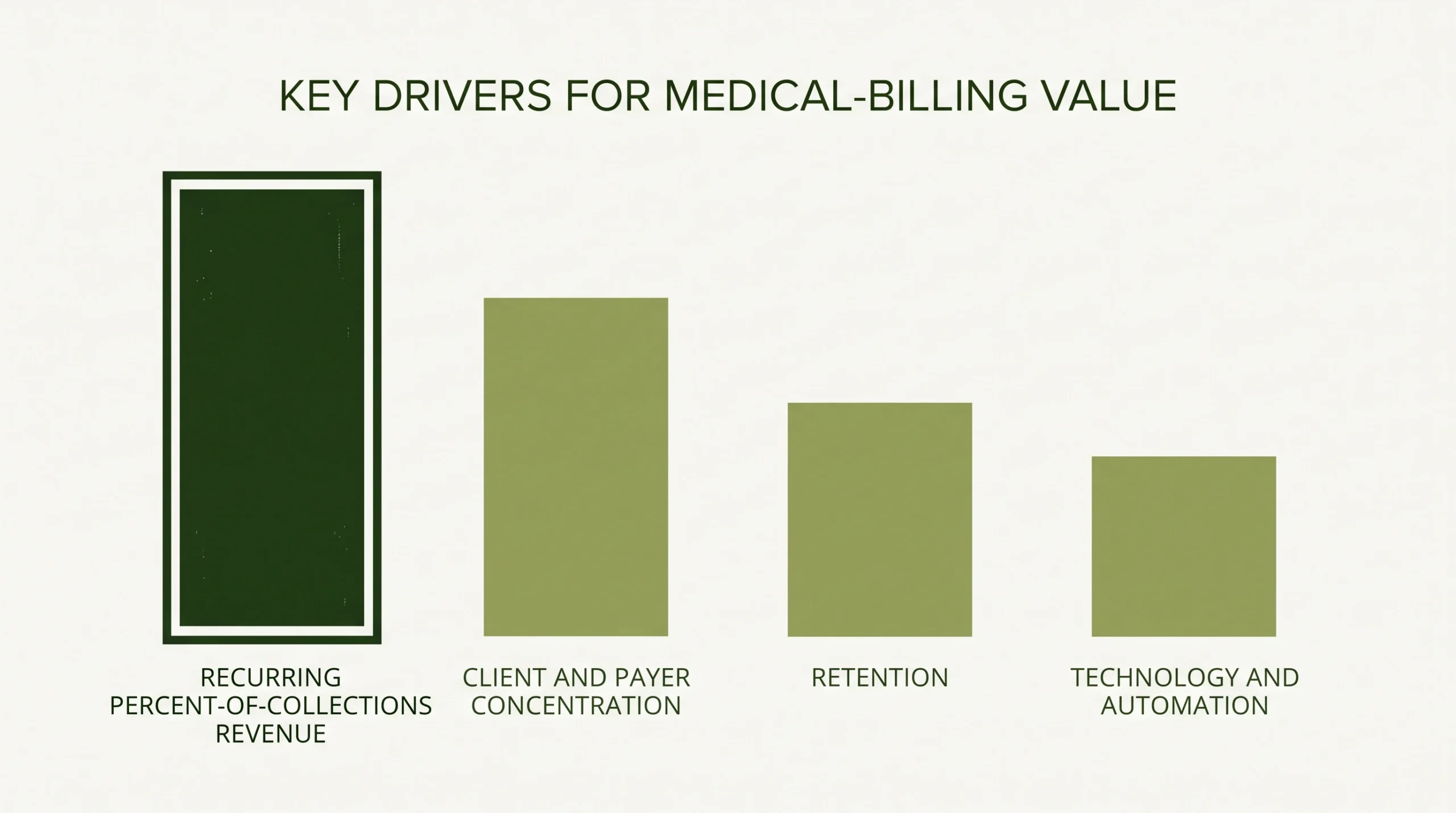
These points tie earnings to risk. The sections below show how pros build each figure. They also show the traps that sink a weak valuation.
What are typical RCM valuation multiples?
Medical billing firms are valued on a multiple of earnings. Small firms use Seller’s Discretionary Earnings, or SDE. Larger firms use EBITDA. Scope Research puts small billing offices near 3x to 6x EBITDA. Mid-sized platforms sit at 6x to 11x. Large, tech-driven RCM firms reach 12x to 30x. In one 2025 deal, EQT bought GeBBS Healthcare for about $850 million, near 17x EBITDA.
Size is not the only driver. Recurring revenue, client retention, and margins all shift the multiple. A firm with sticky contracts and low churn sits near the top of its range. The table maps the common tiers.
| Firm profile | Revenue size | Typical multiple | What drives it |
|---|---|---|---|
| Small owner-run billing office | Under $5M | 2.5x to 4.5x SDE | Owner reliance, few clients |
| Mid-sized RCM platform | $5M to $50M | 6x to 11x EBITDA | Recurring contracts, scale |
| Large tech-driven RCM | Over $50M | 12x to 30x EBITDA | Software, automation, retention |
A multiple is a starting point, not an answer. Two firms with equal earnings can carry very different values. The gap comes from risk. A buyer pays more for income likely to arrive next year. Sofer Advisors tests each driver against current deal data, so the multiple reflects the real business.
How does payer mix affect a billing company’s value?
Payer mix shapes cash flow, and cash flow shapes value. A firm that bills mostly commercial insurers tends to collect more per claim, and on a steadier cycle. Firms leaning on Medicare and Medicaid face lower rates and thinner margins. Those programs set their own prices without real talk. A buyer sees that as a risk and pays a lower multiple.
Rate changes are the core worry. Government programs can shift reimbursement rules with little warning. A firm tied to one program feels that change fast. A broad mix of commercial and government payers softens the blow and spreads income across many sources. A balanced book signals a lower chance of a sudden drop, which tends to lift the price a buyer will support.
Why is client concentration a major valuation risk?
Client concentration is one of the biggest risks in any billing firm. When a few clients drive most of the revenue, the firm has a single point of failure. Buyers often watch the 10 to 15 percent line. A client above that share can trigger a discount. Lose that account, and cash flow falls hard. That fear pulls the multiple down before a deal starts.
Owners can lower this risk over time. Long-term contracts lock in revenue for years and slow client churn. High switching costs help too, since moving billing to a rival is slow and costly. The best defense is a wider client base. When no single account holds real power over the books, future cash flow looks safer. That steadier profile tends to raise the multiple.
Which valuation methods apply to RCM firms?
Most RCM valuations rest on the income approach and the market approach. The asset approach acts as a check. The market approach compares a firm to similar billing companies that have sold. It pulls the multiple from real deals. The income approach, led by a discounted cash flow model, projects future earnings. It then discounts them to present value with a discount rate that fits the firm’s risk.
Each approach answers a different question. The market approach shows what buyers pay today. The income approach shows what the future cash is worth now. A firm with long contracts and steady recurring revenue suits a DCF well. The right choice depends on the deal, the standard of value, and the purpose. Sofer Advisors weighs all three, then reconciles them into one defensible number.
How do technology and offshore labor affect worth?
Technology can lift a billing firm from a service shop to a software platform. A firm that owns its billing software builds a moat. It can add clients without hiring at the same pace. That drives higher margins and a higher multiple. Automation and claim-scrubbing tools cut denials and speed up collections. Clean integration with EMR and EHR systems reduces manual entry. Each gain shows up in the value.
Offshore labor plays a part too. Many billing firms staff coding and follow-up work overseas to hold down cost. Done well, this widens margins and lifts adjusted EBITDA. Done poorly, it raises questions about quality, data security, and HIPAA compliance. A buyer studies both sides. The firm that pairs low cost with tight security earns the better price.
What financial adjustments matter for RCM valuation?
Normalized financial statements are the base of any RCM valuation. Raw books mix true operating profit with owner choices. Analysts add back excess owner pay, one-time legal fees, and personal costs run through the business. They also adjust below-market salaries to a fair rate. These steps reveal the real earning power a new owner would inherit. The result is a clean SDE or adjusted EBITDA figure that a buyer can trust.
This work also decides which advisor an owner should pick. The table compares three routes.
| Feature | Sofer Advisors | Healthcare FMV specialist | Online marketplace |
|---|---|---|---|
| Scope | Valuation for M&A, tax, and litigation | Fair market value for compliance | Basic listing estimate |
| Method | Income, market, and asset approaches | Standard approaches, compliance focus | Market data only |
| Deliverable | Defensible report for IRS and courts | Compliance opinion | Broker opinion or calculator |
The choice rests on how much scrutiny the value will face. An online tool gives a fast guess, but it cannot support a tax filing or a court case. Firms such as Alvarez and Marsal or Kroll serve very large clients. Sofer Advisors brings that same senior-level rigor to middle-market billing firms. Its work rests on IRS Revenue Ruling 59-60 and the AICPA valuation standards, so the number holds up under review.
Why are private equity firms buying RCM companies?
Private equity has driven a wave of RCM deals. Buyers want recurring revenue, wide client bases, and strong technology. VERTESS reports that private equity made up nearly half of healthcare IT deals in 2024. Many firms follow a roll-up plan. They buy several small billing companies, then merge them into one larger platform. Scale cuts cost per claim and raises the exit multiple.
This demand is good news for owners, but it raises the bar. A buyer with a full deal team will test every claim in your books. Weak records or client concentration can cut the price late in talks. This is where The Sofer Difference matters. It is a four-phase process of Discovery, Diligence, Analysis, and Delivery, led by founder David Hern CPA ABV ASA. It also reflects the Heart of a Teacher approach: show an owner the math, not just the answer.
Frequently Asked Questions
How do you value a medical billing company?
Start by normalizing the financials to show true earnings. Add back excess owner pay and one-time costs to reach adjusted EBITDA. Then apply the income and market approaches to find fair market value. The work must weigh client retention, payer mix, and contract strength, not just plain revenue. Sofer Advisors tests these drivers against current deal data to build a defensible number.
What is a good EBITDA multiple for an RCM company?
Most billing firms trade between 3x and 6x EBITDA, though the range is wide. Small owner-run offices sit near the low end. Mid-sized platforms reach 6x to 11x. Large firms with owned software and strong retention can command 12x to 30x. Your exact figure depends on size, margins, and risk. Sofer Advisors pins down where your firm fits within these current market tiers.
How does payer mix affect value?
Payer mix drives cash flow stability. Commercial insurers usually pay more per claim and on a steadier cycle than Medicare or Medicaid. A firm loaded with government payers faces rate cuts it cannot fight. That risk lowers the multiple. A broad mix of work spreads the risk. Sofer Advisors runs a payer concentration review to show how your mix shapes value.
Do long-term client contracts raise the multiple?
Yes. Long-term contracts lock in revenue and slow client churn. They give a buyer more comfort that next year’s income will arrive. That predictable cash flow supports a higher multiple during a sale. Short or month-to-month deals do the opposite, since clients can leave fast. Sofer Advisors reviews the terms and renewal history of your contracts to gauge how firm a floor they set under your value.
How profitable are medical billing companies?
Profit varies with automation, payer mix, and claim accuracy. Efficient firms often post EBITDA margins near 20 to 35 percent. Heavy manual work and high labor cost push margins lower. Strong margins signal a scalable model and lift the multiple. Sofer Advisors compares your cost structure to industry data to show whether your margins hold up against peers.
Why do private equity firms buy RCM companies?
Private equity wants recurring revenue and scalable technology. Buyers often run roll-ups. They buy several small billing firms, then merge them into one platform to cut cost per claim. That scale raises the exit value. Nearly half of 2024 healthcare IT deals came from private equity. This demand helps owners, but a PE deal team will test every number. Sofer Advisors helps you prepare books that hold up.
Does proprietary software raise a billing firm’s value?
Yes. A firm that owns its billing software gains a real edge. It can add clients without hiring at the same pace, which raises margins. Automation and claim scrubbing cut denials and speed collections. Clean EMR and EHR integration lowers manual work and errors. Buyers pay more for these gains, and weigh HIPAA and data security controls alongside them.
What financial adjustments does an RCM valuation need?
An analyst normalizes the books to show true, ongoing profit. Common add-backs include excess owner pay, one-time legal fees, and personal costs run through the business. Below-market salaries get raised to a fair rate. These steps reveal the adjusted EBITDA a new owner would earn. Sofer Advisors performs these adjustments under recognized standards, so your earnings picture is accurate before any sale.
How much does a business valuation from Sofer Advisors cost?
Business valuations from Sofer Advisors typically run from 7,500 to 25,000 dollars. The price depends on the complexity of your books and the scope of the work. Simpler jobs for planning or tax fall toward the lower end. Deals and litigation support need deeper analysis, so they sit higher. Contact Sofer Advisors for a fee quote matched to your goal.
Related Case Studies
- How to Value a Healthcare Management Services Organization (MSO)
- How to Value an IT Managed Services (MSP) Business
- Customer Concentration: Why It Cuts Sale Price 10 to 30 Percent
Executive Summary
A medical billing company valuation prices an RCM firm on its recurring collections and risk. Small firms trade near 3x to 6x EBITDA. Large, tech-driven platforms reach 12x to 30x, and one 2025 deal closed near 17x. Client concentration, payer mix, and contract strength move the number the most. Owned software and disciplined offshore labor lift margins. Private equity roll-ups keep demand strong. Sofer Advisors normalizes the financials, weighs the income and market approaches, and grounds each figure in IRS Revenue Ruling 59-60 and AICPA standards.
What Should You Do Next?
Start by normalizing your financials so owner costs and one-time items do not blur true earnings. Next, review your top five clients and your payer mix, since both shape the multiple. Then confirm the purpose of the valuation before you begin.
For a value you can stand behind, work with David Hern CPA ABV ASA. His team has given expert witness testimony in 11+ cases across Georgia, Florida, California, and New Mexico. Schedule a consultation to discuss the valuation that fits your firm.
People Also Read
- Owner Compensation Normalization: Why Salary Affects Sale Value
- EBITDA Add-Backs: What Buyers Accept and What They Reject
About the Author
This guide was prepared by David Hern CPA ABV ASA, founder of Sofer Advisors, a business valuation firm headquartered in Atlanta, GA serving clients across the United States. David holds dual accreditations as an Accredited Senior Appraiser (ASA) and is Accredited in Business Valuation (ABV), credentials recognized by the IRS, SEC, and FINRA. He also holds the Certified Exit Planning Advisor (CEPA) designation. With 15+ years of valuation experience, David has served as an expert witness in 11+ cases across multiple jurisdictions and built Sofer Advisors into an Inc. 5000-recognized firm with 180+ five-star Google reviews. Its full W2 employee team maintains subscriptions to all major valuation databases and operates under a next business day response policy. For professional business valuation services, visit soferadvisors.com/about-us/ or contact Sofer Advisors at soferadvisors.com/contact-us/.
Disclaimer: This content is for informational purposes only and does not constitute professional valuation advice. Business valuation conclusions depend on specific facts and circumstances. Contact Sofer Advisors for guidance regarding your specific situation.









