


Last Updated: July 2026
An MSP is an IT company that runs a client’s tech systems from a distance, watching over them in a steady, proactive way. An MSP valuation tells you what a managed services provider is worth.
This kind of review uses proven methods, and the two most common are the income approach and the market approach. Together they capture the value of steady contracts and skilled staff. Since Sofer Advisors began in 2019, the firm has offered clear, independent insight that helps owners and stakeholders learn what their company is worth.
The work calls for a close look at real data, so analysts study service deals, churn rates, and profit margins. Churn is the rate at which clients leave, and this careful review builds a value estimate you can defend.
The team holds 180+ five-star Google reviews, a track record that reflects deep skill with tech firms. It also allows a careful study of client mix and delivery costs, both key value drivers in the tech field.
The firm stays neutral in every review, which helps find the true forces behind your market value while keeping the findings fair and grounded in facts.
Knowing your value matters at key moments, whether you plan a sale, file taxes, or pass the firm on. These reviews rest on both past results and future earning power. So good data stays the base of any solid report.
Owners who prepare tend to move faster. Sort your client contracts and financial records first, and the whole review becomes smoother and more open.
Key Takeaways
- Revenue Quality Impacts Value: Steady monthly income drives value more than total sales alone.
- Reviewing Multiples Ranges: Common multiples for service firms run from 4x to 8x EBITDA. Strong firms can top 10x, per Business Valuation Resources (BVR / DealStats).
- Risk Assessment Factors: Client mix, written contracts, and reliance on key staff can lower a firm’s multiple.
- Defensible Methodology Standards: A solid review uses more than one method, often pairing a Market Approach with an Income Approach.
- Operational Value Enhancers: Written procedures and a strong team lift value because they reduce how much the firm leans on the owner.
The sections below cover each area in depth.
What Are the Core MSP Valuation Metrics?
The main metrics focus on two things. First is the stability of steady income, and second is the long-term profit from the business model.
Monthly Recurring Revenue (MRR) shows how steady your top-line income is. Meanwhile, Annual Recurring Revenue (ARR) gives a wider yearly view. Both help analysts gauge how predictable your cash flow is, and that predictability matters under Revenue Ruling 59-60, the IRS framework that anchors most private-company valuations.
Analysts also study the gross margin on services to check that costs leave room for healthy profit. Sofer Advisors uses these numbers to see one thing: how well the firm turns work into steady cash for owners.
Reviewers look past top-line income too. They study customer lifetime value (CLV), the total profit one client brings over time, and customer acquisition cost (CAC). This is what it costs to win a new client. They also track the churn rate.
A low churn rate means clients stay, and strong retention supports a higher multiple. But a high cost to win clients can be a red flag, since it may mean the firm struggles to grow well.
These figures show the firm’s place in its market against benchmarks like the IBBA Market Pulse Survey.
How Are MSP Valuation Multiples Determined?
Multiples come from applying set benchmarks to a firm’s earnings. Analysts often use EBITDA or Seller’s Discretionary Earnings (SDE), which reflects the full benefit an owner takes from the firm. These earnings give a baseline for current profit.
Analysts then apply a multiple to those figures to yield a total value estimate. The final multiple is rarely fixed.
Several factors move these multiples. A heavy reliance on one big client can lower value, because losing that account would hurt future cash flow. But a broad, stable client base tends to lift the multiple.
Longer contracts also help, since buyers want deals that make income predictable. Other things refine the value too, including a mature service mix and strong internal systems. Analysts weigh these softer factors alongside the raw numbers, which keeps the final estimate accurate and easy to defend.
What Valuation Methods Apply to MSPs?
The best reviews use two methods together. These are the Market Approach and the Income Approach. The Market Approach compares your firm to similar ones that sold, drawing multiples from Business Valuation Resources.
The Income Approach often uses a Discounted Cash Flow (DCF) study. This projects future earnings and then discounts them to today’s value. This shows what future profit is worth now.
There is also an Asset Approach, which can set a floor value. But it often understates what an MSP is truly worth.
Much of an MSP’s value is intangible, resting in long-term contracts and goodwill. Goodwill is the extra value beyond hard assets, and this view matches IRS Revenue Ruling 59-60.
How Do Service Contracts Affect MSP Value?
Contract types shape value in a direct way. They set how sure and how strong future earnings are. So multi-year, fully managed deals are worth more to buyers than month-to-month plans or one-off repair work.
These full contracts make clients stick around, which lowers churn risk and builds a firm base for revenue forecasts.
Predictable cash flow earns a higher multiple because the odds of a sudden income drop go down. But firms that lean on repair jobs face more swings, since those jobs are often one-time, not steady.
Sofer Advisors reviews these terms during due diligence, the deep check a buyer runs before a deal.
The goal is simple: does the model support long-term growth, or does it stay tied to reactive, low-margin work? Owners often work to strengthen these contracts before a sale.
What Is the MSP Valuation Process?
The process starts with Discovery and Diligence. These steps map the business model and check the numbers.
Diligence involves financial statement normalization, which means adjusting for one-time costs and owner perks. This step makes sure the earnings reflect true, ongoing profit.
Next comes The Sofer Difference, a strict Analysis phase that uses more than one method, both Income and Market. The goal is a value you can defend, and this phase blends the findings into one clear report.
The work ends with a Delivery phase, where the firm explains the results. Using a Heart of a Teacher approach, they help stakeholders grasp the logic behind the numbers.
Midway through, owners often weigh these parts as they plan for a sale or tax filing. The process is easier with an expert at your side.
Sofer Advisors has earned 180+ five-star Google reviews that praise clear, defensible work. Request a valuation estimate to see where your firm stands.
Which Factors Increase an MSP’s Valuation?
Some factors lift value in a clear way. A low churn rate is one, and so are high gross margins and strong recurring income.
Owners with churn below 10 percent draw more buyer interest. And gross margins above 50 percent are a good sign too. They tell buyers the delivery model is healthy, which means the firm can grow without cost spikes.
Beyond the numbers, written systems matter. Documented Standard Operating Procedures (SOPs) reduce risk, since they are step-by-step guides for daily tasks.
When a firm runs on clear steps, it looks more stable because it does not depend on one person’s memory. A focus on one industry helps too, marking the firm as a niche expert.
That reputation supports premium pricing and boosts client retention. This makes value easier to defend in any deal.
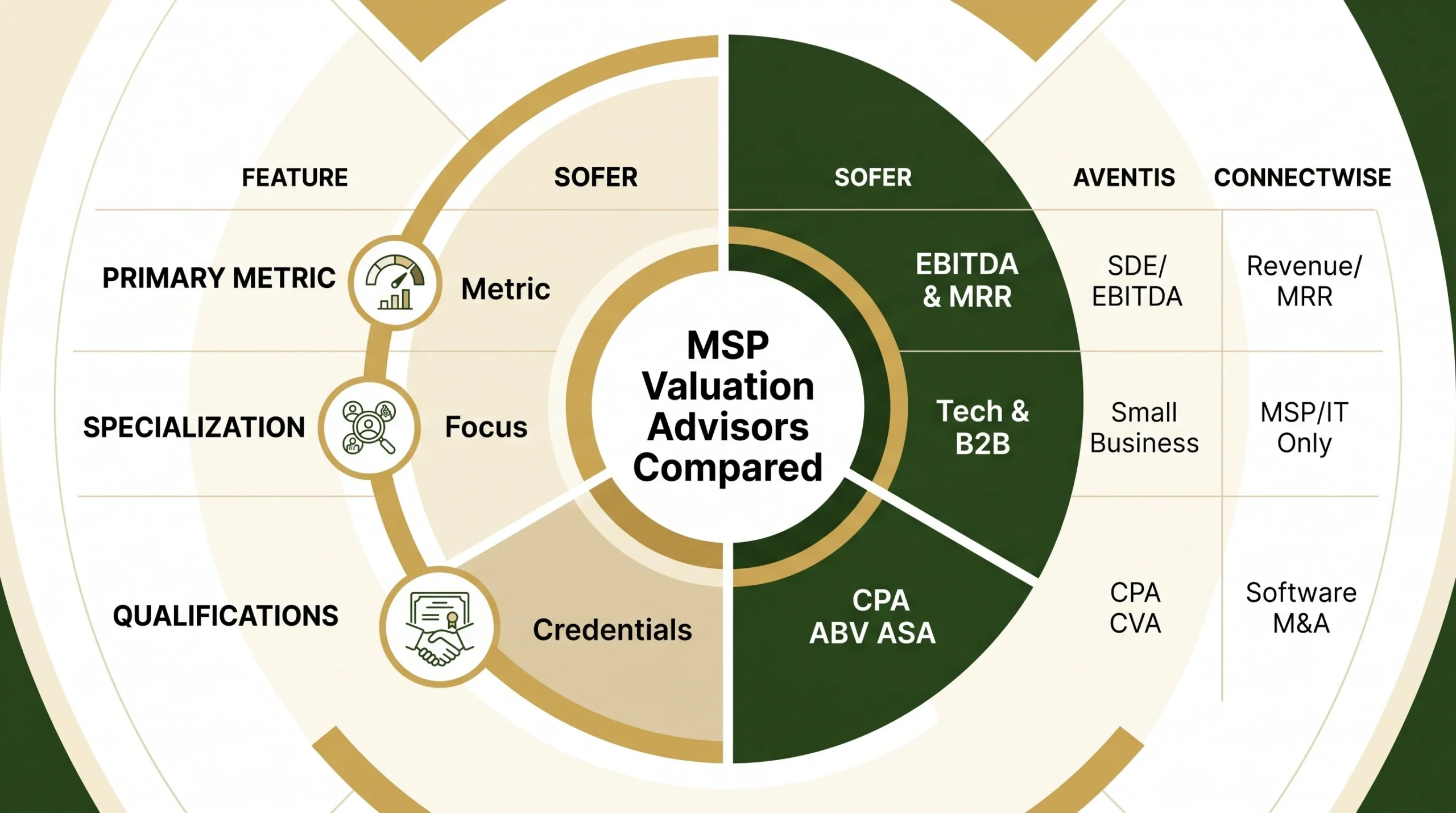
The table below shows how firms differ across method, focus, and credentials.
| Feature | Sofer Advisors | Aventis-Advisors | ConnectWise (via service) |
|---|---|---|---|
| Primary Valuation Metric | Normalized EBITDA & MRR Quality | SDE or EBITDA | Primarily Revenue/MRR |
| Industry Specialization | Broad Technology & B2B Services | General Small Business | MSP/IT Services Exclusive |
| Qualifications | CPA, ABV, ASA accredited team | CPA, CVA | Software-driven M&A advice |
Your choice depends on your goal. Do you need a formal report for taxes, or a strategic benchmark for internal plans? Software groups may give quick, revenue-based estimates.
Specialized firms apply stricter standards, which draw on the Uniform Standards of Professional Appraisal Practice and the ABV credential framework that governs accredited valuation work. A firm with strong credentials and deep field knowledge helps most, since it gives the truest view of total value.
Owners should check one thing first: does the partner grasp recurring revenue in their sector? That clarity keeps findings solid in talks or reviews.
What should the valuation review compare?
The points below sum up the core choices, each tied to the records and market data.
| Decision area | Evidence and review focus |
|---|---|
| What Are the Core MSP Valuation Metrics | The core MSP valuation metrics are centered on the stability of recurring revenue streams and the long-term profitability of the business model. |
| How Are MSP Valuation Multiples Determined | MSP valuation multiples are determined by applying specific benchmarks to a business’s earnings, typically using EBITDA multiples or Seller’s Discretionary Earnings (SDE). |
| What Valuation Methods Apply to MSPs | The most credible valuations for managed service providers (MSPs) rely on a combination of the Market Approach and the Income Approach. |
The final report should tie these areas together and should not treat any method or input alone.
Frequently Asked Questions
How to value an MSP?
Start by checking how steady the recurring income is. Weigh it against past operating costs, then use the income approach to project future cash flow and the market approach to compare with similar tech firms.
This dual method reveals one thing: can the firm earn profit through its service deals? Sofer Advisors uses these standards to set a value you can defend, one that reflects contract quality and churn risk.
What does MSP stand for?
MSP stands for managed service provider. It is a third party that runs a client’s IT systems from afar and also manages end-user devices.
These firms offer proactive care, security, and upkeep, covering network systems for a set monthly fee.
How much is a business worth with $500,000 in sales?
Sales alone rarely equal value. Profit margins and assets matter far more. So a firm with these sales might be worth just a slice of its revenue if it carries high debt or few hard assets.
A high-margin firm could earn a higher multiple. Sofer Advisors gives a custom estimate that weighs your earnings, risk, and balance sheet strength.
What is an MSP in finance?
In finance and valuation, an MSP means a certain kind of firm. It provides outsourced digital and network services and earns steady monthly income.
Because these firms rely on multi-year deals and stable fees, they are valued differently than factories or shops.
What is a good EBITDA multiple for an MSP?
Common multiples for service firms run from 4x to 8x EBITDA. Strong firms with high recurring income can top 10x, a figure that comes from Business Valuation Resources data.
The exact multiple depends on several things, including contract length, client retention, and team depth. All three lower the risk a buyer sees. And Sofer Advisors reviews your earnings to place your firm in these ranges.
What churn rate makes an MSP more attractive to buyers?
Owners with churn below 10 percent tend to draw more buyer interest. A low churn rate means clients stay, and strong retention supports a higher multiple. It also lowers the risk that income drops suddenly, so buyers will pay more. Sofer Advisors reviews churn and contract terms to gauge how steady your revenue really is.
Why does recurring revenue matter more than total sales?
Steady monthly income drives value more than total sales alone. Metrics like Monthly Recurring Revenue and Annual Recurring Revenue show how predictable your cash flow is. Predictable earnings earn a higher multiple because the odds of a sudden income drop go down. Sofer Advisors weighs this recurring revenue quality when setting a value you can defend.
What gross margin signals a healthy MSP?
Gross margins above 50 percent are a good sign to buyers. They show the delivery model is healthy, which means the firm can grow without cost spikes. Analysts study the gross margin on services to confirm that costs leave room for healthy profit. Sofer Advisors uses these numbers to see how well the firm turns work into steady cash.
How do service contracts affect an MSP’s value?
Contract types shape value in a direct way by setting how sure future earnings are. Multi-year, fully managed deals are worth more than month-to-month plans or one-off repair work, since they lower churn risk and steady the revenue base. Predictable cash flow earns a higher multiple. Sofer Advisors reviews these terms during due diligence to judge long-term growth.
Related Case Studies
- SaaS Valuation: Complete Guide to Software Company Value
- Technology Company Valuation Methods: A Complete Guide
- How to Value a Cybersecurity Company: ARR, NRR, and 2026 Comps
Executive Summary
An MSP valuation determines the worth of a managed services provider by weighing recurring revenue stability against long-term profitability. The two most credible methods are the income approach, often built on a discounted cash flow analysis, and the market approach, which draws EBITDA or SDE multiples from comparable sales. Service firms commonly trade between 4x and 8x EBITDA, while firms with churn below 10 percent, gross margins above 50 percent, and multi-year managed contracts can exceed 10x.
Client concentration, month-to-month plans, and heavy owner reliance compress the multiple, whereas documented SOPs and niche focus expand it. Sofer Advisors normalizes earnings, applies more than one method, and grounds every conclusion in IRS Revenue Ruling 59-60 to produce a defensible result.
What Should You Do Next?
Track your recurring income and churn each quarter so you always hold a clear view of your market position. Gather a summary of your contracts, EBITDA, and retention data to prepare for a formal review. Bring in a professional early to fix weak spots before a sale or reporting cycle.
David Hern CPA ABV ASA, founder of Sofer Advisors provides neutral, defensible valuations for managed IT services providers. Schedule a free consultation to discuss your situation.
People Also Read
- How to Value a Healthcare Management Services Organization (MSO)
- Business Valuation Services United States: Expert Guide 2025
About the Author
This guide was prepared by David Hern CPA ABV ASAc, founder of Sofer Advisors, a business valuation firm headquartered in Atlanta, GA serving clients across the United States. David holds dual accreditations as an Accredited Senior Appraiser (ASA) and is Accredited in Business Valuation (ABV), credentials recognized by the IRS, SEC, and FINRA. He also holds the Certified Exit Planning Advisor (CEPA) designation. With 15+ years of valuation experience, David has served as an expert witness in 11+ cases across multiple jurisdictions and built Sofer Advisors into an Inc. 5000-recognized firm with 180+ five-star Google reviews. Its full W2 employee team maintains subscriptions to all major valuation databases and operates under a next business day response policy.
For professional business valuation services, visit soferadvisors.com/about-us/ or contact Sofer Advisors at soferadvisors.com/contact-us/.
Disclaimer: This content is for informational purposes only and does not constitute professional valuation advice. Business valuation conclusions depend on specific facts and circumstances. Contact Sofer Advisors for guidance regarding your specific situation.