

Last Updated: August 2026
A laundromat valuation is the process of finding the fair market value of a self-service laundry business. It weighs cash flow, the age of the washers and dryers, and the lease. Private deal data shows most stores sell for about 3.5 to 5 times yearly earnings. Sofer Advisors builds each estimate on numbers a buyer, lender, or court can check.
Owners usually order one when a sale, a partner buyout, a loan, or an estate plan puts a real number on the table. The United States has roughly 29,500 laundromats, most independently owned, so private sale data guides pricing. Price the store too high and it sits unsold. Price it too low and the owner leaves money behind.
Key Takeaways
- Earnings first: Value rests on Seller’s Discretionary Earnings, not gross sales.
- The multiple: Most laundromats sell near 3.5 to 5 times yearly SDE.
- Equipment age: Old washers and dryers cut the price to cover replacement costs.
- The lease: A long, transferable lease at fair rent adds real value.
- Clean records: Verifiable cash and card revenue supports a higher price.
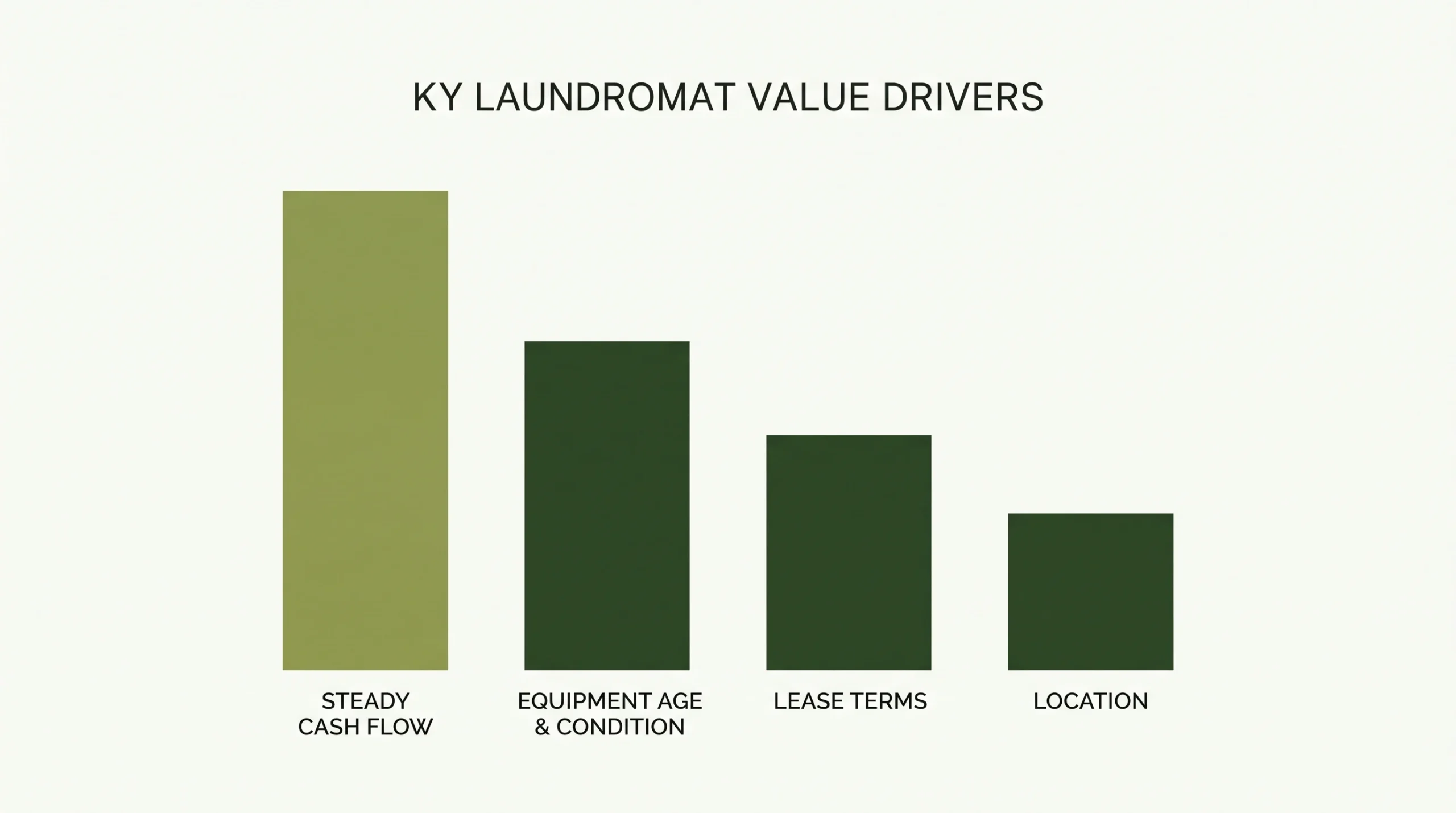
Each point ties back to how steady the income looks to a buyer. The sections below walk through cash flow, equipment, the lease, and the multiples that set the final number.
What is a laundromat valuation?
A laundromat valuation is a supported estimate of what a coin or card laundry is worth. An appraiser reviews the books, the machines, and the lease, then applies a method. Most stores are priced on the income approach, which turns yearly earnings into value. The asset approach and market approach act as a check. Under IRS Revenue Ruling 59-60, the work must weigh both the numbers and the risks behind them. The goal is one defensible value.
Three methods guide the work. The income approach divides normalized earnings by a rate that reflects risk. The asset approach adds up the washers, dryers, and fixtures at fair value, then subtracts debts. The market approach compares recent sales of similar stores. Appraisers weight these results by the quality of the records. USPAP and the AICPA valuation standards, known as SSVS, ask for that same discipline. A store with clean books earns a firmer number than one that tracks sales by hand.
How does cash flow set the value?
Cash flow sets most of the value because buyers pay for the income a store throws off. The key figure is Seller’s Discretionary Earnings, or SDE. It starts with net profit, then adds back the owner’s pay, interest, taxes, and depreciation. A steady SDE history gives a lender the comfort to fund a deal. Because much of the revenue is cash, an appraiser checks water and power bills against reported sales. The meters rarely lie.
Laundromats take both cash and card, so the review digs into how money is counted. Card and app systems log every wash, which makes revenue easy to prove. Loose cash is harder, so an appraiser ties sales back to water use and machine cycle counts. Water and power are the two largest costs, and they rise with real usage. If the bills suggest more loads than the books report, the owner may be missing income. The firm shows owners the math behind these add-backs, the Heart of a Teacher approach it brings to every job. For the full method, see how to value a business based on cash flow.
Do equipment age and condition matter?
Equipment age and condition matter because the machines earn the money. A washer or dryer lasts about 10 to 15 years with good care. Near the end of that life, a buyer faces a large bill to replace the fleet. That future cost, called deferred maintenance, pulls the price down. A store with newer, energy-efficient machines holds value better. An appraiser also sets aside a replacement reserve, so the value reflects the real cost of keeping the store open.
A full equipment list drives this part of the work. It should show each machine’s make, model, install date, and service history. With that record, an appraiser can judge how many years of use remain. Older machines that makers no longer support carry a lower value, since parts get scarce and repairs cost more. Efficient units also cut the water and power bills, which lifts earnings. Sofer Advisors builds a replacement reserve into the model, so the value matches the true state of the assets.
How does the lease and location count?
The lease and location often decide the value. A laundromat cannot move its plumbing, so the site is the business. A long lease, ten years or more, with fair rent and the right to transfer, adds value and lowers risk. A short lease, or one with steep rent hikes, does the opposite. Location matters too. Stores near dense rental housing, where few homes have machines, draw steady traffic. Rent and foot traffic together shape future earnings.
Buyers read the lease closely because rent is a fixed cost they cannot escape. Rent below the local market rate acts like an asset, since it protects the margin. An assignable lease lets the sale close without a new negotiation. If the landlord can block a transfer or reset the rent, the store is harder to sell. Owners should check for renewal options and yearly increase caps before they list. These terms fall inside the audit scope of any formal appraisal, and they move the number.
Attended or unattended: does it matter?
Attended and unattended stores earn value in different ways. An unattended store runs on lower labor cost, but it leans fully on the machines and card systems. An attended store adds staff, wash-and-fold service, and longer hours, which lift revenue but also raise payroll. Neither model wins on its own. The value depends on how each choice affects normalized earnings and risk. The table below compares the two on the factors a buyer weighs most.
| Factor | Unattended store | Attended store |
|---|---|---|
| Labor cost | Low, mostly cleaning | Higher, staff on site |
| Revenue mix | Self-service washes | Washes plus wash-and-fold |
| Owner time | A few hours a week | Daily oversight |
| Main risk | Machine downtime | Payroll and turnover |
| Typical multiple | Lower end of the range | Higher end with strong SDE |
The right model depends on the site and the owner’s goals. An unattended store suits an investor who wants light, steady income and few staff worries. An attended store suits an operator who wants to grow revenue through service and volume. In a valuation, the model shapes the add-backs and the risk rating, which then moves the multiple. A store with proven wash-and-fold income and reliable staff can support a higher price. The firm weighs both models against the local market before it sets a value.
What multiples fit a laundromat?
Most laundromats sell for about 3.5 to 5 times yearly SDE, based on private deal data. The exact multiple turns on equipment age, lease length, and how clean the books are. A newer store with a long lease sits near the top of the range. An older store with a short lease sits near the bottom. Appraisers also cross-check the result with EBITDA and a simple revenue multiplier, so no single method drives the answer.
Sofer Advisors treats the multiple as a starting point, not the whole answer. The firm normalizes earnings first, strips out owner perks and one-time costs, then tests the result against recent sales. This is The Sofer Difference, a four-phase process of Discovery, Diligence, Analysis, and Delivery that yields an audit-ready report. Founder David Hern CPA ABV ASA has valued businesses for more than 15 years. Large firms such as Alvarez and Marsal or the Big 4 aim at enterprise clients. The firm brings that same senior-level rigor to a single-store owner, and unlike a solo practitioner, it backs each number with a full W2 team of 14.
Frequently Asked Questions
How much is a laundromat worth?
A laundromat is worth about 3.5 to 5 times its yearly SDE in most markets. A store with 120,000 dollars of earnings might sell near 420,000 to 600,000 dollars. The final price shifts with equipment age, lease length, and local competition. These figures are estimates, not a promise of any sale price. The firm builds value from your own records and recent deals in your area.
What multiples are used for laundromats?
Laundromats usually trade at 3.5 to 5 times Seller’s Discretionary Earnings, based on private deal data. That multiplier is applied to normalized earnings to reach a purchase price. A cleaner store with modern machines and a long lease sits near the 5 mark. An older store with a short lease sits closer to 3.5. The firm checks these benchmarks against your specific numbers before it settles on a range.
How do you value used laundromat equipment?
Used equipment value rests on its remaining life, current condition, and demand for the make and model. An appraiser reads service logs and physical wear to judge how many cycles are left before major repairs. Machines that makers no longer support carry a lower value, since parts cost more. The firm adds this asset review to the income work, so the value reflects both earnings and the real state of the fleet.
Is a laundromat a good investment in 2026?
A laundromat can still be a solid investment in 2026 for owners who manage it well. The business offers steady cash flow, low inventory, and high barriers to entry from permits and utility work. Success rests on machine upkeep and rent that stays sustainable over time. Rising water and power costs can squeeze margins if the owner ignores them. A formal valuation shows whether a specific store meets your return goals.
What is a good SDE for a laundromat?
A strong SDE for a single-store laundromat often falls between 80,000 and 200,000 dollars a year. That range assumes modern, efficient machines and repair costs that stay under control. Higher figures usually point to a good site with steady demand and limited nearby competition. The firm normalizes past expenses to show a typical owner’s true economic benefit, so the earnings figure reflects real performance rather than one unusual year.
How does the lease affect the value?
The lease is often the single biggest factor in the value. A lease with ten or more years left, fair rent, and a transfer right acts as a major asset. An expiring lease with no renewal protection creates real risk and cuts the price a buyer will pay. Steep annual rent hikes have the same effect. The firm reviews every lease term to show how the contract shapes your total value.
Does an attended store sell for more?
An attended store can sell for more when its extra services add proven, steady income. Wash-and-fold and longer hours lift revenue, though staff raise payroll and add risk. The value depends on whether the added earnings survive normalization once the owner’s pay is counted. An unattended store may still price well on lower costs and light oversight. The firm tests each model against the local market before it sets a number.
How much does a business valuation from Sofer Advisors cost?
A business valuation from Sofer Advisors typically runs from 7,500 to 25,000 dollars. The price depends on how complex your financials are and the purpose of the report. Simpler jobs for planning or tax fall toward the lower end. Deals and litigation support need deeper analysis, so they fall higher. These figures are a general range, not a quote. Contact the firm for a fee matched to your situation.
Related Case Studies
- Car Wash Valuation: How to Value Express, Tunnel, and Subscription Models
- How to Value a Self-Storage Facility: Cap Rates and Operations
- When the Cost Approach Wins: Valuing Asset-Heavy Businesses
Executive Summary
A laundromat valuation turns one year of adjusted earnings into a business value. Most stores sell at 3.5 to 5 times SDE, based on DealStats deal data. Cash flow carries the most weight, so an appraiser ties reported sales to water and power use. Equipment age sets a replacement reserve, and the lease can add or strip value fast. The income approach leads, with asset and market checks alongside. The work follows IRS Revenue Ruling 59-60 and AICPA valuation standards, so the number holds up for a sale, tax filing, or dispute.
What Should You Do Next?
Start by gathering your tax returns, profit and loss statements, and a full equipment list with install dates. Confirm the purpose of the valuation, since a figure for planning may not survive IRS or court review. Then match the value to real market evidence rather than a rough rule of thumb.
For a value you can stand behind, work with David Hern CPA ABV ASA. His team has given expert witness testimony in 11+ cases across Georgia, Florida, California, and New Mexico. Schedule a consultation to discuss the value of your laundromat.
People Also Read
- EBITDA Add-Backs: What Buyers Accept and What They Reject
- Owner Compensation Normalization: Why Salary Affects Sale Value
About the Author
This guide was prepared by David Hern CPA ABV ASA, founder of Sofer Advisors, a business valuation firm headquartered in Atlanta, GA serving clients across the United States. David holds dual accreditations as an Accredited Senior Appraiser (ASA) and is Accredited in Business Valuation (ABV), credentials recognized by the IRS, SEC, and FINRA. He also holds the Certified Exit Planning Advisor (CEPA) designation. With 15+ years of valuation experience, David has served as an expert witness in 11+ cases across multiple jurisdictions and built Sofer Advisors into an Inc. 5000-recognized firm with 180+ five-star Google reviews. Its full W2 employee team maintains subscriptions to all major valuation databases and operates under a next business day response policy. For professional business valuation services, visit soferadvisors.com/about-us/ or contact Sofer Advisors at soferadvisors.com/contact-us/.
Disclaimer: This content is for informational purposes only and does not constitute professional valuation advice. Business valuation conclusions depend on specific facts and circumstances. Contact Sofer Advisors for guidance regarding your specific situation.









