


Last Updated: August 2026
A golf course valuation is a formal estimate of what a course and its land are worth. It reads the golf business and the real estate as two linked parts. Private deal data shows most courses sell for about 1.0 to 1.5 times yearly revenue. Sofer Advisors treats each course as a business and a piece of land at once, then tests both.
Owners need this number for a sale, a partner buyout, an estate filing, or a bank loan, and each purpose shapes the work. Rounds played hit record highs again in 2025, yet about 2,000 fewer courses now absorb that demand, which supports the value of a well-run site. Getting the figure right protects an owner whether they sell, refinance, or pass the course on.
Key Takeaways
- Three approaches: A sound valuation blends the income, market, and asset approaches. Each one checks the others.
- Rounds set the income: Rounds played and green fees drive daily revenue. Steady play points to a higher value.
- Dues add stability: Private clubs earn recurring member dues. That steady cash often lifts value above a public course.
- Land can lead: The real estate is valued on its own. Sometimes the ground is worth more than the golf.
- Upkeep cuts value: Deferred repairs and old equipment lower the number, often dollar for dollar.
These points connect play, people, and property. The sections below show how each one feeds a single value that holds up under review.
What is a golf course valuation?
A golf course valuation is a formal estimate of what a course and its land are worth. It views the golf business and real estate as two linked parts. Appraisers use three methods to reach the number. The income approach reads cash flow from rounds, dues, and food sales. The market approach compares recent course sales. The asset approach values the land, buildings, and equipment. Each method tests the others, so the fair market value can stand up to review.
Owners order a valuation for many reasons, and the purpose shapes the work. A tax report must meet IRS Revenue Ruling 59-60 and AICPA SSVS. Sofer Advisors builds each report to fit its stated use, so it survives an audit or a court test.
How do rounds and green fees set value?
Rounds played and green fees are the core of course income. A round is one golfer playing the course once. The green fee is what that round costs. Multiply the two and you get the main revenue line. Cart rentals, the driving range, and lessons add more on top. Appraisers study how many rounds the course draws each year and at what price. Growing, steady play signals a healthy business and supports a higher value.
Analysts often track revenue per available round, a blend of price and how full the tee sheet stays. Food and beverage sales and the pro shop round out the income. From these figures an appraiser builds normalized earnings, then a matching EBITDA.
How do membership dues models compare?
Membership is where private and public courses split apart. A private club charges a joining fee and yearly dues. That money arrives whether members play or not, so it is steady and easy to forecast. A public, daily-fee course earns most of its cash at the counter. It lives on green fees, which rise and fall with weather and the season. Steady dues usually earn a private club a higher value than a public course of similar size.
| Feature | Private club | Public daily-fee course |
|---|---|---|
| Main revenue | Member dues and joining fees | Green fees per round |
| Cash stability | High, paid on a set schedule | Lower, tied to weather and season |
| Key risk | Member losses and aging rolls | Empty tee times in slow months |
| Typical value | Higher, backed by recurring dues | Lower, driven by daily play |
A semi-private course blends both models, taking dues from members and fees from the public. Whatever the model, retention is the number to watch. A club that keeps its members holds its value, while heavy turnover drags it down. Food and beverage margins and pro shop sales also swing the result. An appraiser weighs each stream, then judges how firm the cash looks over time. Firm, repeatable revenue always earns a stronger value than income that depends on a good weather year.
How is the golf course real estate valued?
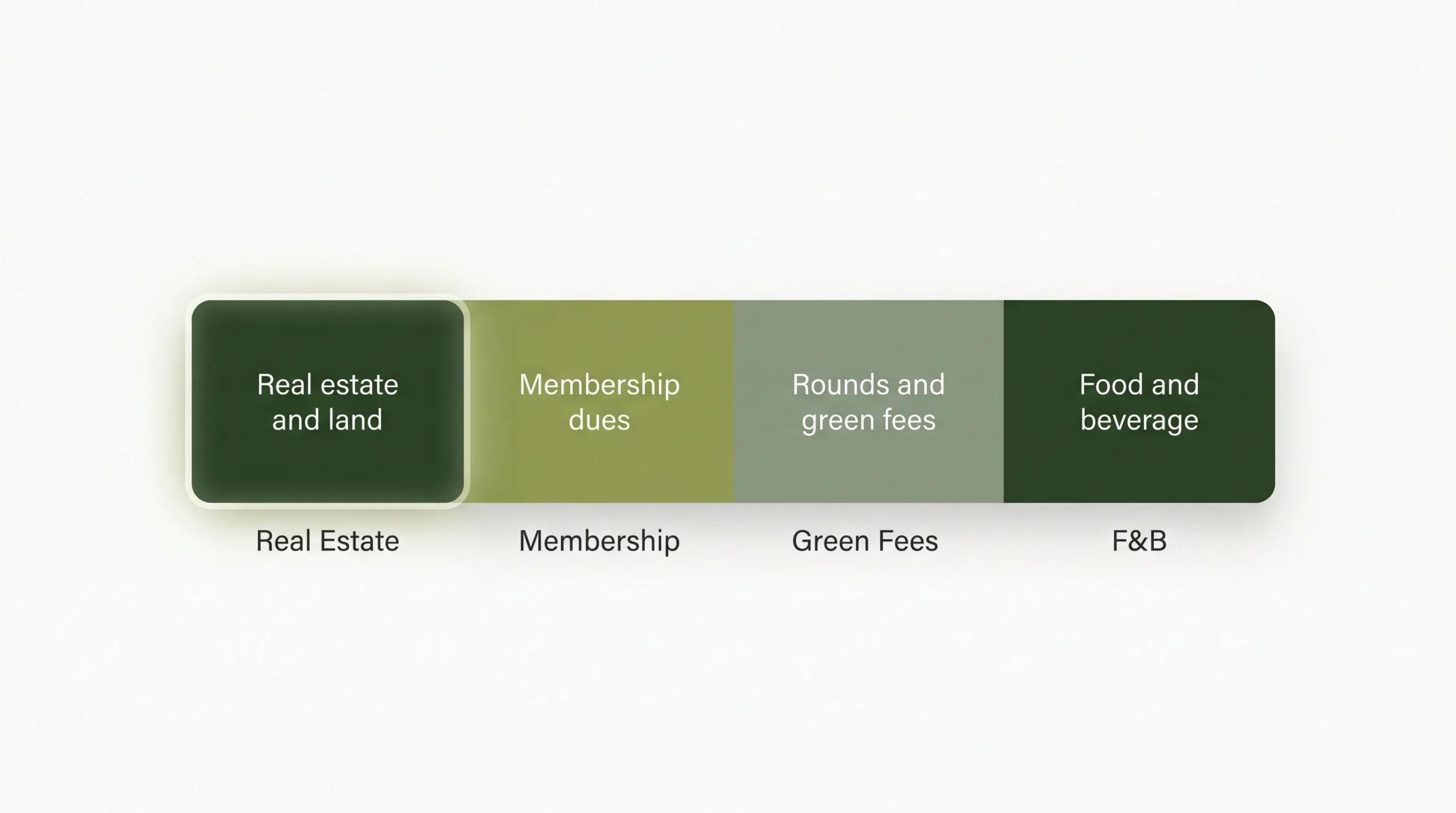
A golf course sits on a large piece of land, and that land is valued on its own. Appraisers run the highest and best use test. They ask whether the ground is worth more as a course or as homes, shops, or offices. Zoning sets the limit on what is legal to build. If the site could hold housing, its land value may pass what the golf earns. So real estate can drive the whole number, not just support it.
The asset approach handles this split. It prices the land, the clubhouse, the cart barn, and the maintenance equipment apart from the golf business. Any excess acreage not needed for play is valued on its own. A conservation easement changes the math. It trades tax benefits for a permanent ban on building, which strips out development value. Goodwill, such as a strong name or a loyal roster, adds intangible worth on top. The Appraisal Foundation sets the USPAP rules that keep this work defensible.
How do upkeep and seasons affect value?
Golf courses cost a lot to keep green. Mowers, irrigation lines, and cart fleets wear out and need replacing. Appraisers count this maintenance capital as a real, recurring cost. Deferred work lowers value, often dollar for dollar. Seasons matter too. A course in a cold state may sit idle for months, which caps its yearly rounds. Water rights can make or break a course in dry regions. Each of these risks changes the cash the course can safely earn.
These risks flow straight into the value. A higher risk means a higher discount rate and a lower price. An appraiser who finds a failing irrigation system will mark the value down by the repair bill. Uncertain water access does more damage still. Sofer Advisors tests each of these drivers against real deal data, so the final figure reflects the true course, not a generic average.
Which valuation approach fits best?
No single method rules every course. Appraisers run all three, then weigh them. A profitable, stable course leans on the income approach. Here they capitalize earnings or run a discounted cash flow, using a discount rate that fits the risk. A course near a growing town leans on the asset approach and its land value. The market approach, built on recent sales, checks both. The appraiser then blends the results into one figure through reconciliation.
The math sets the enterprise value, but the review makes it defensible. A capitalization rate or WACC must trace back to market evidence, not a hunch. Large firms like Alvarez and Marsal or Kroll aim this rigor at big corporate clients. Sofer Advisors brings the same senior-level work to middle-market course owners. Unlike a solo appraiser, it backs each number with a full W2 team of 14 and every major valuation database. Its four-phase method, David Hern CPA ABV ASA calls The Sofer Difference: Discovery, Diligence, Analysis, and Delivery. In the Heart of a Teacher tradition, the firm walks owners through the math, not just the answer.
Frequently Asked Questions
How do you value a golf course?
You value a golf course by blending three approaches: income, market, and asset. The income approach reads cash flow from rounds, dues, and food sales. The market approach compares recent course sales in the region. The asset approach prices the land, buildings, and equipment. An appraiser weighs the three, then reconciles them into one number. The work follows USPAP and IRS Revenue Ruling 59-60, so the result holds up for tax, estate, or deal use.
What multiple does a golf course sell for?
Most golf courses sell for about 1.0 to 1.5 times yearly gross revenue. That range covers green fees, cart rentals, and food and beverage sales. A private club with steady dues often sits at the top of the range. A public course in a crowded market tends to land lower. Some buyers also study an EBITDA multiple, though private deals rarely publish net income. An appraiser adjusts the range to fit the course, its location, and its condition.
How is the real estate valued separately?
The land is valued on its own through a highest and best use test. An appraiser asks whether the ground is worth more as a course or as homes, shops, or offices. Local zoning sets what is legal to build. If the site could hold housing, its land value may top the golf income. This split matters most for estate filings, tax reports, and any deal where redevelopment is on the table.
How does a private club differ from a public course?
A private club earns most of its cash from member dues and joining fees. That money is steady, so it is easy to forecast and supports a higher value. A public, daily-fee course lives on green fees at the counter. Its income rises and falls with weather and the season. Because of that swing, a public course often carries a lower value than a private club of similar size. Member retention is the key figure to watch.
What is as-is versus stabilized value?
As-is value reflects the course today, with all its current repair needs and gaps in management. Stabilized value assumes the course runs at a normal, healthy level after those fixes are done. The gap between the two shows the upside a buyer could earn by investing. Owners use both figures to plan improvements or price a sale. An appraiser models each one from the same records, so the comparison stays fair and clear.
Can an unprofitable course still be worth a lot?
Yes, an unprofitable course can still hold real value in its land. If local zoning allows housing or retail, the ground may be worth more than the golf ever earned. In that case an appraiser leans on the asset and market approaches instead of income. The highest and best use test decides the outcome. Many struggling courses sell for redevelopment rather than play, which is why the land review is so important.
How do deferred repairs affect the value?
Deferred repairs act as a direct liability that lowers the value, often dollar for dollar. Failing irrigation, worn cart fleets, and an aging clubhouse all raise the risk a buyer takes on. That buyer subtracts the repair bill from the price they will pay. An appraiser lists these needs and prices them into the report. Ignoring them would overstate the value and leave the number open to challenge in an audit or a court case.
How long does a golf course valuation take?
Most golf course valuations take about four to eight weeks. The timeline covers a review of financial statements, operating records, and regional sale data. It also allows time to reconcile the three approaches into one defensible figure. A complex course with heavy real estate or a court deadline can take longer. Sofer Advisors sets a clear schedule at the start and holds a next business day response policy throughout the work.
How much does a business valuation from Sofer Advisors cost?
A business valuation from Sofer Advisors typically runs $7,500 to $25,000. The price depends on the complexity of the course and the purpose of the report. Simpler jobs for planning or a tax filing fall toward the lower end. Deals, estate matters, and litigation support need deeper analysis, so they sit higher. Contact Sofer Advisors for a fee quote matched to your course and its stated use.
Related Case Studies
- How to Value a Self-Storage Facility: Cap Rates and Operations
- Boutique Hotel Valuation: How to Value Your Property with ADR, RevPAR, and Key Multiples
- When the Cost Approach Wins: Valuing Asset-Heavy Businesses
Executive Summary
A golf course valuation blends three views of worth into one number. The income approach reads rounds, dues, and food sales. The market approach compares recent course sales, usually near 1.0 to 1.5 times gross revenue. The asset approach prices the land, which can be worth more than the golf itself. Deferred repairs and water risk pull the figure down, while steady dues lift it. Sofer Advisors reconciles all three under IRS Revenue Ruling 59-60, AICPA SSVS, and USPAP. The result is a defensible value for a tax filing, an estate, a loan, or a sale.
What Should You Do Next?
Start by gathering three years of financial statements, a list of your equipment, and current membership or lease records. Confirm the purpose of the valuation, since a tax report and a sale call for different support. Then have the land reviewed for its highest and best use, because that test can change the whole result.
For a value you can stand behind, work with David Hern CPA ABV ASA. His team has given expert witness testimony in 11+ cases across Georgia, Florida, California, and New Mexico. Schedule a consultation to discuss the course valuation that fits your situation.
People Also Read
- The Net Asset Value Method: Balance Sheet Over Earnings
- How to Value a Craft Brewery or Distillery in 2026
About the Author
This guide was prepared by David Hern CPA ABV ASA, founder of Sofer Advisors, a business valuation firm headquartered in Atlanta, GA serving clients across the United States. David holds dual accreditations as an Accredited Senior Appraiser (ASA) and is Accredited in Business Valuation (ABV), credentials recognized by the IRS, SEC, and FINRA. He also holds the Certified Exit Planning Advisor (CEPA) designation. With 15+ years of valuation experience, David has served as an expert witness in 11+ cases across multiple jurisdictions and built Sofer Advisors into an Inc. 5000-recognized firm with 180+ five-star Google reviews. Its full W2 employee team maintains subscriptions to all major valuation databases and operates under a next business day response policy. For professional business valuation services, visit soferadvisors.com/about-us/ or contact Sofer Advisors at soferadvisors.com/contact-us/.
Disclaimer: This content is for informational purposes only and does not constitute professional valuation advice. Business valuation conclusions depend on specific facts and circumstances. Contact Sofer Advisors for guidance regarding your specific situation.