


Last Updated: November 2026
A government contractor valuation measures what a federal contracting business is worth, and it turns on risks that private-sector work does not carry. Funded backlog is far more certain than unfunded backlog, and an IDIQ ceiling is capacity, not promised revenue. Heavy reliance on one agency raises the risk and lowers the value. Contract type, set-aside status, security clearances, and clean compliance all shape the final number.
Sofer Advisors builds these valuations for owners, buyers, and attorneys.
This guide explains the drivers that matter most, from backlog and agency concentration to contract type and compliance.
Key Takeaways
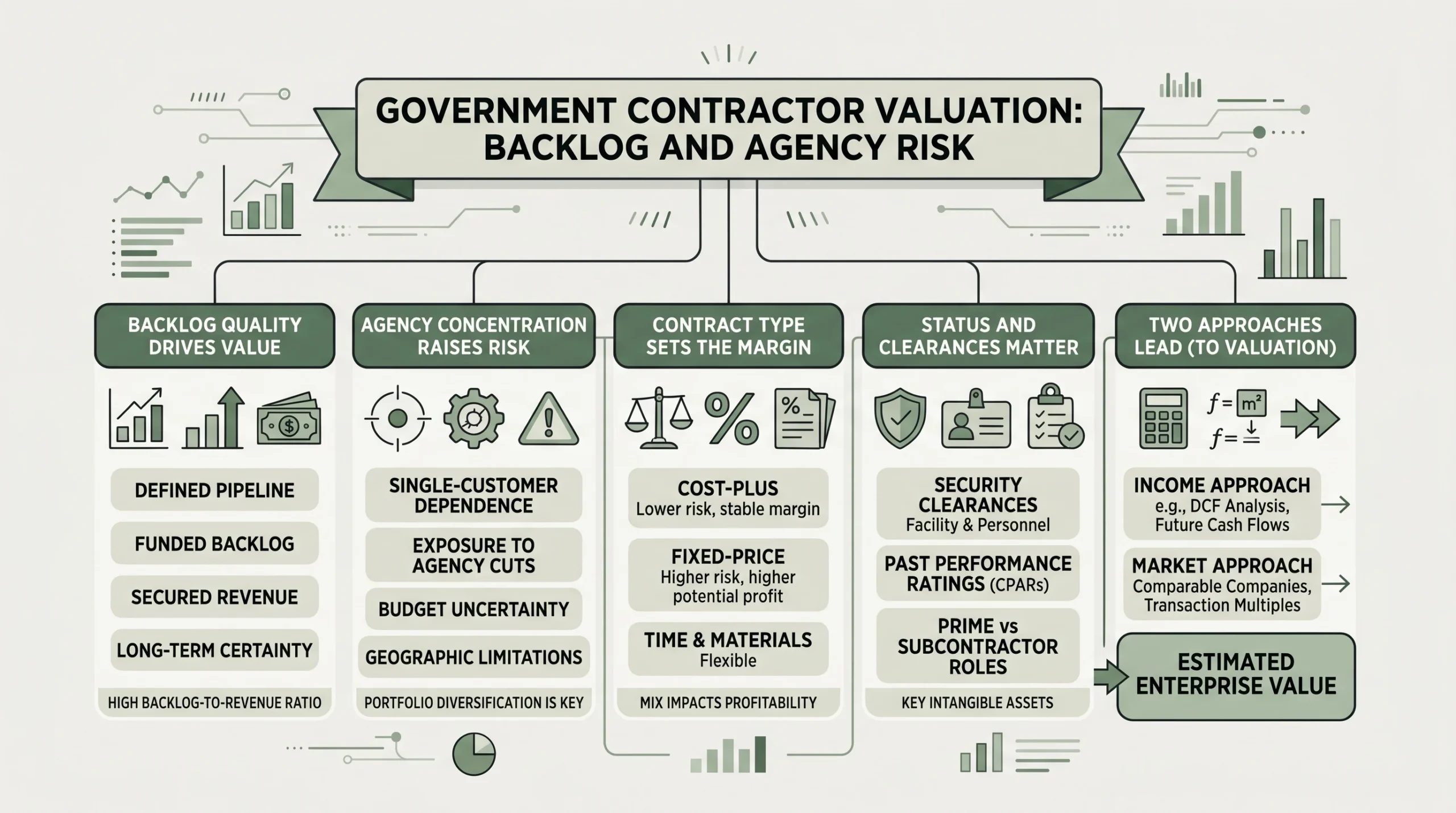
- Backlog quality drives value: Funded backlog is far more certain than unfunded backlog. An IDIQ ceiling is capacity, not promised revenue.
- Concentration raises risk: Heavy reliance on one agency or one contract lifts the discount rate and lowers the multiple.
- Contract type sets the margin: Fixed-price, cost-plus, and time-and-materials work carry different risk and different reward.
- Status and clearances matter: Set-aside status, security clearances, and clean compliance can add value or create a cliff.
- Two approaches lead: Most analysts rely on the income approach and the market approach, then weigh the results.
Why is valuing a government contractor different?
A federal contractor earns revenue in a world of rules. Those rules change the risk. That is why the valuation differs from a standard business.
Private customers can leave at any time. Federal customers work through contracts with fixed terms and option years. That structure looks stable. It is not always as stable as it seems. An agency can decline to exercise an option. A program can lose its budget. A contract can be recompeted and lost.
Compliance adds another layer. Federal contractors must follow the Federal Acquisition Regulation. Many must also meet cost accounting rules. An analyst often adjusts the financial statements to show true earnings. Fair market value for these firms traces back to Revenue Ruling 59-60, the long-standing IRS standard.
So the work demands industry knowledge. A generalist may miss the risks that drive the price. The sections below walk through the main ones.
What makes contract backlog valuable?
Backlog is the value of work already awarded but not yet performed. It points to future revenue. But not all backlog is equal. The quality matters more than the headline figure.
Analysts split backlog into two parts. Funded backlog is work with money already obligated. It carries real certainty. Unfunded backlog is work expected but not yet funded. It depends on future appropriations. A buyer discounts unfunded backlog much more heavily.
An IDIQ contract is a common source of confusion. IDIQ stands for indefinite delivery, indefinite quantity. These contracts set a ceiling. The ceiling is a spending limit, not a guarantee. Winning a large IDIQ does not mean the contractor will earn that amount. It means the contractor may compete for task orders up to that cap. Treat the ceiling as capacity, not booked revenue.
Contract length also counts. A longer term with option years gives steadier cash flow. A short base period with heavy recompete risk does not. The analyst weighs each award on its own terms.
Incumbency is part of the story too. An incumbent that already holds a contract often has an edge at rebid. It knows the work, the staff, and the customer. That edge raises the odds of keeping the revenue. A strong past performance record supports the same point. Agencies track how well a contractor delivers, and a clean record helps win the next award.
How does agency concentration affect value?
Agency concentration risk is the reliance a firm places on one customer. In federal work, that customer is often a single agency or a single program.
Concentration is dangerous. If one agency provides most of the revenue, one budget cut can gut the business. A lost recompete can do the same. Buyers see that exposure clearly. They price it in.
The effect shows up in two places. A concentrated contractor earns a higher discount rate in a cash flow model. It also earns a lower multiple in a market comparison. Both push the value down.
A diversified contractor fares better. Revenue spread across several agencies is safer. Work spread across many contracts is safer still. Prime positions help too, since a prime controls the client relationship. A subcontractor depends on the prime above it.
Analysts measure concentration in plain terms. They look at the share of revenue from the top customer. They look at the top three contracts as well. The higher those shares, the greater the exposure. A firm with no customer above a modest share of revenue looks much safer to a buyer.
How does contract type change the risk?
The mix of contract types tells an analyst a lot. Each type splits risk between the contractor and the government in a different way. That split drives the margin a buyer will pay for.
The table below sums up the three main types.
| Contract type | Who carries cost risk | Margin profile |
|---|---|---|
| Firm-fixed-price | The contractor | Higher potential, rewards efficiency |
| Cost-plus | The government | Lower and capped, heavily reviewed |
| Time-and-materials | Shared | Moderate, tied to labor hours |
Firm-fixed-price work pays a set price. The contractor keeps the savings if it runs lean. It absorbs the loss if costs run over. Buyers often like this type because it rewards good management.
Cost-plus work reimburses allowable costs plus a fee. The margin is thin and the fee is limited. Auditors review these costs closely. Time-and-materials work pays for labor hours plus materials. It sits in the middle on risk.
A healthy book usually holds a mix. Too much cost-plus work can cap the upside. A strong base of fixed-price work can lift the multiple.
What role do set-asides, clearances, and compliance play?
Many federal contractors grow inside small-business programs. These set-asides reserve certain contracts for qualifying firms. Common ones include 8(a), service-disabled veteran-owned, HUBZone, and woman-owned small business.
Set-aside status can be a real advantage. It limits the field of competitors. It can also create a cliff. The 8(a) program lasts only nine years. A firm can also outgrow the size standard for its industry. When that happens, it must suddenly compete against much larger players. An analyst must ask what the business looks like after the status ends. Revenue that depends on a set-aside deserves a careful look.
Security assets cut the other way. A facility security clearance is hard to get. It takes time and sponsorship. A firm that holds one can perform classified work that rivals cannot. That barrier to entry adds value. Personnel with active clearances add value too.
Compliance rounds out the picture. Defense contractors increasingly must meet the Cybersecurity Maturity Model Certification, known as CMMC. Many face audits from the Defense Contract Audit Agency, or DCAA. A clean audit history lowers risk. A record of findings raises it and can shave value off the price. A buyer may also hold back part of the price until these issues are resolved. Strong compliance systems make the whole deal smoother and support a higher offer.
Which valuation methods apply?
Two approaches do most of the work for a government contractor. They are the income approach and the market approach. An analyst usually applies both and compares them.
The income approach centers on a discounted cash flow model, or DCF. It projects future cash flow, then discounts it to today. This method fits federal contractors well. Backlog and option years give the model a real basis for the forecast. The risks discussed above feed straight into the discount rate. More concentration or more unfunded backlog means a higher rate.
The market approach looks at comparable sales. It studies what buyers paid for similar firms. It often uses a multiple of EBITDA. The analyst adjusts the comparison for size, contract mix, and agency spread. Public company data can help, but federal contractors need careful peer selection.
Both approaches rest on clean financials. The analyst normalizes the numbers first. That means removing one-time items and owner perks that will not continue. It also means checking that reported costs match the contract type. Normalized earnings give a fairer base for the forecast and the multiple. The asset approach exists as a third option, but it rarely drives the value of a going-concern contractor.
The two results rarely match to the dollar. The analyst weighs them and explains the gap. For a deeper look at method selection, a Sofer Advisors valuation specialist can walk through the options for a specific firm.
Frequently Asked Questions
What is the difference between funded and unfunded backlog?
Funded backlog is work with money already obligated to the contract. It carries real certainty. Unfunded backlog is expected work that still depends on future appropriations. A buyer trusts funded backlog far more and discounts the unfunded part.
Does an IDIQ contract count as guaranteed revenue?
No. An IDIQ ceiling is a spending cap, not a promise. It sets the most the government could buy under the vehicle. The contractor still has to win task orders against that ceiling. Treat it as capacity, not booked revenue.
How does agency concentration affect the discount rate?
Heavy concentration raises the discount rate. One agency or one program providing most of the revenue is a large risk. A budget cut or a lost recompete could end much of the cash flow. The model reflects that risk with a higher rate and a lower value.
Which contract type is worth the most in a sale?
There is no single answer, but buyers often favor firm-fixed-price work. It rewards efficient management and offers higher margin potential. Cost-plus work carries thin, capped margins and close review. A strong base of fixed-price work tends to support a better multiple.
What happens to value when a company ages out of a set-aside?
Value can drop sharply. The 8(a) program lasts nine years, and a firm can also outgrow its size standard. After that, it competes against larger rivals without the set-aside shield. An analyst studies how much revenue depends on that status and what remains once it ends.
How does recompete risk affect valuation?
Recompete risk is the chance a firm loses a contract when it comes up for rebid. High recompete risk makes future revenue less certain. That pushes the discount rate up and the value down. A long base period with incumbency strength lowers the concern.
Does a facility security clearance add value?
Yes. A facility security clearance is slow and costly to obtain. It lets a firm perform classified work that uncleared rivals cannot pursue. That barrier to entry is an intangible asset. Buyers often pay more for a firm that holds one.
How do CMMC and DCAA compliance affect value?
Both affect the risk profile. Many defense contractors must meet CMMC cybersecurity requirements to keep working. DCAA audits test cost accounting. A clean compliance record lowers risk and supports value. A history of findings raises risk and can reduce the price.
Which valuation approach is used for a government contractor?
Most analysts use the income approach and the market approach. The income approach relies on a discounted cash flow model built from backlog and option years. The market approach compares the business to similar sales, often using an EBITDA multiple. The two results are weighed together.
Related Case Studies
- Section 83(b) Elections: Timing, Risk, Valuation
- Electrical Contractor Valuation Multiples: What Drives the Number
- Customer Backlog Valuation: Pricing Signed Orders
Executive Summary
Funded backlog is far more certain than unfunded backlog. An IDIQ ceiling is capacity, not promised revenue. Heavy reliance on one agency or one contract lifts the discount rate and lowers the multiple. Fixed-price, cost-plus, and time-and-materials work carry different risk and different reward. Set-aside status, security clearances, and clean compliance can add value or create a cliff. Most analysts rely on the income approach and the market approach, then weigh the results.
What Should You Do Next?
Start by organizing your records. Gather your contract backlog, your option years, and three years of financial statements. Add your compliance and audit history. These documents let an analyst judge your revenue stability and your risk. Sofer Advisors provides independent valuations led by David Hern CPA ABV ASA CVA. Schedule a consultation to discuss your situation.
People Also Read
- HVAC Contractor Valuation: Multiples and Service Contracts
- Key Person Discount Valuation: Sizing the Risk
About the Author
This guide was prepared by David Hern CPA ABV ASA CVA, founder of Sofer Advisors, a business valuation firm headquartered in Atlanta, GA serving clients across the United States. David holds accreditations as an Accredited Senior Appraiser (ASA) and is Accredited in Business Valuation (ABV), credentials recognized by the IRS, SEC, and FINRA, and is also a Certified Valuation Analyst (CVA). David has served as an expert witness in dozens of cases across multiple jurisdictions, and Sofer Advisors is an Inc. 5000 honoree in 2024 and 2025 with 240+ five-star Google reviews.
For professional business valuation services, visit soferadvisors.com/about-us/ or contact Sofer Advisors at soferadvisors.com/contact-us/.
Disclaimer: This content is for informational purposes only and does not constitute professional valuation advice. Business valuation conclusions depend on specific facts and circumstances. Contact Sofer Advisors for guidance regarding your specific situation.