


Last Updated: November 2026
A market participant acquisition premium, or MPAP, is the extra amount a typical buyer would pay to control a business. It sits on top of the value of a small, publicly traded minority share. Control has real worth, because a controlling owner can change strategy, cut costs, and improve cash flow. MPAP measures the benefits a normal market buyer could expect to gain, not the gains unique to one special bidder.
The team at Sofer Advisors prepares fair value and valuation analyses for owners, CPAs, and attorneys.
This guide explains what MPAP is, how it differs from the older control premium, and how analysts support it with real evidence.
Key Takeaways
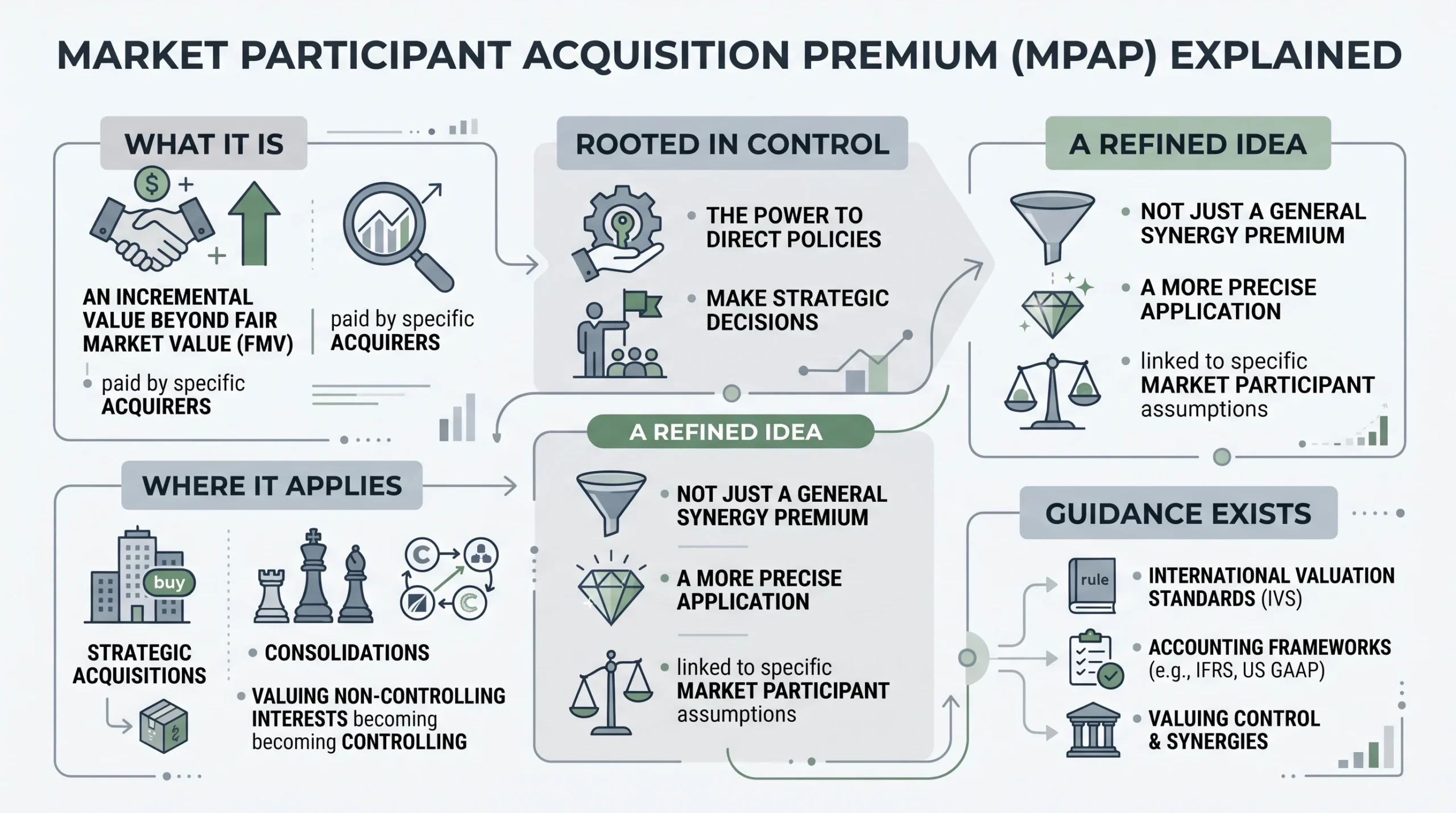
- What it is: MPAP is the premium a typical buyer pays for control. It sits above the value of a traded minority share.
- Rooted in control: The premium reflects the benefits of control, such as synergies, better cash flow, and lower risk.
- A refined idea: MPAP is a disciplined version of the older control premium. It must be backed by specific cash-flow benefits.
- Where it applies: It affects fair value under ASC 820 and goodwill impairment testing under ASC 350.
- Guidance exists: The AICPA published an Accounting and Valuation Guide on MPAP in 2017 to improve consistency.
What is a market participant acquisition premium?
A market participant acquisition premium is the value of control, seen through the eyes of a typical buyer. That buyer is called a market participant. A market participant is independent, well informed, and both willing and able to buy.
Value comes in layers. The lowest layer here is the marketable minority level. This is the price a small share fetches on a public exchange. It reflects the view of a passive investor who cannot direct the company.
A controlling interest is worth more than that. The owner of control can steer the business and capture new benefits. MPAP is the gap between the two levels. It is the premium a market participant would pay to move from a minority share to control.
The key word is typical. MPAP does not measure what one eager buyer might pay. It measures what a normal, rational buyer in the market could expect to achieve. This keeps the figure grounded in market behavior rather than in one party’s hopes.
Why does the layer matter so much? A minority price and a control price answer different questions. A minority price tells you what a passive stake trades for. A control price tells you what the whole business is worth to a buyer who can run it. Fair value work usually needs the second number. MPAP is the bridge between the two.
How does MPAP differ from a control premium?
The two ideas are close, but MPAP is more disciplined. The older control premium was often set by a shortcut. Analysts looked at past takeovers. They found the average percentage paid over the public share price. Then they applied that average to the business at hand.
That shortcut has a flaw. An average takeover premium bundles many deals together. Some buyers overpaid. Some chased benefits only they could reach. The average tells you little about the specific company you are valuing.
MPAP fixes this. It asks a sharper question. What cash-flow benefits could a market participant actually achieve here? The analyst then values those benefits directly. Observed deal data can serve as a sanity check. It does not serve as the whole answer.
So MPAP still measures control. The difference is the standard of proof. A control premium can lean on averages. An MPAP must rest on the specific gains a typical buyer could obtain.
Why would a buyer pay this premium?
A buyer pays for control because control creates economic benefits. These benefits are the reason the premium exists. They fall into a few clear groups.
The first is synergy. A buyer can often cut shared costs after a deal. It can combine back-office work such as accounting and payroll. It can also raise revenue by selling to a wider customer base.
The second is better cash flow. A new owner can replace weak management or fix poor pricing. These changes lift the earnings the business produces each year.
The third is lower risk. A larger, better-run company may borrow at a lower cost. A buyer who can reduce risk may accept a lower required return. That alone can raise the value of the business.
A market participant weighs all of these. The premium reflects the benefits that a typical buyer could realistically capture, not every benefit a dreamer might imagine.
Consider a simple, illustrative case. A company trades at a value that implies a minority share. A typical buyer sees a chance to trim duplicate costs and lift margins. Those gains raise the cash flow the business can produce. The present value of those gains is the acquisition premium. The figures here are illustrative only, but the logic holds in real work.
Where does MPAP matter in financial reporting?
MPAP shows up in fair value work. Under ASC 820, fair value uses the assumptions a market participant would use. Because a controlling owner can capture more value, control carries a premium. MPAP is how analysts measure that premium in a consistent way.
The most common setting is goodwill impairment testing under ASC 350. A company tests each reporting unit at fair value. Fair value reflects what a buyer would pay for control of that unit.
Here a puzzle often appears. A reporting unit’s fair value can exceed its public market capitalization. The reason is simple. Market capitalization reflects minority trading prices. Fair value reflects control. MPAP explains and supports that gap.
Getting this right matters for the audit. A premium that lacks support will not survive review. A premium backed by real cash-flow benefits will.
The same logic appears in deal work. A buyer and seller often disagree on value. Part of that gap is the premium for control. A clear MPAP analysis shows what control is worth and why. It turns a vague argument into a figure both sides can discuss.
How do analysts measure and support MPAP?
A defensible MPAP is built from the ground up. The analyst starts with the specific benefits a market participant could achieve. These are the synergies, cash-flow gains, and risk reductions described above.
Next, the analyst puts numbers to those benefits. The expected cash-flow gains are projected over time. They are then discounted to present value. The result is the premium a typical buyer could justify paying.
Market data plays a supporting role. Observed takeover premiums can test whether the figure looks reasonable. If the built-up premium sits far outside normal deal ranges, the analyst revisits the assumptions. The data checks the answer. It does not replace the analysis.
The AICPA Accounting and Valuation Guide on MPAP, published in 2017, promotes this approach. Its goal was to improve consistency in how control premiums are measured for fair value. The guide steers analysts away from blanket averages and toward evidence.
How do MPAP and related premiums compare?
It helps to see the layers of value side by side. Each layer answers a different question. The table below shows how they fit together.
| Value level | What it measures | Premium applied |
|---|---|---|
| Marketable minority interest | A small, freely traded stake | None |
| Market participant control value | Control value to a typical buyer | Market participant acquisition premium |
| Strategic buyer value | Value to one specific buyer | Buyer-specific synergies |
The first two rows drive fair value. Marketable minority value is the base. MPAP lifts it to the level of control that a typical buyer would pay for.
The third row sits outside fair value. Buyer-specific synergies belong to one acquirer alone. A typical market participant could not capture them. For that reason, they are excluded from a fair value measurement. Mixing them into MPAP is a common error that inflates the premium.
What are the common mistakes with MPAP?
The first mistake is leaning on averages. A premium pulled from average takeover data is easy to challenge. It does not describe the business being valued.
The second mistake is including buyer-specific gains. These gains are real for one buyer, but not for the market. They belong in that buyer’s own analysis, not in a fair value premium.
The third mistake is ignoring risk. Control can add value, but integration also carries cost and uncertainty. A premium that assumes only upside will not hold up. A careful analyst weighs both sides and documents the logic.
A fourth mistake is weak documentation. A premium can be sound yet still fail a review. If the file does not explain each benefit, a reader cannot follow the math. Clear notes on every assumption make the premium easy to defend. They also speed up the audit and reduce back-and-forth. In the end, strong support is what separates a credible MPAP from a mere guess.
Frequently Asked Questions
What is a market participant acquisition premium in simple terms?
It is the extra amount a typical buyer would pay to control a business. The starting point is the value of a small, publicly traded share. MPAP is the premium that raises that value to the price of control.
Is MPAP the same as a control premium?
They are closely related, but MPAP is a refinement. A traditional control premium can rest on average takeover data. An MPAP must rest on the specific cash-flow benefits a market participant could actually achieve.
Which accounting standard governs MPAP?
MPAP is applied within fair value measurement under ASC 820. Fair value relies on the assumptions a market participant would use. The AICPA also published a dedicated guide on MPAP in 2017.
How does MPAP relate to goodwill impairment testing?
Goodwill impairment testing under ASC 350 measures a reporting unit at fair value. Fair value reflects control, so it can include an acquisition premium. MPAP is the disciplined way to measure and support that premium.
Can average takeover premiums alone justify MPAP?
No. Average premiums can serve as a reasonableness check. They cannot stand as the sole support. A defensible MPAP is built from the specific benefits a typical buyer could capture.
Who counts as a market participant?
A market participant is an independent, knowledgeable buyer who is both willing and able to transact. The term describes a typical buyer in the relevant market. It does not describe one particular strategic bidder.
Does MPAP include buyer-specific synergies?
No. MPAP reflects only the benefits a typical market participant could achieve. Synergies unique to a single buyer are excluded from fair value. They become part of that buyer’s own return, not the market premium.
Why can a reporting unit’s fair value exceed its market capitalization?
Market capitalization reflects minority trading prices. Fair value reflects control. Because control carries a premium, fair value can sit above the traded market value. MPAP measures and explains that difference.
When did the AICPA issue guidance on MPAP?
The AICPA published its Accounting and Valuation Guide on MPAP in 2017. The guide aimed to improve consistency in how control premiums are measured for fair value.
Related Case Studies
- Calculating Goodwill in an Acquisition: Formula Explained
- Deferred Revenue Fair Value Acquisition: The Haircut Explained
- Fair Market Value Definition: IRS Standard Explained
Executive Summary
MPAP is the premium a typical buyer pays for control. It sits above the value of a traded minority share. The premium reflects the benefits of control, such as synergies, better cash flow, and lower risk. MPAP is a disciplined version of the older control premium. It must be backed by specific cash-flow benefits. It affects fair value under ASC 820 and goodwill impairment testing under ASC 350. The AICPA published an Accounting and Valuation Guide on MPAP in 2017 to improve consistency.
What Should You Do Next?
Review any deal, impairment test, or purchase price allocation where control affects value. Check that the premium rests on real, supportable benefits rather than a blanket average. If you want an independent, defensible measurement, Sofer Advisors can help, with work led by David Hern CPA ABV ASA CVA.
People Also Read
- What Is a Control Premium? How It Is Measured
- Fair Market Value Calculator: Why No Calculator Can Do It
About the Author
This guide was prepared by David Hern CPA ABV ASA CVA, founder of Sofer Advisors, a business valuation firm headquartered in Atlanta, GA serving clients across the United States. David holds accreditations as an Accredited Senior Appraiser (ASA) and is Accredited in Business Valuation (ABV), credentials recognized by the IRS, SEC, and FINRA, and is also a Certified Valuation Analyst (CVA). David has served as an expert witness in dozens of cases across multiple jurisdictions, and Sofer Advisors is an Inc. 5000 honoree in 2024 and 2025 with 240+ five-star Google reviews.
For professional business valuation services, visit soferadvisors.com/about-us/ or contact Sofer Advisors at soferadvisors.com/contact-us/.
Disclaimer: This content is for informational purposes only and does not constitute professional valuation advice. Business valuation conclusions depend on specific facts and circumstances. Contact Sofer Advisors for guidance regarding your specific situation.