


Last Updated: October 2026
An electrical contractor valuation turns earnings, backlog, and risk into one defensible number. Most buyers anchor on a multiple of profit. The part they underprice sits with one or two people. If the master electrician license that lets the company pull permits rests on a single name, the whole value leans on that person staying. That is the discount nobody models, and it is the first thing a careful appraiser prices in.
Sofer Advisors values electrical contracting companies for owners, CPAs, and buyers, backed by Inc. 5000 recognition and 180+ five-star Google reviews. A clean multiple is only a starting point. The real work is adjusting the earnings, testing the multiple against the income approach, and pricing the risks a quick rule of thumb ignores.
This guide explains the methods appraisers use, the multiples the market pays, where the benchmark data comes from, and how license and customer concentration drive a discount. It also covers working capital, GAAP financials, and the IRS rules that shape how a sale is reported.
Key Takeaways
- Multiples are a starting point: SDE multiples run about 2.5x to 4.5x for smaller shops, and EBITDA multiples run about 3.5x to 5.5x for larger firms, before any risk adjustment.
- License concentration is the hidden discount: when one or two people hold the master license that lets the company bid and pull permits, buyers cut the price for that key-person risk.
- Normalize the earnings first: a defensible number starts by removing owner perks, one-time costs, and nonrecurring items to find the real cash flow a buyer inherits.
- Use all three approaches: appraisers weigh the income, market, and asset approaches together, rather than trusting a single multiple to carry the whole conclusion.
- Working capital and backlog matter: a funded backlog of signed work and a normal level of working capital both lift the multiple a buyer will pay.
Each piece feeds the final figure. The sections below take them one at a time.
Why Is Electrical Contractor Valuation Important to Understand?
A valuation sets a fact-based price for a sale, a partner buyout, an estate filing, or an SBA loan. Owners who guess at value tend to miss on both sides. They scare off buyers with a high ask, or they leave money on the table with a low one. A documented number also holds up when a lender, a court, or the IRS reviews it. For a trade that lives on licenses and backlog, the number has to reflect those facts, not just last year’s profit.
Why Is Master-Electrician License Concentration the Discount Nobody Models?
Most electrical work requires a licensed master electrician of record. That license lets the company bid jobs, pull permits, and pass inspections. In a lot of small shops, the owner is the license. When that is true, a buyer is really buying one person’s credential, not a transferable business. If the owner leaves, retires, or dies, the company can lose the right to operate until a new qualifier is in place.
Buyers price that risk as a discount, and appraisers should too. The size of the cut depends on how many employees hold their own master license, whether a qualifier can be hired, and how the transition is structured. A shop with three licensed leads is far less exposed than one built around a single name. Naming the risk and sizing it is what separates a credible valuation from a rule of thumb.
How Do You Value an Electrical Contracting Company?
Appraisers use three approaches. The income approach projects future cash flow and discounts it to today, which fits a growing shop with a strong backlog. The market approach applies a multiple drawn from comparable sales, using Seller’s Discretionary Earnings for smaller owner-run shops and EBITDA for larger ones. The asset approach tallies the net value of trucks, tools, and inventory, and it tends to set a floor for an asset-heavy business.
The step that decides the result is normalization. The appraiser adds back the owner’s above-market pay, personal expenses, and one-time items to reach true earnings. That adjusted figure is what the multiple applies to. A clean set of books makes this fast and defensible. A messy set invites the buyer to guess low, which is why the groundwork matters as much as the multiple itself.
What Multiples Do Electrical Contractors Trade At?
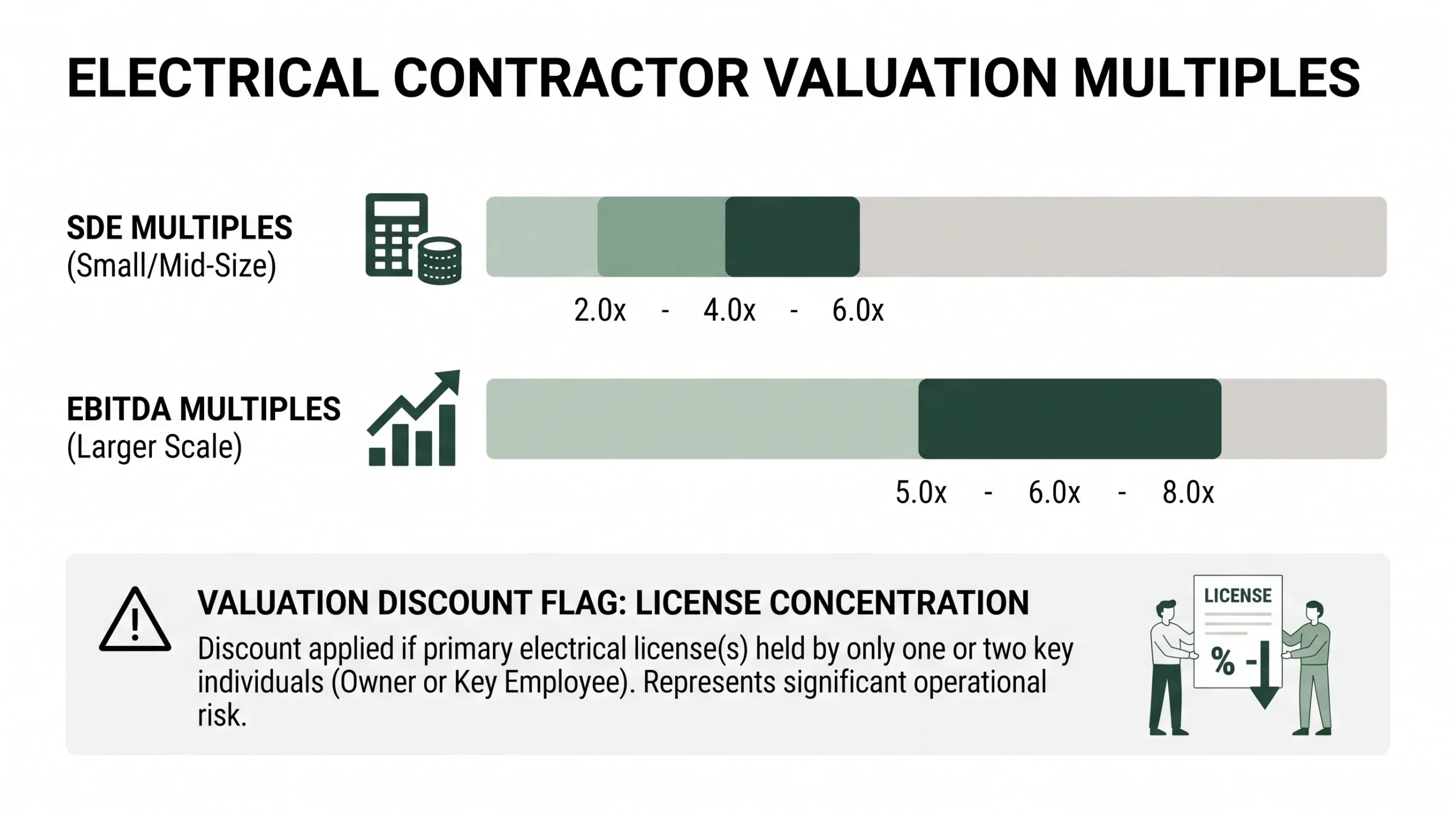
As a benchmark, smaller electrical shops tend to sell for about 2.5x to 4.5x SDE, while larger firms with a management layer trade closer to 3.5x to 5.5x EBITDA. Those are ranges, not promises. The actual multiple moves with backlog, customer mix, license depth, and the quality of the financials. Commercial and industrial work with recurring service contracts usually earns a higher multiple than one-off residential project work.
Appraisers pull comparable data from transaction databases such as DealStats, published by Business Valuation Resources, and from the IBBA Market Pulse survey. These sources show what similar companies actually sold for, broken down by size and trade. A number backed by real transactions survives review. A number pulled from a forum post does not.
How Do Working Capital and GAAP Financials Shape the Number?
Most deals assume the seller leaves a normal level of working capital in the business. Electrical contractors carry retainage, work in process, and receivables that can swing hard between jobs. If the appraiser does not set a working capital target, the buyer and seller fight over it later, and the price shifts. A clear target protects the headline multiple.
Financials prepared on a consistent GAAP basis also raise the price. Buyers trust accrual statements that match revenue to the job it came from more than they trust a cash-basis tax return. When the books show percentage-of-completion accounting done well, a buyer can see that the team estimates jobs accurately. That confidence shows up directly in the multiple.
What Is a Shop at $300,000 Profit or $500,000 in Sales Worth?
Profit tells you more than revenue, but neither gives a price by itself. A shop earning $300,000 in true owner earnings might be worth roughly $750,000 to $1.35 million at a 2.5x to 4.5x SDE multiple, before adjusting for risk. The license and customer concentration can move it well below that range. A business doing $500,000 in sales is harder to pin down, because value tracks the cash flow under that revenue, not the revenue itself. Two shops at the same sales can be worth very different amounts.
Owners planning a sale can review how Sofer Advisors handles deal-stage work on its transactional advisory page. The point is simple. A real price comes from adjusted earnings and a defensible multiple, not from a single headline figure.
Which IRS Rules Apply When an Electrical Contractor Sells?
Most electrical contractor sales are asset deals, so the buyer and seller must allocate the price across the assets under IRC Section 1060. Both sides file Form 8594, and the numbers have to match. The allocation decides how much of the deal is taxed as ordinary income versus capital gain, so it is worth modeling before signing.
Goodwill and other intangibles the buyer acquires are amortized over 15 years under IRC Section 197. For a contractor, goodwill often holds the customer relationships and the trained crew, which is why pricing it correctly matters. A valuation that supports the allocation keeps both sides out of trouble if the return is ever examined.
Who Values an Electrical Contractor, and How Do the Options Compare?
Owners choose a valuation partner based on the size of the deal, the audit exposure, and the budget. Large national firms such as Alvarez & Marsal, Stout, and Kroll serve big public companies with broad advisory teams. Sofer Advisors focuses on defensible, partner-led valuations for closely held and middle-market contractors, with expert witness testimony in 11+ cases behind its reports. The table below sets out the common options.
| Provider | Typical role | Best for |
|---|---|---|
| Specialized valuation firm (e.g. Sofer Advisors) | Normalizes earnings and prices license and backlog risk into a defensible multiple | Closely held contractors needing audit-ready support for a sale, buyout, or the IRS |
| Large national firm | Broad advisory plus valuation at enterprise scale | Large public companies with complex, multi-entity plans |
| Online valuation tool | Instant estimate from a few inputs, with no review | Early, informal benchmarking before a real engagement |
Sofer Advisors runs each engagement through a four-phase process it calls The Sofer Difference, moving from Discovery to Diligence to Analysis to Delivery. That structure keeps every adjustment and multiple tied to the facts behind it. It reflects the Heart of a Teacher approach, which means explaining the reasoning behind a number rather than handing over a figure. For a valuation that stands up to review, that trail of evidence is the product.
Frequently Asked Questions
How do you value an electrical contracting company?
You value an electrical contracting company by normalizing its earnings, then applying a market multiple and testing it against the income approach. Appraisers adjust for owner pay, one-time costs, and nonrecurring items to find real cash flow. They weigh backlog quality, customer mix, and license concentration against comparable sales. Sofer Advisors runs all three approaches and documents each adjustment, so the final number holds up with a buyer, a lender, or the IRS.
How much is an electrical contractor that makes $300,000 in profit worth?
A shop with $300,000 in true owner earnings might be worth roughly $750,000 to $1.35 million at a 2.5x to 4.5x SDE multiple, before risk adjustments. License concentration, customer concentration, and thin backlog can pull it below that range. The quality of the books and the depth of the crew push it up. Sofer Advisors measures each of these drivers before settling on the multiple that actually fits the business.
What is the average profit margin for an electrical contractor?
Net profit margins for electrical contractors commonly run between 5% and 15%, depending on the mix of residential, commercial, and industrial work. Specialized service and maintenance work tends to earn higher margins than competitive-bid new construction. Margins also move with crew productivity and overhead control. Sofer Advisors compares a shop’s margins against industry norms to flag the gaps that either lift or weigh on the valuation multiple a buyer will pay.
How much is a business with $500,000 in sales worth?
Revenue alone does not set value, because two contractors with identical sales can earn very different profits. A shop doing $500,000 in sales with strong margins and a deep crew is worth more than a larger shop losing money on every job. Value tracks the adjusted cash flow under the revenue, not the revenue itself. Sofer Advisors focuses on that cash flow, so the resulting number reflects the real economics of the business.
How does master electrician license concentration affect value?
When one or two people hold the master license that lets the company bid and pull permits, the business depends on them staying. Buyers treat that as key-person risk and cut the price for it. The discount shrinks when several employees hold their own license or a qualifier can be hired. Sofer Advisors sizes this risk directly, rather than leaving it buried in a vague catch-all discount, so the conclusion is transparent and defensible.
Does customer concentration affect an electrical contractor’s value?
Yes. If a few clients or one general contractor account for most of the revenue, losing a single account can gut earnings overnight. Appraisers apply a risk premium to concentrated revenue, which lowers the multiple. A broad, repeat customer base signals stability and supports a higher number. Sofer Advisors reviews the client list and the revenue spread so the valuation reflects how durable the earnings really are, not just their size.
What financial adjustments are made before valuing a contractor?
Appraisers normalize the income statement to show the earnings a buyer would actually inherit. That means adding back above-market owner pay, personal expenses, and one-time items like a legal settlement or a truck purchase. They also correct for any revenue timing that does not match the work performed. Sofer Advisors cleans and documents each adjustment, which turns a messy owner-run set of books into a consistent basis a buyer and lender can trust.
What multiple do electrical contractors sell for?
Smaller owner-run electrical shops tend to sell for about 2.5x to 4.5x SDE, while larger firms with a management layer trade closer to 3.5x to 5.5x EBITDA. The exact multiple depends on backlog, customer mix, license depth, and the quality of the financials. Commercial service work usually earns more than one-off residential jobs. Sofer Advisors draws the comparable multiple from transaction databases and then adjusts it for the specific risks in the business.
How much does an electrical contractor valuation cost?
Most electrical contractor valuations run from $7,500 to $25,000 and take about two to six weeks, depending on the size of the business and the deadline. The range covers the normalization work, the comparable research, and a report built to survive review. A flat fee is quoted up front, so the cost is clear before the work starts. Request a free estimate from Sofer Advisors for your situation.
Related Case Studies
- Construction and Contractor Multiples: 2026 by Trade
- How to Value a Construction Company: Expert Business Valuation Guide
- What Is Seller’s Discretionary Earnings (SDE)? A Clear Guide
Executive Summary
An electrical contractor valuation starts with a multiple and ends with a defensible number. Smaller shops trade around 2.5x to 4.5x SDE, larger firms around 3.5x to 5.5x EBITDA, with the real figure set by backlog, customer mix, and the quality of the books. The biggest hidden factor is license concentration. When one or two people hold the master license, buyers cut the price for key-person risk, and a credible appraiser sizes that cut rather than ignoring it. The first step is clean financials, a defensible multiple, and an honest read of who holds the license.
What Should You Do Next?
Gather three years of financial statements, a current backlog report, and a list of who holds each master license, since a clean file supports a defensible multiple. Decide whether your engagement is for a sale, a buyout, a loan, or the IRS, because the purpose shapes the report. This guide was prepared by David Hern CPA ABV ASA, founder of Sofer Advisors, an Inc. 5000 firm specializing in neutral third-party valuations. Schedule a free consultation to discuss your specific situation.
People Also Read
- EBITDA Multiple for Business Valuation by Industry
- How to Value an HVAC Company: Multiples and Buyer Demand 2026
About the Author
This guide was prepared by David Hern CPA ABV ASA, founder of Sofer Advisors, a business valuation firm headquartered in Atlanta, GA serving clients across the United States. David holds dual accreditations as an Accredited Senior Appraiser (ASA) and is Accredited in Business Valuation (ABV), credentials recognized by the IRS, SEC, and FINRA. He also holds the Certified Exit Planning Advisor (CEPA) designation. With 15+ years of valuation experience, David has served as an expert witness in 11+ cases across multiple jurisdictions and built Sofer Advisors into an Inc. 5,000-recognized firm with 180+ five-star Google reviews. Its full W2 employee team maintains subscriptions to all major valuation databases and operates under a next business day response policy.
For professional business valuation services, visit soferadvisors.com/about-us/ or contact Sofer Advisors at soferadvisors.com/contact-us/.
This content is for informational purposes only and does not constitute professional valuation advice. Business valuation conclusions depend on specific facts and circumstances. Contact Sofer Advisors for guidance regarding your specific situation.