
Last Updated: November 2026
An auto repair shop is valued mainly on its earnings, not its revenue. For a small, owner-run shop, appraisers measure profit as Seller’s Discretionary Earnings, or SDE. Larger shops use EBITDA instead. Once the profit figure is clean, the appraiser applies a market multiple to reach a value, leaning on the income and market approaches with the asset approach as a floor.
The team at Sofer Advisors prepares these valuations for business owners, attorneys, and CPAs.
This guide explains the common methods, the main value drivers, and how the real estate fits in.
Key Takeaways
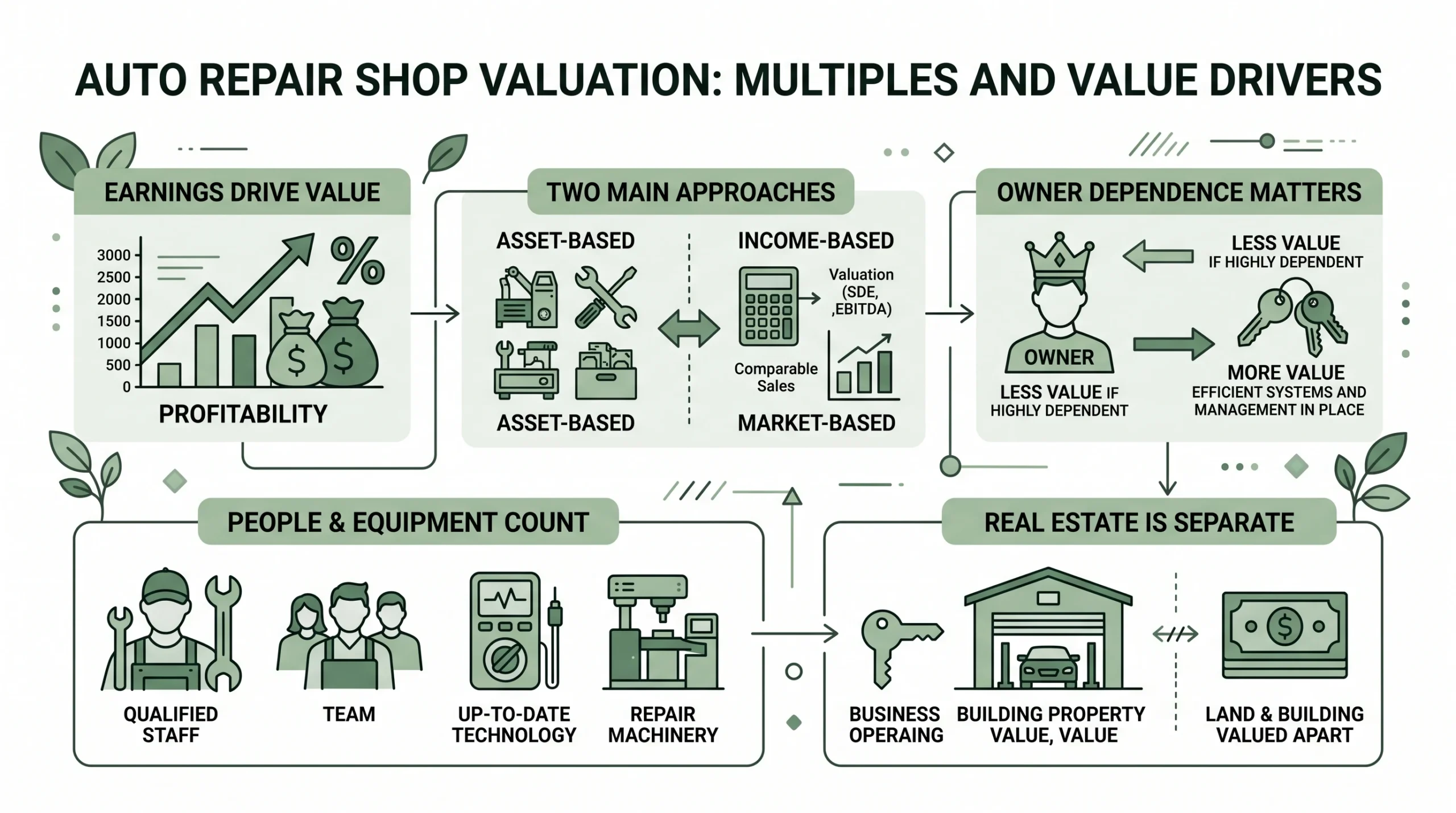
- Earnings drive value: Most shops are valued on profit, measured as SDE or EBITDA, not on revenue.
- Two main approaches: Appraisers lean on the income approach and the market approach, with the asset approach as a floor.
- Owner dependence matters: A shop that runs without the owner sells for more than one that depends on them.
- People and equipment count: Certified technicians, service bays, and tools all support the value.
- Real estate is separate: The building is valued on its own, apart from the operating business.
How are auto repair shops valued?
An auto repair shop is valued mainly on its earnings. Appraisers first find the shop’s true profit. For a small, owner-run shop, that profit is Seller’s Discretionary Earnings, or SDE. SDE is the cash the business returns to one working owner. It adds back the owner’s salary, perks, interest, and one-time costs.
Larger shops are measured by EBITDA instead. EBITDA means earnings before interest, taxes, depreciation, and amortization. It reflects profit for a shop run by hired managers, not the owner. Once the profit figure is clean, the appraiser applies a market multiple to reach a value.
The multiple is not a fixed number. It rises and falls with the risk and growth of the shop. A stable shop with loyal customers earns a higher multiple. A shaky one earns less. For that reason, this guide keeps the multiple qualitative rather than quoting a single rate.
Why does the reason for the valuation matter?
The purpose of the valuation shapes the whole report. It sets the standard of value and the methods an appraiser can use. The same shop can carry different figures for different needs.
A sale uses fair market value or an investment value for a specific buyer. A partner buyout may follow terms in the operating agreement. A gift or estate filing must meet IRS fair market value rules. A divorce or other dispute may answer to a court and state law.
Tell your appraiser the purpose up front. It guides the data gathered, the discounts applied, and the level of support the report needs. A valuation built for a casual sale may not hold up in court. Matching the method to the purpose keeps the result defensible.
What are the main valuation approaches?
Appraisers rely on three approaches. Most shops use a blend of the first two.
The income approach turns earnings into value. The appraiser takes normalized SDE or EBITDA and capitalizes it at a market rate. This method fits profitable shops with steady cash flow. It rewards a shop that shows predictable, growing profit.
The market approach looks at real sales of similar shops. The appraiser studies completed deals and the multiples that buyers actually paid. This gives a reality check against the income approach. Used together, the two methods produce a defensible range.
The asset approach adds up the value of equipment, parts, and other assets, then subtracts debts. It usually sets a floor, not the final answer. It matters most for a shop that is closing or that holds heavy, specialized gear.
What drives the value of an auto repair shop?
Several factors push the multiple up or down. Each one tells a buyer how safe the future earnings are.
Owner dependence comes first. A shop that leans on the owner for repairs, sales, and customer trust is riskier. When the owner leaves, the earnings may leave too. A shop with a strong team and clear systems is worth more.
Staffing is next. Certified technicians are hard to find and harder to keep. The skilled-labor shortage makes a trained, loyal crew a real asset. A shop that retains its technicians holds its value better.
Equipment and service bays set the shop’s capacity. More bays and modern tools mean more cars served and more revenue. Well-kept lifts, scanners, and alignment gear support the value. Old or failing equipment drags it down.
Customers and contracts bring in steady work. A loyal base of repeat customers is worth a premium. Fleet accounts, warranty work, and service agreements add predictable revenue. Strong reviews and a good local reputation help too. A well-kept customer database makes that base easier to prove to a buyer.
Modern diagnostic capability matters more each year. Newer vehicles need scan tools and trained staff to service. A shop that can work on current models reaches more customers. One stuck with aging tools serves a shrinking market.
Location and lease terms also shape value. A busy, visible site draws more traffic. A long, transferable lease gives a buyer confidence. A short or costly lease raises risk. Specialization, such as diesel or European repair, can lift value when demand is strong.
How does owner dependence change the multiple?
Owner dependence is often the single biggest driver. Buyers pay for earnings they can keep after the sale. If those earnings walk out the door with the owner, the shop is worth less.
Picture two shops with the same profit. In the first, the owner handles the hard diagnostics and knows every customer. In the second, a service manager runs the floor and the owner is rarely there. The second shop carries less risk. It earns a higher multiple, even though the profit matches.
Owners can cut this risk before a sale. Writing down processes, training staff, and stepping back from daily work all help. These steps make the business easier to transfer to a new owner.
How is the real estate handled?
Many shop owners also own the building. In a valuation, the business and the real estate are kept separate.
The operating business is valued on its earnings. The property is valued on its own, like any commercial real estate. This split matters because the two assets sell to different buyers and carry different risks. It also keeps the earnings clean. If the owner pays little or no rent, the appraiser adds a market rent charge before measuring profit.
When the shop only leases its space, the lease itself becomes a value driver. A fair rate and a long term that a buyer can assume both add value. A weak lease can scare buyers away.
Why do environmental factors matter?
Auto repair shops handle oil, solvents, and other hazardous materials. These raise environmental concerns that a buyer must weigh.
Waste oil storage, in-ground lifts, and old underground tanks can carry cleanup costs. A careful buyer checks for contamination before closing. Known or likely problems can lower the price or stall a sale. A clean compliance record, by contrast, supports the value.
Here is a simple view of how the main approaches line up.
| Approach | Best for | What it measures |
|---|---|---|
| Income | Profitable, stable shops | Normalized SDE or EBITDA, capitalized |
| Market | Shops with comparable sales | Multiples buyers actually paid |
| Asset | Closing or equipment-heavy shops | Net value of assets after debts |
An illustrative example shows how the income approach flows. Suppose a shop has normalized SDE of $200,000. An appraiser might apply a market multiple drawn from comparable sales. The result would be the indicated value of the operating business. The real multiple depends on the shop’s risk, so this figure is illustrative only.
How can an owner raise a shop’s value before a sale?
A few steps can lift value well before a sale. Each one lowers the risk a buyer sees.
Clean up the books first. Clear, accurate records let an appraiser prove the shop’s true profit. Separate personal costs from business costs. Keep tax returns and financial statements current.
Reduce your own role next. Train a service manager and your technicians to run the floor. Write down your key processes. The less the shop depends on you, the easier it is to sell.
Build steady revenue where you can. Grow fleet accounts, service plans, and repeat customers. Keep your equipment in good shape and your bays full. Address any environmental or lease issues early, since both can slow a deal. Small, steady gains in these areas add up over time.
Frequently Asked Questions
What is the difference between SDE and EBITDA?
SDE measures the full benefit to one working owner. It adds the owner’s pay and perks back to profit. EBITDA measures profit for a shop run by hired managers. Small owner-run shops are usually valued on SDE. Larger shops are valued on EBITDA.
Is revenue a good way to value a repair shop?
No. Revenue alone does not set value. Two shops with equal sales can earn very different profits. Buyers pay for earnings, not for top-line sales. Appraisers focus on SDE or EBITDA instead.
How do certified technicians affect value?
Trained, certified technicians are a real asset. Skilled labor is scarce, so a loyal crew lowers risk for a buyer. A shop that keeps its technicians tends to hold its value better.
Why do appraisers add back a market rent?
If an owner-occupant pays below-market rent, profit looks higher than it should. Appraisers add a fair market rent charge to normalize earnings. This shows the true profit a new owner would see.
Do fleet and warranty contracts increase value?
Yes. They bring steady, repeat work that is easier to predict. Predictable revenue lowers risk. That often supports a stronger multiple.
What documents do I need for a valuation?
Gather three years of tax returns and financial statements. Add a profit and loss statement, a list of equipment, and your lease. These records let an appraiser measure the shop’s earning power.
Can environmental issues lower my shop’s value?
Yes. Contamination from oil, solvents, or old tanks can carry cleanup costs. A buyer weighs that risk against the price. A clean compliance record supports a higher value.
How is a collision shop different from a general repair shop?
A collision shop often depends on insurance referral work and heavy equipment. A general repair shop relies more on retail customers and routine service. Both are valued on earnings. Still, their risks and customer mix differ. A collision shop may also need paint booths and frame machines, which add equipment value and cost.
Does a franchise affiliation change the value?
It can cut both ways. A known brand and set systems can draw customers and steady work. Royalty fees and strict rules reduce the profit an owner keeps. An appraiser weighs the brand benefit against those costs when valuing the shop.
Related Case Studies
- Boutique Hotel Valuation: How to Value Your Property with ADR, RevPAR, and Key Multiples
- Retail Company Valuation Multiples: Complete Guide 2026
- Medical Practice Valuation Multiples 2025-2026: Complete Guide
Executive Summary
Most shops are valued on profit, measured as SDE or EBITDA, not on revenue. Appraisers lean on the income approach and the market approach, with the asset approach as a floor. A shop that runs without the owner sells for more than one that depends on them. Certified technicians, service bays, and tools all support the value. The building is valued on its own, apart from the operating business.
What Should You Do Next?
Start by gathering your tax returns, financial statements, and equipment list. Review how much the shop depends on you each day. Note your lease terms and any fleet or warranty contracts. These details drive value more than revenue does. Sofer Advisors prepares independent auto repair shop valuations, led by David Hern CPA ABV ASA CVA. Schedule a free consultation to discuss your shop.
People Also Read
About the Author
This guide was prepared by David Hern CPA ABV ASA CVA, founder of Sofer Advisors, a business valuation firm headquartered in Atlanta, GA serving clients across the United States. David holds accreditations as an Accredited Senior Appraiser (ASA) and is Accredited in Business Valuation (ABV), credentials recognized by the IRS, SEC, and FINRA, and is also a Certified Valuation Analyst (CVA). David has served as an expert witness in dozens of cases across multiple jurisdictions, and Sofer Advisors is an Inc. 5000 honoree in 2024 and 2025 with 240+ five-star Google reviews.
For professional business valuation services, visit soferadvisors.com/about-us/ or contact Sofer Advisors at soferadvisors.com/contact-us/.
Disclaimer: This content is for informational purposes only and does not constitute professional valuation advice. Business valuation conclusions depend on specific facts and circumstances. Contact Sofer Advisors for guidance regarding your specific situation.