


Last Updated: October 2026
Maintenance agreements convert an HVAC business from seasonal revenue into a recurring asset. A contractor that only installs equipment lives and dies by the weather and the housing market. Add a book of service contracts, and the same company earns steady cash all year. Buyers pay more for that stability, so the value rises. The size of that lift is what an HVAC contractor valuation measures.
The team at Sofer Advisors values HVAC and mechanical contractors for owners, buyers, lenders, and CPAs, backed by Inc. 5000 recognition in both 2024 and 2025. The work rests on one idea. Value follows earnings and risk, not the top line. A clean set of books and a loyal service base can lift a shop well above a quick revenue estimate.
This guide explains what drives HVAC value, how SDE and EBITDA multiples work, and how service contracts raise the number. It also covers profit margins, working capital, the IRS reporting that follows a sale, and the benchmark data behind every credible multiple.
Key Takeaways
- Earnings set the price: value comes from a multiple of Seller’s Discretionary Earnings or EBITDA, not from revenue, with most HVAC deals landing at 2.0x to 4.0x SDE.
- Contracts lift the multiple: recurring maintenance agreements turn seasonal work into steady cash flow, which lowers risk and raises value.
- Client mix matters: a balance of commercial and residential accounts, with low customer concentration, supports a stronger price.
- Clean records win: three to five years of accurate statements, tax returns, and an asset schedule make a valuation defensible.
- Intangibles count: brand, trained technicians, and the service book carry real goodwill beyond trucks and equipment.
Each piece ties back to the earnings and the risk behind them. The sections below take them one at a time.
Why Is HVAC Contractor Valuation Important to Understand?
An HVAC valuation decides what an owner can sell for, borrow against, or pass to a partner. Guess too high and a deal stalls or a lender walks. Guess too low and the owner leaves money on the table. A grounded number also sets the price for a buyout, an estate filing, or an SBA loan. The valuation is the proof behind each of those decisions, and recurring service revenue is often the part that moves it most.
What Drives the Value of an HVAC Contractor?
The biggest driver is how much revenue comes from recurring maintenance contracts. Steady service income is worth more than one-time installs, because a buyer can count on it. After that comes the customer mix. A spread of commercial and residential accounts lowers the risk that one lost client sinks the year. Heavy reliance on a single customer does the opposite and pulls the price down.
Operations and people matter too. Trained, certified technicians signal quality and reduce the risk of a messy handoff. The age and condition of the service fleet tell a buyer how much they must spend soon after closing. Clean financial records tie it all together. When the numbers reconcile to the tax returns, a buyer trusts the earnings, and trust supports a higher multiple.
How Are HVAC Businesses Valued With SDE and EBITDA Multiples?
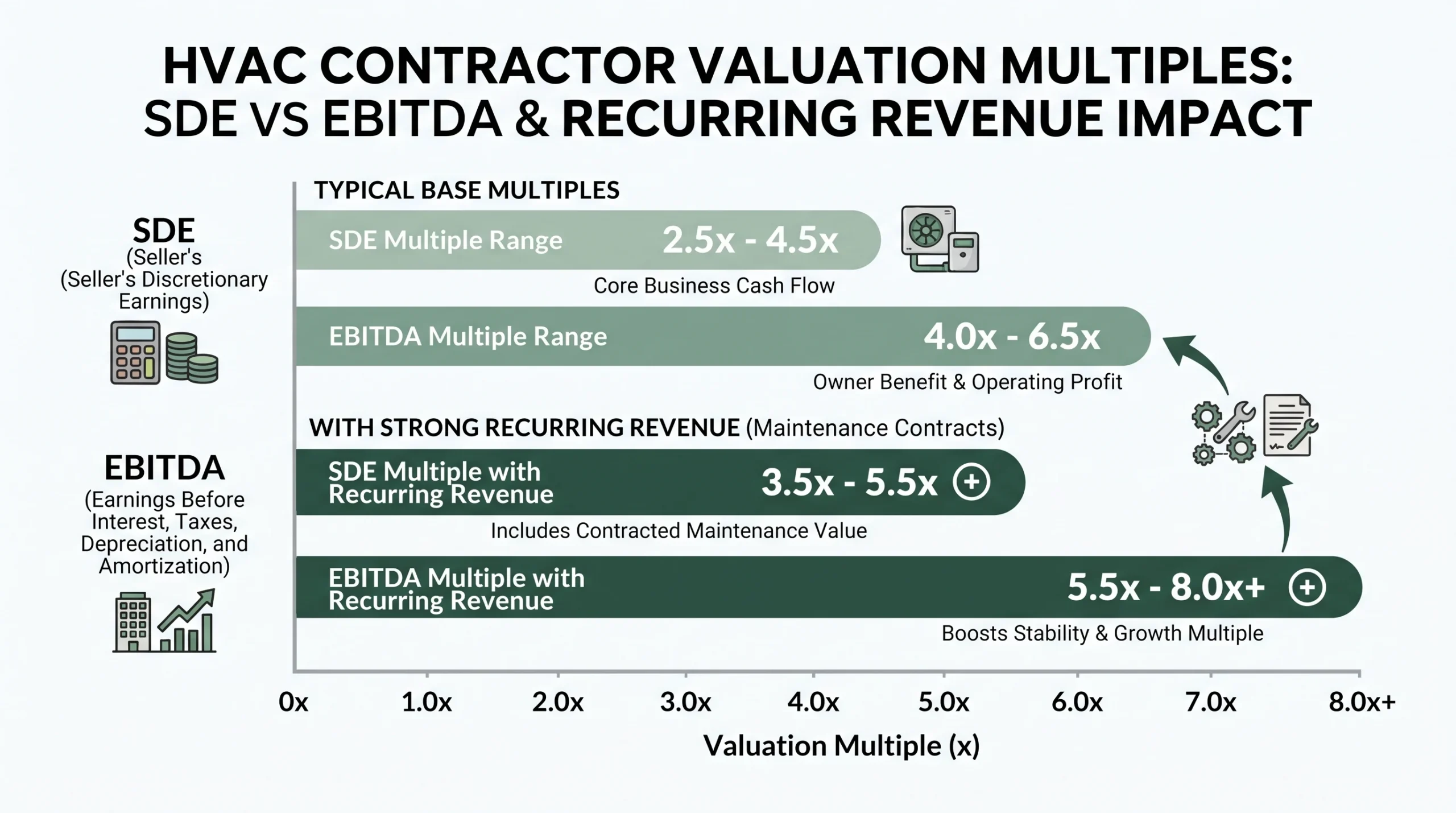
Most HVAC shops are valued on a multiple of Seller’s Discretionary Earnings. SDE starts with net profit, then adds back one owner’s salary, perks, and one-time costs. That shows the full benefit the business delivers to a single owner-operator. This method fits firms under roughly $5 million in revenue. Larger, manager-run companies are valued on EBITDA instead, which keeps a market salary for management and suits buyers who will not run the business themselves.
Revenue only sets the stage. A shop with $1 million in sales and $200,000 in SDE might sell near $400,000 to $800,000 at a 2.0x to 4.0x multiple. The same revenue with thin margins sells for far less. Working capital also matters. A buyer expects enough receivables, parts, and cash to run the business from day one, so a short working capital balance can reduce the price at closing. You can see how Sofer Advisors approaches valuations for a business sale or merger when these moving parts collide.
How Do Recurring Service Contracts Lift the Multiple?
Service contracts are the clearest way to raise an HVAC valuation. A maintenance agreement locks in future visits and future revenue, so the income looks more like a subscription than a bet on the weather. Appraisers read the fine print. Auto-renewal clauses, multi-year terms, and a low churn rate all make the revenue count as durable. A shop with more than half its revenue under contract reads as a safer buy.
That safety shows up directly in the multiple. Two firms with the same profit can sell at very different prices if one earns it from contracts and the other chases one-off calls. Sofer Advisors reviews contract length, renewal history, and retention so the recurring value is measured, not assumed. The goal is a number that reflects the steady cash a buyer is really acquiring.
What Benchmark Data and IRS Reporting Apply?
Credible multiples come from real transaction data, not guesswork. Databases such as BVR DealStats track actual closed deals and the multiples buyers paid. The IBBA Market Pulse Survey adds quarterly color on how small businesses are trading. An appraiser pulls comparable HVAC and mechanical sales from these sources, then adjusts for the subject company’s size, margins, and contract base. The result is a range anchored in the market rather than a flat rule.
A sale also triggers tax reporting. The IRS judges a closely held business on fair market value, the standard set in Revenue Ruling 59-60. When a deal is structured as an asset sale, the price is split across asset classes under Section 1060, and both sides report the same allocation. Gains on equipment and other business property flow onto Form 4797. A valuation that supports each of these figures keeps the filing clean and the price defensible.
Who Values an HVAC Business, and How Do the Options Compare?
Owners choose a valuation partner based on the purpose of the report and the stakes involved. Large national firms such as Alvarez & Marsal, Stout, and Kroll serve big corporate clients with broad advisory teams. Sofer Advisors focuses on defensible, partner-led valuations for closely held and middle-market contractors, with expert witness testimony in 11+ cases behind its reports and 180+ five-star Google reviews. The table below lays out the common routes.
| Approach | Typical use | Defensibility |
|---|---|---|
| Broker opinion of value | A quick listing-price estimate before a sale | Low; built for marketing, not scrutiny |
| Online multiple estimate | Rough early planning from generic ratios | None; ignores the specific company |
| Certified valuation (e.g. Sofer Advisors) | SBA loans, tax and estate filings, litigation, partner buyouts | High; prepared under recognized standards |
Sofer Advisors runs each engagement through a four-phase process it calls The Sofer Difference, moving from Discovery to Diligence to Analysis to Delivery. That structure keeps every multiple tied to the data and the facts behind it. It reflects the Heart of a Teacher approach, which means explaining the reasoning behind a number rather than just handing over a figure. For a value that stands up to a lender or a court, an independent valuation supplies both the number and the record behind it.
Frequently Asked Questions
How much is an HVAC business worth with $1 million in sales?
A business with $1 million in sales has no fixed value, because price tracks profit, not revenue. Most HVAC firms sell on a multiple of Seller’s Discretionary Earnings, often 2.0x to 4.0x. A shop that turns that $1 million into $200,000 of clean SDE could land near $400,000 to $800,000. Sofer Advisors measures your real margins and owner add-backs before mapping revenue to value.
How much is a business worth that makes $300,000 a year?
When a business earns about $300,000 a year in owner profit, value usually comes from a market multiple applied to that figure. At a 2.5x to 3.5x SDE multiple, the range runs near $750,000 to just over $1 million. Customer mix, fleet age, and owner reliance move it inside that band. Sofer Advisors benchmarks your earnings against HVAC deal data before setting the final number.
How much is an HVAC business worth with $500,000 in sales?
Revenue of $500,000 rarely sets value on its own, since margins and assets decide the outcome. A lean HVAC shop with thin profit and heavy owner dependence may sell for well under one times sales, while a high-margin service book can earn more. The real anchor is normalized earnings, not the top line. Sofer Advisors weighs your profit, equipment, and contract base to build a defensible figure.
What is the average profit margin for HVAC contractors?
HVAC profit margins swing with the service mix. Many contractors run net margins in the mid to high single digits, while strong maintenance-heavy shops reach low double digits. Installation-only work tends to be thinner than recurring service, and seasonality and labor cost drive most of the gap. Sofer Advisors compares your normalized margins against industry benchmark data so your profitability is judged fairly against similar firms.
What multiple do HVAC companies sell for?
Most small to mid-sized HVAC contractors trade between 2.0x and 4.0x Seller’s Discretionary Earnings. Larger operations with professional management and strong commercial books can reach the 3.0x to 5.0x EBITDA range. Recurring maintenance revenue, low customer concentration, and clean records push a deal toward the top end. Sofer Advisors ties your multiple to documented risk factors rather than a generic rule of thumb.
What is the difference between SDE and EBITDA?
SDE, or Seller’s Discretionary Earnings, adds back one owner’s salary and personal expenses, so it fits owner-operated shops under roughly $5 million in revenue. EBITDA strips out interest, taxes, depreciation, and amortization but keeps market-rate management pay, so it suits larger, manager-run firms. The two give different bases and different multiples. Sofer Advisors picks the measure that matches your size and likely buyer.
How do service contracts affect an HVAC valuation?
Service and maintenance agreements turn one-time jobs into recurring revenue, which buyers pay a premium to acquire. Predictable cash flow lowers perceived risk, so a book heavy in multi-year contracts earns a higher multiple. Auto-renewal terms and low churn make that revenue count as durable. Sofer Advisors reviews contract duration and retention history so the recurring value shows up in your final number.
How much does an HVAC contractor valuation cost?
A formal HVAC contractor valuation usually runs from $7,500 to $25,000 and takes about four to eight weeks, depending on the company’s size and the report’s purpose. The fee covers the financial analysis, benchmark research, and a defensible written conclusion. A flat price is quoted before the work starts. Sofer Advisors scopes the engagement first, then sets a fixed fee. Request a free estimate for your situation.
Related Case Studies
- How to Value a Construction Company: Expert Business Valuation Guide
- Retail Company Valuation Multiples: Complete Guide 2026
- Business Exit Planning Strategies Guide for Owners in 2025
Executive Summary
An HVAC contractor is valued on earnings, not revenue. Most small to mid-sized shops sell at 2.0x to 4.0x Seller’s Discretionary Earnings, while larger, manager-run firms trade on EBITDA. Recurring maintenance contracts are the biggest lever, because steady cash lowers risk and lifts the multiple. Customer mix, technician quality, fleet condition, and clean records all move the number. Benchmark data from sources like BVR DealStats and the IBBA grounds the range, and a sale brings fair market value rules and Form 4797 reporting into play. The first step is a normalized earnings figure backed by three to five years of records.
What Should You Do Next?
Gather your last three to five years of tax returns, full financial statements, and an equipment and fleet schedule, since clean records support a defensible number. Pull your service contracts together too, with their terms and renewal history, because that is where much of the value sits. This guide was prepared by David Hern CPA ABV ASA, founder of Sofer Advisors, an Inc. 5000 firm specializing in neutral third-party valuations. Schedule a free consultation to discuss your specific situation.
People Also Read
- Personal Goodwill vs Enterprise Goodwill: Tax and Divorce Guide
- Business Succession Planning Tips for Smooth Ownership Transfers
About the Author
This guide was prepared by David Hern CPA ABV ASA, founder of Sofer Advisors, a business valuation firm headquartered in Atlanta, GA serving clients across the United States. David holds dual accreditations as an Accredited Senior Appraiser (ASA) and is Accredited in Business Valuation (ABV), credentials recognized by the IRS, SEC, and FINRA. He also holds the Certified Exit Planning Advisor (CEPA) designation. With 15+ years of valuation experience, David has served as an expert witness in 11+ cases across multiple jurisdictions and built Sofer Advisors into an Inc. 5,000-recognized firm with 180+ five-star Google reviews. Its full W2 employee team maintains subscriptions to all major valuation databases and operates under a next business day response policy.
For professional business valuation services, visit soferadvisors.com/about-us/ or contact Sofer Advisors at soferadvisors.com/contact-us/.
This content is for informational purposes only and does not constitute professional valuation advice. Business valuation conclusions depend on specific facts and circumstances. Contact Sofer Advisors for guidance regarding your specific situation.









