


Last Updated: October 2026
A key person discount valuation is a reduction in a company’s value that reflects how much the business leans on one essential individual. That person might be the founder, the top rainmaker, or the one engineer who holds the technical knowledge. If their exit would cut earnings or scare off customers, a buyer pays less for the business. Appraisers size that risk as a percentage haircut, often in the 5% to 25% range, tied to the facts of the company.
The team at Sofer Advisors prices this risk for business owners, CPAs, and estate attorneys, with 11+ expert witness cases behind its reports and 180+ five-star Google reviews. The discount is not a penalty. It is a measurement. It answers the question a buyer or the IRS always asks. How much of this value walks out the door if the key person does?
This guide explains what the discount is, when it applies, and how analysts size it. It also covers how the discount interacts with other discounts, and how Revenue Ruling 59-60 and the Tax Court have treated key person risk.
Key Takeaways
- What it measures: the discount captures the earnings and relationships a business would lose if one essential person left or died.
- Typical range: most key person discounts land between 5% and 25% of value, with the exact number driven by the facts.
- How it is sized: appraisers use a with-and-without earnings model, a cost-to-replace estimate, or a bump to the company-specific risk premium.
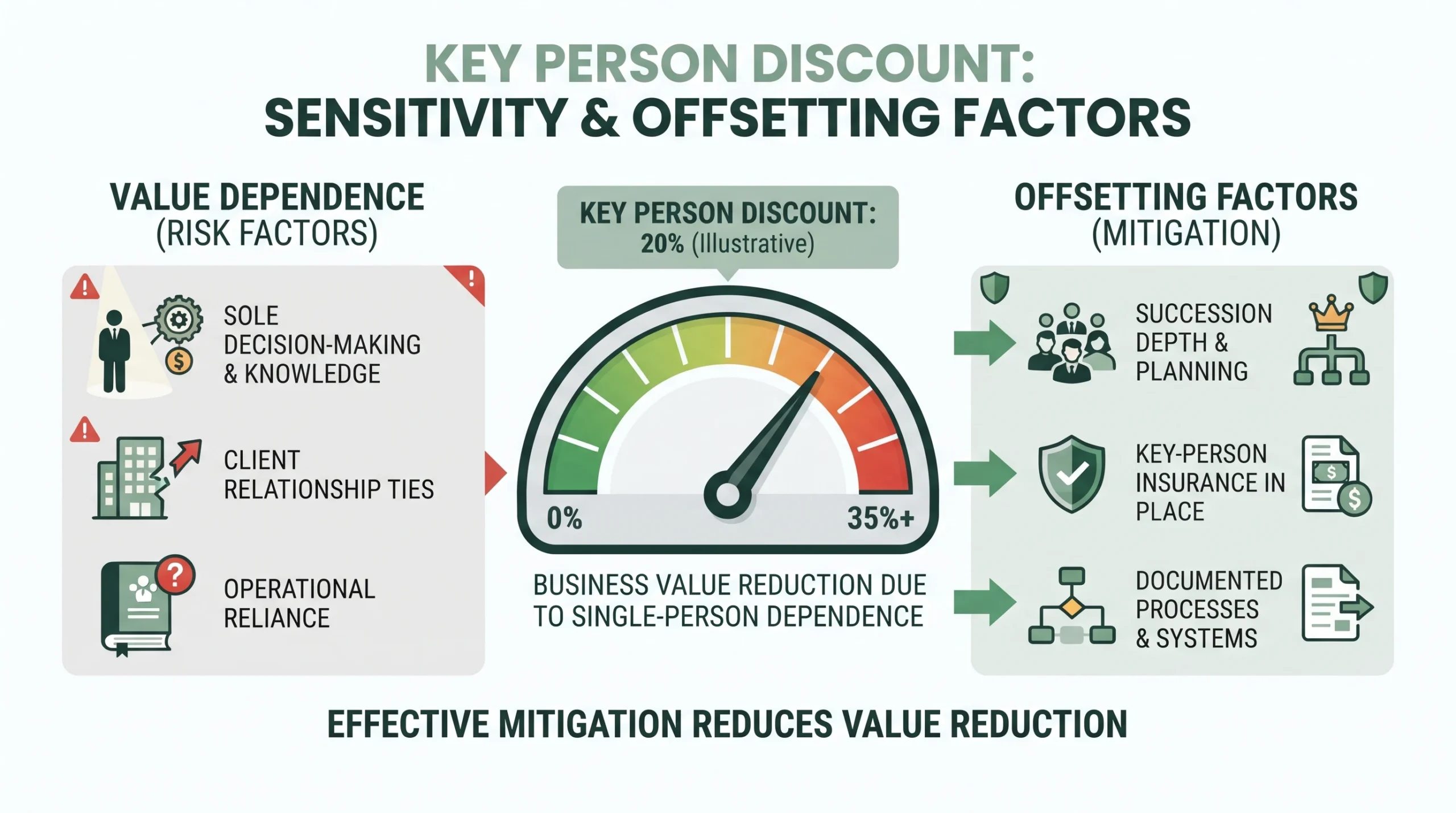
- It can be shrunk: a deep management bench, documented processes, written client contracts, and key person insurance all lower the discount.
- Courts accept it: the Tax Court has allowed key person discounts when the record shows real, measurable dependence on one individual.
Each of these points connects to the others. The sections below take them one at a time.
Why Does a Key Person Discount Apply?
A key person discount applies because value follows earnings, and some earnings depend on one person. When a founder brings in most of the clients, or a lead surgeon generates most of the revenue, their absence puts those earnings at risk. A buyer will not pay full price for a stream that could dry up. The discount lowers value to match the real risk the business carries.
The loss of a key person rarely stops at one empty chair. Clients who followed that person may leave. Lenders may pull back. Employees may lose confidence and look elsewhere. Trade knowledge that lived in one head may vanish overnight. Each of these effects lands on future cash flow, which is what a valuation measures. So the appraiser tests how the business would perform if that person were suddenly gone, then prices the gap.
What Is a Key Person Discount in Business Valuation?
A key person discount is a downward adjustment to value that reflects a company’s over-reliance on one individual. It is sometimes called a key man discount. The idea is simple. If a single person is the reason the business earns what it earns, that concentration is a risk, and risk lowers value. The discount turns a soft worry into a number a report can defend.
The discount is not automatic. Many businesses run well without any single point of failure. A company with several partners, a trained second tier, and client contracts signed at the company level may warrant no discount at all. The adjustment applies only when the record shows a measurable loss if the person left. That is why the analysis starts with the facts, not with a fixed percentage pulled from a table.
How Do Appraisers Size the Key Person Discount?
Appraisers size the discount with three main tools. The first is a with-and-without analysis, which values the company twice, once as it runs today and once with the key person removed, then measures the drop. The second is a cost-to-replace estimate, which adds up recruiting, training, and lost-productivity costs. The third folds the risk into the discount rate as part of the company-specific risk premium.
Each tool fits a different situation. The with-and-without model works best when you can trace specific revenue to the person. The cost-to-replace method fits roles that a successor could fill with time and money. Loading the company-specific risk premium suits cases where the risk is spread across many small effects. A careful appraiser often tests more than one method, then reconciles them. The point is to tie the number to evidence a third party can follow.
When Does It Apply, and How Does It Interact With Other Discounts?
A key person discount shows up most often in estate and gift tax filings, divorce and shareholder disputes, buy-sell agreements, and M&A due diligence. In each setting, the value turns on whether the business can survive the loss of one person. For transfer tax, the relevant standard is fair market value, the same standard that governs the gross estate under IRC Section 2031 and the value of gifts under IRC Section 2512.
The key person discount is its own adjustment, separate from the usual entity-level discounts. It typically reduces the company’s total value first. Only after that do appraisers apply a discount for lack of control or marketability to a specific interest. Stacking the discounts without clear support draws scrutiny. For estate and gift work, see the IRS rules on valuing the gross estate under 26 U.S. Code Section 2031 and gifts under Section 2512, which both set fair market value as the measure.
How Have the Tax Courts Treated Key Person Risk?
Revenue Ruling 59-60, the IRS roadmap for valuing closely held stock, names the loss of a sole manager as a factor that can depress value, especially when no trained successor stands ready. It also notes that life insurance and capable backup management can offset that risk. The Tax Court has put this idea to work in several estate cases, accepting a key person discount when the facts supported one.
In Estate of Mitchell, the valuation of John Paul Mitchell Systems, the court reduced the company’s value by about 10% for the loss of the founder’s public presence and creative role. In Estate of Furman, a case involving a Burger King franchisee, the court accepted a key person discount tied to the founder’s lender and site-selection relationships. The lesson in both is the same. A discount holds up when the record shows what the business would actually lose, and it fails when the number is a guess.
Who Sizes Key Person Risk, and How Do the Options Compare?
Owners choose a valuation partner based on the size of the business, the audit or litigation exposure, and the budget. Large national firms such as Alvarez & Marsal, Stout, and Kroll serve big public companies with broad advisory teams. Sofer Advisors focuses on defensible, partner-led valuations for closely held and middle-market businesses, backed by Inc. 5000 recognition in both 2024 and 2025. The table below sets out the common options.
| Provider | Typical role | Best for |
|---|---|---|
| Specialized valuation firm (e.g. Sofer Advisors) | Tests key person dependence and documents the discount with a with-and-without model | Closely held businesses needing audit-ready support for tax, divorce, or M&A |
| Large national firm | Broad advisory plus valuation at enterprise scale | Large public companies with complex, multi-entity plans |
| Business broker | Prices a sale using rules of thumb and market comps; does not issue a defensible report | Owners wanting a quick, informal sale estimate |
Sofer Advisors runs each engagement through a four-phase process it calls The Sofer Difference, moving from Discovery to Diligence to Analysis to Delivery. That structure keeps every discount tied to evidence rather than a round number. It reflects a Heart of a Teacher approach, which means explaining the reasoning behind a figure instead of just handing one over. To see how a defensible key person analysis fits a full report, review our business valuation services.
Frequently Asked Questions
What is a key person discount in business valuation?
A key person discount is a downward adjustment to a company’s value that reflects heavy reliance on one essential individual. If that person’s exit would cut earnings, cost major clients, or remove knowledge no one else holds, the business carries extra risk, and risk lowers value. The discount turns that worry into a defensible number. Sofer Advisors applies it only when the record shows a real, measurable loss would follow the person’s departure.
What is a typical key person discount range?
Most key person discounts fall between 5% and 25% of the company’s total value, though the exact figure depends on the facts. A business built around one founder with no backup sits at the high end. A company with a trained second tier and signed client contracts sits at the low end, or warrants no discount at all. Sofer Advisors sizes the number to the evidence rather than defaulting to a market average.
How do appraisers calculate a key person discount?
Appraisers use three main methods. A with-and-without analysis values the company twice, with the person present and with them removed, then measures the drop. A cost-to-replace model adds up recruiting, training, and lost-productivity expenses. A third approach folds the risk into the company-specific risk premium in the discount rate. Sofer Advisors often tests more than one method, then reconciles them so the final discount holds up under review.
When does a key person discount apply?
The discount applies most often in estate and gift tax filings, divorce and shareholder disputes, buy-sell agreements, and M&A due diligence. Each setting turns on whether the business can survive the loss of one person. It does not apply to every company, since many operate with no single point of failure. Sofer Advisors reviews management depth and revenue concentration first to decide whether a discount is justified at all.
Does key person insurance reduce the discount?
Yes, key person insurance usually lowers the discount. A policy gives the company cash to cover lost profits and the cost of hiring and training a successor if the individual dies or leaves. That buffer shrinks the economic loss the discount is meant to capture. Revenue Ruling 59-60 recognizes insurance as an offsetting factor. Sofer Advisors weighs the policy’s face value against the potential loss when setting the final adjustment.
How does a key person discount differ from a marketability discount?
A key person discount reflects reliance on one individual and usually reduces the company’s total value. A marketability discount reflects how hard it is to sell a specific interest quickly, and it applies to that interest after the entity value is set. The two measure different risks and are calculated separately. Sofer Advisors keeps them distinct in every report so a reviewer can follow how each adjustment was reached.
Can a founder be a key person even with a full management team?
Yes. A founder can remain a key person if they hold the main client relationships, the technical vision, or the lender ties that drive the business. A large team matters only if its members can actually fill the gap. If the founder’s exit would still harm earnings or stability, the role stays critical. Sofer Advisors tests the depth of the bench, not just its size, before deciding the discount applies.
What Tax Court cases support a key person discount?
Two estate cases stand out. In Estate of Mitchell, the valuation of John Paul Mitchell Systems, the court cut value by about 10% for the loss of the founder’s public presence. In Estate of Furman, involving a Burger King franchisee, the court accepted a discount tied to the founder’s lender and site relationships. Both show the discount holds up when backed by evidence. Sofer Advisors documents that evidence so the number can withstand an IRS challenge.
How much does a key person discount valuation cost?
A business valuation that includes key person analysis generally runs from $7,500 to $25,000 and takes about four to eight weeks, depending on the company’s complexity and the deadline. The range covers the with-and-without modeling and the written support needed to defend the discount. A flat fee is quoted up front, so the cost is clear before work starts. Request an estimate from Sofer Advisors for your situation.
Related Case Studies
- Key Person Discount: How Owner Dependence Reduces Business Value
- Owner Dependency vs Key Person Discount: Which Applies to You
- Valuation Discounts: DLOC and DLOM on Estate and Gift Tax Returns
Executive Summary
A key person discount lowers a company’s value to reflect how much it depends on one essential individual. The size, often 5% to 25%, follows the facts: revenue concentration, the depth of the management bench, documented processes, client and supplier ties, and whether key person insurance is in place. Appraisers size it with a with-and-without earnings model, a cost-to-replace estimate, or a bump to the company-specific risk premium. The discount applies most in estate, gift, divorce, buy-sell, and M&A settings, and it reduces total value before any lack-of-control or marketability discount. Revenue Ruling 59-60 and Tax Court cases like Estate of Mitchell and Estate of Furman accept the discount when the record shows a real, measurable loss. The first step is an honest look at how much the business leans on one person.
What Should You Do Next?
List the people your business truly cannot run without, then gather the facts that show the risk: who holds the client relationships, what is documented, and whether any key person insurance is in place. That file lets an analyst separate real dependence from a problem you have already solved. This guide was prepared by David Hern CPA ABV ASA, founder of Sofer Advisors, which provides independent business valuation services for tax, litigation, and transactions. Schedule a free consultation to discuss your specific situation.
People Also Read
- Control Premium in Business Valuation: When It Applies
- How Is a Buy-Sell Agreement Funded With Life Insurance?
About the Author
This guide was prepared by David Hern CPA ABV ASA, founder of Sofer Advisors, a business valuation firm headquartered in Atlanta, GA serving clients across the United States. David holds dual accreditations as an Accredited Senior Appraiser (ASA) and is Accredited in Business Valuation (ABV), credentials recognized by the IRS, SEC, and FINRA. He also holds the Certified Exit Planning Advisor (CEPA) designation. With 15+ years of valuation experience, David has served as an expert witness in 11+ cases across multiple jurisdictions and built Sofer Advisors into an Inc. 5,000-recognized firm with 180+ five-star Google reviews. Its full W2 employee team maintains subscriptions to all major valuation databases and operates under a next business day response policy.
For professional business valuation services, visit soferadvisors.com/about-us/ or contact Sofer Advisors at soferadvisors.com/contact-us/.
This content is for informational purposes only and does not constitute professional valuation advice. Business valuation conclusions depend on specific facts and circumstances. Contact Sofer Advisors for guidance regarding your specific situation.









