


Last Updated: November 2026
A capital adequacy opinion is an independent, third-party opinion that a company will stay solvent and hold enough capital to keep operating right after a major transaction. An outside expert reviews the deal before it closes and tests whether the business can survive it. Boards ask for one before deals that move a lot of money out of a company, such as a leveraged buyout, a large dividend, or a big share buyback.
The team at Sofer Advisors prepares these opinions for the private company boards, private equity sponsors, and lenders who back such deals.
This guide explains what the opinion covers, when a board needs one, the three tests it runs, and how it differs from a fairness opinion.
Key Takeaways
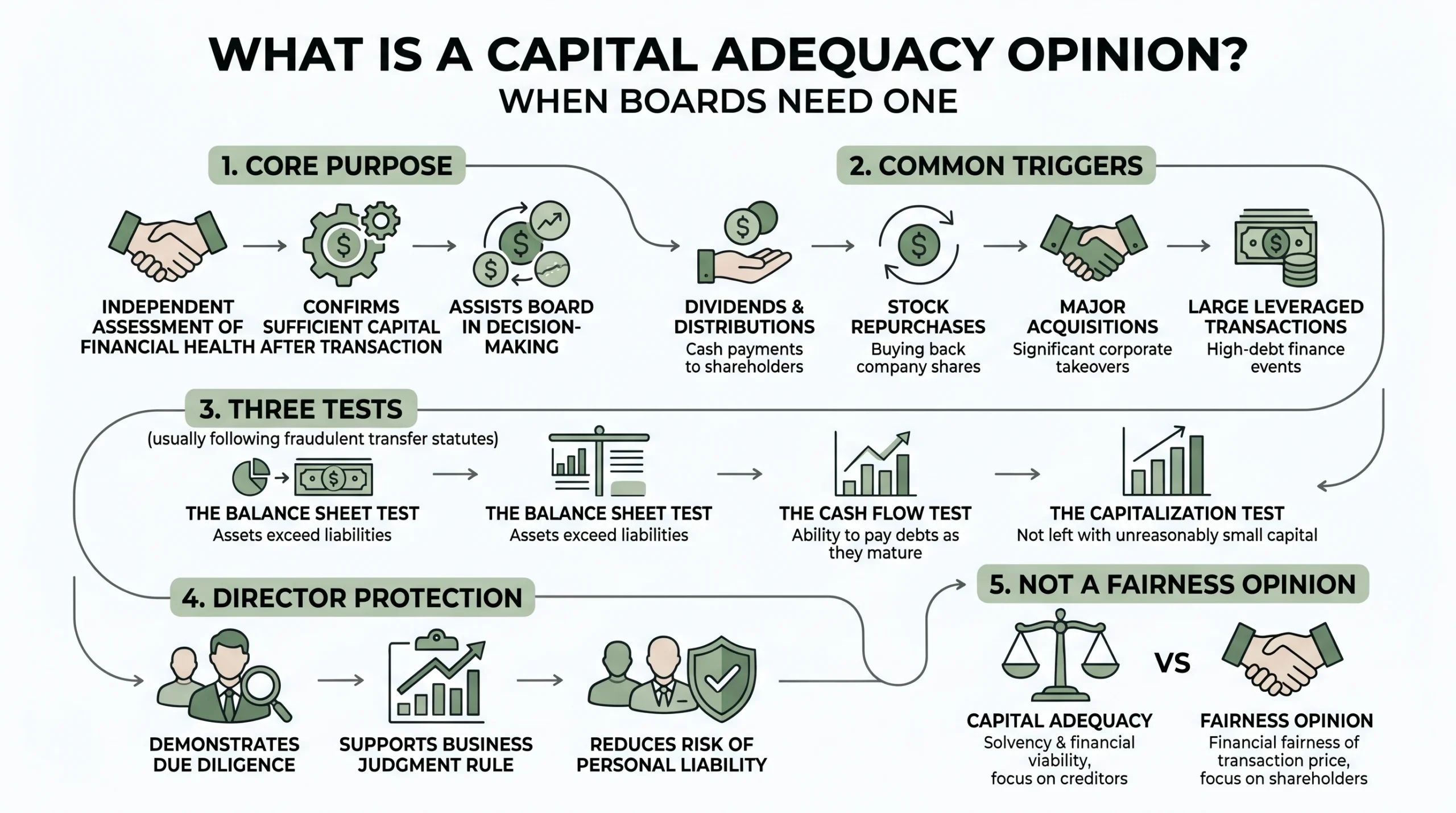
- Core purpose: A capital adequacy opinion confirms a company stays solvent and well funded right after a major transaction.
- Common triggers: Boards get one before a leveraged buyout, a leveraged dividend or recapitalization, a large distribution, or a big share buyback.
- Three tests: The analysis checks the balance sheet, the cash flow, and whether the company keeps reasonable capital.
- Director protection: The opinion supports fiduciary duties and helps defend against fraudulent transfer claims if the company later fails.
- Not a fairness opinion: It addresses the company’s condition after the deal, not whether the price is fair to shareholders.
What is a capital adequacy opinion?
A capital adequacy opinion is a written view from an independent expert. It addresses one question. Will the company stay solvent and well funded right after the deal closes?
The opinion is closely related to a solvency opinion. In practice, the two terms often overlap. A solvency opinion focuses on whether the company is solvent at closing. A capital adequacy opinion puts more weight on the capital left to run the business. The exact line between the two is not fixed. Usage varies by firm and by counsel.
The expert studies the company as it will exist after the transaction. That means reviewing pro forma financials. These are projections that fold in the new debt, the payout, or the buyback. The expert then tests whether the post-deal company can stand on its own.
The opinion is independent by design. The board, the buyer, or the lender may request it. But the expert works from the facts, not from the outcome anyone wants. That independence is what gives the opinion weight.
When do boards need one?
Boards need this opinion before a transaction that weakens the balance sheet. The common triggers share one trait. Each one moves cash or value out of the company, or adds heavy debt.
A leveraged buyout is a classic example. The buyer funds the purchase with borrowed money. That debt sits on the acquired company after closing. A leveraged dividend or recapitalization works in a similar way. The company borrows to pay its owners a large dividend.
Large distributions and big share buybacks also trigger the need. Both return cash to owners or shareholders. Both can leave less behind to fund the business. In each case, the board wants proof that the company can still pay its debts.
Private company boards and private equity sponsors are the most frequent users. Lenders may also ask for one to support their own files. The goal is the same across all of them. Everyone wants a clear record that the deal did not sink the company.
What three tests does the opinion cover?
Most capital adequacy and solvency work rests on three standard tests. Together they track how courts look at these deals. An expert runs all three before signing.
The first is the balance sheet test. It asks whether the fair value of the company’s assets exceeds its liabilities. This is a measure of net worth at fair value, not just book value.
The second is the cash flow test. It asks whether the company can pay its debts as they come due. The expert models future cash against future obligations. A company can show positive net worth and still fail this test if cash runs short.
The third is the reasonable capital test. It asks whether the company is left with enough capital for its business. A company might pay its near-term bills yet still be too thin to handle normal swings. This test guards against that.
| Test | Core question |
|---|---|
| Balance sheet test | Do assets at fair value exceed liabilities? |
| Cash flow test | Can the company pay its debts as they come due? |
| Reasonable capital test | Is enough capital left to run the business? |
All three tests point the same way. They ask whether the company can survive the deal and keep going. An opinion that passes all three gives the board solid ground to stand on.
How does the opinion protect directors?
Directors owe duties to the company and its stakeholders. When a board approves a risky payout, those duties come into focus. A capital adequacy opinion helps directors show they did their homework.
The bigger risk is legal. If a company fails soon after a large payout, creditors may sue. They may claim the deal was a fraudulent transfer. That means the company gave away value while insolvent, or became insolvent because of the deal.
State law covers these claims through the Uniform Voidable Transactions Act. It was formerly called the Uniform Fraudulent Transfer Act. Federal law covers them too, through Section 548 of the Bankruptcy Code. Under these rules, a court can unwind a transfer or hold parties liable.
A capital adequacy opinion is strong evidence against such claims. It shows the company was solvent and well funded at closing, based on an independent review. It does not grant total immunity. But it gives directors and sponsors a documented, expert basis for the decision.
How is it different from a fairness opinion?
People often confuse the two. They are not the same. Each answers a different question about the same deal.
A fairness opinion addresses price. It asks whether the terms of a transaction are fair to shareholders from a financial point of view. A board uses it when it must judge whether an offer is a good deal for owners.
A capital adequacy opinion addresses financial condition. It asks whether the company stays solvent and well funded after the deal. It says nothing about whether the price was fair.
A single transaction can call for both. A board might get a fairness opinion to support the price. It might also get a capital adequacy opinion to confirm the company can survive the payout. The two opinions work side by side. One does not replace the other.
How is it different from a solvency opinion?
These two terms sit very close together. Many experts treat a capital adequacy opinion as a form of solvency opinion. The overlap is real, and the labels vary. No single industry definition draws a hard line between them.
A solvency opinion usually centers on the moment of closing. It confirms the company is solvent as the deal completes. A capital adequacy opinion leans more on the forward look. It stresses whether the company holds enough capital to operate in the period that follows.
In practice, a well-built opinion of either name runs the same three tests. It checks the balance sheet, the cash flow, and the reasonable capital left in the business. The naming matters less than the analysis behind it.
What goes into the analysis?
The expert starts with the deal terms. New debt, interest costs, and payout amounts all go into the model. The expert then builds pro forma financials for the company after closing.
Good projections rest on support. The expert ties them to the company’s budget and its track record. The expert also tests downside cases. A model that only works in a rosy scenario does not hold up.
The expert also weighs the timing of the new debt. Some payments come due soon. Others stretch out for years. The model lines up each obligation against the cash on hand. It then checks whether the company can meet them in order.
The final opinion sets out the assumptions and the tests. Clear documentation is what makes it useful later. A report that spells out each step is far easier to rely on than a bare conclusion. It also stands up better if a court reviews the deal years down the road.
Frequently Asked Questions
What is a capital adequacy opinion in simple terms?
It is an independent expert’s view that a company will stay solvent and well funded right after a big transaction. The expert tests the post-deal company against standard solvency measures. The opinion gives the board proof that the deal does not leave the company too weak to survive.
When should a board get one?
A board should consider one before any deal that moves large value out of the company. Common examples are leveraged buyouts, leveraged dividends, large distributions, and big share buybacks. If a deal adds heavy debt or drains cash, the opinion is worth getting.
What are the three solvency tests?
The three tests are the balance sheet test, the cash flow test, and the reasonable capital test. The first checks that assets at fair value exceed liabilities. The second checks that the company can pay its debts as they come due. The third checks that enough capital remains to run the business.
How is a capital adequacy opinion different from a fairness opinion?
A fairness opinion addresses price. It asks whether a deal’s terms are fair to shareholders. A capital adequacy opinion addresses financial condition. It asks whether the company stays solvent after the deal. They answer different questions, and both can apply to one transaction.
Is a capital adequacy opinion the same as a solvency opinion?
They are closely related and often overlap. A solvency opinion tends to focus on solvency at closing. A capital adequacy opinion leans more on whether enough capital remains going forward. In practice, both rely on the same three solvency tests.
What law makes these opinions matter?
Two bodies of law drive the need. State fraudulent transfer law, now the Uniform Voidable Transactions Act, lets creditors challenge deals. Section 548 of the Bankruptcy Code does the same under federal law. An opinion helps defend a deal against these claims.
Does the opinion remove all legal risk for directors?
No. It is strong evidence that the board acted with care and that the company was solvent. It does not grant immunity. It gives directors a documented, independent basis for their decision, which courts weigh seriously.
Who prepares a capital adequacy opinion?
An independent financial expert or valuation provider prepares it. The provider must be free of any stake in the deal’s outcome. Independence is what gives the opinion its weight with courts, creditors, and lenders.
What information does the expert need?
The expert needs the deal terms, current financials, and management’s projections. New debt, interest costs, and payout amounts all feed the model. Clear support for the projections makes the final opinion more reliable.
Related Case Studies
- Fairness Opinion in M&A Atlanta: What Georgia Business Owners and Boards Need to Know
- Solvency Opinion for a Dividend Recapitalization
- What Is Invested Capital? Definition and How to Calculate It
Executive Summary
A capital adequacy opinion confirms a company stays solvent and well funded right after a major transaction. Boards get one before a leveraged buyout, a leveraged dividend or recapitalization, a large distribution, or a big share buyback. The analysis checks the balance sheet, the cash flow, and whether the company keeps reasonable capital. The opinion supports fiduciary duties and helps defend against fraudulent transfer claims if the company later fails. It addresses the company’s condition after the deal, not whether the price is fair to shareholders.
What Should You Do Next?
If a leveraged payout or buyout is on your table, test the company’s footing before you sign. Review your pro forma balance sheet and cash flow with the new debt in place. Document your assumptions so the decision holds up later. Sofer Advisors provides independent capital adequacy and solvency analysis, led by David Hern CPA ABV ASA CVA. Schedule a consultation to discuss your transaction.
People Also Read
- What is a Fairness Opinion in Mergers and Acquisitions?
- What Is a Solvency Opinion? Complete Guide for Business Owners
About the Author
This guide was prepared by David Hern CPA ABV ASA CVA, founder of Sofer Advisors, a business valuation firm headquartered in Atlanta, GA serving clients across the United States. David holds accreditations as an Accredited Senior Appraiser (ASA) and is Accredited in Business Valuation (ABV), credentials recognized by the IRS, SEC, and FINRA, and is also a Certified Valuation Analyst (CVA). David has served as an expert witness in dozens of cases across multiple jurisdictions, and Sofer Advisors is an Inc. 5000 honoree in 2024 and 2025 with 240+ five-star Google reviews.
For professional business valuation services, visit soferadvisors.com/about-us/ or contact Sofer Advisors at soferadvisors.com/contact-us/.
Disclaimer: This content is for informational purposes only and does not constitute professional valuation advice. Business valuation conclusions depend on specific facts and circumstances. Contact Sofer Advisors for guidance regarding your specific situation.