


Last Updated: November 2026
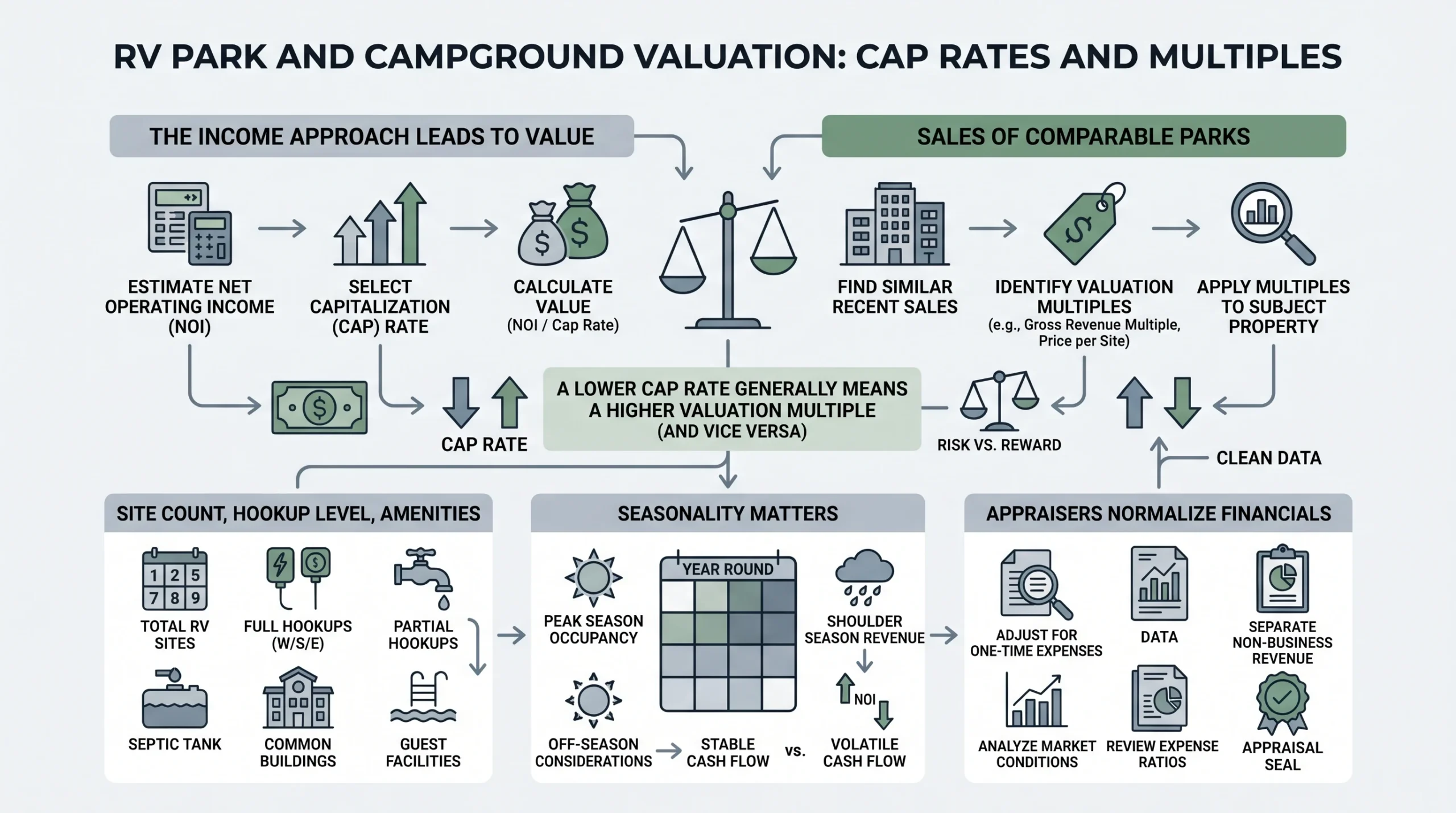
An RV park or campground is valued mainly with the income approach, because it is an income-producing property whose worth tracks the cash it generates. The core formula is plain. Value equals net operating income divided by a market cap rate. Sales of comparable parks back up that figure, and appraisers also check the price per site. A lower cap rate, which a stable, well-run park earns, produces a higher value.
The team at Sofer Advisors prepares these valuations for owners, buyers, lenders, and attorneys.
This guide walks through the methods, the key metrics, and the drivers that move value up or down.
Key Takeaways
- The income approach leads. Value equals net operating income divided by a market cap rate.
- Sales of comparable parks support the income figure. Appraisers also check price per site.
- A lower cap rate means a higher value. Stable, well-run parks earn lower cap rates.
- Site count, hookup level, occupancy, and location drive most of the value.
- Seasonality matters. Appraisers normalize income so one slow winter does not distort the result.
How are RV parks and campgrounds valued?
RV parks are valued mainly with the income approach. The park earns money from guests. So its worth tracks the income it produces. The core formula is plain. Value equals net operating income, or NOI, divided by a cap rate.
The sales-comparison approach backs this up. Here an appraiser looks at recent sales of similar parks. Those sales show what buyers actually pay. The cost approach plays a smaller role. It estimates what the land and improvements would cost to rebuild. That method fits newer parks better than older ones.
In most engagements, the income approach carries the most weight. The other two serve as a check. When the methods agree, the conclusion holds up well.
Why does the income approach lead? A campground is a business first and land second. Buyers care about the cash it throws off each year. Two parks can sit on similar land yet earn very different income. The income approach captures that gap. It ties the price to real performance, not just acreage or site count.
How does the income approach work?
The income approach rests on one idea. A buyer pays for future cash flow. So the appraiser first builds a clean picture of yearly income.
Start with net operating income. That is total revenue minus normal operating expenses. Revenue includes site rentals and extras like a camp store. Operating expenses include taxes, insurance, payroll, utilities, and routine upkeep. NOI leaves out loan payments and major capital projects.
Next comes the cap rate. The cap rate reflects the risk and the expected return for that kind of property. You divide NOI by the cap rate to reach value. A park with steady bookings and low risk earns a lower cap rate. A lower cap rate produces a higher value. A riskier park earns a higher cap rate and a lower value.
A short example shows the math. These figures are illustrative only. Say a park produces $200,000 in net operating income. An appraiser applies a cap rate of 9 percent. Value equals $200,000 divided by 0.09, or about $2.2 million. Now raise the cap rate to 11 percent. The same income yields roughly $1.8 million. A small shift in the rate moves the value a lot. That is why appraisers support the cap rate with market evidence and sound judgment.
What are the key metrics in campground valuation?
Three metrics come up again and again. The first is the cap rate. It links income to value and lets buyers compare parks on equal footing.
The second is price per site, sometimes called price per pad. You divide the sale price by the number of sites. This gives a quick way to compare parks of different sizes. The third is the gross income multiplier. It compares total gross income to price. It is a rough screen, not a precise tool.
No single metric tells the whole story. A high price per site may still be fair if the sites command strong rates. Appraisers read these numbers together, with the park’s condition and location in mind.
What revenue streams does an RV park have?
RV parks earn money in several ways. Understanding the mix is key to a sound valuation. Some income is steady. Some swings with the season.
The table below shows the common site types and how they earn.
| Site or stream | Typical guest | Revenue pattern |
|---|---|---|
| Transient (nightly) | Short-stay traveler | Highest nightly rate, seasonal swings |
| Weekly or monthly | Extended-stay guest | Steady, lower per-night rate |
| Seasonal or annual | Long-term resident | Predictable, paid in advance |
| Cabins or park models | Guests without an RV | Added rental income |
| Ancillary services | All guests | Store, propane, laundry, activities |
Full-hookup sites with water, sewer, and electric earn more than partial or tent sites. The amp level matters too. A 50-amp site serves larger rigs and commands a higher rate than a 30-amp site. Ancillary income can lift the bottom line. A camp store, propane sales, laundry, and paid activities all add to NOI.
What drives an RV park’s value?
Several factors set one park apart from the next. Site count is the starting point. More sites mean more income potential, if demand supports them.
Hookup level is next. Modern water, sewer, and electric service raises both rates and value. Occupancy and its pattern matter a great deal. A park that fills up only a few months a year carries more risk than one with steady, year-round demand. Location feeds that demand. Parks near highways, lakes, parks, or popular attractions draw more guests.
The guest mix also shapes risk. Long-term and seasonal guests give steady income. Transient guests pay more per night but come and go. Amenities help as well. Pools, clubhouses, and good Wi-Fi support higher rates. Strong management and modern infrastructure reduce risk and lift value. A tie to a recognized franchise or membership brand can help, and solid online reviews reflect guest demand.
Why does seasonality matter so much?
Most parks earn the bulk of their income in a short season. A lake park may be packed all summer and quiet by November. That pattern creates risk, and it can distort a single year of records.
Appraisers normalize NOI to handle this. They look at several years, not one. They smooth out a freak boom or a slow stretch. The goal is a sustainable income figure that a buyer can rely on. A park with a longer season, or one in a warm-weather market, usually carries less risk. Less risk supports a lower cap rate and a stronger value.
How do reviews and reputation affect value?
Online reviews act as a window into demand. Guests read them before they book. A park with strong ratings tends to fill more sites and hold higher rates. That feeds directly into net operating income.
Reputation also lowers risk. A steady stream of happy guests points to repeat business and stable cash flow. A park with poor reviews may struggle to keep sites full, even in a good location. An appraiser looks at ratings, booking trends, and guest comments as part of the review. A tie to a known franchise or membership brand can add trust and bring in traffic. These signals do not replace the numbers. They help explain why the numbers look the way they do.
How does deferred maintenance affect value?
Deferred maintenance drags value down. Worn roads, aging hookups, and tired buildings all raise future costs. A buyer sees that bill coming and pays less today.
An appraiser checks the physical condition of the park with care. Cracked paving, weak electric service, and old water lines are common red flags. These repairs are costly, and they often cannot wait. Modern, well-kept infrastructure has the opposite effect. It supports higher rates, lowers risk, and lifts value. Owners who invest in upkeep usually protect their price when they sell.
When do owners need a formal valuation?
Owners seek a valuation at key moments. A sale or purchase is the most common one. Both sides want a defensible price.
Lenders are another trigger. SBA lenders generally require an independent appraisal before they fund a park purchase. Tax and estate matters call for one too. The IRS looks for fair market value under Revenue Ruling 59-60 for gift and estate filings. Partner buyouts, divorce, and litigation also need a credible, independent figure. In each case, a formal report carries weight that a quick online estimate cannot match.
Frequently Asked Questions
How do you value an RV park?
You value an RV park mainly with the income approach. First you find net operating income. Then you divide it by a market cap rate. Sales of similar parks support that figure. The result reflects the cash the park can produce.
What is a cap rate for an RV park?
A cap rate links a park’s income to its value. You divide net operating income by the cap rate to estimate value. Rates vary by location, condition, and risk. A stable, well-run park earns a lower cap rate and a higher value.
What is price per site?
Price per site, or price per pad, divides the sale price by the number of sites. It offers a fast way to compare parks of different sizes. It is a useful screen. It does not replace a full income analysis.
How is NOI calculated for a campground?
Net operating income is total revenue minus normal operating expenses. Revenue includes site fees, cabin rentals, and store sales. Expenses include taxes, insurance, payroll, utilities, and upkeep. NOI excludes loan payments and major capital projects.
Does seasonality affect an RV park’s value?
Yes. Most parks earn the bulk of their income in a short season. Appraisers normalize income across several years to smooth out that swing. A longer season or a warm-weather location lowers risk and supports a higher value.
What revenue streams add the most value?
Steady, recurring income tends to add the most value. Seasonal and annual sites give predictable cash flow. Full-hookup sites earn more than partial or tent sites. Ancillary income from a store, propane, laundry, and activities also helps.
Do cabins and park models increase value?
They can. Cabins and park models reach guests who do not own an RV. That widens the market and adds rental income. They also raise maintenance and capital needs. An appraiser weighs both sides when modeling income.
Which valuation approach matters most?
The income approach usually matters most. RV parks are income-producing properties. The sales-comparison approach supports the income figure. The cost approach plays a smaller role, mostly for newer parks.
When should an owner get a formal valuation?
An owner should get one before a sale, a purchase, or a partner buyout. Lenders often require one for financing. Tax, estate, divorce, and litigation matters call for a credible, independent figure as well.
Related Case Studies
- Retail Company Valuation Multiples: Complete Guide 2026
- Medical Practice Valuation Multiples 2025-2026: Complete Guide
- Construction Company Valuation Multiples by Trade
Executive Summary
The income approach leads. Value equals net operating income divided by a market cap rate. Sales of comparable parks support the income figure. Appraisers also check price per site. A lower cap rate means a higher value. Stable, well-run parks earn lower cap rates. Site count, hookup level, occupancy, and location drive most of the value. Seasonality matters. Appraisers normalize income so one slow winter does not distort the result.
What Should You Do Next?
Start by gathering three years of financial records, occupancy reports, and site details. Clean records lead to a clearer picture of your true net operating income. If a sale, loan, or tax filing is near, act early so gaps do not stall the process. For an independent valuation of your park, Sofer Advisors can help, with work led by David Hern CPA ABV ASA CVA.
People Also Read
- DTC Ecommerce Valuation: Why Multiples Compressed in 2026
- Veterinary Practice Valuation: Methods and Multiples
About the Author
This guide was prepared by David Hern CPA ABV ASA CVA, founder of Sofer Advisors, a business valuation firm headquartered in Atlanta, GA serving clients across the United States. David holds accreditations as an Accredited Senior Appraiser (ASA) and is Accredited in Business Valuation (ABV), credentials recognized by the IRS, SEC, and FINRA, and is also a Certified Valuation Analyst (CVA). David has served as an expert witness in dozens of cases across multiple jurisdictions, and Sofer Advisors is an Inc. 5000 honoree in 2024 and 2025 with 240+ five-star Google reviews.
For professional business valuation services, visit soferadvisors.com/about-us/ or contact Sofer Advisors at soferadvisors.com/contact-us/.
Disclaimer: This content is for informational purposes only and does not constitute professional valuation advice. Business valuation conclusions depend on specific facts and circumstances. Contact Sofer Advisors for guidance regarding your specific situation.