


Last Updated: November 2026
A mobile home park is valued as an income-producing asset, worth its net operating income divided by a market cap rate. The park rents out lots to residents who usually own their homes. The rent they pay for each pad, called lot rent, is the core of the park’s value. Lot rents that sit below the local market often point to room for growth.
Sofer Advisors prepares these reports for owners, CPAs, and attorneys.
This guide explains how the income approach works, what drives value up or down, and where the risks hide.
Key Takeaways
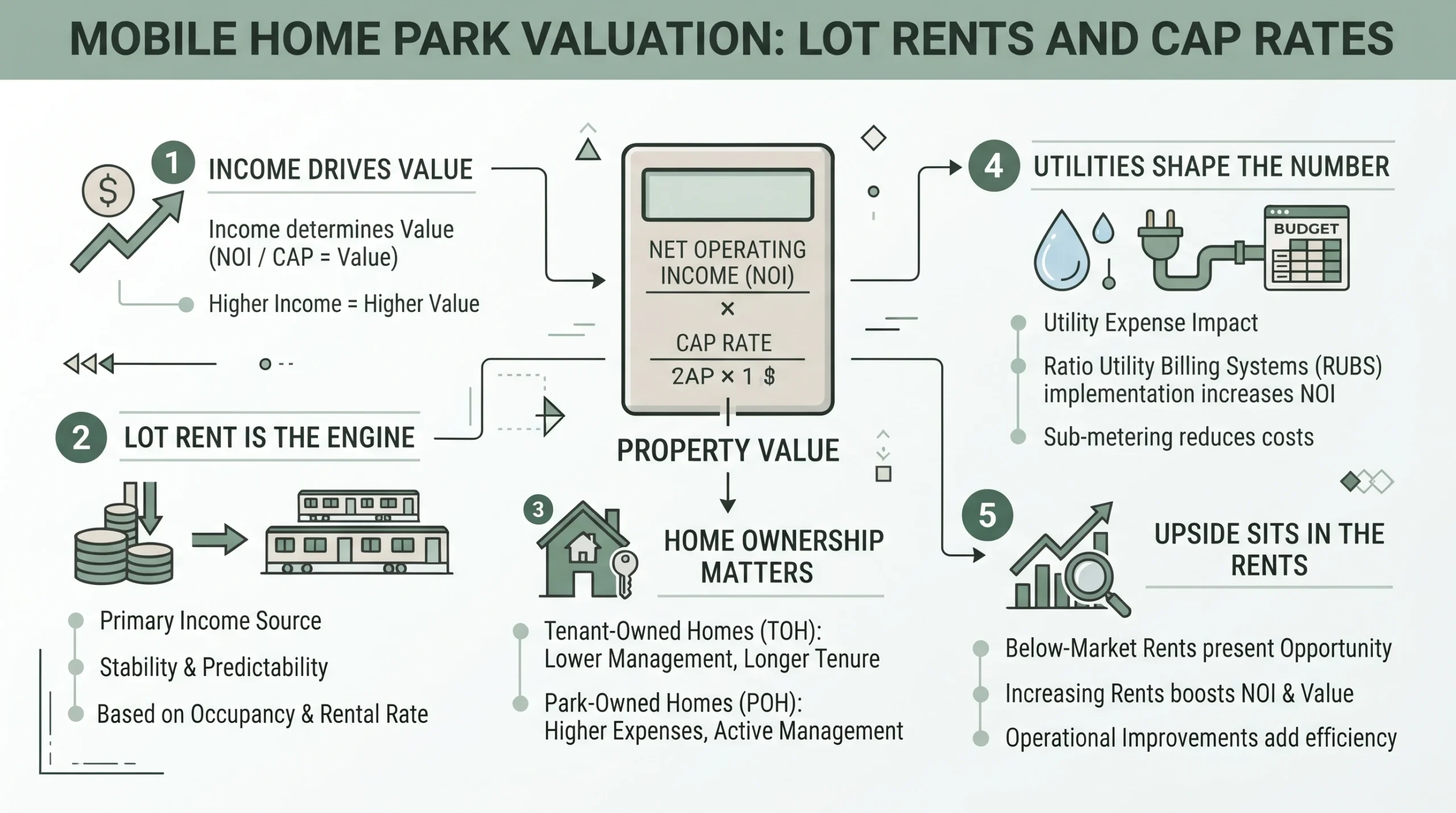
- Income drives value: A park is worth its net operating income divided by a market cap rate.
- Lot rent is the engine: Most income comes from renting pads to people who own their homes.
- Home ownership matters: Tenant-owned homes mean less cost and risk than park-owned homes.
- Utilities shape the number: City water and sewer usually beat private wells and septic.
- Upside sits in the rents: Lot rents below the local market point to room for growth.
Why is a mobile home park valued differently?
A mobile home park is part real estate and part operating business. The owner rents land, not finished apartments. In most parks, residents own their homes. They rent only the lot beneath them.
This changes the cost picture. The owner does not repair kitchens or roofs on tenant-owned homes. The owner maintains the roads, the utility lines, and the common areas. That means lower upkeep per unit than a typical apartment building.
Because the income is steady and the costs are lean, investors treat these parks as durable assets. Residents rarely move. Moving a home is costly and hard. That keeps turnover low and income stable.
Buyers range from individual owners to large funds. Many like the mix of real estate and steady cash flow. This demand supports values in strong markets. It also means an appraiser must think like a buyer. The value has to reflect what a real investor would pay today.
What is the income approach to value?
The income approach is the main method for these parks. The formula is simple. You divide net operating income by a market cap rate. The result is the value.
Net operating income, or NOI, is the park’s yearly income after operating costs. It does not subtract the mortgage. It does not subtract income tax. It reflects what the property itself earns.
To find NOI, an appraiser starts with all the income the park can collect. This full figure, before any loss, is the gross potential income. Then they subtract a vacancy and collection allowance. That allowance covers empty lots and unpaid rent. Then they subtract operating expenses. What remains is the NOI.
Occupancy comes in two forms. Physical occupancy is the share of lots that are filled. Economic occupancy is the share that actually pays. A park can look full yet collect poorly. Appraisers focus on the paying occupancy, since that is what drives real income.
Here is an illustrative example. Say a park has an NOI of $300,000. Say the market cap rate is 8 percent. Divide 300,000 by 0.08. The indicated value is $3,750,000. The numbers are illustrative, but the steps match real work.
How do lot rents drive value?
Lot rent is the rent a resident pays for the pad their home sits on. It is the largest income source in most parks. Because it is predictable, it anchors the valuation.
Appraisers compare a park’s lot rents to nearby parks. Rents that sit below the local market are a signal. They often point to upside. A new owner may be able to raise rents over time, which lifts income and value.
Rents that already match or beat the market leave less room to grow. The appraiser weighs this when setting the cap rate and the growth outlook.
Raising rents is not automatic. It depends on local demand and what residents can pay. It can also depend on rent rules in some areas. A sound valuation does not assume rents jump overnight. It phases any increase in over a realistic period.
What is the difference between tenant-owned and park-owned homes?
This split matters a lot. Tenant-owned homes belong to the residents. The park collects lot rent only. The owner carries little repair risk on those homes.
Park-owned homes belong to the park. The park rents out the whole home, not just the lot. This brings in more rent per unit. It also brings more cost and more work. The owner must fix, insure, and manage each home.
Many investors prefer parks with mostly tenant-owned homes. The income is cleaner. The management load is lighter. An appraiser treats the two revenue streams apart, because their expense profiles differ.
What income and expenses go into NOI?
Income is more than lot rent. It can include rent from any park-owned homes. It can include utility reimbursements, where residents pay back water or trash costs. It can include fees for pets, storage, or late payments.
Expenses cover the cost of running the park. Common items are property taxes, insurance, and management. Others include water, sewer, trash, repairs, and reserves for big future fixes.
A careful appraiser tests the owner’s numbers. They compare reported income and costs to what similar parks show. They look for expenses that were left out. They look for income that may not last. The goal is an NOI the market would accept.
| Income sources | Operating expenses |
|---|---|
| Lot rent | Property taxes |
| Park-owned home rent | Insurance |
| Utility reimbursements | Management fees |
| Pet, storage, and late fees | Water, sewer, and trash |
| Other resident fees | Repairs and reserves |
How do cap rates work for these parks?
A cap rate is the return a buyer expects on the price. It turns income into value. A lower cap rate means a higher value for the same income. A higher cap rate means a lower value.
Cap rates are not set by a formula. They come from the market. Appraisers study recent sales of similar parks. They see what buyers paid relative to income. That tells them the going rate.
Many things move the cap rate. A well-kept park in a strong area draws a lower rate. An older park with weak utilities or thin demand draws a higher one. The rate reflects the risk a buyer takes on.
Cap rates also shift with the wider market. When borrowing costs rise, buyers often expect higher returns. That can push cap rates up and values down, even when a park has not changed. A good appraiser uses rates drawn from recent, local sales.
What drives a park’s value up or down?
Several factors stand out. Economic occupancy is one. This is the share of lots that actually pay, not just the share that are filled. Strong, paying occupancy supports a higher value.
Utilities are another big driver. City water and sewer are simple and low-risk. Private wells, septic fields, or master-metered systems add cost and liability. A buyer pays less when the owner carries that burden.
Location, condition, and layout matter too. So does the resident mix. An age-restricted park serves a different market than an all-age park. Each of these shapes demand, risk, and the final value.
What other methods support the valuation?
The income approach leads, but two other methods add support. The first is the sales comparison approach. It looks at recent sales of similar parks nearby.
Appraisers often use price per pad in this method. They divide a sale price by the number of lots. This lets them compare parks of different sizes. The measure is rough, so it works best as a cross-check.
The second is the cost approach. It values the land, then adds the cost to rebuild the improvements, less depreciation. It fits newer parks better than older ones. For most income-producing parks, the income approach still carries the most weight.
What risks should owners watch?
Aging utility systems are the top risk. Private water and sewer lines can fail. Repairs run high, and a failure can halt income. A buyer will price this risk into the offer.
Rules can shift too. Rent control or new zoning can cap future income or block expansion. Local demand can weaken if a major employer leaves. Each of these can pull value down.
Good records help. Clear financials and a history of upkeep make a park easier to value and to sell. They also make the final number easier to defend.
One tenant risk is worth a note. A park that leans on park-owned homes carries more exposure. Those homes can age, need repairs, and sit empty. A park that leans on tenant-owned homes spreads that risk to residents. Buyers tend to reward the steadier model.
Frequently Asked Questions
How is a mobile home park valued?
Most parks are valued with the income approach. An appraiser finds the net operating income, then divides it by a market cap rate. The result is the indicated value. Sales of similar parks, and at times the cost approach, back up that figure.
What is lot rent, and why does it matter?
Lot rent is the fee a resident pays to place their home on a lot. It is the main income source in most parks. Because it is steady and predictable, it anchors the valuation.
What is the difference between tenant-owned and park-owned homes?
Tenant-owned homes belong to residents, so the park collects lot rent only. Park-owned homes belong to the park, which rents out the full home. Park-owned homes earn more rent but cost more to repair, insure, and manage.
What is a cap rate in a mobile home park valuation?
A cap rate is the return a buyer expects on the purchase price. It converts income into value. A lower cap rate reflects lower risk and a higher value. A higher cap rate reflects more risk and a lower value.
Why do many investors prefer tenant-owned homes?
The income is cleaner and the work is lighter. The park collects lot rent without repairing or insuring each home. Turnover also tends to be low, since moving a home is costly. That stability appeals to buyers.
How do utilities affect a park’s value?
Utilities carry real weight. City water and sewer keep costs and liability low. Private wells, septic systems, or master meters add expense and risk. Parks on public utilities often command stronger values.
What is price per pad?
Price per pad is a sale price divided by the number of lots. It lets buyers compare parks of different sizes. It is a quick gauge, not a full valuation, so appraisers use it as a cross-check.
Can below-market lot rents raise a park’s value?
They often signal upside. If rents sit below the local market, a new owner may raise them over time. Higher income can lift value. The gain depends on local demand and any rent rules.
What records are needed for a valuation?
An appraiser needs the rent roll, recent financial statements, and a tax bill. Useful extras include utility records, a map of the lots, and a list of park-owned homes. Clear records lead to a faster, more defensible result.
Related Case Studies
- A Complete Guide to Funeral Home Valuation
- Self Storage Facility Valuation: Occupancy and Rates
- How to Value an Assisted Living Facility: Census, Cap Rates
Executive Summary
A park is worth its net operating income divided by a market cap rate. Most income comes from renting pads to people who own their homes. Tenant-owned homes mean less cost and risk than park-owned homes. City water and sewer usually beat private wells and septic. Lot rents below the local market point to room for growth.
What Should You Do Next?
Start by gathering your rent roll, recent financials, and tax records. These tell the story of your park’s income and costs. With them in hand, a valuation can move quickly and hold up to scrutiny. Sofer Advisors prepares mobile home park valuations through its business valuation services practice, led by David Hern CPA ABV ASA CVA. Schedule a free consultation to discuss your park.
People Also Read
About the Author
This guide was prepared by David Hern CPA ABV ASA CVA, founder of Sofer Advisors, a business valuation firm headquartered in Atlanta, GA serving clients across the United States. David holds accreditations as an Accredited Senior Appraiser (ASA) and is Accredited in Business Valuation (ABV), credentials recognized by the IRS, SEC, and FINRA, and is also a Certified Valuation Analyst (CVA). David has served as an expert witness in dozens of cases across multiple jurisdictions, and Sofer Advisors is an Inc. 5000 honoree in 2024 and 2025 with 240+ five-star Google reviews.
For professional business valuation services, visit soferadvisors.com/about-us/ or contact Sofer Advisors at soferadvisors.com/contact-us/.
Disclaimer: This content is for informational purposes only and does not constitute professional valuation advice. Business valuation conclusions depend on specific facts and circumstances. Contact Sofer Advisors for guidance regarding your specific situation.