


Last Updated: October 2026
A customer backlog valuation is the work of pricing a company’s signed but undelivered orders as a separate intangible asset. It comes up in a business combination, when the buyer spreads the purchase price across the assets it bought under ASC 805. The value is not the full contract price. It is the profit left in those orders after the costs to fill them.
The team at Sofer Advisors values these intangibles for acquirers, CFOs, and their auditors, with Inc. 5000 recognition in both 2024 and 2025 behind its reports. Backlog sounds easy. The orders are already signed. But a buyer cannot record the whole order as value. It has to strip out the cost to deliver and a charge for the other assets that help deliver it.
This guide explains what backlog is, how it differs from customer relationships, and how appraisers price it. It covers the excess earnings and relief-from-royalty methods, the short runoff period, and why backlog usually lands as a small, short-lived asset.
Key Takeaways
- Backlog is a separate asset: signed, unfilled orders meet the contractual-legal test under ASC 805, so the buyer records them apart from goodwill.
- Value is profit, not price: the number is the cash the orders throw off after the cost to fill them and a charge for the assets that help.
- Excess earnings leads: most appraisers use a multi-period excess earnings model, with relief-from-royalty as a backup for certain fact patterns.
- The life is short: backlog runs off as the orders ship, often within about a year, so it is amortized fast.
- It is usually small: because the pool is finite and the life is short, backlog is often one of the smaller intangibles in a deal.
Each piece feeds the wider purchase price allocation. The sections below take them one at a time.
Why Does Customer Backlog Valuation Matter in a Deal?
Customer backlog valuation matters because it keeps the buyer’s opening balance sheet honest. When a company is bought, the price has to be split across every asset acquired under ASC 805. Signed orders carry real, near-term profit. If no one values them, that value falls into goodwill by default. Goodwill is then overstated, and the backlog amortization that should hit early earnings never shows up.
The error surfaces later. Goodwill is tested for impairment each year, while backlog is amortized over its short life. Park backlog value in goodwill and the expense pattern is wrong from day one. Auditors push back, and a restatement can follow. A clean backlog figure also gives the deal team a defensible record of what the orders were worth on the closing date, which matters if the numbers are ever questioned.
What Is a Customer Backlog as an Intangible Asset?
A customer backlog is the pool of signed, not-yet-delivered orders a company holds on the acquisition date. These are firm commitments, not sales leads. Because each order rests on a contract, the backlog meets the contractual-legal criterion for a separate intangible under ASC 805. That is true even when a customer holds a right to cancel, though cancellation risk lowers the value the appraiser assigns.
Think of a maker with a year of booked production or a builder with signed jobs waiting to start. Those orders will turn into revenue without any new selling. According to PwC’s business combinations guide, backlog from purchase or sales orders is a recognized type of intangible in a deal. The buyer records it, then writes it off as the orders ship. You can see how this fits the wider purchase price allocation under ASC 805.
How Does Backlog Differ From Customer Relationships?
Backlog and customer relationships both sit in the customer-related bucket, but they measure different things. Backlog captures orders already on the books. Its value is close to certain and short. A customer relationship captures the expected repeat business from the same customers after those orders are gone. That value is less certain and runs for years. Valuing both as one asset would double count the same future sales.
So appraisers draw a clean line. Backlog carries the revenue under contract today. The relationship carries the revenue the buyer hopes to win tomorrow. Because backlog is near certain, it often gets a lower discount rate than the relationship or the technology in the same deal. The two assets also get different lives, which is why they are split. For the relationship side, see how Sofer Advisors handles customer relationship valuation in a PPA.
How Is a Customer Backlog Valued?
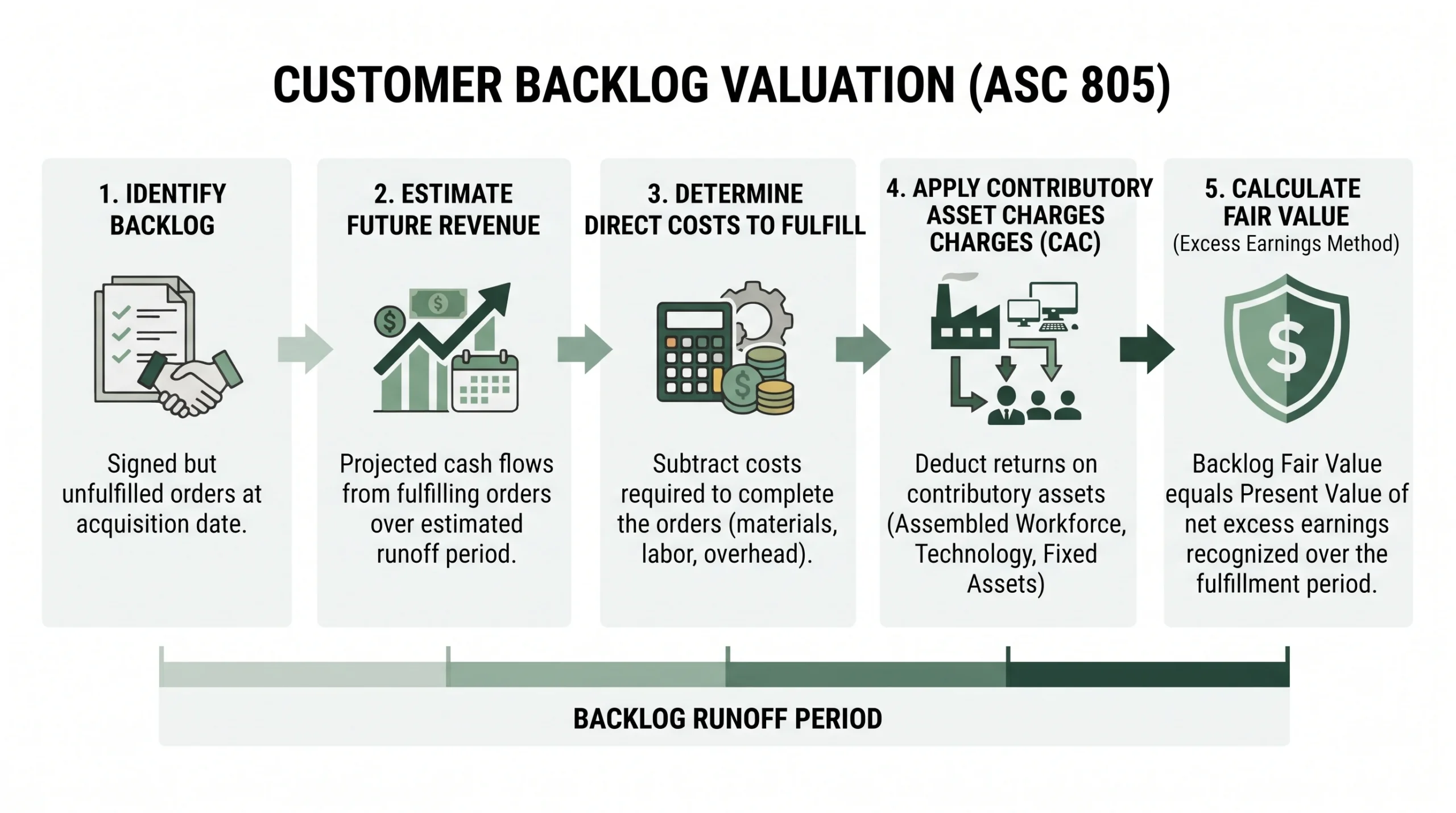
A customer backlog is valued with an income approach, most often the multi-period excess earnings method. The appraiser starts with the revenue locked in the signed orders. Then it subtracts the direct cost to fill them, an operating margin, and a contributory asset charge for the equipment, working capital, and workforce that help deliver. What is left is the excess earnings that belong to the backlog alone. Those earnings are discounted to present value.
The contributory asset charge is the step people miss. Orders do not ship by themselves. Plant, inventory, and staff all pitch in, so each must earn a fair return that is netted out first. For simple order books, a relief-from-royalty or excess earnings model can both work, and the appraiser picks the one that fits the facts. Deloitte’s roadmap confirms backlog is recognized even when orders can be cancelled, with that risk priced into fair value.
Backlog work sits inside a full purchase price allocation. You can see how Sofer Advisors approaches financial reporting valuations under ASC 805 across every intangible class in a deal.
What Gives Backlog Such a Short Useful Life?
Backlog has a short life because it is a fixed pool of orders that empties as the work ships. There is no new selling inside it. Once an order is delivered, it leaves the backlog and never returns. So the useful life is set by how long it takes to run the current orders off. In most deals that period is close to a year, and sometimes less.
Public acquisition filings show the pattern plainly. Buyers often assign backlog a life near one to one and a half years, while customer relationships in the same deal run five years or more. Because the life is short and the pool is finite, the recorded value is usually small next to goodwill, technology, or the relationship asset. The amortization lands fast, loading expense into the first year or two after the deal closes.
Who Values a Customer Backlog, and How Do the Options Compare?
Buyers pick a valuation partner based on deal size, audit exposure, and how many intangibles are in play. Large national firms such as Alvarez & Marsal, Stout, and Kroll serve big public companies with broad advisory teams. Sofer Advisors focuses on partner-led, audit-ready valuations for closely held and middle-market deals, with expert witness testimony in 11+ cases behind its reports and 180+ five-star Google reviews. The table below sets out the common options.
| Provider | Typical role | Best for |
|---|---|---|
| Specialized valuation firm (e.g. Sofer Advisors) | Prices backlog and the other intangibles, nets costs and the contributory asset charge, and documents each life | Middle-market deals that need audit-ready ASC 805 support |
| Large national firm | Broad advisory plus valuation at enterprise scale | Large public companies with complex, multi-entity combinations |
| In-house accounting team | Gathers the order data and books the entries; rarely values alone | Companies that still need an independent appraiser for the fair value work |
Sofer Advisors runs each engagement through a four-phase process it calls The Sofer Difference, moving from Discovery to Diligence to Analysis to Delivery. That structure keeps every intangible tied to the contracts and the facts behind it. It reflects the Heart of a Teacher approach, which means explaining the reasoning behind a number rather than just handing over a figure. For a backlog figure that holds up in an audit, an independent valuation supplies both the value and the trail of evidence behind it.
Frequently Asked Questions
What is a customer backlog in a business combination?
A customer backlog is the set of signed, not-yet-delivered orders a target company holds on the closing date. These are firm contracts, not sales prospects, so they will turn into revenue without new selling. In a deal, the buyer values that pool and records it as a separate intangible under ASC 805. Sofer Advisors reviews the order data to confirm the backlog qualifies and to price what those committed orders are truly worth.
Is a customer backlog a separate intangible asset under ASC 805?
Yes. Signed orders rest on contracts, so a customer backlog meets the contractual-legal test for a separate intangible under ASC 805. The buyer records it apart from goodwill, even when a customer can cancel, since that cancellation risk is priced into fair value rather than used to deny recognition. Sofer Advisors tests each order book against the criteria so the asset is recognized correctly and the allocation stands up in an audit.
How is backlog different from customer relationships?
Backlog is the revenue already under contract on the closing date. A customer relationship is the repeat business the buyer expects to win from those same customers later. Backlog is near certain and short. The relationship is less certain and runs for years. Valuing them together would double count the same sales, so appraisers split them. Sofer Advisors separates the two assets, giving each its own cash flows, discount rate, and useful life.
What method is used to value a customer backlog?
Most appraisers use an income approach, usually the multi-period excess earnings method. It starts with the revenue in the signed orders, then subtracts the cost to fill them, an operating margin, and a contributory asset charge. The excess earnings that remain are discounted to present value. For a simple order book, a relief-from-royalty model can also fit. Sofer Advisors chooses the method that matches the contracts and documents every input behind the result.
What is a contributory asset charge in a backlog valuation?
A contributory asset charge is a rent on the other assets that help deliver the backlog. Orders do not ship on their own. Equipment, working capital, and the workforce all contribute, so each must earn a fair return that is subtracted before the backlog keeps any profit. Skip this step and the backlog is overstated. Sofer Advisors builds these charges into the excess earnings model so the backlog carries only the profit that is truly its own.
Why does a customer backlog have such a short useful life?
Backlog is a fixed pool of orders that empties as the work ships, with no new selling inside it. Once an order is delivered it leaves the pool for good. So the useful life equals the time it takes to run the current orders off, often close to a year. Sofer Advisors sets that life from the real delivery schedule, which is why backlog is amortized quickly in the first year or two after a deal.
How do order cancellations affect backlog value?
Cancellation risk lowers the value but does not erase the asset. If customers can walk away, the appraiser trims the projected revenue by an expected cancellation rate drawn from the company’s own history. The orders still qualify as a separate intangible; they are simply worth less. Sofer Advisors studies past cancellation and fulfillment data so the backlog number reflects what will realistically ship, not the full face value of every signed order.
What documents are needed to value a customer backlog?
The appraiser needs the signed order or contract list at the closing date, expected delivery dates, and the price on each order. It also needs the direct cost to fulfill, historical cancellation rates, and detail on the equipment, working capital, and staff used to deliver. Sofer Advisors uses this file to isolate the cash flows that belong to the backlog alone, which keeps the valuation defensible under the fair value rules of ASC 805.
How much does a customer backlog valuation cost?
Backlog is priced inside a full purchase price allocation, which runs from $15,000 to $50,000 and takes about 6 to 12 weeks, depending on how many intangibles are in the deal and how clean the order data is. The backlog piece itself is one part of that scope. Sofer Advisors quotes a fixed fee after a short scoping call. Request a free estimate for your deal.
Related Case Studies
- Valuing Customer Relationships in a Purchase Price Allocation
- Database Valuation of an Acquired Customer List
- Deferred Revenue Fair Value in an Acquisition
Executive Summary
A customer backlog is the pool of signed, undelivered orders a company holds when it is bought. Under ASC 805 the buyer records it as a separate intangible, apart from goodwill. The value is not the order price. It is the profit left after the cost to fill the orders and a contributory asset charge, found with a multi-period excess earnings model and discounted to present value. Because the pool is finite and runs off as the work ships, backlog carries a short life, often near a year, and is amortized fast. That also makes it one of the smaller intangibles in most deals. A clean figure keeps goodwill from being overstated and the early expense pattern correct.
What Should You Do Next?
Pull the signed order list as of the closing date, the delivery schedule, and the direct cost to fill each order, since a clean file supports a defensible backlog number. Separate the backlog from the customer relationship early so the two are not double counted. This guide was prepared by David Hern CPA ABV ASA, founder of Sofer Advisors, an Inc. 5000 firm that provides neutral third-party valuations for financial reporting. Schedule a free consultation through our business valuation services team or contact us to discuss your specific situation.
People Also Read
- The Multi-Period Excess Earnings Method (MPEEM) Explained
- Goodwill vs Intangible Assets: Key Differences Explained
About the Author
This guide was prepared by David Hern CPA ABV ASA, founder of Sofer Advisors, a business valuation firm headquartered in Atlanta, GA serving clients across the United States. David holds dual accreditations as an Accredited Senior Appraiser (ASA) and is Accredited in Business Valuation (ABV), credentials recognized by the IRS, SEC, and FINRA. He also holds the Certified Exit Planning Advisor (CEPA) designation. With 15+ years of valuation experience, David has served as an expert witness in 11+ cases across multiple jurisdictions and built Sofer Advisors into an Inc. 5,000-recognized firm with 180+ five-star Google reviews. Its full W2 employee team maintains subscriptions to all major valuation databases and operates under a next business day response policy.
For professional business valuation services, visit soferadvisors.com/about-us/ or contact Sofer Advisors at soferadvisors.com/contact-us/.
This content is for informational purposes only and does not constitute professional valuation advice. Business valuation conclusions depend on specific facts and circumstances. Contact Sofer Advisors for guidance regarding your specific situation.









