


Last Updated: July 2026
A Section 83(b) election is an IRS rule that lets a founder or worker pay tax on restricted stock when it is granted, rather than later when the stock vests. Vesting simply means you earn full rights to the shares over time. Sofer Advisors gives independent valuation analysis for the choices we cover here, and this guide walks through the timing, the risks, and the valuation work behind a sound election.
This choice needs a specific written statement filed with the IRS, and you must send it within 30 days of the grant date, the day the stock moves to you. Per the IRS, missing this deadline cannot be undone, so if you miss it, you pay regular income tax on the full value as the shares vest.
Founders and key staff often use this election when they expect their equity to grow a lot before it vests. Sofer Advisors helps clients weigh these tax plans during formal valuation work, backed by 180+ five-star Google reviews and 11+ expert witness cases that translate into clear, defensible guidance. Your tax plan should fit both your current shares and your long-term goals.
Picking the right plan for restricted stock takes real care, because you must know how tax law meets your current company value. Owners weigh the tax cost now against future tax on gains, so this work reviews share price, expected growth, and the terms of the grant.
Key Takeaways
- Immediate Tax Advantages: Filing under IRC Section 83(b) lets you pay tax at the grant-date value, which can save money if the share price climbs a lot.
- Strict Filing Deadline: You must file within 30 days of the grant date, and the IRS grants no extensions for late forms.
- Permanent Risk Factor: You might pay tax on stock that later loses all worth, or forfeit the shares, with no refund from the IRS.
- Formal Valuation Necessity: A defensible Fair Market Value matters for private firms, and this work often mirrors the rigor of a 409A report.
- Capital Gains Potential: The election treats future stock growth as a capital gain rather than ordinary income, which may mean a lower long-term tax rate at exit.
The sections below cover the valuation standards and rules that support this gains planning.
What is a Section 83(b) election?
A Section 83(b) election is an optional tax choice under Internal Revenue Code Section 83 that lets a taxpayer pay income tax on property at the grant, not at vesting. When a business transfers restricted stock to a worker as a form of equity compensation, that stock often carries a real risk of forfeiture, meaning you could lose the shares if you leave early.
The law usually delays tax until your rights become secure, so if the stock gains value while it vests, you would owe tax on the higher amount. Filing this election instead locks in the fair market value on the day you get the shares. Fair market value, or FMV, is simply the price a willing buyer would pay. Restricted stock also differs from restricted stock units and stock options, and only actual restricted stock grants qualify for an 83(b) election.
This move turns future growth into long-term capital gains for tax reports. The choice cannot be reversed, and you must file it with the IRS within thirty days of the transfer, which is why many leaders talk with their tax counsel first. If your shares are worth little now, paying tax on that small value may cost far less than waiting.
When should you file an 83(b) election?
You must file an 83(b) election within a strict 30-day window. The clock starts on the actual grant date, and this is a firm IRS rule that no one can extend for any reason.
Startup founders often make this filing right when they get their founder shares, and early staff equity grants cross the same line. Workers usually want to lock in a low tax basis, the value used to figure future gain or loss; our guide on cost basis vs fair market value explains why that starting number matters so much.
The benefit is highest when the stock has a very low value at grant, because filing means you pay tax on the current value instead of waiting for future gains. Still, the choice is not right for everyone, and you should weigh your own facts before you file.
What are the risks of an 83(b) election?
The main risk is the upfront tax payment. You may pay tax on stock that later loses value, or even forfeit the shares, and there is no tax refund if the investment drops in worth. When you file this election, you commit to a tax bill that covers the gap between what you paid and the FMV at grant.
Market risk plays a big role here. The business could fail, or the equity value could fall below what you paid, and in that case you cannot get your tax money back. You paid the tax before the shares had real liquidity, so the loss becomes permanent.
Sofer Advisors tracks these tax results so clients grasp the risk before they file. Weigh how likely the company is to grow against what you can afford to lose.
How is an 83(b) valuation determined?
An 83(b) valuation sets the FMV of company stock on the exact grant date. Private firms lack a public market price, so founders need a formal business valuation to back the amount they report and meet IRS rules for early-stage grants. A defensible FMV also follows professional standards, such as those set by the AICPA and the Appraisal Foundation.
Founders often think their first shares are worth almost nothing, but regulators want an objective analysis that helps avoid future fights about the reported tax. Many firms run a report much like a 409A valuation for startups, which sets the FMV of common stock for private companies and keeps the tax filing in line with current finances.
This analysis gives a supportable FMV that holds up if the firm later raises venture money or sells. A documented approach guards against a real risk, since the IRS could otherwise recast the grant as too much pay, and Sofer Advisors prepares these reports to head off such tax challenges. Setting the value early removes doubt for all shareholders in the grant.
A formal valuation helps your tax filings show defensible pricing, so get a defensible valuation for your 83(b) election before you file.
How do you file an 83(b) election?
You file an 83(b) election by mailing a signed written statement to the IRS, sent to the service center where you file your federal tax return. This document must include your name and address, your taxpayer ID number, a description of the property, the transfer date, the taxable year, and the agreed FMV per share. It must also spell out the nature of the restrictions and state the amount you paid, if any, for the property.
Send the package by certified mail, which gives you proof of the postmark date. Look at Form 15,620 if your case needs specific guidance, since that form covers the notice process. Keep this record safe, because it serves as key proof if tax authorities check the timing of your filing. Sofer Advisors helps by giving the defensible valuation estimates that support these filings.
Which providers assist with 83(b) valuations?
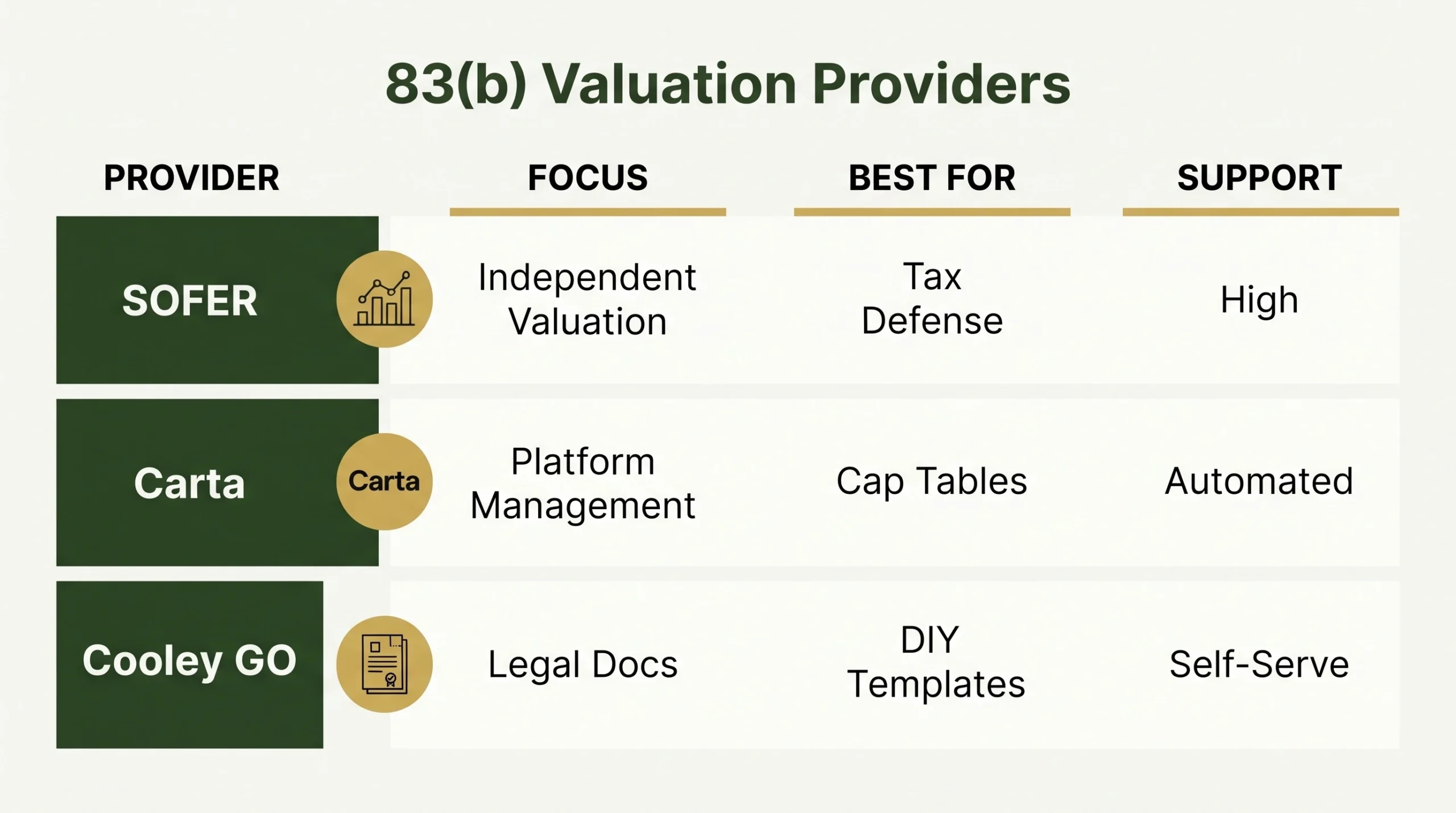
Several providers assist with 83(b) valuations, and they all touch equity pay but focus on different parts of the work. Sofer Advisors gives formal, defensible valuation reports for tax compliance. Carta tracks cap tables, which list who owns what in the company, and automates basic filing support. Cooley GO offers templates and legal guidance that founders use to build their own documents.
| Provider | Focus Area | Best For | Support Level |
|---|---|---|---|
| Sofer Advisors | Independent Valuation | Tax Compliance & Defense | High |
| Carta | Platform Management | Cap Table Tracking | Automated |
| Cooley GO | Legal Documentation | Document Generation | Self-Serve |
Leaders should pick a provider based on their needs, weighing tax complexity against their own capacity. Software platforms work well as daily hubs for equity tracking, while valuation firms give the depth needed for tax and regulatory audits. Sofer Advisors runs a detailed business valuation that gives a defensible number for private firms, following a set process of Discovery, Diligence, Analysis, and Delivery so every report stands up to review.
What should the valuation review compare?
A defensible analysis ties each big judgment to real evidence, using records and market data from the valuation date. The points below sum up the core decisions in this article.
| Decision area | Evidence and review focus |
|---|---|
| What the election is | An optional choice under IRC Section 83 to pay income tax on property at grant rather than at vesting. |
| When to file | Within a strict 30-day deadline that starts on the actual grant date. |
| The main risk | Upfront tax on stock that may later be forfeited or decline in value, with no refund. |
When the election works as planned, later appreciation can pair with planning tools like the Section 1202 QSBS exclusion to lower the tax due at exit.
Frequently Asked Questions
Where can I find the 83(b) election form PDF?
There is no official pre-formatted tax form for the 83(b) election on the government site. The election needs a formal written statement with your personal details, tax information, and a property description to meet the rules under IRC Section 83. Sofer Advisors suggests working with a qualified tax pro so your submission includes all needed legal disclosures.
What is Form 15,620?
Form 15,620 is an IRS document that gives taxpayers guidance on the notice rules for an 83(b) election, listing the required items for your written statement so the Treasury Department can validate your request.
What is a Section 83(b) election?
An 83(b) election lets a person pay income tax on the full FMV of restricted property at the grant. The taxpayer locks in their tax basis early and treats future gain as a capital gain rather than ordinary income. Sofer Advisors runs the business valuation needed to set the FMV.
Where can I file an 83(b) election online?
You cannot file an 83(b) election through an online system right now. The IRS requires a physical paper submission sent by certified mail, so you must provide a signed, original document to the office that handles your federal returns to get a valid postmark date.
How do I file an 83(b) election online?
Filing online is not an option under current rules. The process needs a physical signature and a verifiable certified mail timestamp, so mail remains the only way to prove your filing within the required 30-day window.
What happens if you miss the 30-day filing deadline?
If you miss the strict 30-day window, the choice cannot be undone, because the IRS grants no extensions. You then pay regular income tax on the full value of the shares as they vest, not on the smaller grant-date value. This is why many founders file right when they receive their shares.
Why do private companies need a formal valuation for an 83(b)?
Private firms lack a public market price, so founders need a formal business valuation to set a defensible FMV on the exact grant date. Regulators want an objective analysis that avoids future fights about the reported tax, so many firms run a report much like a 409A valuation. Sofer Advisors prepares these reports to head off tax challenges.
Which providers assist with 83(b) valuations?
Independent firms such as Sofer Advisors give formal, defensible reports for tax compliance. Carta tracks cap tables and automates basic filing support, while Cooley GO offers templates and legal guidance for founders who build their own documents. Each group focuses on a different part of the work.
How does an 83(b) election affect capital gains?
By locking in the grant-date FMV, you turn later appreciation into a long-term capital gain rather than ordinary income, which may mean a lower tax rate at exit. This benefit is highest when the shares have a very low value at the time of the grant.
Related Case Studies
- 409A Valuation for Startups: Complete Compliance Guide 2026
- Restricted Stock Units vs Stock Options: Key Differences
- What Is Equity Compensation? Types and How They Are Valued
Executive Summary
A Section 83(b) election lets a taxpayer pay ordinary income tax on restricted stock at its grant-date fair market value rather than at vesting. The election must be filed as a signed written statement, sent to the IRS by certified mail within 30 days of the grant, and the deadline cannot be extended. Its chief benefit is converting future appreciation into long-term capital gain, largest when the shares carry a very low value at grant. Its chief risk is paying tax on stock that may later be forfeited or fall in value, with no refund. Because private companies lack a public market price, founders need a formal valuation, often resembling a 409A analysis, to set a defensible fair market value. Providers range from independent firms like Sofer Advisors to platforms such as Carta and legal resources like Cooley GO, each serving a different part of the process.
What Should You Do Next?
First, review your own situation and decide whether the election fits your equity and your outlook on future growth. Second, gather your financial statements for the past three to five years, your current cap table, and copies of key governing documents. Third, confirm the exact grant date and calendar the 30-day filing window so you do not miss it.
David Hern CPA ABV ASA, founder of Sofer Advisors provides neutral, defensible valuations for Section 83(b) elections. Schedule a free consultation to discuss your situation.
People Also Read
- Section 1202 QSBS: Qualifying for the $10M Capital Gains Exclusion
- Cost Basis vs Fair Market Value: Key Differences Explained
–About the Author
This guide was prepared by David Hern CPA ABV ASAc, founder of Sofer Advisors, a business valuation firm headquartered in Atlanta, GA serving clients across the United States. David holds dual accreditations as an Accredited Senior Appraiser (ASA) and is Accredited in Business Valuation (ABV), credentials recognized by the IRS, SEC, and FINRA. He also holds the Certified Exit Planning Advisor (CEPA) designation. With 15+ years of valuation experience, David has served as an expert witness in 11+ cases across multiple jurisdictions and built Sofer Advisors into an Inc. 5000-recognized firm with 180+ five-star Google reviews. Its full W2 employee team maintains subscriptions to all major valuation databases and operates under a next business day response policy.
For professional business valuation services, visit soferadvisors.com/about-us/ or contact Sofer Advisors at soferadvisors.com/contact-us/.
Disclaimer: This content is for informational purposes only and does not constitute professional valuation advice. Business valuation conclusions depend on specific facts and circumstances. Contact Sofer Advisors for guidance regarding your specific situation.









