


Last Updated: October 2026
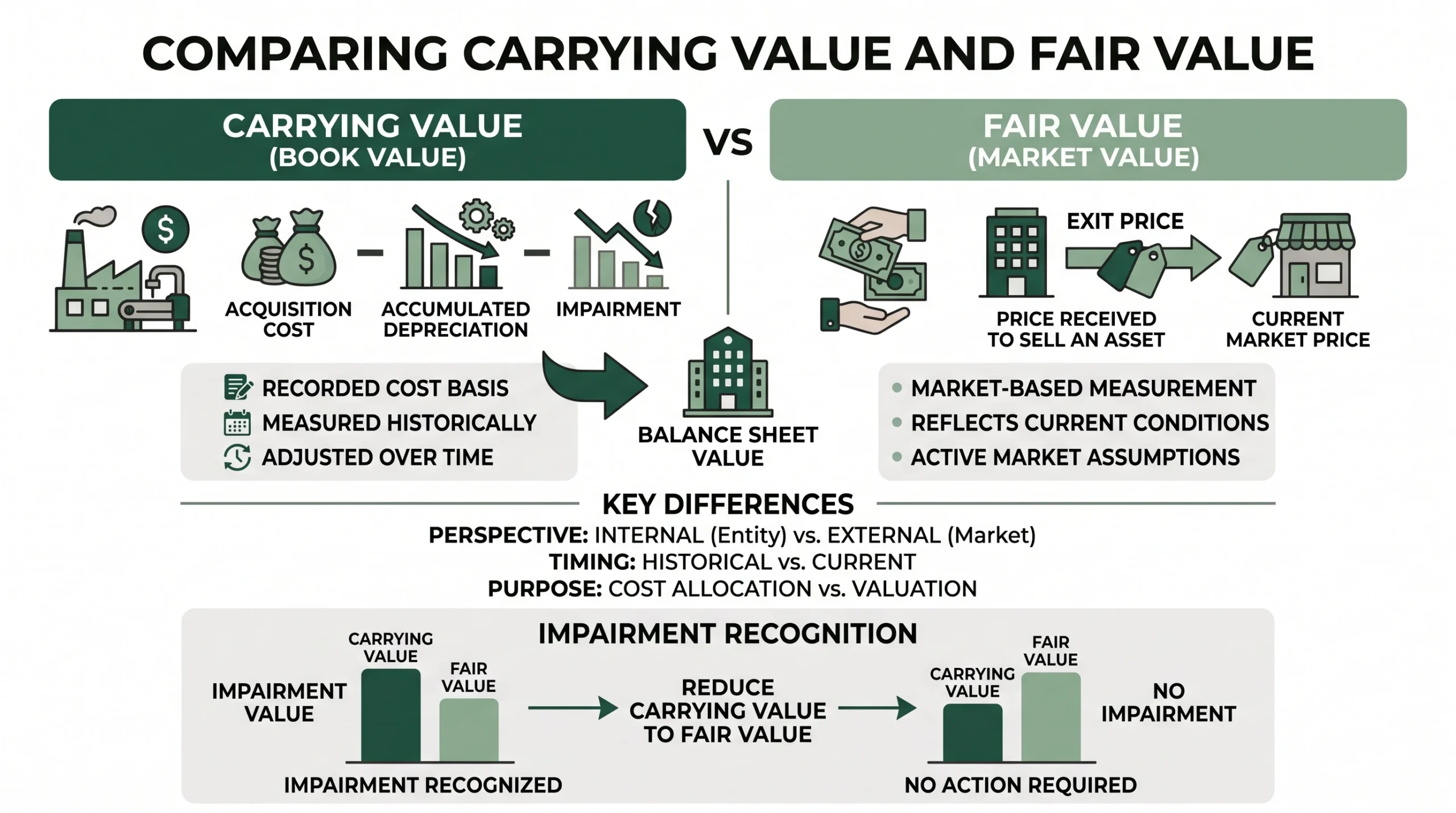
Impairment testing compares two numbers: fair value and carrying value. Carrying value is what an asset is worth on the books. Fair value is what it would sell for today. When carrying value sits higher than fair value, the asset may be impaired. The company then writes it down to the lower figure. That single comparison is the heart of the test.
The team at Sofer Advisors runs these tests for business owners, CPAs, and controllers, backed by Inc. 5000 recognition in both 2024 and 2025. The gap between the two numbers is where the write-down lives. If you read the gap wrong, the balance sheet is wrong too.
This guide defines each value in plain terms. It explains why impairment compares them, how ASC 350 and ASC 360 apply, and where fair value, market value, and book value part ways.
Key Takeaways
- Carrying value looks back: it is an asset’s cost less accumulated depreciation, amortization, and any prior impairments, so it reflects the ledger, not the market.
- Fair value looks forward: under ASC 820 it is the exit price the asset would fetch today in an orderly sale between market participants.
- Impairment is the trigger: an asset or reporting unit is impaired when carrying value exceeds fair value, and the excess is written off.
- ASC 360 screens first: long-lived assets face an undiscounted cash flow test before fair value is ever measured.
- ASC 350 tests goodwill: goodwill is not amortized, so a reporting unit is checked at least once a year against its fair value.
Each piece ties back to the same comparison. The sections below take them one at a time.
Why Does Impairment Compare Fair Value and Carrying Value?
Impairment compares the two because they drift apart over time. Carrying value is set at cost, then lowered on a fixed schedule. Fair value moves with the market. An asset can lose real worth while its book figure stays high. The comparison catches that gap. It keeps the balance sheet honest, so the reported number does not overstate what the asset is truly worth. That protection is the whole point of the test.
Think of a machine bought for a factory that later loses a key customer. The ledger still shows most of its cost. The resale market tells a harsher story. Without a test, the books would carry a value no buyer would pay. Accounting rules close that door. When events signal trouble, the asset is measured against the market, and any shortfall is recorded as a loss.
What Is Carrying Value on a Balance Sheet?
Carrying value is the amount an asset is recorded at on the balance sheet. You start with the original cost. You subtract accumulated depreciation or amortization. You subtract any impairment already booked. What remains is the carrying value, also called book value. It reflects spending and time, not current demand. The figure stays put from one period to the next unless a new entry changes it.
Because it is cost based, carrying value is easy to trace and easy to audit. A reviewer can tie it back to an invoice and a depreciation record. That is its strength. Its weakness is relevance. A number anchored to a past purchase says little about what the asset is worth now. For a closer look, see this guide on the difference between book value and fair value.
What Is Fair Value Under ASC 820?
Fair value is the price that would be received to sell an asset in an orderly transaction between market participants at the measurement date. That definition comes from ASC 820, the FASB standard on fair value. The key word is exit. Fair value is a selling price, not the price you paid to buy. It reflects how the market would price the asset, not how one owner feels about it.
ASC 820 ranks the inputs used to reach that price. Level 1 inputs are quoted prices in active markets for identical items. Level 2 inputs are other observable data, such as prices for similar assets. Level 3 inputs are unobservable and lean on models and judgment. Many private company assets land in Level 3, which is where an independent valuation earns its keep. You can read more on the ASC 820 fair value hierarchy.
How Does the Impairment Comparison Work?
The mechanics depend on the asset. For long-lived assets like equipment, ASC 360 uses a two-step path. First comes a recoverability screen. The carrying value is compared to the undiscounted cash flows the asset is expected to generate. If carrying value is lower, the asset passes and no loss is booked. If carrying value is higher, the asset fails, and only then is fair value measured to size the write-down.
Goodwill follows a different path under ASC 350. There is no cash flow screen. A reporting unit is compared straight to its fair value at least once a year. If carrying value exceeds fair value, the difference is the impairment loss, capped at the goodwill on the books. The undiscounted screen in ASC 360 is deliberately lenient, so many assets pass it. Goodwill gets no such cushion. For the long-lived asset rules, see this guide to ASC 360 impairment.
How Do Fair Value, Market Value, and Book Value Differ?
These three terms get mixed up, but they are not the same. Book value is carrying value, the cost-based figure in the ledger. Market value is the observed price in an active market, often for a traded security. Fair value is a reporting standard under ASC 820, an estimated exit price built from market inputs and, when needed, judgment. Fair value borrows from market data, yet it is a measured estimate, not always a live quote.
The distinction matters at tax and reporting time. Fair value is not fair market value, the IRS standard used for tax, and the two should never be used as synonyms. Fair value is also not the final price a specific buyer pays, which can run higher or lower for strategic reasons. Keeping the labels straight keeps a report defensible. Sofer Advisors documents which standard applies before a single number is set.
Who Measures These Values, and How Do the Options Compare?
Companies choose a valuation partner based on asset size, audit exposure, and budget. Large national firms such as Alvarez & Marsal, Stout, and Kroll serve big public companies with broad advisory teams. Sofer Advisors focuses on defensible, partner-led fair value and impairment work for closely held and middle-market businesses, backed by 180+ five-star Google reviews. Internal finance teams often handle the first screen in house. The table below lays out the common options.
| Provider | Typical role | Best for |
|---|---|---|
| Specialized valuation firm (e.g. Sofer Advisors) | Measures fair value and documents the impairment comparison for the auditor | Closely held and middle-market companies needing audit-ready support |
| Large national firm | Broad advisory plus valuation at enterprise scale | Large public companies with many reporting units |
| Internal finance team | Tracks carrying value and runs the first recoverability screen | Early monitoring before an outside specialist is brought in |
Sofer Advisors runs each engagement through a four-phase process it calls The Sofer Difference, moving from Discovery to Diligence to Analysis to Delivery. That structure ties every fair value estimate to the inputs and facts behind it. It reflects a Heart of a Teacher approach, which means explaining the reasoning behind a number rather than just handing over a figure. Sofer Advisors supports impairment and fair value work through its business valuation services practice.
Frequently Asked Questions
What is the difference between fair value and carrying value?
Carrying value is the cost of an asset less accumulated depreciation, amortization, and any past impairments. It looks backward, to what was paid. Fair value is the exit price the asset would fetch today in an orderly sale, measured under ASC 820. It looks forward, to the market. The first sits in the ledger. The second moves with conditions. Sofer Advisors measures both so a reported figure matches real economic worth.
When is an asset impaired?
An asset is impaired when its carrying value exceeds its fair value and that higher book figure cannot be recovered. For long-lived assets, ASC 360 first checks whether undiscounted cash flows cover the carrying value. For goodwill, ASC 350 compares a reporting unit straight to its fair value. In both cases, the excess of carrying value over fair value is the loss. Sofer Advisors quantifies that shortfall and documents it for auditors.
Can carrying value be higher than fair value?
Yes, and that gap is exactly what an impairment test looks for. Carrying value is fixed at cost and lowered on a set schedule, so it can stay high while demand falls. A lost customer, a new technology, or a weak market can all pull fair value below the book figure. When that happens, the asset is written down. Sofer Advisors measures the gap so the balance sheet reflects current economic reality.
What is an example of carrying value?
Say a company buys a piece of equipment for $100,000. Over several years it records $30,000 of accumulated depreciation. The carrying value is $70,000, the cost less that depreciation. If an earlier impairment of $5,000 had been booked, the carrying value would drop to $65,000 instead. That figure, not the resale price, is what appears on the balance sheet. Sofer Advisors uses it as the starting point for any impairment comparison.
How does GAAP define fair value?
GAAP defines fair value under ASC 820 as the price that would be received to sell an asset, or paid to transfer a liability, in an orderly transaction between market participants at the measurement date. The definition stresses an exit price, not the entry price paid to buy the item. It also assumes market participant assumptions, not one owner’s view. Sofer Advisors applies that framework so each reporting deliverable meets the standard.
What is the difference between fair value and market value?
Market value is the observed price an asset trades at in an active market, often a public exchange. Fair value is a reporting measurement under ASC 820, an estimated exit price built from market inputs and, where data is thin, from models and judgment. Market value feeds fair value, but the two are not identical, especially for private assets. Sofer Advisors ties fair value to the best available market evidence at the measurement date.
Is carrying value the same as book value?
Yes. Carrying value and book value are two names for the same figure: an asset’s cost less accumulated depreciation, amortization, and prior impairments. Both describe what sits in the ledger rather than what the asset would sell for. Some people use book value for a whole company’s equity, but for a single asset the terms match. Sofer Advisors confirms which meaning applies before comparing the number to fair value in a test.
What is the recoverability test under ASC 360?
The recoverability test is the first step for long-lived assets. A company compares the asset’s carrying value to the undiscounted future cash flows it expects the asset to produce. If those cash flows cover the carrying value, the asset is recoverable and no loss is recorded. If they fall short, the asset fails, and fair value is then measured to size the write-down. Sofer Advisors builds the cash flow support that this screen demands.
How much does an impairment valuation from Sofer Advisors cost?
Impairment testing under ASC 350 or ASC 360 generally runs from $7,500 to $25,000 and takes about two to six weeks. The range depends on the number of reporting units, the asset types, and the audit deadline. A flat fee is quoted up front, so the cost is clear before work starts. Sofer Advisors scopes the engagement first, then prices it. Request a free estimate for your situation.
Related Case Studies
- The Recoverability Test: Undiscounted Cash Flows Under ASC 360 (Step 1)
- ASC 360 Impairment Loss: Measuring Fair Value (Step 2)
- ASC 360 vs ASC 350: Which Impairment Standard Applies
Executive Summary
Impairment testing compares carrying value with fair value. Carrying value is cost less accumulated depreciation, amortization, and prior impairments, a backward-looking ledger figure. Fair value is the ASC 820 exit price, the amount an asset would sell for today between market participants. An asset or reporting unit is impaired when carrying value exceeds fair value. For long-lived assets, ASC 360 first applies an undiscounted cash flow screen, and only a failed screen leads to a fair value measurement. Goodwill under ASC 350 is compared straight to fair value at least once a year, with the loss capped at the goodwill balance. Fair value, market value, and book value are distinct, and fair value is not the IRS fair market value standard.
What Should You Do Next?
Pull your fixed asset ledger and recent cash flow figures, then flag any asset whose book value looks higher than its likely market price. Confirm whether ASC 360 or ASC 350 governs each one before you test. This guide was prepared by David Hern CPA ABV ASA, founder of Sofer Advisors, an Inc. 5000 firm offering neutral third-party financial reporting valuations. Schedule a free consultation through our contact page to discuss your specific situation.
People Also Read
- What Is Impairment Testing? Asset Value Assessment Guide
- Goodwill Impairment Testing ASC 350: Complete Guide for 2025-2026
About the Author
This guide was prepared by David Hern CPA ABV ASA, founder of Sofer Advisors, a business valuation firm headquartered in Atlanta, GA serving clients across the United States. David holds dual accreditations as an Accredited Senior Appraiser (ASA) and is Accredited in Business Valuation (ABV), credentials recognized by the IRS, SEC, and FINRA. He also holds the Certified Exit Planning Advisor (CEPA) designation. With 15+ years of valuation experience, David has served as an expert witness in 11+ cases across multiple jurisdictions and built Sofer Advisors into an Inc. 5,000-recognized firm with 180+ five-star Google reviews. Its full W2 employee team maintains subscriptions to all major valuation databases and operates under a next business day response policy.
For professional business valuation services, visit soferadvisors.com/about-us/ or contact Sofer Advisors at soferadvisors.com/contact-us/.
This content is for informational purposes only and does not constitute professional valuation advice. Business valuation conclusions depend on specific facts and circumstances. Contact Sofer Advisors for guidance regarding your specific situation.









