Last Updated: November 2026
The Weighted Average Return on Assets, or WARA, is a reasonableness test, not a valuation method. It is the fair-value-weighted average of the required returns on every asset acquired in a deal, across four groups: monetary assets, tangible assets, identifiable intangibles, and goodwill. You compare the WARA to the buyer’s weighted average cost of capital and to the deal’s internal rate of return. In a sound purchase price allocation under ASC 805, those three rates sit close to one another. A wide gap is a warning that the discount rates or the allocation need another look.
Sofer Advisors builds and reviews these allocations for business owners, CPAs, and auditors.
This guide explains what the WARA measures, how the cross-check works, and where it tends to break.
Key Takeaways
- WARA is the fair-value-weighted average of the required returns on each acquired asset class.
- It is a cross-check, not a valuation method. It tests whether a PPA holds together under ASC 805.
- The WARA should reconcile with the deal WACC and the deal IRR. Those three rates should be close.
- Riskier assets carry higher required returns. Goodwill and intangibles sit above monetary and tangible assets.
- A wide gap between WARA and WACC is a warning. It signals that the discount rates or the allocation need another look.
Why is WARA important in purchase price allocations?
WARA is important because it keeps a purchase price allocation honest. An appraiser assigns a value to each acquired asset. Each value carries an implied rate of return. The WARA rolls those returns into one blended rate. That blended rate should match the cost of capital for the whole deal.
Think of it as a sum-of-the-parts check. The parts are the individual assets. The whole is the acquired business. If the parts do not add up to the whole, something in the model is off. The allocation may push too much value onto intangibles. The discount rates may not reflect each asset’s real risk.
Auditors lean on this test for exactly that reason. It is a quick way to spot an aggressive allocation. A WARA that drifts far from the WACC invites more questions. It can also lead to model changes before the financial statements are filed.
How is the WARA calculated step-by-step?
The WARA is a weighted average, so the steps are simple. First, list every acquired asset class and its fair value. Second, assign a required rate of return to each class. Third, weight each return by that class’s share of total fair value. Fourth, add the weighted returns together. The total is the WARA.
The required returns come from each asset’s risk. Monetary assets use a low rate near a short-term borrowing rate. Tangible assets sit a little higher. Identifiable intangibles use a rate at or above the WACC. Goodwill takes the highest rate of all. Analysts often use the multi-period excess earnings method to isolate the cash flow of a key intangible. That method subtracts contributory asset charges, which pay for the other assets that support it.
Here is an illustrative example. The numbers are made up to show the math, not to set a benchmark. Say a deal has a WACC near 12 percent.
| Asset class | Fair-value weight | Illustrative required return | Weighted return |
|---|---|---|---|
| Net working capital | 10% | 4% | 0.4% |
| Tangible assets (PP&E) | 20% | 7% | 1.4% |
| Identifiable intangibles | 40% | 14% | 5.6% |
| Goodwill | 30% | 16% | 4.8% |
| WARA total | 100% | 12.2% |
The weighted returns add up to about 12.2 percent. The WACC was near 12 percent. The two rates sit close, so the allocation looks reasonable. If the WARA had landed at 16 or 8 percent, the appraiser would revisit the inputs.
What assets are included in the WARA calculation?
The WARA covers every asset acquired in the deal. That list starts with net working capital, such as cash, receivables, and inventory. It includes tangible assets like property, plant, and equipment. It includes each identifiable intangible, such as customer relationships, technology, trade names, and non-compete agreements. It ends with goodwill, the residual value left after every other asset is priced.
Each class gets its own required return based on risk. Lower-risk assets earn lower returns. Working capital turns over fast and is easy to value, so its rate is low. Higher-risk assets earn higher returns. Intangibles depend on future cash flow that may not arrive, so their rates climb. Goodwill is the riskiest piece, so it carries the top rate.
The weighting is what ties it together. A large asset class moves the WARA more than a small one. So the mix of assets matters as much as the rates. A deal heavy in goodwill will show a higher WARA than a deal heavy in receivables.
How does WARA relate to the WACC?
The WACC is the required return for the whole business. It blends the cost of equity and the cost of debt. The WARA blends the required returns of the individual assets. Both describe the same deal from different angles. One looks from the top down. The other builds from the bottom up. When the allocation is sound, they meet in the middle.
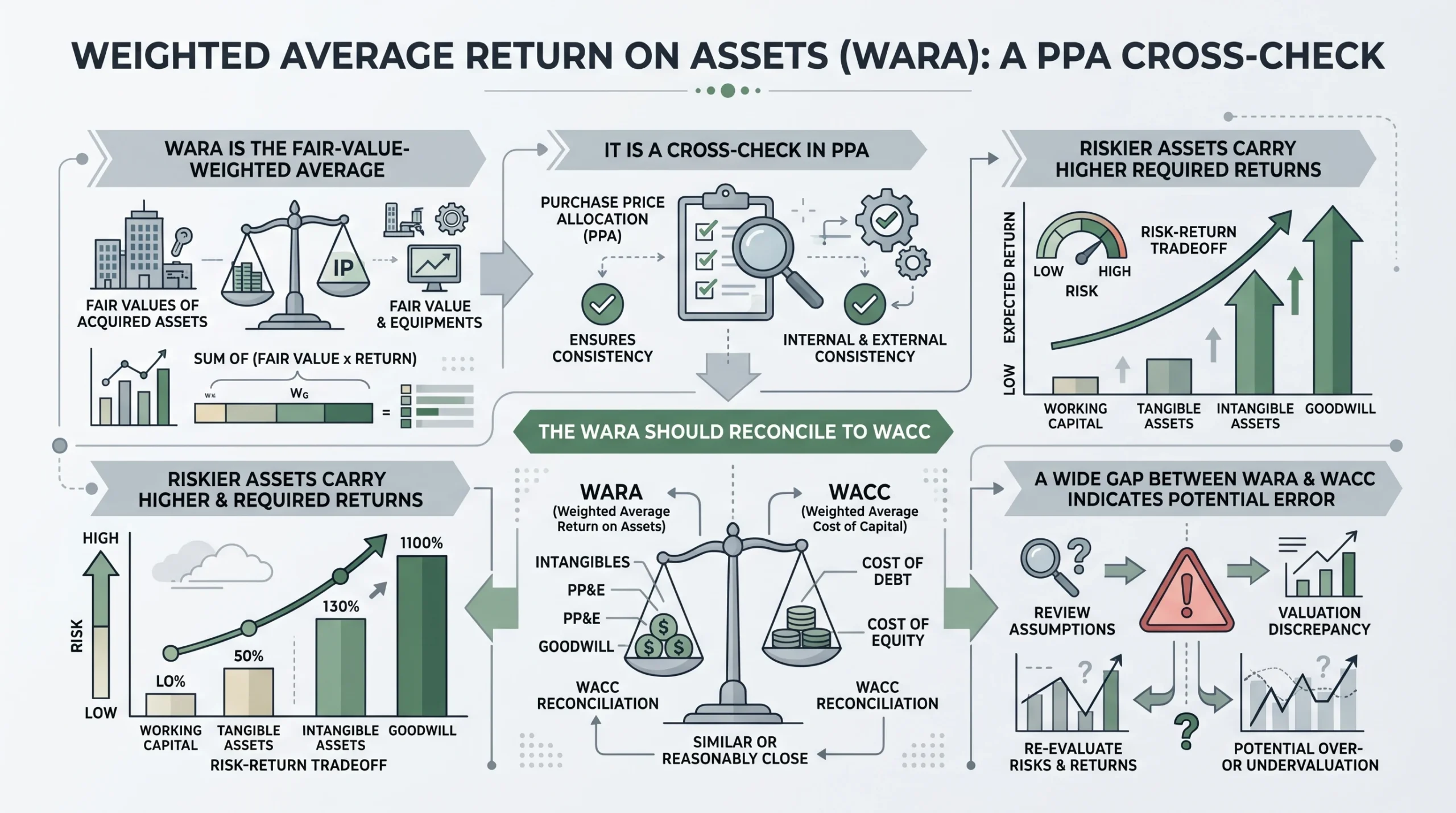
A material gap between the WARA and the WACC is a red flag. Suppose the WARA comes out well above the WACC. That often means the intangible returns are too high, or the intangibles hold too much of the value. Suppose the WARA comes out well below the WACC. That often means the returns are too low to be real. Either way, the appraiser goes back to the discount rates or the allocation.
The deal IRR rounds out the check. The IRR is the rate that sets the purchase price equal to the projected cash flows. In a clean deal, the WARA, the WACC, and the IRR cluster together. AICPA valuation guidance and the Mandatory Performance Framework both point to this WARA-WACC-IRR reconciliation. A wide spread among the three rates tells the appraiser to dig deeper before signing off.
How does WARA compare to other valuation checks?
The WARA is one of several checks used in a PPA. It works from the bottom up. It confirms that the return on each asset makes sense against the cost of capital. The deal IRR works from the top down. It confirms that the whole deal earns a return in line with the price paid. The goodwill residual is the third piece. It is the value left over once every identifiable asset is priced.
These checks answer different questions, so appraisers use them together. The IRR keeps the deal grounded in the price actually paid. The WARA defends the value of each separate asset. The goodwill residual shows whether the leftover value looks sensible. A goodwill figure that is huge or tiny often points back to an error in the identifiable assets.
Running all three builds a story that can survive an audit. No single asset should carry a return that looks unreal. No single check should contradict the others. When the numbers agree, the allocation stands on firm ground.
What are common pitfalls in a WARA analysis?
Most WARA problems come from the inputs. A frequent one is a bad contributory asset charge. These charges pay for the assets that support an intangible. Get them wrong, and the intangible return is wrong, and the WARA fails to reconcile. Another common error is a single generic return applied across different asset classes. Risk differs by asset, so the rates must differ too.
Mismatched assumptions cause the rest. The growth rate baked into the WACC terminal value should match the growth in the cash-flow forecast. Asset lives should line up with the forecast horizon. Stale market data drags the whole model off course. When the pieces are not coordinated, the WARA and the WACC pull apart. Sofer Advisors reviews these inputs together so the reconciliation holds before auditors see it.
The fix is discipline. Tie each required return to the asset’s real risk. Keep the forecast, the discount rates, and the asset lives on the same page. Document why each rate was chosen. A well-supported allocation is far easier to defend than one that only states a number.
Frequently Asked Questions
What is the weighted average return on assets (WARA)?
WARA is the fair-value-weighted average of the required returns on every asset acquired in a business combination. The asset classes are monetary assets, tangible assets, identifiable intangibles, and goodwill. You weight each return by the asset’s share of total value, then add them up.
Is WARA a valuation method or a reasonableness test?
It is a reasonableness test. WARA does not value a business on its own. It checks whether the values assigned in a purchase price allocation are internally consistent. The result is compared against the WACC and the deal IRR.
What is the WARA-WACC-IRR reconciliation?
It is the core cross-check in a PPA. The WARA builds a return from the bottom up. The WACC sets the return for the whole business. The IRR is the return implied by the price paid. In a sound deal, all three rates land close to one another.
Which assets carry the highest required returns in a WARA?
Riskier assets carry higher returns. Monetary and tangible assets sit at the low end, near borrowing rates. Identifiable intangibles sit higher, at or above the WACC. Goodwill carries the highest required return of all.
What happens if the WARA does not match the WACC?
A material gap is a warning sign. It usually means the asset-specific returns, the fair values, or the WACC itself need a second look. The appraiser revisits the discount rates or the allocation until the numbers reconcile.
What accounting standard requires the PPA behind a WARA check?
ASC 805, Business Combinations, governs how an acquirer allocates a purchase price to acquired assets and liabilities. The WARA is the reasonableness test appraisers and auditors run against that allocation. It supports the fair-value conclusions reported under the standard.
What guidance governs the WARA reconciliation?
AICPA valuation guidance on business combinations describes the WARA-WACC-IRR reconciliation. The Mandatory Performance Framework, issued through The Appraisal Foundation, sets documentation expectations for the professionals who perform this work. Both treat the cross-check as standard practice.
What is a contributory asset charge, and how does it relate to WARA?
A contributory asset charge is a return paid to the supporting assets that help an intangible earn cash flow. The multi-period excess earnings method subtracts these charges to isolate one intangible’s return. A wrong charge distorts that return and can break the WARA reconciliation.
How is WARA different from WACC?
The WACC is a single rate for the whole enterprise, built from the cost of equity and debt. The WARA disaggregates that return across the individual assets on the balance sheet. One is a top-down figure. The other is built from the bottom up to test the allocation.
Related Case Studies
- WARA Reconciliation: Testing PPA Discount Rates
- Accretion Dilution Analysis: A Deal Price Cross-Check
- Excess Earnings: Valuing Goodwill and Assets
Executive Summary
WARA is the fair-value-weighted average of the required returns on each acquired asset class. It is a cross-check, not a valuation method. It tests whether a PPA holds together under ASC 805. The WARA should reconcile with the deal WACC and the deal IRR. Those three rates should be close. Riskier assets carry higher required returns. Goodwill and intangibles sit above monetary and tangible assets. A wide gap between WARA and WACC is a warning. It signals that the discount rates or the allocation need another look.
What Should You Do Next?
Pull your current purchase price allocation and run the cross-check. Confirm that the asset-level returns roll up to a WARA near your deal WACC and IRR. Do it as soon as the initial asset values are set, well before the audit. Sofer Advisors provides independent purchase price allocation and ASC 805 reporting through its business valuation services practice, led by David Hern CPA ABV ASA CVA. Schedule a consultation to review your allocation.
People Also Read
- ASC 360 Impairment of Long-Lived Assets: A Complete Guide
- What is PPA in Accounting? Purchase Price Allocation Explained
About the Author
This guide was prepared by David Hern CPA ABV ASA CVA, founder of Sofer Advisors, a business valuation firm headquartered in Atlanta, GA serving clients across the United States. David holds accreditations as an Accredited Senior Appraiser (ASA) and is Accredited in Business Valuation (ABV), credentials recognized by the IRS, SEC, and FINRA, and is also a Certified Valuation Analyst (CVA). David has served as an expert witness in dozens of cases across multiple jurisdictions, and Sofer Advisors is an Inc. 5000 honoree in 2024 and 2025 with 240+ five-star Google reviews.
For professional business valuation services, visit soferadvisors.com/about-us/ or contact Sofer Advisors at soferadvisors.com/contact-us/.
Disclaimer: This content is for informational purposes only and does not constitute professional valuation advice. Business valuation conclusions depend on specific facts and circumstances. Contact Sofer Advisors for guidance regarding your specific situation.