


Last Updated: November 2026
A billboard is valued mostly on the income it earns, not on the steel and vinyl that hold it up. Appraisers use the income approach, capitalizing net operating income or discounting future cash flows. They study the lease revenue, the location, and the legal right to operate the sign. A valid permit, the traffic a site draws, and the strength of the lease all shape the final number.
The team at Sofer Advisors values outdoor advertising assets for owners, lenders, and the advisors who serve them.
This guide explains the income approach, the main value drivers, and the legal rules that shape the market, including permits, digital signs, and the land under the sign.
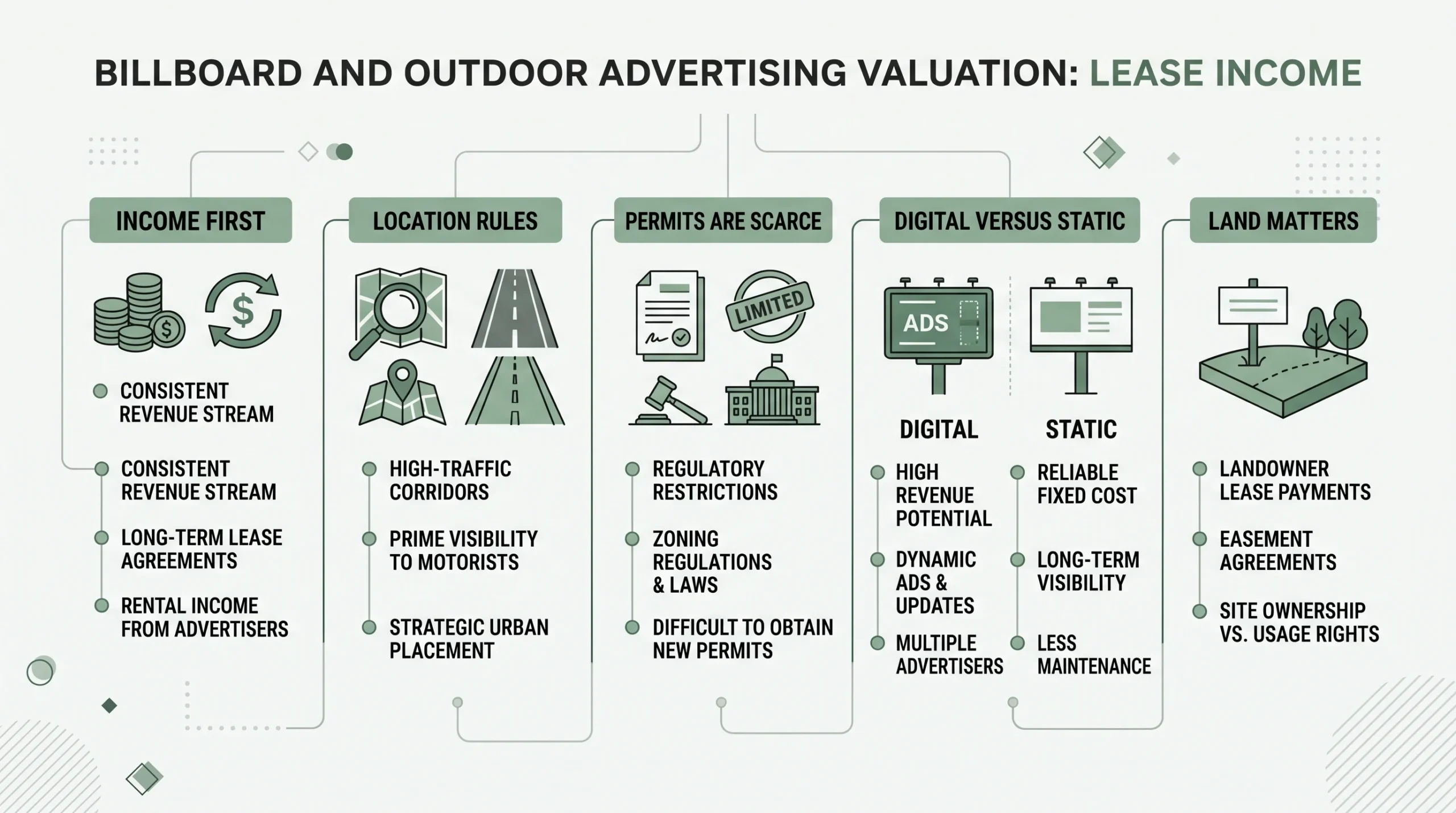
Key Takeaways
- Income first: The income approach drives most billboard valuations. Appraisers capitalize net operating income or discount future cash flows.
- Location rules: Traffic, visibility, and the size of the viewing audience shape the rent a sign can earn.
- Permits are scarce: Federal and local law limits new billboards, so a legal permit carries real value.
- Digital versus static: Digital signs can earn more, but they also cost more to build and run.
- Land matters: Owning the ground under a sign is worth more than leasing it.
How is a billboard valued?
Most billboards are valued with the income approach. The logic is simple. A sign is worth the income it can produce over time.
An appraiser starts with the advertising revenue. Then they subtract the operating costs. These include ground rent, power, maintenance, insurance, and permit fees. What remains is net operating income, or NOI.
From there, the appraiser has two common paths. One is direct capitalization. You divide the NOI by a market capitalization rate to reach a value. The other is a discounted cash flow. You project future income and discount it back to today’s dollars.
The market approach can support the result. Here the appraiser looks at recent sales of similar signs. Good comparable data is often hard to find. So this method tends to play a backup role. The cost approach is used least of all. It measures what a new structure would cost to build. That figure ignores the earning power of the location, which is where most of the value sits.
The capitalization rate deserves a closer look. It reflects the risk and the expected return for a buyer. A safer, well-located sign draws a lower rate and a higher value. A risky site with a short lease draws a higher rate and a lower value. The appraiser sets this rate from market evidence, not from a fixed rule. The quality of the income stream guides the choice.
What drives a billboard’s value?
Several factors decide how much a sign earns. Location leads the list.
Traffic and visibility come first. A sign on a busy highway reaches more people than one on a quiet road. Appraisers often study daily effective circulation. That is a measure of how many viewers actually see the face. More qualified views support higher advertising rates.
Occupancy is the next driver. A board that stays booked earns steady income. Empty weeks pull the average down. Appraisers review the fill rate and the history of the lease payments.
Advertiser quality matters too. A long contract with a strong, reliable advertiser is worth more than a short deal with a weak one. Longer terms and better credit mean safer cash flow.
Condition plays a part as well. A well-kept structure costs less to maintain. It also faces fewer safety issues. Deferred repairs lower value and can raise insurance costs.
The local market shapes value too. Advertising rates follow the strength of the local economy. A busy commercial corridor supports stronger demand for ad space. A fading area may see rates and occupancy slip. Appraisers read these local trends before they set their assumptions. They also check how many competing signs sit nearby, since crowding can split the available demand.
Why do permits and zoning matter?
Permits may be the most important factor of all. You cannot simply build a billboard wherever you like.
The federal Highway Beautification Act of 1965 limits signs along interstate and federal-aid highways. State and local rules add more limits on top. Many areas now cap or ban new off-premises signs. New construction is hard, and in some places it is not allowed at all.
This scarcity gives existing permits real value. A legally permitted sign is hard to replace. Some older signs no longer meet current rules but are allowed to remain. These are called grandfathered nonconforming structures. They often cannot be rebuilt or relocated if they come down. That limited status can make the permit itself worth more than the steel.
Four states go further and ban billboards outright. Vermont, Maine, Hawaii, and Alaska do not allow them. In those markets, the few legal signs that exist can be especially valuable.
An appraiser checks the permit status for every site. A sign without a valid permit may be worth little more than scrap. A secure permit, by contrast, protects the income for years to come.
How do digital billboards change the value?
Digital billboards use LED screens instead of printed vinyl. That one change affects both income and cost.
On the income side, a digital face can rotate several advertisers. A static sign shows one message at a time. A digital sign might cycle through six or eight ads in a loop. More advertisers on one structure can mean more revenue from the same spot.
The cost side runs higher too. LED screens are expensive to install. They draw power around the clock. They need software, upkeep, and eventual replacement. An appraiser weighs this added income against the added cost.
Rules matter here as well. Many local boards treat digital signs more strictly than static ones. Concerns about brightness, driver distraction, and light pollution lead to tighter permits. In some towns, converting a static sign to digital is not allowed.
| Factor | Static billboard | Digital billboard |
|---|---|---|
| Advertisers per face | One at a time | Several in rotation |
| Revenue potential | Lower | Higher |
| Upfront cost | Lower | Higher |
| Operating cost | Lower | Higher |
| Permit difficulty | Lower | Often higher |
Does the land under the sign affect value?
Yes, and the effect is large. A billboard sits on a piece of ground. Who controls that ground changes the math.
If the owner holds the land, the income is secure. There is no ground rent to pay. There is no landlord who can decline to renew. That certainty raises value.
Most signs, though, sit on leased land. Then the ground lease terms drive the result. An appraiser reads the lease closely. How many years remain? Can it be renewed? Does the rent rise over time? Can the lease pass to a buyer?
A long, transferable lease with modest rent supports a higher value. A short lease that is about to expire does the opposite. If the land owner can end the lease soon, the sign’s future income is at risk. Renewal options and rent escalators can swing the result either way.
The rent level itself matters as much as the term. A sign that pays low ground rent keeps more of its revenue. A sign that pays steep rent keeps less, so its net income shrinks. The appraiser compares the current rent to market rates for similar ground. A below-market lease can be a hidden source of value.
How is the sign’s value split from the real estate?
A billboard engagement often has to separate three things. There is the physical structure. There is the permit and the operating business. And there is the underlying land.
Each piece can belong to a different owner. A media company may own the sign and the permit while renting the land. The appraiser has to value the right bundle for the task at hand.
For a sale of the sign business, the focus is the structure, the permit, and the lease income. For a real estate matter, the focus shifts to the land and its highest use. Confusing the two leads to errors. A clear scope at the start keeps the valuation defensible. Sofer Advisors sets this scope with the client before the work begins.
Frequently Asked Questions
How are billboards usually valued?
Most billboards are valued with the income approach. The appraiser estimates the net income the sign produces. Then they either capitalize that income or discount future cash flows. The market and cost approaches play smaller, supporting roles.
Why does a permit add so much value?
New billboards are tightly restricted by federal and local law. A legal permit is hard to get and hard to replace. That scarcity makes the permit a valuable asset in its own right. In some cases it is worth more than the physical structure.
Are digital billboards worth more than static ones?
They can be. A digital face rotates several advertisers, which can raise revenue. But digital signs cost more to build and run. They also face stricter permits in many places. The net effect depends on the site.
Does owning the land matter?
Yes. A sign on owned land carries no ground rent and no renewal risk. A sign on leased land depends on the lease terms. A long, transferable lease supports value. A short one reduces it.
What is a grandfathered billboard?
It is an older sign that no longer meets current zoning rules but is allowed to stay. These signs usually cannot be rebuilt or relocated once removed. That limited status can make the existing permit especially valuable.
What documents does an appraiser need?
The appraiser typically needs the lease agreements, the advertising contracts, and the permit records. Revenue and expense history helps as well. Traffic data and site maps round out the picture.
How is valuing one sign different from valuing a billboard company?
A single sign is valued on its own income and lease. A company holds many signs, plus staff, debt, and overhead. A company valuation adds those parts together. It also weighs the portfolio and the management behind it as a whole.
Which valuation purposes require a formal appraisal?
Lenders, courts, and tax authorities often require one. A loan against a sign needs support for the collateral value. A gift or estate filing needs a value the IRS can accept. A sale or a dispute may call for an independent report. In each case, a documented and defensible valuation protects the owner.
Can a billboard be worth more than the land it sits on?
Often, yes. The permit and the lease income can carry most of the value. The land under the sign may be small or have limited other uses. When the sign earns steady income and the permit is secure, the structure and its rights can outweigh the ground itself.
Related Case Studies
- Cost Approach vs Income Approach: Real Valuation Case Examples with Numbers
- Valuation Timing
- A Complete Guide to Funeral Home Valuation
Executive Summary
The income approach drives most billboard valuations. Appraisers capitalize net operating income or discount future cash flows. Traffic, visibility, and the size of the viewing audience shape the rent a sign can earn. Federal and local law limits new billboards, so a legal permit carries real value. Digital signs can earn more, but they also cost more to build and run. Owning the ground under a sign is worth more than leasing it.
What Should You Do Next?
Start by gathering your leases, permits, and revenue records for each site. Clear documents make for a stronger valuation. Note the permit status and the remaining lease term for every sign. If a sale, loan, or tax filing is coming, plan the appraisal early. Sofer Advisors prepares independent billboard valuations led by David Hern CPA ABV ASA CVA. Schedule a consultation to discuss your sites.
People Also Read
- Cost Approach vs Income Approach: Complete Guide
- How to Appraise a Restaurant: A Complete Valuation Guide
About the Author
This guide was prepared by David Hern CPA ABV ASA CVA, founder of Sofer Advisors, a business valuation firm headquartered in Atlanta, GA serving clients across the United States. David holds accreditations as an Accredited Senior Appraiser (ASA) and is Accredited in Business Valuation (ABV), credentials recognized by the IRS, SEC, and FINRA, and is also a Certified Valuation Analyst (CVA). David has served as an expert witness in dozens of cases across multiple jurisdictions, and Sofer Advisors is an Inc. 5000 honoree in 2024 and 2025 with 240+ five-star Google reviews.
For professional business valuation services, visit soferadvisors.com/about-us/ or contact Sofer Advisors at soferadvisors.com/contact-us/.
Disclaimer: This content is for informational purposes only and does not constitute professional valuation advice. Business valuation conclusions depend on specific facts and circumstances. Contact Sofer Advisors for guidance regarding your specific situation.