Last Updated: November 2026
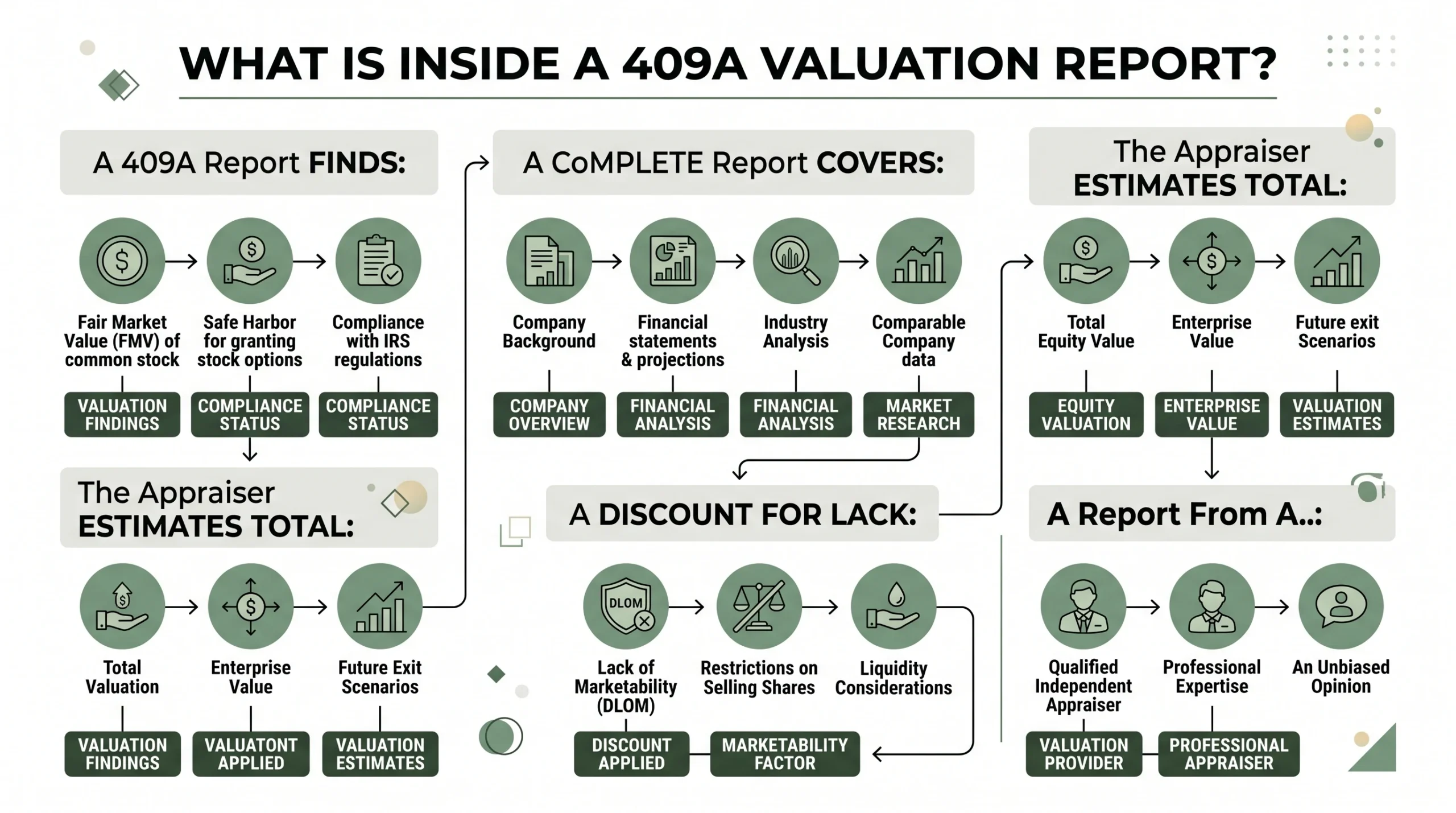
A 409A valuation report sets the fair market value of a private company’s common stock, and companies use that value to price employee stock options under Section 409A of the Internal Revenue Code. Inside, it documents the valuation date, a company and industry review, the financials, the valuation methods, and the step that allocates total equity value to common shares. It also applies a discount for lack of marketability, because private stock is hard to sell. The report is both a number and a record of the work behind it.
The team at Sofer Advisors prepares 409A valuations for private companies and the advisors who guide them.
This guide walks through each section, how the appraiser reaches total equity value, and how a report earns safe harbor status under the tax rules.
Key Takeaways
- A 409A report finds the fair market value of common stock to price stock options under IRC Section 409A.
- A complete report covers the valuation date, a company and industry review, the financials, the valuation methods, and the allocation to common shares.
- The appraiser estimates total equity value, then splits it across share classes using methods like the OPM, PWERM, a hybrid, or a backsolve.
- A discount for lack of marketability lowers the common share value because private stock is hard to sell.
- A report from a qualified, independent appraiser earns safe harbor for up to 12 months, unless a material event occurs first.
What is a 409A valuation report?
A 409A valuation report is a formal opinion of value. It states the fair market value of a private company’s common stock on a set date. The company uses that number as the strike price for stock options.
Private shares do not trade on an exchange. So there is no market price to copy. An independent appraiser has to estimate the value instead. The report shows the work behind that estimate.
The report is both a number and a record. It gives the per-share value. It also documents the data, methods, and judgment used to reach it. That record is what a company shows the IRS if the price is ever questioned.
When does a company need a 409A valuation?
A company needs a 409A valuation before it grants stock options. It also needs a fresh one after certain events. The goal is a current, defensible strike price each time options are issued.
Three triggers are common. The first is the initial option grant. The second is a new round of financing. The third is any material event that changes the company’s value, such as a large deal or a major shift in the business.
A report stays valid for up to 12 months, as long as nothing material changes. If a material event happens sooner, the company needs a new valuation. Keeping the report current is how a company holds on to safe harbor.
What are the main sections of a 409A report?
Most 409A reports follow a similar order. Each section builds on the one before it. Together they lead the reader from the purpose of the report to the final per-share value.
The table below lists the sections you will usually find.
| Section | What it covers |
|---|---|
| Introduction and purpose | Why the report was prepared and who may rely on it |
| Valuation date and standard of value | The “as of” date and the use of fair market value |
| Company overview | The business, its stage, and its history |
| Economic and industry overview | Outside conditions that affect the company |
| Financial review | Historical and projected financials, plus the cap table |
| Valuation approaches | The income, market, and asset methods considered |
| Equity value conclusion | The total value of the company’s equity |
| Allocation method | How total value is split to reach the common share value |
| Discount for lack of marketability | The reduction for illiquid private shares |
| Concluded value | The final per-share fair market value of common stock |
| Assumptions and limiting conditions | The ground rules and limits of the analysis |
| Appraiser qualifications | The credentials and independence of the appraiser |
How does the report set the standard of value?
Every valuation needs a clear standard. A 409A report uses fair market value. This is the price a willing buyer and a willing seller would agree on. Both sides act freely and know the facts.
The report also fixes a valuation date. The value is an opinion as of that single day. Facts known after that date do not change the figure. This keeps the analysis tied to one point in time.
The report then describes the company. It covers the business model, the stage of growth, and the history. It adds an economic and industry review. This context shows why the numbers look the way they do.
A financial review comes next. The appraiser studies past results and future projections. The cap table matters here too. It lists every share class, warrant, and option pool. The appraiser needs that detail to split value correctly in a later step.
How does the report establish total equity value?
Before splitting value among share classes, the appraiser finds the total. This means estimating what the whole equity of the company is worth. The appraiser weighs three standard approaches.
The income approach looks at future cash flow. A common form is the discounted cash flow, or DCF, method. It projects the company’s cash flow and discounts it to today. The discount rate reflects the risk in those projections.
The market approach looks at comparable companies. The guideline public company method uses the trading multiples of similar public firms. The transaction method uses prices from the sale of similar private firms. Both anchor the value to real market data.
The asset approach looks at the balance sheet. It values the company’s assets and subtracts its liabilities. This approach fits asset-heavy or very early-stage firms best. The appraiser picks the approaches that suit the company.
For companies with recent funding, the appraiser may use a backsolve. This takes the price paid in a recent round. It then works backward to find the implied value of the whole equity. A backsolve ties the result to a real, arm’s-length deal.
How does the report allocate value to common stock?
Total equity value is not the same as common stock value. Most private companies have more than one class of shares. Preferred shares often carry rights that common shares lack, such as liquidation preferences. The report must split the total value fairly across these classes.
The appraiser chooses an allocation method for this step. The Option Pricing Method, or OPM, is common. It treats each share class as a call option on the company’s equity. This method works well when a future exit is uncertain and far off.
The Probability-Weighted Expected Return Method, or PWERM, is another choice. It models several future outcomes, such as a sale, an IPO, or staying private. It then weights each outcome by its chance of happening. PWERM fits companies that can see a likely exit ahead.
Some reports use a hybrid of the two. A hybrid applies PWERM to near-term outcomes and the OPM to the rest. The backsolve, noted above, is often paired with the OPM. The appraiser selects the method that best reflects the company’s stage.
What discount applies to the common stock?
Private common stock is hard to sell. There is no ready market, and a sale can take time and money. So the appraiser applies a discount for lack of marketability, or DLOM. This lowers the common share value to reflect that limit.
Appraisers estimate the DLOM with support, not guesswork. Some use restricted stock studies, which compare restricted shares to freely traded ones. Others use option-based models, such as a protective put, to size the cost of waiting to sell. The report should explain the method and the inputs.
After the discount, the report states the concluded value. This is the final per-share fair market value of the common stock. That figure becomes the strike price for new option grants.
The report closes with its ground rules. It lists the assumptions and limiting conditions behind the analysis. It confirms the valuation date and the standard of value. These closing pages tell the reader how far the opinion reaches, and how far it does not.
What makes a 409A report defensible?
A 409A report is only useful if it holds up. The tax rules offer a safe harbor for this reason. A report that meets the safe harbor is presumed reasonable. The IRS must then show the price was grossly unreasonable to challenge it.
Independence is the first key. A qualified, independent appraiser should prepare the report. The appraiser should have no stake in the result. The report states these qualifications and confirms the independence.
Documentation is the second key. The report lists its assumptions and limiting conditions. It explains each method and input. Many appraisers follow the AICPA practice aid on valuing privately held company equity securities issued as compensation. That guide is the common reference for this work.
Timing is the third key. Safe harbor lasts up to 12 months from the valuation date. It ends sooner if a material event changes the company’s value. A current report is a defensible report.
Frequently Asked Questions
What does a 409A valuation measure?
It measures the fair market value of a private company’s common stock. That value sets the strike price for employee stock options. It does not measure the total worth of the whole business.
Who should prepare a 409A valuation?
A qualified, independent appraiser should prepare it. Independence and credentials support the safe harbor. A company can run internal math, but an internal estimate is harder to defend.
How long is a 409A valuation valid?
It is valid for up to 12 months from the valuation date. It can end sooner if a material event occurs. Common events include a new financing round or a major change in the business.
What is a material event?
A material event is something that could change the company’s value. Examples include a new funding round, an acquisition offer, or a big shift in the business. After one, the prior valuation is no longer current.
What allocation methods appear in a 409A report?
The main ones are the Option Pricing Method and the Probability-Weighted Expected Return Method. Reports also use a hybrid of the two or a backsolve to a recent round. The appraiser picks the method that fits the company’s stage.
Why does the report apply a discount for lack of marketability?
Private common shares cannot be sold quickly or easily. The discount reflects that lack of liquidity. It lowers the per-share value to a level a buyer would actually pay.
What happens if the strike price is set too low?
Section 409A can impose extra taxes on the affected option holders. The statute adds a 20% federal tax on the income, plus interest. A defensible report lowers this risk.
Can a startup use a recent funding round as the value?
Not directly, because investors buy preferred stock, not common. A backsolve uses the round price as a starting point. The appraiser then adjusts for the rights of each share class.
What standards guide a 409A valuation?
The report uses fair market value as the standard of value. Many appraisers follow the AICPA practice aid for equity issued as compensation. These standards guide the methods and the documentation.
Related Case Studies
- How Often Do You Need a 409A Valuation Update?
- 409A Valuation for Startups: Complete Compliance Guide 2025-2026
- 409A Valuation Requirements: Complete Compliance Guide 2025
Executive Summary
A 409A report finds the fair market value of common stock to price stock options under IRC Section 409A. A complete report covers the valuation date, a company and industry review, the financials, the valuation methods, and the allocation to common shares. The appraiser estimates total equity value, then splits it across share classes using methods like the OPM, PWERM, a hybrid, or a backsolve. A discount for lack of marketability lowers the common share value because private stock is hard to sell. A report from a qualified, independent appraiser earns safe harbor for up to 12 months, unless a material event occurs first.
What Should You Do Next?
Start by gathering your cap table, recent financials, and any funding documents. These records drive a clean, defensible valuation. Sofer Advisors prepares independent 409A valuations led by David Hern CPA ABV ASA CVA. Schedule a consultation to discuss your situation.
People Also Read
- Business Succession Plan: The Valuation Inside It
- What Happens If You Skip a 409A Valuation: Penalties
About the Author
This guide was prepared by David Hern CPA ABV ASA CVA, founder of Sofer Advisors, a business valuation firm headquartered in Atlanta, GA serving clients across the United States. David holds accreditations as an Accredited Senior Appraiser (ASA) and is Accredited in Business Valuation (ABV), credentials recognized by the IRS, SEC, and FINRA, and is also a Certified Valuation Analyst (CVA). David has served as an expert witness in dozens of cases across multiple jurisdictions, and Sofer Advisors is an Inc. 5000 honoree in 2024 and 2025 with 240+ five-star Google reviews.
For professional business valuation services, visit soferadvisors.com/about-us/ or contact Sofer Advisors at soferadvisors.com/contact-us/.
Disclaimer: This content is for informational purposes only and does not constitute professional valuation advice. Business valuation conclusions depend on specific facts and circumstances. Contact Sofer Advisors for guidance regarding your specific situation.