Last Updated: November 2026
Patent valuation estimates what a patent is worth in dollars. Analysts rely on three approaches: the income approach, the market approach, and the cost approach. Relief-from-royalty, an income method, is the one analysts reach for first, because it values the royalty payments an owner avoids by holding the patent instead of licensing it. A patent’s worth depends on its remaining legal life, the breadth of its claims, how well it is enforced, and how it is used in the market. A US utility patent generally lasts 20 years from its filing date.
Sofer Advisors builds these valuations for business owners, CPAs, and attorneys across the country.
This guide explains the three approaches, the drivers that move value, and the common reasons a formal valuation is required.
Key Takeaways
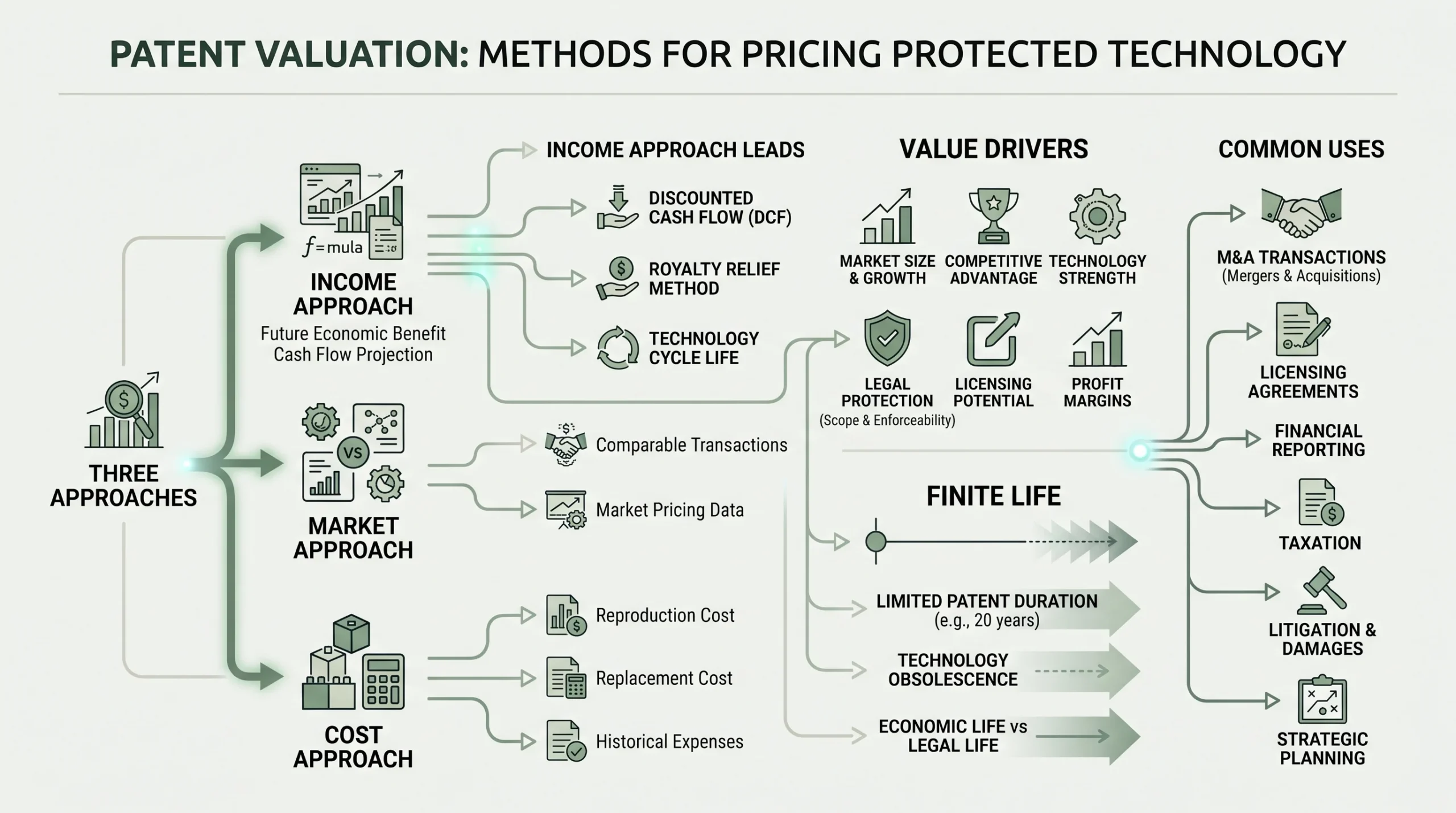
- Three approaches: Analysts value patents with the income, market, and cost approaches. Many reports apply more than one and compare the results.
- Income approach leads: Relief-from-royalty is the most common method. It values the royalty payments an owner avoids by holding the patent instead of licensing it.
- Value drivers: A patent’s worth depends on its remaining legal life, the breadth of its claims, how well it is enforced, and how it is used in the market.
- Finite life: US utility patents generally last 20 years from the filing date. That limit shapes every income forecast.
- Common uses: Owners need valuations for licensing, M&A, litigation damages, financial reporting under ASC 805, and tax.
Why does patent valuation matter?
A patent valuation turns a legal right into a financial figure. That figure then guides a decision. The decision might be a sale, a license, a loan, or a lawsuit. In each case, someone needs to know what the patent is worth.
Deals are the clearest example. In a merger or acquisition, the buyer wants to know what the patents add to the price. A clear value helps both sides negotiate. It also feeds the financial reporting that follows the deal.
Financing is another reason. A lender may accept patents as collateral. Before it does, it wants an independent report on their value. The report lowers the lender’s risk.
Disputes drive many valuations too. If a patent is infringed, the owner must prove the harm in dollars. That proof often rests on lost profits or a reasonable royalty. A sound valuation supports the damages claim.
Tax and reporting round out the list. Companies must value acquired patents for purchase price allocation under ASC 805. They must test them for impairment under ASC 350. Owners also need values for gift and estate tax when they transfer the asset.
What are the three patent valuation methods?
There are three main approaches to valuing a patent. They are the income approach, the market approach, and the cost approach. Each looks at value from a different angle. Analysts often use more than one and check whether the answers agree.
The income approach projects the money the patent will earn. It then discounts that money to a present value. This is the most common approach for patents that produce clear cash flow.
The market approach looks outward. It studies prices from comparable patent sales or license deals. It also draws on published royalty rate benchmarks. Good comparables can be hard to find, since every patent is unique.
The cost approach measures what it would take to recreate the technology. It adds up the cost to replace or rebuild the invention. This approach fits early-stage patents that do not yet earn income. It can understate value when a patent blocks rivals from a whole market.
The table below sums up the three approaches.
| Approach | What it measures | Common method |
|---|---|---|
| Income | The future economic benefit the patent is expected to generate | Relief-from-royalty, DCF of patent earnings, incremental cash flow |
| Market | Prices paid in comparable patent sales or license deals | Comparable transactions, royalty rate benchmarks |
| Cost | The cost to recreate or replace the technology | Replacement or reproduction cost |
How does the income approach value a patent?
The income approach values a patent by the cash it is expected to produce. The analyst forecasts that cash. Then the analyst discounts it to today’s dollars. The discount rate reflects the risk of the specific patent. A newer, unproven technology carries a higher rate.
Relief-from-royalty is the method most analysts reach for first. The logic is simple. If you did not own the patent, you would have to license it. Licensing costs a royalty. By owning the patent, you avoid that royalty. The avoided royalty is a benefit, and that benefit has value.
The method works in a few steps. First, the analyst forecasts the revenue tied to the patent. Second, a market royalty rate is applied to that revenue. The rate comes from comparable license deals. Third, the yearly royalty savings are discounted to a present value over the patent’s remaining life.
A discounted cash flow model is a second income method. Instead of a royalty, it projects the actual earnings the patent drives. This fits a patent with strong, specific growth prospects. The incremental method is a third option. It compares the business with the patent to the same business without it. The gap in cash flow is the patent’s value.
What does a relief-from-royalty calculation look like?
A short example shows the flow. The numbers below are illustrative. They are not from a real engagement.
Say a patent is expected to support $2,000,000 in revenue each year. A review of comparable deals points to a 5% royalty rate. Applied to revenue, that rate implies $100,000 in royalty savings a year. The patent has eight years of legal life left.
The analyst then discounts those yearly savings to a present value. Using a discount rate that reflects the patent’s risk, the stream might come to roughly $600,000 today. That figure is the indicated value of the patent. The inputs are illustrative, but the steps match real work. Change the revenue, the royalty rate, or the discount rate, and the value moves with them.
What drives a patent’s value?
A patent’s value rests on a few clear drivers. The first is remaining legal life. A US utility patent generally lasts 20 years from its filing date. The longer the remaining life, the longer the owner can earn protected income. As the term runs down, so does the value.
The breadth of the claims matters just as much. Broad claims cover more ground and are harder to design around. Narrow claims are easier for a rival to sidestep. A broad, strong patent raises the barrier to entry. That strength supports higher cash flow.
Enforceability is the next driver. A patent is only as valuable as the owner’s ability to defend it. Prior art can threaten its validity. A patent that has survived a challenge carries less risk. One under a cloud is worth less.
Commercial use ties these factors together. A patent that covers a widely used product holds real value. A patent for a niche or unproven idea holds less. The competitive advantage the patent creates is what a buyer ultimately pays for.
When do you need a formal patent valuation?
A formal valuation is called for when the figure must stand up to outside review. That review may come from an auditor, the IRS, or a court. Each setting has its own standard.
Financial reporting is a common trigger. After an acquisition, a company must allocate the purchase price to each asset. Patents are valued as part of that work under ASC 805. Later, the company must test those assets for impairment under ASC 350.
Tax is another trigger. When an owner transfers a patent as a gift or through an estate, the transfer needs a supportable value. A sound report helps the filing survive an audit.
Litigation is the third. In an infringement case, the owner must prove damages. Those damages often take the form of a reasonable royalty or lost profits. Licensing talks also benefit from an independent value, since both sides want a fair rate. Sofer Advisors prepares these neutral reports so owners can meet each standard with confidence.
Frequently Asked Questions
How much can a patent be sold for?
There is no fixed price for a patent. The sale price depends on the technology, the breadth of the claims, and the remaining legal life. A patent that covers an industry standard or blocks a key rival can command a high price. One for a niche idea may fetch little. A valuation estimates the range a specific patent could support.
What are the three patent valuation approaches?
The three approaches are income, market, and cost. The income approach projects and discounts the patent’s future earnings. The market approach looks at prices from comparable sales and license deals. The cost approach measures what it would take to recreate the technology. Analysts often apply more than one and compare the results.
What is the relief-from-royalty method?
Relief-from-royalty is the most common income method for patents. It assumes you would otherwise license the technology and pay a royalty. By owning the patent, you avoid that royalty. The method applies a market royalty rate to the patent’s projected revenue. It then discounts those savings to a present value.
How long does a patent last?
A US utility patent generally lasts 20 years from its filing date. After that, the invention enters the public domain. At that point, anyone may use the technology without infringing. This finite life is why remaining term is a core input in any income model.
Can a pending patent application be valued?
Yes. A pending application can be valued when there is reasonable evidence of future use. The analyst applies a risk adjustment for the chance the patent is not granted. This is common in early-stage M&A and venture funding. The value reflects both the commercial promise and the legal uncertainty.
How is valuing a patent different from valuing a trademark?
The main difference is legal life. A patent has a fixed term, so its value declines as the term runs out. A trademark can last indefinitely if it stays in use. A trademark’s value rests on brand strength, while a patent’s value rests on protected technology and remaining term.
What role do royalty rates play in patent valuation?
Royalty rates anchor the relief-from-royalty method. The analyst finds rates from comparable license deals in the same field. That market rate is applied to the patent’s revenue to estimate the savings from ownership. A well-supported rate is central to a defensible conclusion.
Why is a patent’s remaining legal life so important?
Remaining life sets the window for earning protected income. A longer window supports more years of cash flow and a higher value. A short window limits the forecast. Analysts match the income projection to the years of protection that remain.
How are patents valued in litigation?
In litigation, the goal is to measure damages. The two common measures are a reasonable royalty and lost profits. A reasonable royalty estimates what a willing licensee would have paid. Lost profits estimate the earnings the owner lost to the infringement. Both rest on a clear, well-documented model. The court weighs how well each input is supported.
Related Case Studies
- Technology Company Valuation Methods: A Complete Guide
- Developed Technology Valuation in a Software Deal
- Veterinary Practice Valuation: Methods and Multiples
Executive Summary
Analysts value patents with the income, market, and cost approaches. Many reports apply more than one and compare the results. Relief-from-royalty is the most common method. It values the royalty payments an owner avoids by holding the patent instead of licensing it. A patent’s worth depends on its remaining legal life, the breadth of its claims, how well it is enforced, and how it is used in the market. US utility patents generally last 20 years from the filing date. That limit shapes every income forecast. Owners need valuations for licensing, M&A, litigation damages, financial reporting under ASC 805, and tax.
What Should You Do Next?
Start by listing the patents that drive your revenue and noting the remaining life on each. If a sale, a tax filing, or a dispute is on the horizon, document your assumptions early so the report holds up under review. For an independent, defensible patent valuation, Sofer Advisors offers a free consultation led by David Hern CPA ABV ASA CVA.
People Also Read
- 409A Valuation Cost: Pricing Guide for Startups
- Goodwill Valuation Methods: Which Approach Is Right?
About the Author
This guide was prepared by David Hern CPA ABV ASA CVA, founder of Sofer Advisors, a business valuation firm headquartered in Atlanta, GA serving clients across the United States. David holds accreditations as an Accredited Senior Appraiser (ASA) and is Accredited in Business Valuation (ABV), credentials recognized by the IRS, SEC, and FINRA, and is also a Certified Valuation Analyst (CVA). David has served as an expert witness in dozens of cases across multiple jurisdictions, and Sofer Advisors is an Inc. 5000 honoree in 2024 and 2025 with 240+ five-star Google reviews.
For professional business valuation services, visit soferadvisors.com/about-us/ or contact Sofer Advisors at soferadvisors.com/contact-us/.
Disclaimer: This content is for informational purposes only and does not constitute professional valuation advice. Business valuation conclusions depend on specific facts and circumstances. Contact Sofer Advisors for guidance regarding your specific situation.