Last Updated: November 2026
How a business sale is taxed depends mostly on how the deal is structured. The two main structures are an asset sale and a stock sale, and each is taxed in a different way. The structure decides which gains count as ordinary income and which count as capital gains. It also decides whether one layer of tax applies or two. For a C corporation, an asset sale can be taxed once at the company level and again when the cash reaches the owners.
Sofer Advisors prepares independent valuations that help owners and their advisors model these outcomes before a deal closes.
This guide explains how each structure is taxed under current US federal rules, why buyers and sellers want different structures, and which elections can bridge the gap.
Key Takeaways
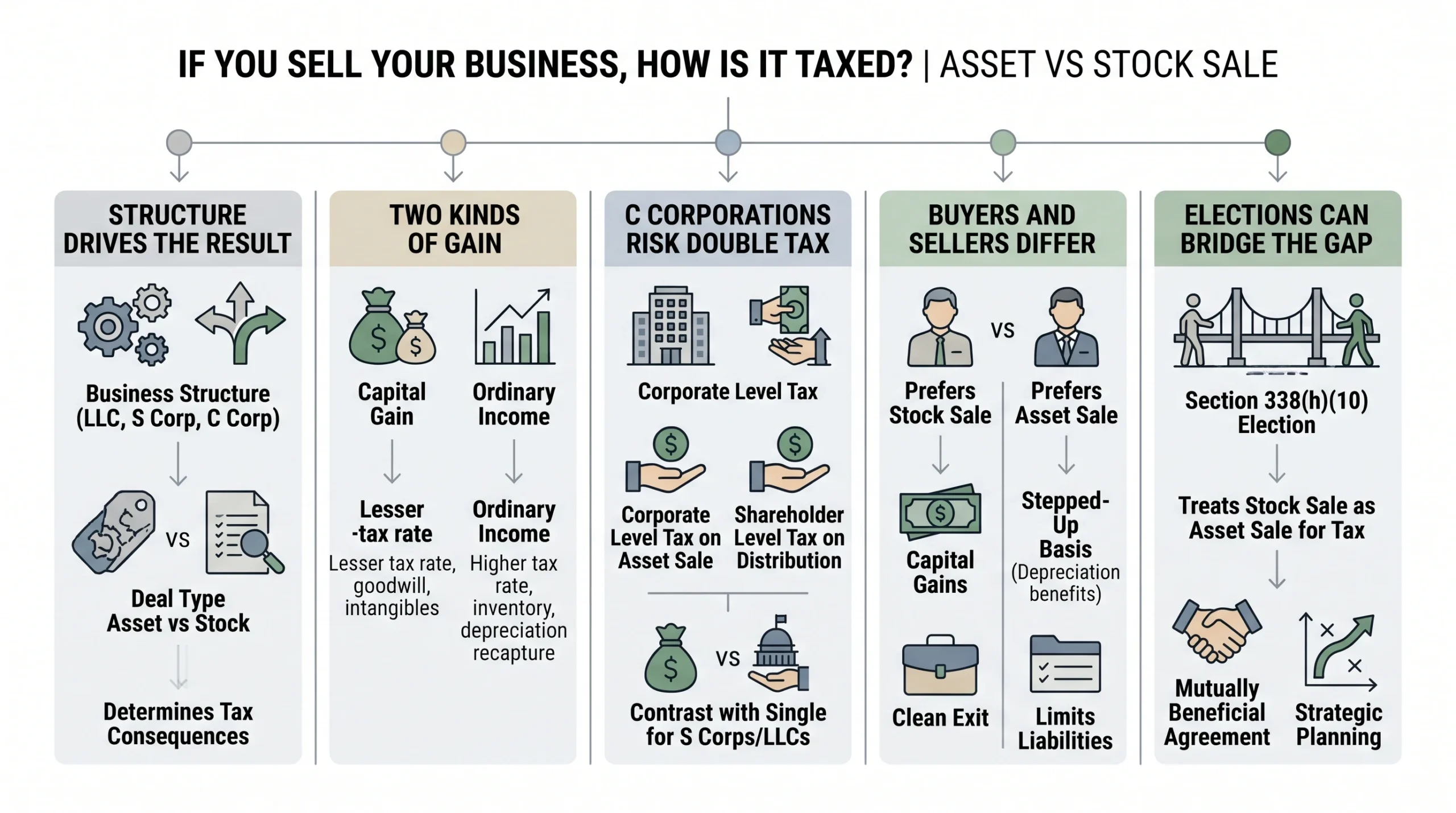
- Structure drives the result: An asset sale and a stock sale are taxed in very different ways, and the choice shapes your net proceeds.
- Two kinds of gain: Sale profit is taxed as either ordinary income or long-term capital gains, based on the structure and the asset.
- C corporations risk double tax: An asset sale can be taxed once at the company level and again when cash reaches the owners.
- Buyers and sellers differ: Buyers often want asset deals for a basis step-up, while sellers often want stock deals for capital gains treatment.
- Elections can bridge the gap: Tools like a Section 338(h)(10) election, personal goodwill, and installment sales can shift the outcome with careful planning.
Why does the deal structure change your tax bill?
The IRS taxes a business sale based on what actually changes hands. In a stock sale, you sell your ownership shares. In an asset sale, the company sells its assets. That single choice drives the whole tax result.
Three things shift with the structure. First, the mix of ordinary income and capital gains. Second, the number of tax layers. Third, who gets a step-up in the tax basis of the assets. Each one affects your final proceeds.
The structure also depends on your entity type. A C corporation is taxed differently from an S corporation, a partnership, or an LLC. We flag these points early so owners can plan around them.
What is an asset sale vs. a stock sale?
An asset sale and a stock sale move different things to the buyer. The tax treatment follows what moves.
In a stock sale, the owner sells the equity in the company. The buyer steps into the existing business. Contracts, assets, and liabilities stay with the entity. The legal shell does not change. Only the owner does.
In an asset sale, the company sells its individual assets. These can include equipment, inventory, customer lists, and goodwill. The buyer picks up those assets. The original entity, and often its liabilities, stays with the seller.
The buyer usually takes on fewer unknown liabilities in an asset sale. In a stock sale, the buyer inherits the whole entity. That includes risks that are hard to see. This is one reason the two sides often start with different goals.
How is an asset sale taxed for the seller?
An asset sale is not taxed as one single gain. The seller spreads the purchase price across each asset sold. This follows Section 1060 of the tax code. Both sides report the split to the IRS on Form 8594.
The allocation matters because assets are taxed at different rates. Gain on inventory is taxed as ordinary income. Gain on goodwill is usually taxed as a capital gain. So where the price lands changes the tax bill.
Depreciation recapture is a key trap here. You may sell equipment for more than its depreciated basis. If so, part of the gain is recaptured. That portion is taxed as ordinary income, not as capital gain. Section 1245 covers equipment and similar property. Section 1250 covers real property. Ordinary rates are usually higher than long-term capital gains rates.
C corporations face a bigger problem. The company pays tax on the gain first. Then the owners pay tax again when the cash is distributed. This is the double tax that makes asset sales costly for many C corporations.
How is a stock sale taxed for the seller?
A stock sale is usually simpler for the seller. You sell your shares. The gain is the sale price minus your basis in the stock.
That gain is generally a long-term capital gain if you held the stock for more than a year. Long-term capital gains are taxed at lower rates than ordinary income. There is also just one layer of tax. The entity does not pay a separate corporate tax on the sale.
This is why many sellers prefer a stock sale. The tax is often lower and the paperwork is cleaner. Depreciation recapture does not apply in the same way, because you are selling equity, not assets.
Some sellers of C corporation stock may qualify for the Qualified Small Business Stock rules under Section 1202. These rules can exclude part of the gain from federal tax when strict tests are met. The holding period and company size limits are specific. We check whether a company qualifies before counting on this benefit.
Why do buyers and sellers want different structures?
Buyers and sellers usually pull in opposite directions. The reason is the tax basis of the assets.
In an asset sale, the buyer gets a step-up in basis. The assets are recorded at the price paid. The buyer can then depreciate equipment and amortize intangibles. Acquired goodwill and similar intangibles are amortized over 15 years under Section 197. Those deductions save the buyer tax for years.
The seller sees the same deal differently. An asset sale can trigger recapture. For a C corporation, it can also trigger double tax. So the seller often prefers a stock sale for its single layer of tax and capital gains treatment.
This gap becomes a negotiation. A seller may accept a lower price for a stock sale to keep the tax low. A buyer may pay more for an asset sale to win the future deductions. A valuation helps both sides see the real after-tax value of each path.
What elections and strategies can change the result?
Some tools let the two sides bridge the gap. They can shift the tax result without forcing one side to give up too much.
A Section 338(h)(10) election is one example. It lets the parties treat a stock sale as an asset sale for tax purposes. The buyer gets the step-up in basis. The seller still makes a simple legal transfer of shares. A Section 336(e) election works in a similar way for certain deals.
Personal goodwill is another tool. In some companies, the goodwill belongs to the owner, not the entity. The owner can sell that personal goodwill directly. The gain may then be taxed once at capital gains rates. This can help a C corporation seller avoid part of the double tax.
An installment sale under Section 453 spreads the tax over time. The seller reports gain as payments come in, not all at once. This can ease cash flow. It may also lower the total tax if income falls into later years. Each of these tools has strict rules, so careful planning comes first.
Which structure gives better tax treatment?
There is no single winner. The better structure depends on the entity, the assets, and the goals of each side. The table below sums up the main tax differences.
| Feature | Asset Sale | Stock Sale |
|---|---|---|
| Seller’s main tax | Mix of ordinary income (recapture) and capital gains | Mostly long-term capital gains |
| Tax layers | Two for a C corporation, at the entity and the owner level | One, since the entity is not taxed on the sale |
| Buyer’s asset basis | Stepped up to the price paid | Carries over the old basis |
| Buyer deductions | Depreciates assets and amortizes intangibles over 15 years | No step-up, so fewer new deductions |
| Liabilities | Buyer takes only named liabilities | Buyer inherits the whole entity |
The right answer comes from the numbers, not a rule of thumb. A seller should compare the after-tax proceeds of each path before signing. A buyer should weigh the future deductions against the price. A clear valuation and purchase price allocation support both sides. They also hold up if the IRS asks questions.
Frequently Asked Questions
How is the sale of a business taxed?
It depends on the structure. In an asset sale, the price is split across the assets sold. Some of that gain is ordinary income and some is capital gain. In a stock sale, the gain is usually a single long-term capital gain. Your entity type also affects the result.
Is an asset sale or a stock sale better for taxes?
It depends on the side you are on. Sellers often prefer a stock sale for its single layer of tax and capital gains treatment. Buyers often prefer an asset sale for the step-up in basis and future deductions. The better choice comes from comparing the after-tax numbers.
What is depreciation recapture?
It is a rule that claws back part of a prior tax break. You deduct depreciation on equipment while you own it. When you sell for more than the depreciated basis, part of the gain is recaptured. That portion is taxed as ordinary income under Section 1245 or Section 1250.
What is a Section 338(h)(10) election?
It lets the parties treat a stock sale as an asset sale for tax purposes. The buyer gets a step-up in the basis of the assets. The seller still transfers shares in a simple legal step. Both sides must agree, and strict rules apply.
Why do C corporations face double taxation in an asset sale?
Because the tax hits twice. The corporation first pays tax on the gain from selling its assets. Then the owners pay tax again when the company distributes the cash. This second layer is what makes asset sales costly for many C corporations.
What is Form 8594 and who files it?
Form 8594 is the IRS form for an asset sale. It reports how the buyer and seller split the purchase price across the asset classes. Both the buyer and the seller file it. The two filings should match.
How does an installment sale lower my tax?
It spreads the gain over several years. Under Section 453, you report gain as payments arrive, not all in the year of sale. This can ease cash flow. It may also reduce the total tax if your income drops into lower brackets in later years.
What is personal goodwill in a business sale?
Personal goodwill is value tied to the owner, not the company. It can include personal relationships, reputation, or know-how. If the owner sells it directly, the gain may be taxed once at capital gains rates. This can help a C corporation seller avoid part of the double tax.
Does my entity type change how the sale is taxed?
Yes. A C corporation can face double tax on an asset sale. S corporations, partnerships, and LLCs are usually pass-through entities, so income is taxed once at the owner level. Your entity type should shape how you plan the deal.
Related Case Studies
- Section 1060 Asset Allocation in a Business Sale
- Asset Sale vs Stock Sale: Tax and Deal Structure Guide
- What Is an Earnout in a Business Sale?
Executive Summary
An asset sale and a stock sale are taxed in very different ways, and the choice shapes your net proceeds. Sale profit is taxed as either ordinary income or long-term capital gains, based on the structure and the asset. An asset sale can be taxed once at the company level and again when cash reaches the owners. Buyers often want asset deals for a basis step-up, while sellers often want stock deals for capital gains treatment. Tools like a Section 338(h)(10) election, personal goodwill, and installment sales can shift the outcome with careful planning.
What Should You Do Next?
Start by comparing the after-tax proceeds of a stock sale and an asset sale for your own numbers. Model the recapture, the tax layers, and the purchase price allocation before you negotiate. Sofer Advisors prepares independent valuations for this work, led by David Hern CPA ABV ASA CVA. Schedule a free consultation to discuss your situation.
People Also Read
About the Author
This guide was prepared by David Hern CPA ABV ASA CVA, founder of Sofer Advisors, a business valuation firm headquartered in Atlanta, GA serving clients across the United States. David holds accreditations as an Accredited Senior Appraiser (ASA) and is Accredited in Business Valuation (ABV), credentials recognized by the IRS, SEC, and FINRA, and is also a Certified Valuation Analyst (CVA). David has served as an expert witness in dozens of cases across multiple jurisdictions, and Sofer Advisors is an Inc. 5000 honoree in 2024 and 2025 with 240+ five-star Google reviews.
For professional business valuation services, visit soferadvisors.com/about-us/ or contact Sofer Advisors at soferadvisors.com/contact-us/.
Disclaimer: This content is for informational purposes only and does not constitute professional valuation advice. Business valuation conclusions depend on specific facts and circumstances. Contact Sofer Advisors for guidance regarding your specific situation.