


Last Updated: October 2026
Donating closely held stock to a donor advised fund can erase the capital gains tax on years of appreciation. The catch sits in two places. The deduction is capped by the appraisal, and a sponsor will reject stock it cannot value. A donor advised fund, or DAF, is a charitable account held by a public charity. You fund it, take the deduction now, and recommend grants later. With private company shares, the number on your return is only as strong as the appraisal behind it.
The team at Sofer Advisors values closely held stock for these gifts, backed by Inc. 5000 recognition and 180+ five-star Google reviews. The deduction is not the price you hope to reach at a sale. It is fair market value, fixed by a qualified appraisal and reported on Form 8283. Price it too high and the IRS cuts the deduction. Leave the stock hard to value and the sponsor declines the gift before it starts.
This guide covers the IRS rules, the capital gains benefit, the qualified appraisal requirement, the forms you file, and how sponsors turn the shares into cash.
Key Takeaways
- Double tax benefit: a gift of long-term closely held stock skips the capital gains tax and can earn a deduction at fair market value.
- The appraisal sets the ceiling: your deduction equals the appraised fair market value, not the figure you expect at a future sale.
- A qualified appraisal is required: noncash gifts over $5,000 need a qualified appraisal and Form 8283, Section B, signed by the appraiser.
- AGI limits apply: the deduction for appreciated stock is capped at 30% of adjusted gross income, with a five-year carryforward.
- Sponsors can say no: a DAF declines stock it cannot value or sell, and the gift must carry no prearranged sale.
Each of these pieces shapes the gift and its timing. The sections below take them one at a time.
Why Is Donating Closely Held Stock to a DAF Important to Understand?
The decision turns a private, illiquid asset into a charitable deduction and a future stream of grants. Done right, it moves low-basis stock out of your estate, skips the capital gains tax, and funds the causes you care about. Done wrong, it stalls. The sponsor rejects stock it cannot value or sell. Or the IRS trims a deduction that the appraisal does not support. The stakes are the size of the gift, so the valuation is the part that has to hold up.
What Is a Donor Advised Fund?
A donor advised fund is a charitable account housed inside a public charity, called the sponsoring organization. You contribute assets, claim the deduction in the year of the gift, and then recommend grants to charities over time. The sponsor holds legal title to the assets once the gift is complete. That is the trade. You give up control, and in return the tax benefit lands now, even if the grants go out years later.
National sponsors such as Fidelity Charitable, Schwab Charitable, and National Philanthropic Trust run most of these accounts. Many accept publicly traded stock without a second look. Closely held stock is a different matter. It has no market price, so the sponsor must decide whether it can value the shares, hold them, and sell them. That review happens before the gift is accepted, not after.
How Does the Deduction Work, and Why Does the Appraisal Cap It?
When you give long-term appreciated stock, you can deduct its fair market value rather than what you paid. You also skip the capital gains tax you would owe on a sale. That is the double benefit. A founder with low-basis shares often moves more value to charity this way than by selling first and donating the cash left after tax. The rules under IRC Section 170 govern the amount and the limits.
The ceiling is the appraised value. Your deduction equals fair market value, so a thin or inflated appraisal costs you either way. The write-off for appreciated stock given to a DAF is capped at 30% of adjusted gross income in the year of the gift. Anything above that carries forward for up to five years. The stock must be long-term, held more than one year, to deduct full fair market value. Hold it a year or less and the deduction drops to your cost basis.
What Does the Qualified Appraisal Require?
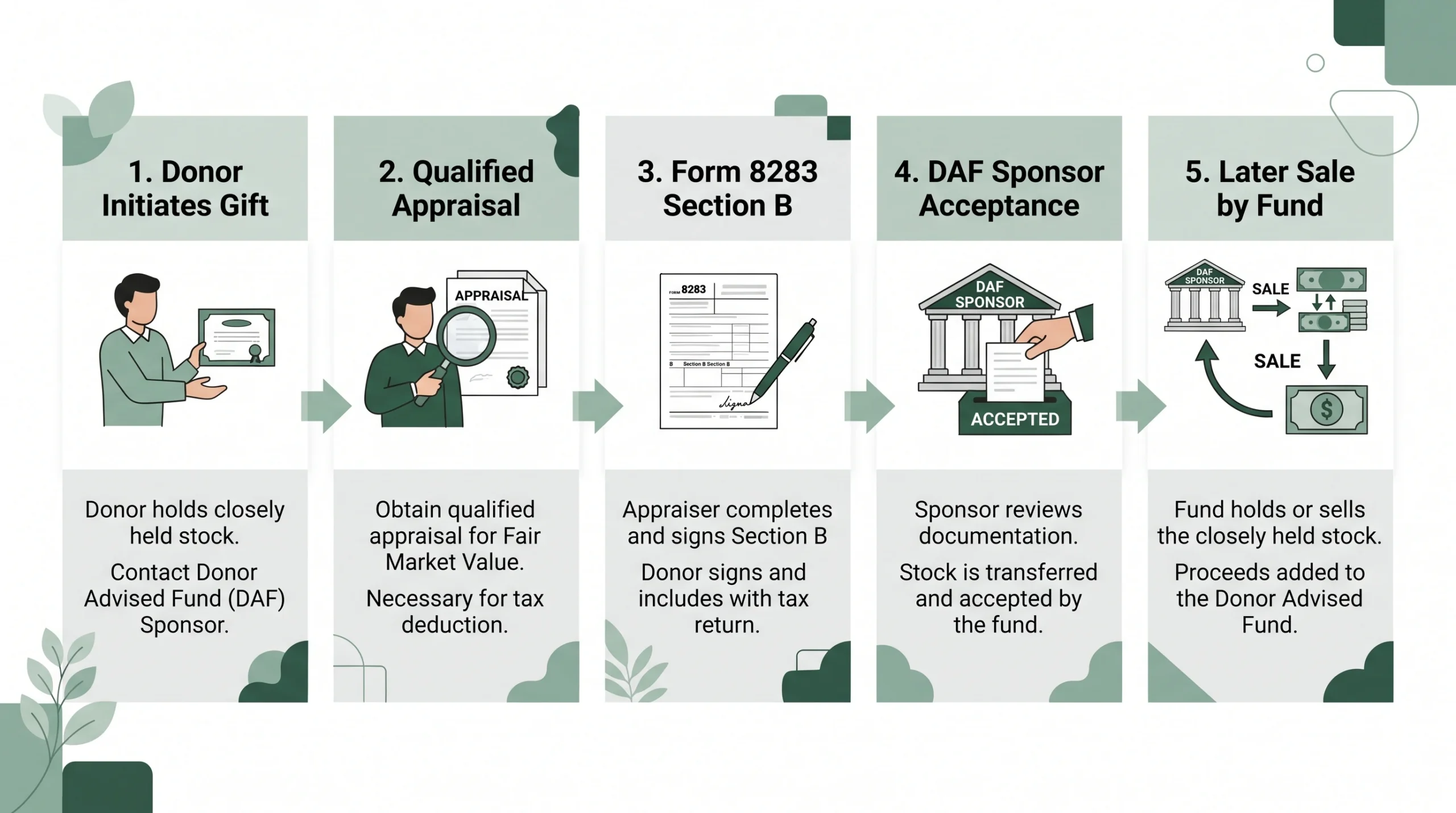
A noncash gift of more than $5,000 needs a qualified appraisal by a qualified appraiser. For closely held stock, fair market value follows Revenue Ruling 59-60, which weighs earnings, book value, the industry outlook, and the company’s financial condition. The appraiser also applies discounts for lack of control and lack of marketability where the facts support them.
Timing and paperwork both matter. Under the substantiation regulations, the appraisal must be made no earlier than 60 days before the gift and no later than the return’s due date. The appraiser signs Form 8283, Section B, and the sponsoring organization signs it to acknowledge receipt. You can see how Sofer Advisors handles tax reporting valuations for gifts like these. A clean file is what keeps the deduction intact if the return is examined.
How Do DAF Sponsors Handle and Liquidate Closely Held Stock?
Before it accepts the gift, the sponsor runs due diligence. It reads the operating agreement and bylaws, checks for transfer restrictions, and confirms the shares are free to sell. If the stock is tangled in a buy-sell, a right of first refusal, or debt, the sponsor may pass. This is why hard-to-value stock gets rejected. The charity takes on legal ownership and the job of selling, and it will not accept an asset it cannot move.
After the gift, the sponsor controls the sale. It may sell back to the company, to other shareholders, or to an outside buyer. One rule governs the timing. There can be no binding sale agreement in place when you give the shares. If a sale was a done deal before the gift, the IRS can treat the gain as yours and tax it.
Which IRS Forms and Rules Apply?
The gift rides on a short list of forms. You report the donation on Form 8283, Section B, with the qualified appraisal attached when the value tops $500,000. The appraiser and the sponsor both sign that section. If the sponsor sells the stock within three years, it files Form 8282 and reports the sale price, which the IRS can compare against your claimed value. A wide gap invites questions.
Current IRS guidance sits in the DAF rules and the substantiation regulations. The agency’s own donor advised funds page lays out the sponsor-control requirement and the limits on donor benefit. Proposed regulations issued in late 2023 would tighten several DAF definitions, so the rules are still moving. The constant is the appraisal. Every form above depends on a defensible fair market value, and a soft number is the first thing an examiner pulls.
Who Values the Stock, and How Do the Options Compare?
Donors pick a valuation partner based on the size of the gift, the audit exposure, and the budget. Large national firms such as Alvarez & Marsal, Stout, and Kroll serve big public companies with broad advisory teams. Sofer Advisors focuses on defensible, partner-led appraisals for closely held and middle-market businesses, with expert witness work in 11+ cases behind its reports. The sponsor administers the account but does not supply the appraisal. The table below sorts out who does what.
| Party | Role in the gift | Best for |
|---|---|---|
| Specialized valuation firm (e.g. Sofer Advisors) | Delivers the qualified appraisal and signs Form 8283, Section B | Closely held gifts that need audit-ready support |
| DAF sponsoring organization | Accepts the stock, holds it, and manages the sale and grants | Donors who want the charity to run the account |
| Wealth advisor | Plans the timing and fit with the wider estate picture | Donors coordinating the gift with a broader plan |
Sofer Advisors runs each engagement through a four-phase process it calls The Sofer Difference, moving from Discovery to Diligence to Analysis to Delivery. That structure ties every value to the records and the standard behind it. It reflects the Heart of a Teacher approach, which means explaining the reasoning behind a number rather than just handing over a figure. For a gift that stands up to review, an independent appraisal supplies both the value and the trail of evidence behind it.
Frequently Asked Questions
What is the downside of a donor advised fund?
The main downside is the loss of control. Once you give the stock, the sponsoring organization owns it and decides when to sell and how to invest the proceeds. You can recommend grants, but you cannot take the assets back or force a particular sale. Grants are also limited to qualified public charities. Sofer Advisors values the shares first so you know the real size of the gift before you give up that control.
How long can funds stay in a donor advised fund?
Federal law sets no deadline for how long money can sit in a donor advised fund before it must be granted out. Some sponsors set their own activity rules, but the IRS does not require a payout on a fixed schedule. That lets donors time gifts around a high-income year. Sofer Advisors fixes the value in the year of the stock gift, so the deduction is clean even when grants go out later.
What are the IRS rules for donating closely held stock to a DAF?
The stock must be long-term to deduct fair market value, and the deduction is capped at 30% of adjusted gross income. Noncash gifts over $5,000 need a qualified appraisal and Form 8283, Section B. The sponsor must hold full control, and no sale can be prearranged before the gift. Sofer Advisors prepares the appraisal to the standard the IRS expects, so the deduction holds if your return is ever examined.
Can you deduct the full fair market value of donated closely held stock?
Yes, if the shares are long-term capital gain property held more than one year, you deduct fair market value and skip the capital gains tax. Shares held a year or less are limited to your cost basis instead. The appraisal sets that fair market value, so an inflated number does not help you. Sofer Advisors builds the value under Revenue Ruling 59-60, applying control and marketability discounts where the facts support them.
Why do DAF sponsors reject some closely held stock?
A sponsor rejects stock it cannot value, hold, or sell. Transfer restrictions, buy-sell agreements, debt, and S corporation issues all give a sponsor reason to decline. Because the charity takes on legal ownership and the job of liquidation, it will not accept an asset it cannot move. Sofer Advisors reviews the shares and documents a defensible value early, which gives the sponsor the support it needs to accept the gift.
Can I donate S corporation stock to a donor advised fund?
Sometimes, but it is harder than giving C corporation stock. Many sponsors decline S corporation shares because the income can trigger unrelated business income tax for the charity. The gift can also threaten the S election if the sponsor is not an eligible shareholder. Sofer Advisors values private equity of either type and flags these traps early, so you can weigh which shares actually fit a charitable gift before you commit.
What happens to the closely held stock after I donate it?
The sponsoring organization takes legal title and later sells the shares to raise cash for grants. It may sell back to the issuing company, to other shareholders, or to an outside buyer. No sale can be locked in before the gift, or the IRS may tax the gain to you. Sofer Advisors provides the independent value the sponsor relies on when it accepts the stock and prices a later sale.
Which IRS forms report a closely held stock donation to a DAF?
You report the gift on Form 8283, Section B, and attach the qualified appraisal once the value tops $500,000. The appraiser and the sponsor both sign that section. If the charity sells the shares within three years, it files Form 8282 and reports the price it received. Sofer Advisors prepares reports that support every figure these forms carry, so your claimed value and the later sale do not drift apart.
How much does a qualified appraisal for closely held stock cost?
Most closely held stock appraisals run from $7,500 to $25,000 and take about two to six weeks, depending on the company and the deadline. The range covers the analysis needed to support fair market value and the signed Form 8283. A flat fee is quoted up front, so the cost is clear before the work starts. Request a free estimate from Sofer Advisors for your situation.
Related Case Studies
- Donating Private Company Stock to a Donor-Advised Fund
- Valuing a Business Interest Donated to a CRT
- Form 8283 Appraisal Summary for a Donated Business Interest
Executive Summary
A gift of closely held stock to a donor advised fund can skip the capital gains tax and earn a deduction at fair market value. That value is set by a qualified appraisal, so the appraisal is the ceiling, not the price you hope to reach. The deduction is capped at 30% of adjusted gross income, with a five-year carryforward, and the shares must be long-term to deduct full value. Sponsors run due diligence first and reject stock they cannot value or sell, so the gift must carry no prearranged sale. The forms are Form 8283, Section B, and Form 8282 if the charity sells within three years, each tied back to the appraisal. The first step is a defensible fair market value of the shares.
What Should You Do Next?
Gather the operating agreement, the stock certificates, and recent financial statements, since a clean file supports a defensible value. Confirm with your chosen sponsor that it will accept closely held stock before you transfer anything. This guide was prepared by David Hern CPA ABV ASA, founder of Sofer Advisors, an Inc. 5000 firm specializing in neutral third-party valuations for tax and estate reporting. Schedule a free consultation to discuss your specific situation.
People Also Read
- Qualified Appraiser IRS Requirements: A Guide to Section 170 and 6695A
- When a Qualified Business Appraisal Is Required
About the Author
This guide was prepared by David Hern CPA ABV ASA, founder of Sofer Advisors, a business valuation firm headquartered in Atlanta, GA serving clients across the United States. David holds dual accreditations as an Accredited Senior Appraiser (ASA) and is Accredited in Business Valuation (ABV), credentials recognized by the IRS, SEC, and FINRA. He also holds the Certified Exit Planning Advisor (CEPA) designation. With 15+ years of valuation experience, David has served as an expert witness in 11+ cases across multiple jurisdictions and built Sofer Advisors into an Inc. 5,000-recognized firm with 180+ five-star Google reviews. Its full W2 employee team maintains subscriptions to all major valuation databases and operates under a next business day response policy.
For professional business valuation services, visit soferadvisors.com/about-us/ or contact Sofer Advisors at soferadvisors.com/contact-us/.
This content is for informational purposes only and does not constitute professional valuation advice. Business valuation conclusions depend on specific facts and circumstances. Contact Sofer Advisors for guidance regarding your specific situation.









