


Last Updated: July 2026
A charitable remainder trust is a trust you cannot undo. It pays income to one or more people for a set term or for life. When that time ends, the rest of the assets go to a charity you name.A business owner can fund the trust with a business stake that has grown in value. Done right, this plan can delay tax on gains. It can also give you income and a partial tax write-off. The tax result depends on the trust terms, the asset, and the timing of any sale.
Sofer Advisors gives independent valuation analysis for the choices in this article. These trusts bring hard legal and tax issues that need care. Owners often look at them when they plan to exit or sell a large stake. These choices shape your future and your family’s future too. So you need to grasp the valuation rules to set things up well. Success starts with picking the right structure before you move assets to the trustee.
Key Takeaways
- Asset Donations: A charitable remainder trust lets you gift business stakes that grow in value while you keep a steady income. Set up right, it also gives you a tax write-off now.
- Qualified Appraisal Requirements: The IRS wants a formal appraisal from a qualified appraiser for non-cash gifts over $5,000. This paperwork backs the value you claim on your tax return.
- Tax-Advantaged Reinvestment: The trust can sell donated assets without a tax on gains right away. All the money is then free to put into other assets.
- Trust Payment Variations: You can choose an Annuity Trust, which pays a fixed dollar amount. Or you can choose a Unitrust, which pays a fixed percent of the trust’s yearly value. Both let you plan payouts to fit your cash needs.
- Irrevocable Legal Structure: Gifts to these trusts are permanent. Some assets, like S corporation stock or stakes with debt, may trigger a special tax. Careful planning helps you avoid these snags.
These ideas form the base for judging if a trust fits your estate plan. The next parts look at the mechanics and rules in more depth.
How does a CRT work for a business owner?
A business owner uses a charitable remainder trust by moving a non-cash asset, such as a business stake, into it. Once the transfer is done, the trust sells the asset and skips the immediate tax on gains. This helps owners who want to exit without a big tax hit from a normal sale, much like other trust-based transfer strategies such as selling a business interest to an IDGT.
After the sale, the trust holds the money and pays you income for a set term or for life. The rest then goes to charity as a remainder gift. Good planning needs a pro valuation to match IRS rules, and Sofer Advisors helps here through its Business Valuation Services.
The trustee handles the sale and the payments. You must set the income term before you fund the trust, and a longer term means more years of payments for you or your family.
Why is a qualified appraisal required for a CRT donation?
A qualified appraisal is a value report from a trained expert. The IRS requires it for any non-cash gift worth more than $5,000, so your write-off matches the true value of what you gave. Without it, tax officials may question your numbers or add penalties if you claim too much.
You must file IRS Form 8283 with your yearly return. It ties a summary of the gift to the full report from a qualified appraiser who meets set rules for schooling and work history. Following these substantiation rules guards against future trouble, and Sofer Advisors makes sure each detail meets current tax and valuation standards.
Keep your records neat and complete. A clear file speeds the process and gives you a strong base if the IRS asks questions later.
How is a business interest valued for a CRT?
Experts find fair market value, the price a willing buyer and seller would agree on, using more than one method under Revenue Ruling 59-60. The income approach sets value from the worth today of future cash flows. The market approach compares the firm to like companies with known sale prices.
For private firms, analysts often apply a discount for lack of control and a discount for lack of marketability. These valuation discounts reflect how hard it is to sell shares in a private firm. Each cut needs strong, proof-based support that aligns with USPAP to hold up before the IRS.
The valuation date matters a great deal. The value must reflect facts known on that day, tied to real records and market data, so the report stays firm and easy to defend.
What are the main types of Charitable Remainder Trusts?
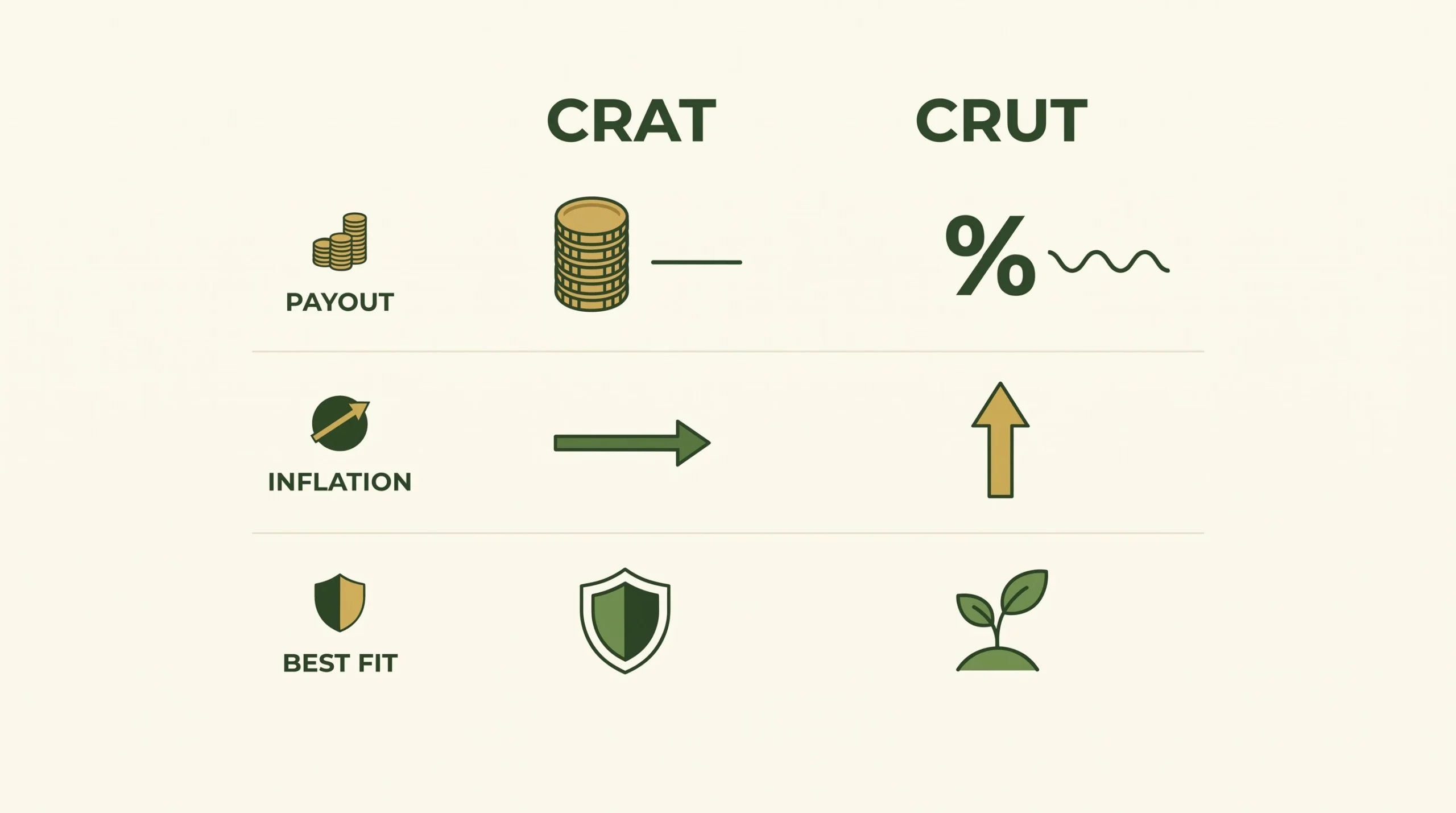
There are two main types. A Charitable Remainder Annuity Trust (CRAT) pays a fixed amount each year, giving steady income no matter how the assets do. A Charitable Remainder Unitrust (CRUT) pays a fixed percent of trust value, so the amount changes each year with performance.
Your choice depends on your cash needs and risk comfort. A CRAT gives income you can count on and suits people who want steady checks over growth. A CRUT shields against rising prices, since its payments grow if the trust assets grow over time.
| Feature | Charitable Remainder Annuity Trust (CRAT) | Charitable Remainder Unitrust (CRUT) | Sofer Advisors’ Role |
|---|---|---|---|
| Annual payout | Pays a fixed dollar amount each year, giving steady income no matter how the assets perform. | Pays a fixed percent of the trust value, so the amount changes each year with asset performance. | Values the donated business interest so each payout rests on a defensible fair market value. |
| Best fit | Owners who want income they can count on and prefer steady checks over growth. | Owners who want a shield against rising prices and can accept payments that move up and down. | Models how each structure affects the gift and the charitable deduction. |
| Inflation exposure | Fixed payments stay the same as prices rise. | Payments can grow if the trust assets grow over time. | Provides the qualified appraisal the IRS requires for a non-cash gift over $5,000. |
What are the risks of using a CRT for a business share?
A trust funded with a business stake brings three main risks: the move cannot be undone, the asset may create special taxable income, and S corporation rules may bar the trust as an owner. Once you transfer an asset, you give up control for good.
If the business is active, the trust may face UBIT, or unrelated business income tax. Though the trust is tax-exempt, it still owes UBIT on income from an unrelated trade or business, which shrinks assets and adds reporting work.
Moving S corporation stock to the trust is often not allowed, because the trust is not a valid shareholder. Such a move ends the firm’s S-status and forces it to become a C corporation, bringing big tax problems right away. Weigh these effects with care before you decide.
Who manages the CRT and its assets after donation?
A named trustee runs the trust after the gift under a fiduciary duty to act in the best interest of others. The trustee follows the trust document and tax laws, holding assets, keeping the books, and managing investments to support the income payments. The trustee must stay loyal to both the income beneficiaries and the charity.
You have some freedom when you pick a trustee, and each choice affects cost and control. Some owners serve as their own trustee; others name a family member, a bank or law firm, or the charity itself. A pro trustee costs more but knows the rules well, while a family member costs less but may lack the know-how.
The qualified appraisal is a separate role from trust administration. A specialist valuation firm values complex non-cash assets and delivers a report compliant with IRS rules and USPAP, while a generalist CPA or corporate trustee often relies on an outside appraiser. Valuation firms focus on the hard rules of AICPA standards and federal tax law, building detailed models to defend a set fair market value if an audit comes.
Frequently Asked Questions
What are the downsides of a charitable remainder trust?
The main downside is that the gift cannot be undone. You cannot get the assets back once they go into the trust. These trusts also bring high admin costs and hard tax filings. This is true above all with the special tax if assets are sold the wrong way.
How does a charitable remainder trust work?
The trust works by taking assets that grew in value. It acts as a tax-exempt entity. The trust sells the assets without a tax on gains right away. It then pays you income for a set time. When the term ends, the rest goes to the charity you chose.
Do charitable remainder trusts avoid capital gains tax?
The trust is tax-exempt and skips the tax on gains when it sells donated assets. But the tax is not gone for good. It is just put off. The income you get from the trust is subject to income tax.
How much does a business valuation for a CRT donation cost?
Valuations for tax gifts range from $7,500 to $25,000. The cost depends on how complex the firm is, how many entities there are, and the timeline. Price depends on the level of analysis needed to meet IRS scrutiny for non-cash gifts.
What is the minimum amount required for a charitable remainder trust?
The IRS sets no fixed minimum. But most trustees and charities want a minimum funding amount to cover admin and legal costs. This often starts at $250,000 to $500,000. Assets below this may not justify the costs and complexity.
What is the difference between a CRAT and a CRUT?
A CRAT, or Charitable Remainder Annuity Trust, pays you a fixed dollar amount each year. This gives steady income no matter how the assets do. A CRUT, or Charitable Remainder Unitrust, pays a fixed percent of the trust value, so the amount changes each year. A CRAT suits people who want certainty, while a CRUT can guard against rising prices.
Can you fund a CRT with S corporation stock?
Moving S corporation stock into the trust is often not allowed. The trust does not count as a valid shareholder. Such a move ends the firm’s S-status and forces it to become a C corporation. This brings big tax problems right away. Owners must weigh these effects with care before they transfer any shares to the trustee.
Who can serve as the trustee of a CRT?
You have some freedom when you pick a trustee. Some owners serve as their own trustee to keep direct command. Others name a family member or a friend. You can also hire a pro trustee, like a bank or law firm, or the charity itself may agree to serve. A pro trustee costs more but knows the rules well.
What is UBIT and how can it affect a CRT?
UBIT stands for unrelated business income tax. If the business is an active firm, the trust may face it. The trust pays no normal tax because it is tax-exempt, but it still owes UBIT on income from an unrelated trade or business. This tax can shrink the trust assets. It also adds to the reporting work.
Related Case Studies
- Selling a Business Interest to an IDGT: Mechanics and Valuation
- What Makes a Valuation IRS Qualified: Section 170 and 6695A
- What Is a GRAT and How Does It Transfer Business Value to Heirs?
Executive Summary
A charitable remainder trust is an irrevocable trust that pays income to you or your beneficiaries for a term or life, with the remainder passing to a named charity. Funding it with an appreciated business interest lets the tax-exempt trust sell the asset without immediate capital gains tax, freeing the full proceeds for reinvestment while you receive income and a partial deduction.
A CRAT pays a fixed dollar amount and a CRUT pays a fixed percentage of trust value, so the choice turns on whether you value certainty or inflation protection. The IRS requires a qualified appraisal filed with Form 8283 for non-cash gifts over $5,000, and appraisers set fair market value under Revenue Ruling 59-60 using income and market approaches with control and marketability discounts.
Key risks include the irreversible transfer, unrelated business income tax on active firms, and the loss of S-corporation status if S stock is contributed. A qualified trustee administers the trust under a fiduciary duty to both the income beneficiaries and the charity.
What Should You Do Next?
Review your trust documents and the specific business interest you plan to transfer to confirm the structure fits your income and tax goals. Engage a qualified appraiser whose credentials satisfy IRS Form 8283 so the fair market value is defensible under Revenue Ruling 59-60. Complete and file this appraisal before you finalize the trust to protect your charitable deduction for the long term.
David Hern CPA ABV ASA, founder of Sofer Advisors provides neutral, defensible valuations for business interests donated to charitable remainder trusts. Schedule a free consultation to discuss your situation.
People Also Read
- Valuation Discounts (DLOC and DLOM) on Estate and Gift Tax Returns
- Using the Annual Gift Exclusion to Transfer Business Interests
About the Author
This guide was prepared by David Hern CPA ABV ASA, founder of Sofer Advisors, a business valuation firm headquartered in Atlanta, GA serving clients across the United States. David holds dual accreditations as an Accredited Senior Appraiser (ASA) and is Accredited in Business Valuation (ABV), credentials recognized by the IRS, SEC, and FINRA. He also holds the Certified Exit Planning Advisor (CEPA) designation. With 15+ years of valuation experience, David has served as an expert witness in 11+ cases across multiple jurisdictions and built Sofer Advisors into an Inc. 5000-recognized firm with 180+ five-star Google reviews. Its full W2 employee team maintains subscriptions to all major valuation databases and operates under a next business day response policy.
For professional business valuation services, visit soferadvisors.com/about-us/ or contact Sofer Advisors at soferadvisors.com/contact-us/.
Disclaimer: This content is for informational purposes only and does not constitute professional valuation advice. Business valuation conclusions depend on specific facts and circumstances. Contact Sofer Advisors for guidance regarding your specific situation.









